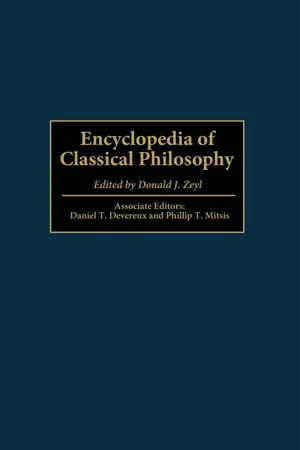
The Encyclopedia of Classical Philosophy is a reference work on the philosophy of Greek and Roman antiquity. It includes subjects and figures from the dawn of philosophy in Ionia in the 6th century BC to the demise of the Academy in Athens in the 6th century AD. Scholarly study of the texts and philosophical thought of this period has been, during the last half of the 20th century, amazingly productive and has become increasingly sophisticated. The 269 articles in the encyclopedia reflect this development.
While the majority of the articles are devoted to individual figures, many of the articles are thematic surveys of broad areas such as epistemology, ethics, and political thought. Some articles focus on particular concepts that evoked significant philosophical treatment by the ancients, and have proved central to later thought. Other articles treat fields that are no longer considered part of philosophy proper, such as mathematics and science. There are articles examining areas of intellectual or cultural endeavour, such as poetry or rhetoric, or genres of philosophical expression, such as dialogue and diatribe. Still others describe the historical developments of philosophical schools and traditions. The encyclopedia includes a chronology and guide to further reading.
Best Reference Source
- 614 pages
- English
- ePUB (mobile friendly)
- Available on iOS & Android
eBook - ePub
Encyclopedia of Classical Philosophy
About this book
A
ACADEMY. The Athenian "school" of philosophy founded by *Plato. Until recently, the standard account has had the Academy founded by Plato and in continuous existence thereafter until Justinian closed the schools of Athens in 529 C.E. Lynch and especially Glucker have completely altered our picture of developments from the first century B.C.E. on. In the second century C.E., *Sextus Empiricus writes (HP 1.220): "There have been, so most say, three Academies: one, and (the) most ancient, that of Plato and his circle, second, the middle (Academy), that of *Arcesilaus, the student of *Polemo, third, the new (Academy), that of *Carneades, *Clitomachus, and their circle; but some add as a fourth that of *Philo (of Larissa), Charmidas, and their circle, and some even count as a fifth that of *Antiochus and his circle." The existence of the "fourth" and "fifth" Academies is doubtful enough, but the situation is far worse thereafter. This article divides the story into five pieces: the Old Academy, the Middle Academy, the New Academy (the latter two labels should not be taken too seriously; see below), Philo and Antiochus, and the Revival of *Platonism.
The Old Academy. In the mid-380s, Plato returned from Sicily to Athens and, in a publicly owned suburban grove sacred to the hero Akademos (or Hekademos) began some sort of teaching activity. He attracted a number of leading intellectuals, including *Eudoxus, *Speusip pus, *Xenocrates, *Heraclides of Pontus, and *Aristotle. There were also apparently at least two women associated with the early Academy, Lastheneia and Axiothea (who is supposed to have taken herself, disguised as a man, to the Academy after reading the Republic). Unfortunately, nothing whatever is known about them.
In spite of the twentieth-century connotation of the name, the Academy was no ivory tower: One of the main enterprises of the Old Academy was the training of politicians and advisors to politicians. Although this was accompanied by a lot of theorizing, many of those associated with the early Academy were men of action, of whom Dion, killed (by another Academic, Callippus) in an attempt to overthrow Dionysius II of Syracuse, is only the most famous. The Academy was best known, however, for its theorizing, in the areas of philosophy, mathematics, astronomy, biology, and just about everything else; and after the Old Academy we hear no more of the training of politicians.
The nature of Plato's teaching activity is unclear; all we have is reports of uncertain reliability to the effect that he conversed with his associates while walking, that he gave a public lecture, "On the Good," and that symposia marked by simple fare and decorous behavior were common. But it looks as if *dialectic, in the form of question-and-answer competitions as Aristotle describes them in Topics 7, was employed as a teaching device.
In such matches, one sooner or later had to argue on both sides of any given question. It is not surprising, then, that the views ascribable to the earliest associates of the Academy show wide variation: hedonism (Eudoxus) alongside an almost puritanical anti-hedonism (Speusippus), acceptance of the "theory of Forms" (for which see PLATO; see also XENOCRATES) and its wholesale rejection (Speusippus, Aristotle). The Academy was not a school concerned to propagate a doctrine, and Plato appears to have set problems (e.g., that of describing the motions of the heavenly bodies in terms of circles: see EUDOXUS) without attempting to establish anything as orthodoxy. Still, however much they might disagree, the members of the Old Academy supposed that there was some way of answering the sorts of problems posed by Plato; this contrasts the Old Academv with its successors.
Plato was the Academy's first head or "scholarch" (the term later used); he was succeeded after his death in 348/347 by Speusippus, and then by Xenocrates (339), Polemo (314), and *Crates of Athens (c. 276; d. c. 273). During the lifetimes of the last two, *Crantor would have been active in the school, and at least a part of its activity was devoted to commenting on the dialogues of Plato.
The Middle Academy. Crates was succeeded as head of the Academy by Arcesilaus, who in turn was succeeded by *Lacydes (in c. 242), Evander, and Hegesinus (these two are only names to us). Under Arcesilaus, the Academy ceased to show the variety of doctrines that had characterized it before; from here on through the New Academy, Academics were *skeptics. "Skeptic" is a later but convenient label; the Academics from Arcesilaus on referred to their view as "suspension" (epochê), that is, suspension of judgment. A number of factors may have been influential in this turn to skepticism: (i) It could be that the very tolerance of variety that prevailed in the Old Academy lent itself to skepticism. In particular, the same tendencies that kept the Old Academy from adopting an orthodox doctrine may have pointed the way: Arcesilaus was noted for his ability to argue on both sides of a question (cf. Cic. Fin. 5.10; D.L. 4.28: the latter needs corrective interpretation), and this was the hallmark of the Academy down to Carneades and Clitomachus. (ii) One of the first of Plato's views to come under attack in the Old Academy was the metaphysics of his middle period, the theory of Forms, but rejection of this seems to have gone along with an acceptance of the extremely high demands placed on knowledge in connection with that theory; hence, the problem surfaces in Aristotle of how we can be said to know anything if knowledge is rooted in universals but reality is composed of particulars (Met. 3.4). (iii) The *Stoics (see STOA, ZENO of Citium, and CHRYSIPPUS) were putting out a positive theory of knowledge, and the evidence (see, e.g., Cic. Acad. 2.77-78) points toward the conclusion that the skeptical Academy's views were formed in interaction with this theory, by way of criticism of it. (iv) There is evidence of a direct influence of *Pyrrho on Arcesilaus (D.L. 3.33; *Numenius, cited in Eus. PE 14.6.4), which cannot be simply discounted, (v) Perhaps most important, the adherents of the skeptical Academy thought they could trace their skepticism back to Plato himself: They read Plato's dialogues as espousing suspension of judgment (cf. Cic. Acad. 1.46, 2.74, Or. 3.67, D.L. 4.32). This is easy enough to understand in the case of the Socratic dialogues; the later dialogues might be more resistant to this interpretation, but even there the Parmenides is critical of the theory of Forms and the Theaetetus fails to provide an analysis of the concept of knowledge.
The skepticism of the Middle and New Academies was regarded as a distinct form of skepticism from that of Pyrrho and Pyrrhonism (see SKEPTICISM, Ancient). Agreement on what the difference is has yet to be found: Sextus, who counts himself as a Pyrrhonist, seems to think of the Academics as professing their skepticism as a positive claim to the effect that things are not knowable, whereas he himself "continues to investigate" (HP 1.3; cf. 232-233), while *Cicero tells us that Arcesilaus denied that anything could be known, including the claim that one knows nothing, and that he convinced people of this by arguing against every positive opinion offered (Acad. 1.45). This latter technique is fairly consistently associated with the Middle and New Academies.
The New Academy. Hegesinus was succeeded by Carneades (d. 129/128) and Clitomachus (d. 110/109); other philosophers mentioned in this connection are Charmadas (who perhaps is the same as the Charmidas mentioned by Sextus), Aeschines, and *Metrodorus of Stratonicea (Cic. Or. 1.45).
Cicero in fact labels the Academy from Arcesilaus on through Carneades "New," and that may suggest that it is only the fame of Carneades that marks Sextus' "New" off from the "Middle" Academy. But there may be a substantive difference: Carneades introduces as "a rule both for the conduct of life and for inquiry," what is plausible or truth-like (Cic. Acad. 2.32). "Plausible" (probabile, often translated, perhaps wrongly, as "probable") and "truth-like" (veri simile) are Cicero's attempts to Latinize the Greek pithanon, "persuasive"; Sextus even refers to the pithanon as a "criterion" (M 7.166-175). How precisely this differentiates Carneades and the New Academy from Arcesilaus and the Middle Academv is a matter of dispute (see CARNEADES).
Another suggestion is that a technique of arguing, not just against every positive opinion as it arises, but pro and con every thesis, was characteristic of the New Academy as opposed to the Middle Academy (cf. Plut, SR 1035f-1036a with Lactantius Institutiones Divinae 5.14.3-5); but since this technique goes back to the practice of dialectic in the Old Academy, it would be surprising if this suggestion were right.
Philo and Antiochus. Clitomachus was succeeded by Philo of Larissa, who seems to have been a skeptic when he studied under Clitomachus; his most notable students included Antiochus of Ascalon and Cicero. It looks as if it was at this point in time that the Academy fell apart, or at least began to fall apart. In 86 B.C.E., Sulla conquered Athens; Philo was already in Rome. The dispute between Philo and Antiochus appears to stem from this Roman period; it concerned skepticism and the history of the Academy itself and is the main subject of Cicero's Academica, in which Cicero sided with Philo. Philo now wanted to defend the possibility of knowledge, as did Antiochus; both wanted to claim that their positions were those of the Old Academy. However, it looks as if, while An tiochus accepted the Stoic idea of a "cognitive impression" (phantasia katalêptikê) as the basis for knowledge, Philo redefined the notion of knowledge so that knowledge could be had for less. The result in both cases, but vastly more so in the case of Antiochus, was an assimilation of the Old Academy to Stoicism, and it was this that led *Aenesidemus to defect from the Academy, saying that "those from the Academy ... are plainly Stoics fighting with Stoics" (Photius Bibliotheca 170ab).
Antiochus is said by Numenius (Eus. PE 739cd) to "have started another Academy." But it appears that the school Antiochus founded was one he called "the Old Academy": It was not a continuation of the Academy at Athens.
In 44 B.C.E. Brutus heard one "Theomnestus the Academic" in Athens (Plut. Brutus 24.1). About him nothing else is known (he may be the same as Theomnestus of Naucratis, mentioned by *Philostratus as a bombastic orator and philosopher in VS 486),
In 63 C.E., *Seneca (Quaestiones Naturales 7.32.2) wrote, "The Academics, both old and new, have no teacher left." There were Platonists in the intervening period, and there were Platonists afterward. But they were not associated with an institution that could be called "the Academy." The following philosophers used to be cited as "scholarchs of the Academy." (i) Ammonius the Egyptian, the teacher of *Plutarch of Chaeronea, taught in Athens and seems to have been a Platonist of sorts, but there is no reason to associate him with the Academy (see Jones), (ii) Calvisius or Calvenus Taurus was Plutarch's student and the teacher of the Roman author Aulus Gellius (c. 130-c. 180); Gellius refers to him as "a man of living memory renowned in the Platonic discipline" (7.10.1) and implies that he taught in his own house (2.2.2). (iii) One Atticus is referred to by *Proclus as a Platonist (In Tim. 1.276.31-277.1), but no ancient source associates him with Athens, (iv) Theodotus and Eubulus (3rd cent. C.E.) are referred to by *Porphyry as "Platonic successors at Athens" (diadochoi, Life of Plotinus 20.39-40, with 15.18-19). But this is after the institution by the emperor *Marcus Aurelius of chairs of Platonic, Stoic, *Peripatetic, and *Epicurean philosophy at Athens (Philos. VS 566): Theodotus and Eubulus were presumably holders of such chairs, not successors to the scholarchate of the Academy.
Revival of Platonism. In the third century Tlotinus lent new life to Platonism by creating the movement referred to as "Neoplatonism" (see PLATONISM); it was carried on by Porphyry and *Iamblichus. None of these had anything much to do with Athens. But in the fifth and sixth centuries C.E. a number of philosophers participated in the great revival of Platonism in Athens; although some of them are described as "Platonic successors/' they do not pretend that their school is in any literal sense a continuation of the Academy. They include *Plutarch of Athens (d. c. 431/432), *Syrianus, Domninus, Proclus, Marinus, Isidore, Zenodotus, *Damascius, and *Simplicius. The last few of these are those affected by Justinian's decree in 529. But it is not clear that this decree had much effect: The activity of these philosophers, after a brief trip to Persia, annears to have resumed at Athens (see Cameron).
But then we hear no more.
BIBLIOGRAPHY: Cameron, A., PCPS 195 (n.s. 15), 1969, 7-29; Glucker, J., Antiochus and the Late Academy [Hypomnemata 56], Göttingen, 1978; Jones, C. P., HSCP 71, 1966, 205-213; Lynch, J. P., Aristotle's School: A Study of a Greek Educational Institution, Berkeley/Los Angeles, 1972.—R. M. DANCY
BIBLIOGRAPHY: Cameron, A., PCPS 195 (n.s. 15), 1969, 7-29; Glucker, J., Antiochus and the Late Academy [Hypomnemata 56], Göttingen, 1978; Jones, C. P., HSCP 71, 1966, 205-213; Lynch, J. P., Aristotle's School: A Study of a Greek Educational Institution, Berkeley/Los Angeles, 1972.—R. M. DANCY
AELIAN, Claudius (c. 170-235 C.E.), of Praeneste. Rhetorician and anthologer. Aelian, an Italian who worked much of his life in Rome under imperial patronage, taught *rhetoric and compiled anthologies in Greek for popular reading and moral instruction. On the Characteristics of Animals was a collection of descriptions of the behavior of animals with special attention to quasi-human behavior, "marvelous" phenomena, and evidence of morality and providential order in nature. Miscellanies (Varia Historia) contained a collection of ethnographic information and anecdotes about famous people with moralizing comments. Though the latter survives only in abridged form, it contains a wealth of otherwise unknown historical and biographical information, some relating to the Greek philosophers. Aelian also wrote On Providence and On Evidences of Divinity, two anthologies that have been lost except for a few quotations. Aelian's works illustrate the extensive influence of *Stoicism on popular culture in the late second century C.E. and remain important sources for lost authors and writings.
BIBLIOGRAPHY: Texts in A. F. Scholfield, ed. and tr., Aelian: On the Characteristics of Animals, 3 vols. (Loeb), Cambridge, MA/London, 1958-59 and M. R. Dilts, ed., Claudius Aelianus, Varia Historia, Leipzig, 1974. Wellmann, M., "Claudius Aelianus (11)," RE 1,1893, 486-88.—DAVID E. HAHM
BIBLIOGRAPHY: Texts in A. F. Scholfield, ed. and tr., Aelian: On the Characteristics of Animals, 3 vols. (Loeb), Cambridge, MA/London, 1958-59 and M. R. Dilts, ed., Claudius Aelianus, Varia Historia, Leipzig, 1974. Wellmann, M., "Claudius Aelianus (11)," RE 1,1893, 486-88.—DAVID E. HAHM
AENESIDEMUS (1st cent. B.C.E.), of Cnossus. Second founder of *Pyrrhonian *skepticism. Though this has been disputed, it seems that Aenesidemus was active in the first century B.C.E. He was an Academic who became dissatisfied with the increasingly dogmatic character of the *Academy of his time and left it to become a Pyrrhonist. Though the evidence does not permit us to speak with certainty on this matter, this seems to have been more a matter of creating or reviving a Pyrrhonian school than joining an already-established one. His writings survive only in fragments. We know of eight books of Pyrrhonian Discourses, an Outline Introduction to Pyrrhonian Matters, and books entitled Against Wisdom and Concerning Inquiry. An important summary of the first of these by Photius, the ninth-century Byzantine Patriarch, has survived. It is probable that these works exerted a significant influence on the form and content of the books of subsequent Pyrrhonists, including *Sextus Empiricus, whose work has survived in bulk and who is, in consequence, our principal source of information about the later Pyrrhonism that begins with Aenesidemus.
To Aenesidemus his fellow Academics seemed to be little better than ""Stoics fighting Stoics, disagreeing only about the cognitive impression, the Stoics' criterion of truth. This characterization seems to apply best to the views of *Philo of Larissa, who was the head of the Academy in the first part of the first century B.C.E. Matters are made more complicated, however, by the fact that Philo seems to have changed his views. Roughly speaking, basing himself on the arguments first developed by *Arcesilaus against the cognitive impression, he first held that knowledge was impossible. At this time he conceived knowledge pretty much as the Stoics did, but unlike them he was able to view his skep...
Table of contents
- Cover
- Title
- Copyright
- Contents
- Preface
- Abbreviations
- Encyclopedia articles A — Z
- A Chronological Outline of Classical Philosophy
- A Guide to Bibliography
- Index
- List of Contributors
Trusted by 375,005 students
Access to over 1.5 million titles for a fair monthly price.
Study more efficiently using our study tools.
Frequently asked questions
Yes, you can cancel anytime from the Subscription tab in your account settings on the Perlego website. Your subscription will stay active until the end of your current billing period. Learn how to cancel your subscription
No, books cannot be downloaded as external files, such as PDFs, for use outside of Perlego. However, you can download books within the Perlego app for offline reading on mobile or tablet. Learn how to download books offline
Perlego offers two plans: Essential and Complete
- Essential is ideal for learners and professionals who enjoy exploring a wide range of subjects. Access the Essential Library with 800,000+ trusted titles and best-sellers across business, personal growth, and the humanities. Includes unlimited reading time and Standard Read Aloud voice.
- Complete: Perfect for advanced learners and researchers needing full, unrestricted access. Unlock 1.5M+ books across hundreds of subjects, including academic and specialized titles. The Complete Plan also includes advanced features like Premium Read Aloud and Research Assistant.
We are an online textbook subscription service, where you can get access to an entire online library for less than the price of a single book per month. With over 1.5 million books across 990+ topics, we’ve got you covered! Learn about our mission
Look out for the read-aloud symbol on your next book to see if you can listen to it. The read-aloud tool reads text aloud for you, highlighting the text as it is being read. You can pause it, speed it up and slow it down. Learn more about Read Aloud
Yes! You can use the Perlego app on both iOS and Android devices to read anytime, anywhere — even offline. Perfect for commutes or when you’re on the go.
Please note we cannot support devices running on iOS 13 and Android 7 or earlier. Learn more about using the app
Please note we cannot support devices running on iOS 13 and Android 7 or earlier. Learn more about using the app
Yes, you can access Encyclopedia of Classical Philosophy by Donald J. Zeyl in PDF and/or ePUB format, as well as other popular books in History & Ancient & Classical Philosophy. We have over 1.5 million books available in our catalogue for you to explore.