eBook - ePub
Slavery and Colonial Rule in Africa
- 312 pages
- English
- ePUB (mobile friendly)
- Available on iOS & Android
eBook - ePub
Slavery and Colonial Rule in Africa
About this book
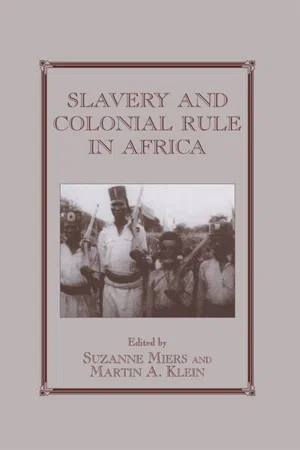
This book brings together a series of new case studies, some by young scholars, others by widely published authors. All are based on original research and designed to enhance our understanding of the process of the abolition of slavery in Africa at the grass-roots level. Part of the studies are on new areas of interest such as the German colonies and the Algerian Sahara. Others throw new light on questions already debated, such as emancipation of the Gold Coast. Some focus on the impact of abolition on particular groups of slaves, such as the royal slaves in Nigeria and concubines in Morocco. Among the themes considered is the role of slaves in their own emancipation, the short and long-term results of abolition, the role of the League of Nations, and the vestiges of slavery in Africa today.
Trusted by 375,005 students
Access to over 1.5 million titles for a fair monthly price.
Study more efficiently using our study tools.
Information
Subtopic
World HistoryIndex
HistoryThe Administration of the Abolition Laws, African Responses, and Post-Proclamation Slavery in the Gold Coast, 1874-1940
This is a study of the administration of abolition laws and the emancipation of slaves in the Gold Coast between 1874 and 1940. The question has been the subject of considerable discussion. Robertson’s case study of post-proclamation female slavery in Accra shows that the courts failed to act as an engine of freedom and sheds light on the demographics of the slaves who used the courts.1 McSheffrey has argued that there was significant slave flight after the proclamation of emancipation and suggests that the courts were instrumental in freeing slaves.2 Dumett and Johnson disagreed, arguing that the impact of the abolition was inconsequential and that the courts remained marginal to the freeing of slaves.3
The administration of the abolition laws remains a lacuna. The literature concentrates on the number of slavery cases dealt with by the courts, rather than on an assessment of how the abolition laws were administered and their relevance to emancipation.4 More attention has been paid to the Colony, the coastal enclave that had contact with the Europeans from the fifteenth century, than to the Protectorate, the interior regions first brought under European rule in the late nineteenth century. In the Colony, British law applied and slavery was illegal, whereas in the Protectorate it was not outlawed, but merely lost its legal status.5 However, the boundaries between the Colony and Protectorate were not defined until 1901. In that year, the Protectorate was merged with the Colony and slavery should have become illegal, but as will be seen, practice and theory were very different in southern Ghana. Existing studies have concentrated on the last three decades of the nineteenth century, essentially, the period of conquest.6 Very little is known about the early decades of the twentieth century, that is, the period of consolidation of colonial rule. In addition to filling these gaps, I discuss administration of the abolition ordinance and have reevaluated the total number of slaves, who utilized the courts as avenues of freedom. Lastly, I examine the responses of African slave-holders and dealers to the implementation of abolition laws.
I argue that implementation of abolition laws was largely confined to the Colony and those areas of the Protectorate, where Christian missions operated. I agree with Dumett and Johnson that abolition laws were erratically administered,7 but this was truer in the Protectorate than in the Colony. From 1874 to 1940, there were three periods of vigorous enforcement. The first was just after the abolition in 1874.8 The second was in 1889–90 when reports submitted separately by Inspector R.E. Firminger and the London-based Aborigines Protection Society (APS) alleged that slavery was widespread in the Gold Coast.9 The most productive period, however, was in response to the pressures from international anti-slavery groups and the Colonial Office between the late 1920s and 1940.10
Abolition laws were vigorously administered only when the Colonial Office and anti-slavery groups in Britain pressured the colonial government into action. Flaws in the administration of the abolition laws partly accounted for post-proclamation slavery. I reject the suggestion that the initial surge in the use of the courts occurred in the Protectorate.11 In the Protectorate it was limited to centres of missionary activity. I take issue with the existing literature which argues that slaves usually used the courts in the Colony in their quest for freedom. Even in the Colony, the courts failed to assist freed slaves in adjusting to freedom. This explains their return to forms of bondage and dependency, and not, as others have maintained, the benignity of slavery or the generosity of holders.12 Thus I agree with Suzanne Miers that ‘the [abolition] ordinances remained very largely a dead letter in [indeed, I would add, from] the 1880s’.13 I reject the assertions of Dumett and Johnson that the British vigorously pursued the elimination of servile institutions in 1911.14 This happened only from the late 1920s.
The Abolition Act
On 21 August 1874 the Earl of Carnarvon, Secretary of State for Colonies, asked Governor Strahan to consult his ‘Law Officer’ - Sir David Chalmers - on the legalities entailed in the proposed emancipation.15 Carnarvon further ordered that emancipation should follow the British-Indian model16 and suggested that compensation, self-redemption and emancipation by degrees should be considered. He authorized Strahan ‘to prepare at once for an early declaration that all children born after the end of this year [1874] shall be born free.’17 In his reply of 19 September 1874 Strahan outlined several proposals that were not markedly different from those proposed by Carnarvon.18 They included ‘immediate prohibition of slave-dealing in every form’ and the rule that ‘no court, English or native shall give effect to any right or claim affecting personal liberty’. This meant that legally slaves would not have to go to court for their freedom and their holders could not reclaim them.19 The Ordinance was to apply to the Gold Coast Colony and the ‘Protected Territories’. It also stated that henceforth slaves who entered the Protectorate and the Colony would be automatically free.20 Thus Strahan’s policy sought modification of servile institutions rather than their elimination.21
The colonial court system, dating back to the 1850s, was revamped in 1876,22 but very little is known about which courts administered abolition laws. Indeed, special courts were assigned to deal with slave dealing, ‘matters open for summary jurisdiction in minor offences being given to Magistrates and Commandants, major offences being triable in the Supreme Court of the Colony’. In the Protectorate slave cases could ‘be tried before whatever Tribunal’ might ‘be from time to time for all reasons the most eligible’.23 Initially, the maximum penalty for ‘aggravated cases’ or ‘repeated offenses’ was five years but it was later changed to seven years, and fines could be imposed ‘either in addition to or in place of any term of imprisonment’. Most important, the abolition laws excluded the chief’s court from adjudicating slavery cases since ‘it may be expected that their [chiefs] sympathies would be more with the offenders than with the law, and that trials by them would frequently be illusory’.24 Also although the abolition ordinance did not provide for witnesses and jurors25 they actually took part in slavery cases.26
The operation of the abolition ordinance was stagnant and erratic until the late 1920s, when pressure from foreign anti-slavery societies led to revisions, making it more viable as an instrument of legal status abolition. First, there was the Slave-dealing Abolition Ordinance of 1928 that strengthened the previous Ordinance.27 Second, the ‘Reaffirmation of the Abolition of Slavery Ordinance, 1930’ clearly stated that ‘slavery in any form whatsoever was unlawful and that the legal status of slavery did not exist’.28 The same year, Ashanti Ordinance No. 10 of 1930 and Northern Territories Ordinance No. 6 made the same declaration.29 Similarly, in 1932, the northern section of British mandated Togoland, the Krepi region, which had been a major source of slave supply, came under the ‘law for the time being in force in the Protectorate’.30 Lastly, the Ordinance Extension Ordinance, 1935, unified the Ordinances for the Northern Territories and Asante with that of the Colony, thus streamlining abolition policy for whole of what is now Ghana.31
The Legal System: Operation and Obstacles
After the abolition of 1874–75, Strahan met with the Chiefs of the Central and Western Provinces at Cape Coast to announce the abolition laws. Later, he also toured the Eastern Districts. Further dissemination of the abolition laws had to wait until 1888, when Governor Brandford Griffith instructed District Commissioners (DCs) to put up notices in the Colony to bring abolition laws to the attention of the inhabitants. These instructions were published in the Government Gazette of 30 June, 1888 and again on 29 June 1889. Lastly, on 14 July 1890, a circular was issued ordering all DCs to vigorously enforce the abolition laws, paying particular attention to ‘apprenticed’ children.32 In spite of these efforts, slaves seem to have been poorly informed about their rights. They would doubtless have benefited from a greater effort to publicize the ordinance. There were slaves who knew about the abolition ordinance, yet could not make sense of it.33 The Basel Missionary, Zimmerman, predicted that the Proclamation would only become known by degrees in the more distant parts of the Colony.’34 This was also true for remote parts of the Protectorate.35 Dumett and Johnson have emphasized the lack of literacy of slaves as a roadblock to their utilizing the courts,36 but the problem partly lay with the inept dissemination of the abolition ordinance.
Most scholars writing on the question attribute slow implementation to indifferent attitudes of colonial officials towards slavery.37 Johnson’s model of ‘Attitudes’ towards slavery and how they allowed the perpetuation of slavery is insightful.38 While abolition policy was being formulated and throughout the period of its implementation, colonial officials wrote reports claiming that servile institutions were benign. Consequently, they favoured gradual abolition instead of systematic and rigorous enforcement of the abolition ordinance.39 Lesser officials also made variations of this argument throughout the post-abolition period. Many examples can be gleaned from responses of the DCs to Firminger’s report in 1889-90.40 As late as 1930, when they came under pressure from anti-slavery societies, colonial officials held tenaciously to the view that slavery was benign.41
Another important explanation is the paucity of colonial officials. 42 In the Gold Coast, there was a shortage of colonial officials with professional legal training and experience throughout the colonial period.43 As the political structures of the colonial state developed, the onus of implementing the abolition ordinance devolved on the DCs. The DCs court was solely responsible for adjudicating cases of slavery from the late 1870s.44 It is not clear how many DCs were available at the moment of the abolition, but only four colonial officers, namely Governor Strahan, Dr V.S. Gouldsbury, Captain E. Lees, and Sir David Chalmers were administrators of the abolition ordinance from its inception to the late 1870s.45
The paucity of colonial officials was highlighted in 1875, when the Basel missionaries in Akyem Abuak...
Table of contents
- Cover
- Title
- Copyright
- Contents
- List of Maps
- Introduction
- THE INTERNATIONAL CONTEXT
- FRENCH AFRICA
- GERMAN AFRICA
- BRITISH AFRICA
- Notes on Contributors
- Bibliography
- Index
Frequently asked questions
Yes, you can cancel anytime from the Subscription tab in your account settings on the Perlego website. Your subscription will stay active until the end of your current billing period. Learn how to cancel your subscription
No, books cannot be downloaded as external files, such as PDFs, for use outside of Perlego. However, you can download books within the Perlego app for offline reading on mobile or tablet. Learn how to download books offline
Perlego offers two plans: Essential and Complete
- Essential is ideal for learners and professionals who enjoy exploring a wide range of subjects. Access the Essential Library with 800,000+ trusted titles and best-sellers across business, personal growth, and the humanities. Includes unlimited reading time and Standard Read Aloud voice.
- Complete: Perfect for advanced learners and researchers needing full, unrestricted access. Unlock 1.5M+ books across hundreds of subjects, including academic and specialized titles. The Complete Plan also includes advanced features like Premium Read Aloud and Research Assistant.
We are an online textbook subscription service, where you can get access to an entire online library for less than the price of a single book per month. With over 1.5 million books across 990+ topics, we’ve got you covered! Learn about our mission
Look out for the read-aloud symbol on your next book to see if you can listen to it. The read-aloud tool reads text aloud for you, highlighting the text as it is being read. You can pause it, speed it up and slow it down. Learn more about Read Aloud
Yes! You can use the Perlego app on both iOS and Android devices to read anytime, anywhere — even offline. Perfect for commutes or when you’re on the go.
Please note we cannot support devices running on iOS 13 and Android 7 or earlier. Learn more about using the app
Please note we cannot support devices running on iOS 13 and Android 7 or earlier. Learn more about using the app
Yes, you can access Slavery and Colonial Rule in Africa by Martin A. Klein, Suzanne Miers, Martin A. Klein,Suzanne Miers in PDF and/or ePUB format, as well as other popular books in History & World History. We have over 1.5 million books available in our catalogue for you to explore.