Our Mutual Friend (1864-5) Dickens' last completed novel, has been critically praised as a profound and troubled masterpiece, and yet is has received far less scholarly attention than his other major works. This volume is the first book-length study of the novel. It explores every aspect of Dickens' sustained imaginative involvement with his age. In particular its original research into hitherto neglected sources reveals not only Dickens' reactions to the important developments during the 1860s in education, finance and the administration of poverty, but also his interest in phenomena as diverse as waste collection and the Shakespeare tercentenary. The Companion to Our Mutual Friend demonstrates the varied resources of artistry that inform the novel, and it provides the reader with a fundamental source of information about one of Dickens' most complex works.
Trusted by 375,005 students
Access to over 1.5 million titles for a fair monthly price.
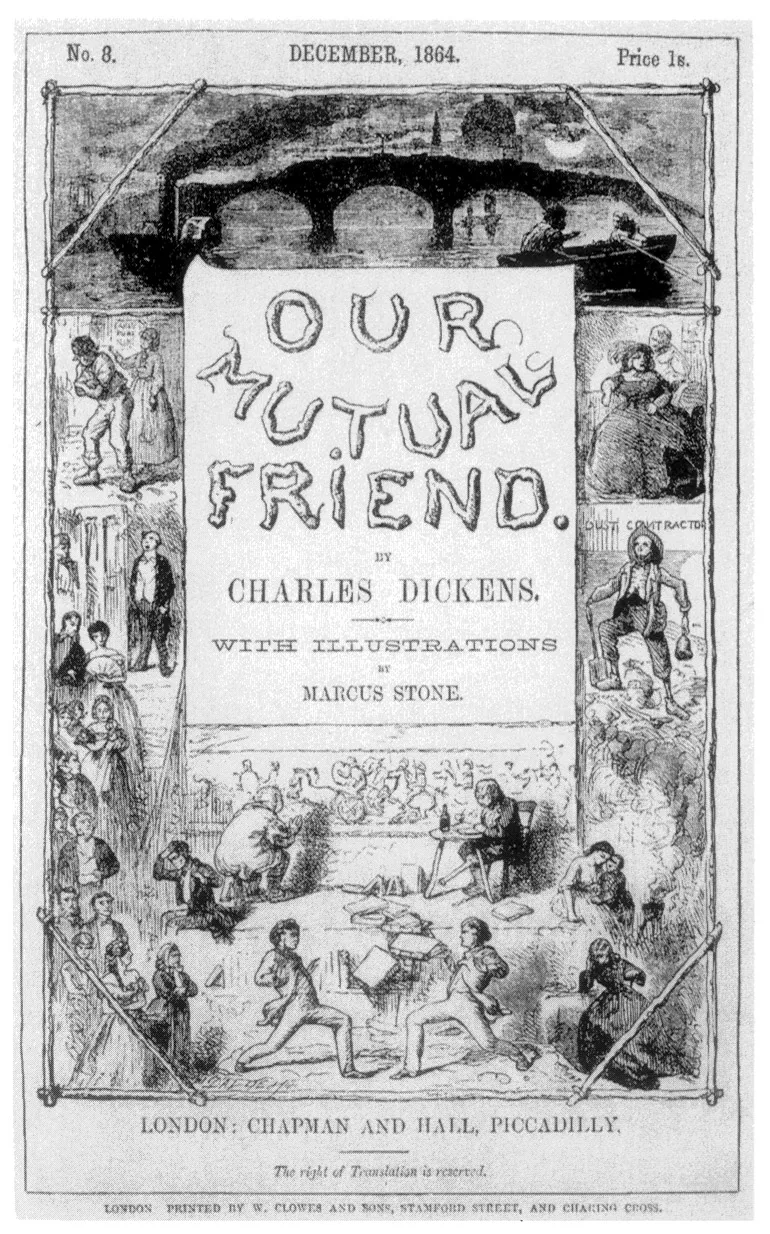
1 The cover of the monthly parts of our Mutual Friend, by Marcus Stone
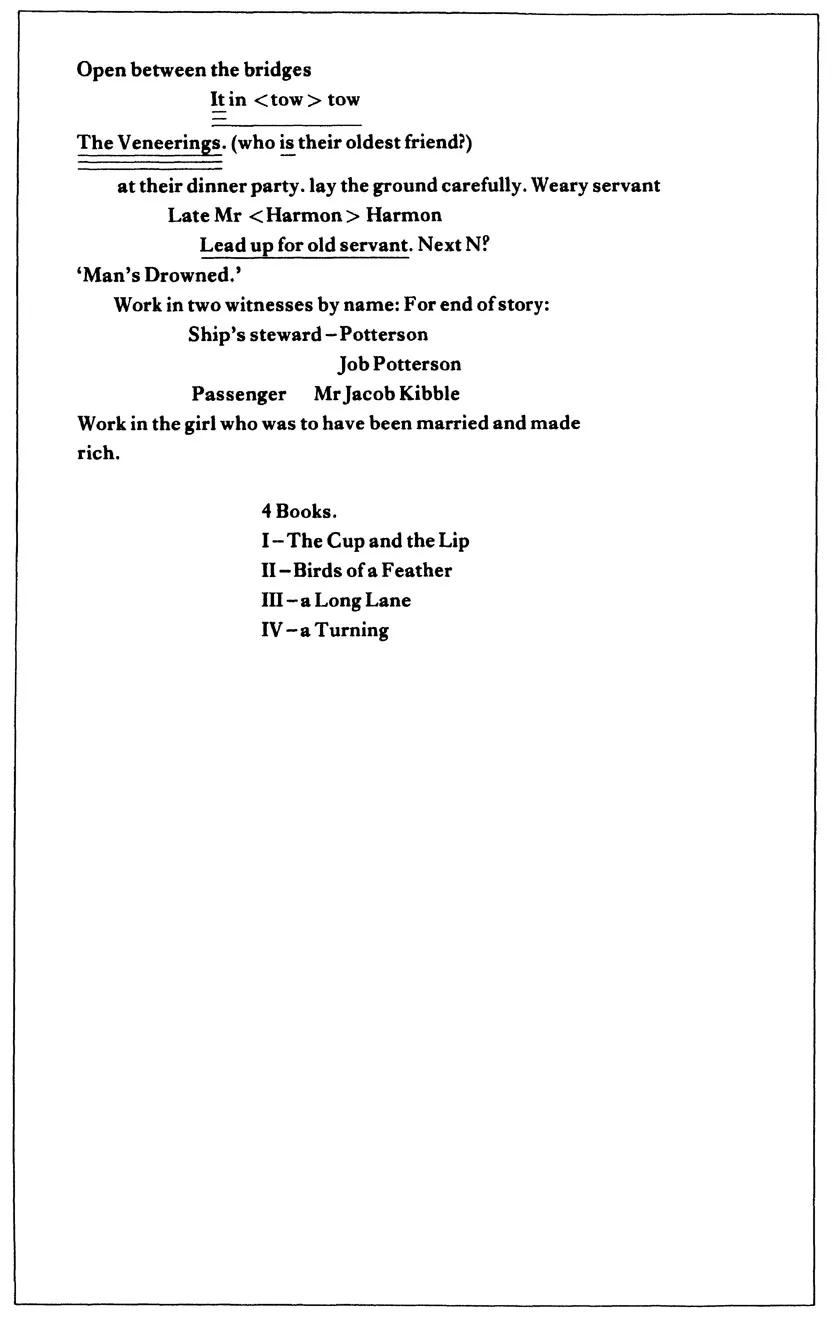
Dickens made a list of ‘General Titles’ in his Book of Memoranda which includes: ‘The Grindstone’, ‘Rokesmith’s Forge’, ‘The Cinder Heap’, ‘Broken Crockery’, ‘Dust’, ‘The Young Person’, ‘Co’ and ‘our Mutual Friend’ (6). A slip inserted at the opening page of the first monthly part of the novel reads: ‘
The Reader will understand the use of the populär phraseOURMUTUALFRIEND, as the title of this book, on arriving at the Ninth Chapter (page 84).’ There Boffin teils the Wilfers three times that Rokesmith is ‘our Mutual Friend’. Generally, Dickens used the phrase as a somewhat pompous cliche; for instance, in The Chimes, the ‘Poor Man’s Friend’ Sir Joseph Bowley says: ‘My lady, the Alderman is so obliging as to remind me that he has had “the distinguished honour” - he is very good - of meeting me at the house of our Mutual Friend Deedles, the banker’ (2). The lack of mutuality in modern society was one of Carlyle’s themes: in Past and Present (1843) he had complained that ‘Our life is not a mutual helpfulness; but rather cloaked under due laws-of-war, named “fair competition” and so forth, it is a mutual hostility’ (3.2). Prior to publication, the novel was advertised at the end of an AYR article which described the exorbitant interest rates of a Mutual, General, Universal, Benevolent, and Prudent Life and Loan Insurance Society (13.168).
Sir James Emerson Tennent [Dedication]
Sir James Emerson Tennent (1804-69) was a distinguished traveller, politician and author. A philhellene who knew Byron in Greece, he became a Member of Parliament for Belfast in 1832 and was for most of his career a liberal conservative. He supported Grey in the struggle for the Reform Bill and Peel over the abolition of the Com Laws. He was knighted in 1845, and from 1845 to 1850 he was the civil secretary to the colonial government of Ceylon. He was permanent secretary to the Poor Law Board from 1852 and secretary to the Board of Trade from the same year. He retired in 1867 and was created a baronet.
His Ceylon: An Account of the Island, Physical, Historical, and Topographieal, 2 volumes (1859), is a masterly and fascinating account. Articles about Ceylon in AYR draw on the work.
Tennent came to know Forster in their days as law students at University College in the late 1820s. Forster included the Tennents in a list of Dickens’s friends in 1848, describing them as ‘very old friends of us both’; Dickens met them on his Italian trip of 1853. In his attack on the Poor Laws in book 3, chapter 8, Dickens remarked that the circumstances of the poor did not appear in ‘the Returns of the Board of Trade’. It seems likely that Tennent’s attitude to Poor Law administration coincided with his own.
Book the First. The Cup and the Lip.
The proverb is ‘There is many a slip between the cup and the lip’. The titles of each of the novel’s four books are parts of proverbs.
Book 1, Chapter 1: On the Look Out.
First monthly number May 1864
In these times of ours
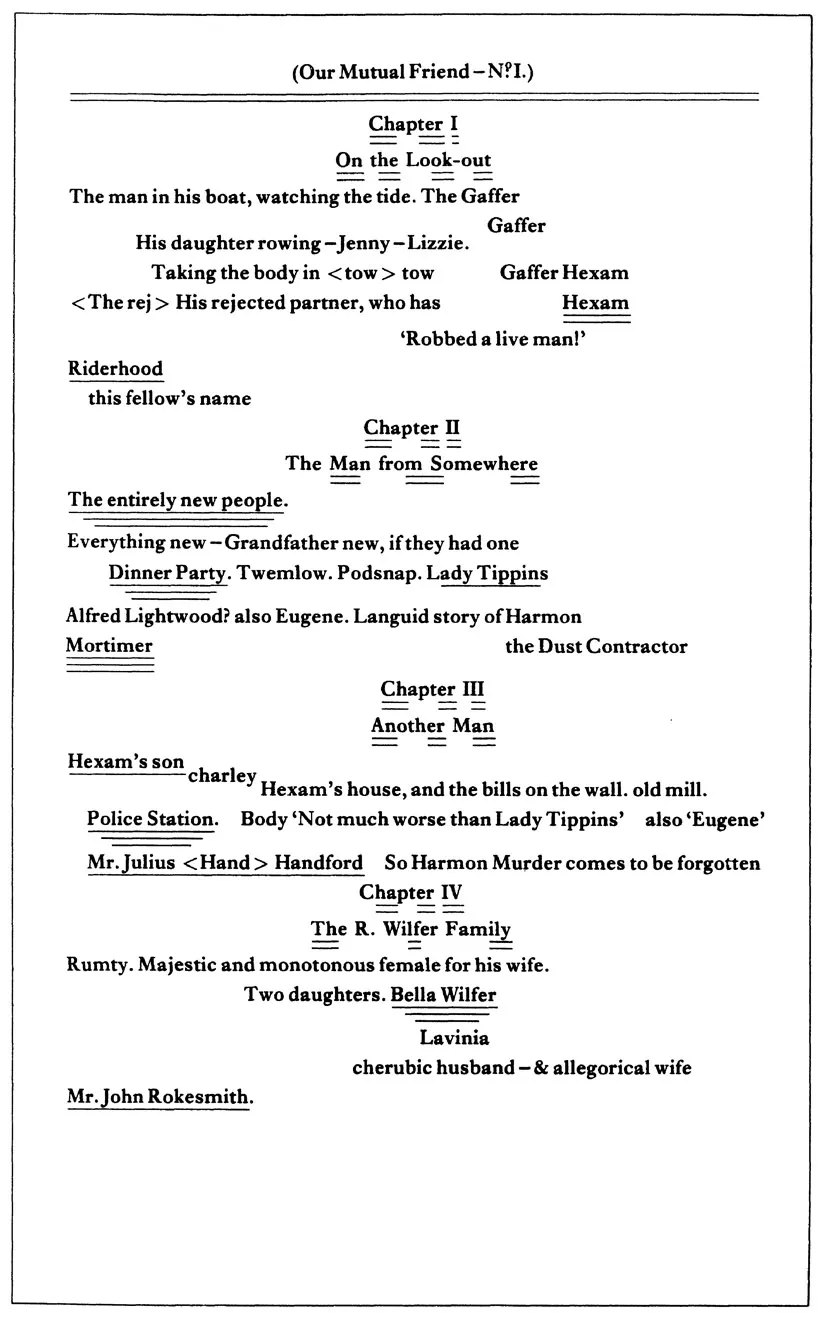
In these times of ours, though concerning the exact year there is no need to be precise] The opening words recall the original title for HT: Hard Times. for These Times. Allusions within the novel suggest it is set in the early 1860s. The events of the novel take place over three and a quarter years. The time-scheme can be established by way of the following references:
1.1
‘an autumn evening’
Year 1
1.10
‘greenhouse plants’ for the Lammles’ wedding
1.12
‘nipping spring’
Year 2
1.17
‘the blooming summer days’
2.1
‘Autumn … full half a year had come and gone since the bird of prey lay dead’: Gaffer died in the spring (1.14)
2.12
‘Not … a summer evening … a cold shrewd windy evening’
2.16
‘the first anniversary of the happy marriage of Mr. and Mrs. Lammle’
3.1
‘a foggy day in London’
3.9
‘the bright wintry scene’
4.1
‘an evening in the summer time’
Year 3
4.4
Bella teils John that she is pregnant
4.12
‘the ship upon the ocean … brought a baby-Bella’ and it is again ‘a winte evening’
Year 4
4.15
‘One winter day’
a boat of dirty and disreputable appearance] Mayhew described the boats of the dredgermen:
There is … always the appearance of labour about the boat, like a ship returning after a long voyage, daubed and filthy, and looking sadly in need of thorough cleansing. The grappling irons are over the bow, resting on a coil of rope; while the other end of the boat is filled with coals, bones, and old rope, mixed with the mud of the river. (2.149)
between Southwark Bridge which is of iron, and London Bridge which is of stone] New London Bridge, built of granite, replaced the ancient and picturesque Old London Bridge, with its two rows of houses, in 1831; in modern times it was removed to Arizona. Southwark Bridge, the ‘Iron Bridge’ of LZ), was opened as a tollbridge by a public Company in 1819. The distance between the two was just over a quarter of a mile.
The figures in this boat
a strong man … and a dark girl … sufficiently like him to be recognizable as his daughter.] Mayhew also described the typical dredgerman:
A short stout figure, with a face soiled and blackened with perspiration, and surmounted by a tarred sou’-wester, the body habited in a soiled check shirt, with the sleeves turned up above the elbows, and exhibiting a pair of sunburnt brawny arms. (2.149)
The girl rowed, pulling a pair of sculls very easily] Lady Tippins imagines Lizzie to be a ‘horrid female waterman’ (4.‘The Last’) such as is described in the HW article ‘Powder Dick and his Train’: ‘His wife plies the oars -a tall, bony, ay, and strong-boned woman - quick of action, quicker of imprecation and vituperation, who on a disputed copper would not scruple to paint your eyes as black as Erebus with the fire out’ (7.238).
his boat had no cushion for a sitter, no paint, no inscription … and he could not be a waterman] Watermen carried passengers on the river. By an Act of Parliament of 1827 they were required to license their boats, and paint on them their names and the number of persons they were authorized to carry. In the eighteenth Century there were as many as forty thousand watermen, but by the 1860s the introduction of steamers and the opening of new bridges had greatly reduced the trade, and many watermen were driven to scavenging for a living. Mayhew remarked that ‘The dredgerman and his boat may be immediately distinguished from all others; there is nothing similar to them on the river. The sharp cutwater fore and aft, and short rounded appearance of the vessel, marks it out at once from the skiff or wherry of the waterman’ (2.149).
his boat was too crazy and too small to take in cargo for delivery, and he could not be a lighterman or river-carrier] ‘The river lightermen (as the watermen style them all, no matter what the craft) are … so far a distinct dass, that they convey goods only, and not passengers’ (Mayhew 3.332).
Allied to the bottom of the river
business-like usage] Gaffer is a dredgerman, so called because of the dredging-nets used to recover articles from the river bottom. He is a professional river-scavenger: ‘They pick up a living, nobody knows how, out of the mud and soppy timbers, as men will pick up livings from every refuse; as a teeming population and an advanced population only can have such livings to be picked up’(‘Powder Dick and his Train’, HW 7.236). There were about a hundred dredgermen operating on the river between Putney and Gravesend. Scavenging often slipped into petty theft from barges and other vessels: for instance, coal was often knocked off barges so it could later be ‘“picked out of the river alongside”’ (Mayhew 2.149). Finding corpses was a small but sensationally interesting part of the activity (which Dickens mentions in BH57 and GE 44). Mayhew recorded:
The dredgers … are the men who find almost all the bodies of persons drowned. If there be a reward offered for the recovery of a body, numbers of the dredgers will at once endeavour to obtain it, while if there be no reward, there is at least the inquest money to be had - beside other chances. What these chances are may be inferred from the well-known fact that no body recovered by a dredgerman ever happens to have any money about it, when brought to shore.
‘“I never finds anythink on the bodies,”’ a dredgerman told him: ‘“Lor bless you! people don’t have any...
Table of contents
Cover
Title
Copyright
Dedication
CONTENTS
List of Illustrations
General Preface by the Editors
Acknowledgements
Abbreviations for Dickens’s Works and Related Material
Bibliographical Symbols and Abbreviations
Introduction
A Note on the Text
How to Use the Notes
The Notes
The Illustrations to Our Mutual Friend
Select Bibliography
Index
Frequently asked questions
Yes, you can cancel anytime from the Subscription tab in your account settings on the Perlego website. Your subscription will stay active until the end of your current billing period. Learn how to cancel your subscription
No, books cannot be downloaded as external files, such as PDFs, for use outside of Perlego. However, you can download books within the Perlego app for offline reading on mobile or tablet. Learn how to download books offline
Perlego offers two plans: Essential and Complete
Essential is ideal for learners and professionals who enjoy exploring a wide range of subjects. Access the Essential Library with 800,000+ trusted titles and best-sellers across business, personal growth, and the humanities. Includes unlimited reading time and Standard Read Aloud voice.
Complete: Perfect for advanced learners and researchers needing full, unrestricted access. Unlock 1.5M+ books across hundreds of subjects, including academic and specialized titles. The Complete Plan also includes advanced features like Premium Read Aloud and Research Assistant.
Both plans are available with monthly, semester, or annual billing cycles.
We are an online textbook subscription service, where you can get access to an entire online library for less than the price of a single book per month. With over 1.5 million books across 990+ topics, we’ve got you covered! Learn about our mission
Look out for the read-aloud symbol on your next book to see if you can listen to it. The read-aloud tool reads text aloud for you, highlighting the text as it is being read. You can pause it, speed it up and slow it down. Learn more about Read Aloud
Yes! You can use the Perlego app on both iOS and Android devices to read anytime, anywhere — even offline. Perfect for commutes or when you’re on the go. Please note we cannot support devices running on iOS 13 and Android 7 or earlier. Learn more about using the app
Yes, you can access The Companion to Our Mutual Friend (RLE Dickens) by Michael Cotsell in PDF and/or ePUB format, as well as other popular books in Literature & Literary Collections. We have over 1.5 million books available in our catalogue for you to explore.