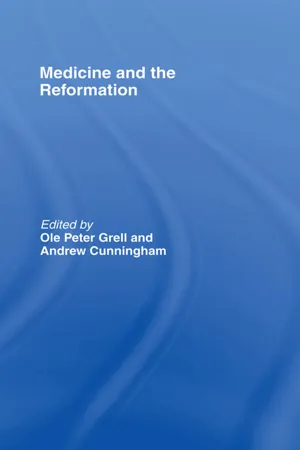
The tremendous changes in the role and significance of religion during Reformation and the Catholic Counter-Reformation affected all of society. Yet, there have been few attempts to view medicine and the ideas underpinning it within the context of the period and see what changes it underwent.
Medicine and the Reformation charts how both popular and official religion affected orthodox medicine as well as more popular healers. Illustrating the central part played by medicine in Lutheran teachings, the Calvinistic rationalization of disease, and the Catholic responses, the contributors offer new perspectives on the relation of religion and medicine in the early modern period. It will be of interest to social historians as well as specialists in the history of medicine.
eBook - ePub
Medicine and the Reformation
- 208 pages
- English
- ePUB (mobile friendly)
- Available on iOS & Android
eBook - ePub
Medicine and the Reformation
About this book
Trusted by 375,005 students
Access to over 1.5 million titles for a fair monthly price.
Study more efficiently using our study tools.
Information
Subtopic
World HistoryIndex
History1
Wittenberg anatomy
Vivian Nutton
The history of anatomy in the sixteenth century is frequently described in terms of the triumph of observation over book-learning, and of the penetration into Northern Europe of techniques, ideas and discoveries first formulated in Bologna and, above all, Padua.1 It is a trail that leads inexorably from Berengario, through Vesalius, Falloppio and Fabricius, to William Harvey, with, occasionally, a special mention for Leonardo da Vinci and his drawings. Statutes and university records are combed for the first references to chairs of anatomy or actual anatomical demonstrations on a corpse in order to confirm the participation of a particular institution in the march of medical progress. There is, in short, widespread agreement that by the end of the century Vesalian anatomy had replaced Galenic, that human dissection was both commonplace and central to any medical study, and that the message from Padua had been received swiftly and enthusiastically. Areas such as Spain, where the new anatomy does not seem to have conquered so easily, are usually forgotten or held up as dire examples of the follies of conservative academics, shortsighted administrators and religious obscurantists.2 From such a perspective, the history of anatomy at the Saxon University of Wittenberg becomes almost inexplicable, for here, as the first part of this chapter will show, Vesalian anatomy was established early, held a central place in the curriculum, yet disappeared quietly in the first years of the seventeenth century, some time before the social, economic, and academic disasters of the Thirty Years' War, without, apparently, contributing much to the annals of medical discovery.
This paradox can be resolved only if we set the study of anatomy in a wider setting, as part of a broader movement for the understanding of man's place in God's creation. As the academic home of Martin Luther, the University of Wittenberg swiftly gained fame (or notoriety) for its theology, and the educational ideals formulated and put into practice there by Phillip Melanchthon (1497–1560) were adopted by many schools and universities within the Lutheran world. They aimed to produce Christian intellectuals, both learned and Lutheran. The methods of teaching employed there, whether in theology, arts, or medicine, were as modern as any in Europe, and, as we shall see, they could be adapted to changing needs and to new discoveries. But, far more than in most other universities, they were employed at Wittenberg within a specifically religious context. True, the notion that man inhabited a divinely ordered universe was commonplace, and the claim that anatomy could reveal something of the wondrous handiwork of the Creator can be found across the religious spectrum, but at Wittenberg the links were much tighter.3 Melanchthon, and his Lutheran followers, posited a strong interaction between body and soul, and hence a knowledge of medicine, the art of the healthy body, was essential if one was to preserve the health of the soul. Anatomy revealed not only the structures, arrangement, and purpose of the body, but also the ways in which the activities of the Christian soul were mediated in thought, imagination, or will. Such a theme was far too important to be left to the physicians or medical students alone; theologians, pastors, teachers, arts students, even pupils in the gymnasia required this information, and the Wittenberg faculty provided it for them. In lectures, books and prints, the coherent message of the Lutheran anatomists was transmitted from Wittenberg to other areas of Germany for a century or more. In this perspective, the tradition of anatomy teaching at Wittenberg was no less important, and on its own terms scarcely less successful, than that of Padua and, as this chapter will show, it deserves more than the neglect of medical and religious historians.
Origins
The University of Wittenberg owed its creation, in large part, to a medical man, Martin Pollich von Meilerstadt (c. 1450–1513), Professor of Medicine at Leipzig and personal physician to Elector Frederick of Saxony. Although his published writings hardly suggest a typical humanist, his support for new Italian ideas brought him into bitter conflict with his fellow professors at Leipzig over both theology and medicine. In 1498 he held the first of a series of public disputations with his colleague Simon Pistoris in which he upheld the views of the Ferrarese professor, Niccolò Leoniceno, on the origin and treatment of the newly arrived syphilis. The debate was not only about a disease; it called into question the whole basis of contemporary medical learning, for Leoniceno (and Melierstadt after him) derided the authority of Avicenna and his medieval interpreters for propagating doctrines based on misunderstandings and mistranslations of classical sources. A return to these purer, and older, springs would, so Leoniceno and Meilerstadt argued, be of practical advantage even in the treatment of an apparently new disease. Two years later, Mellerstadt took up his cudgel to defend the value of poetry in Christian education against the ‘Spartan barbarism’ of Konrad Wimpina and other Leipzig theologians.4
The bitterness of these controversies, which increasingly degenerated into mere personal abuse, hardly made for comfortable cooperation. Hence, when the Elector Frederick mooted the creation of a new university in his own territory of Ernestine Saxony, Mellerstadt was more than eager to assist. Indeed, he was its leading spirit, ‘duxque parensque scole’. Vice-chancellor for the first eleven years of Wittenberg's existence, he was largely responsible for the choice of the new body of teachers and was himself at first the sole professor of medicine. The statutes of the medical faculty, as codified in 1508, are thus likely to reflect his wishes and interests. They can hardly be called novel. In the four-year course of practica and theoretica, the emphasis was on the standard authors of the medieval curriculum, the Articella, Avicenna, and Rhazes, with appropriate medieval commentators. The only concessions to the new medical humanism may be found in the specified translation of Hippocrates' Aphorisms (by Laurentianus) and, perhaps, in the setting of passages on fever from Galen's Method of healing, for Glaucon.5 Of anatomy there is no word, despite the fact that Mellerstadt himself had, some years previously, in 1493, produced at Leipzig an edition of the most famous of medieval anatomy textbooks, the Anatomia of Mondino dei Liuzzi.6
The success of the new university in quickly attracting students in large numbers had immediate repercussions on the older university of Leipzig. Its overlord, Duke George of Augustine Saxony, carried out a ‘Reformation’ in November 1502, and a further reorganization followed in 1511, which involved the medical faculty more deeply.7 On both occasions it was proposed that dissection be introduced into the medical curriculum. In 1502 Dr Benedict Staetz pleaded for a dissection every three years so that the students might learn ‘the inner organisation of the body; for whoever has not seen this is not a proper doctor’ . In 1511 an anonymous proposer suggested that the dissection of an animal or executed criminal in front of students in their final year would show them the inner layout of the human body. Both proposals were turned down, but in the next set of reforms, Duke George acceded to the ‘unanimous and universal’ wish of the medical faculty for an annual dissection. This was introduced for the first time in 1519, when the list of medical lectures announced that ‘an anatomy or dissection of a dead body will take place once a year. For without this a knowledge of diseases and the human constitution is defective’.8
Wittenberg in this now lagged behind. This was hardly unexpected, for after Mellerstadt's move to the faculty of theology, the two chairs of medicine were filled only by young doctors staying for brief periods and were occasionally left vacant. It was not until 1518, with the arrival of Peter Burchard (1487–1539) as professor, that the numbers of students began to rise, and the first signs of a new approach to medicine in Wittenberg can be seen. The preface to Burchard's Parva Hippocratis tabula (1519) contains a plea for the superiority of Greek medicine over that of the Arabs.9 It was contributed by Phillip Melanchthon, whose influence over the whole development of the university, including its medicine, was to remain paramount until his death. On Burchard's return in 1521 to the university of Ingolstadt, his post was divided between Stephan Wild (who stayed for only a year) and Augustin Schurff, who continued to teach until his death in 1548. It was Schurff who, in 1526, carried out the first recorded dissection at Wittenberg, of a human head, in the presence of the medical faculty and students. He repeated the dissection on other occasions, and his example was followed by other colleagues, Caspar Lindemann (professor 1532–36) and Jacob Milich (1501–59), who in 1536 was the first occupant of a new third chair in medicine specifically devoted to anatomy. From now on, lectures on anatomical authors were a central part of the medical curriculum.10
The rise and fall of Wittenberg anatomy?
The history of Wittenberg anatomy over the next eighty years could well take the form of a moral fable. True, there are no reports of spectacular disasters like that of Antonio Pigafetta, an Italian exile, whose failure to demonstrate at Heidelberg in 1574 the passage of blood from one side of the heart to the other via tiny capillaries in the heart wall was swiftly bruited around Europe and could still serve, years later, as a pointed contrast to the sounder methods of Fabricius of Aquapendente at Padua.11 Instead, Wittenberg anatomy is the province of men of solid worth, like Milich, Caspar Peucer (1525–1602), and Salomon Alberti (1540–1600), whose writings on anatomy show how well they fulfilled their academic duties.12 One can point also to a student interest in public anatomies, like that carried out in 1554 in the presence of Professors Milich and Fend.13 The highpoint in such a story would be reached with the new statutes of 1572, when the duties of the third professor of medicine were extended. As well as being responsible for the teaching of medical botany, he had to lecture on the anatomical writings of Galen, Vesalius and Falloppio (or on a suitable modern introductory textbook), pointing out what had been ‘accurately written’, and correcting ‘the mistakes of earlier centuries’;. At the same time, the university also received the statutory right to ask the relevant civil authorities, at an appropriate moment, for the bodies of executed criminals for use in an anatomy.14 But from then on, there is an apparently swift decline. Anatomies rarely took place, and, in 1601, the most capable of Wittenberg anatomy professors, Johann Jessen (1566–1621), left in high dudgeon for Prague after a brush with the civil powers. The medical professors complained of a lack of support for anatomy by the authorities and bewailed the interference of what Jessen called ‘importunate busybodies'.15 When Tobias Tandler, professor from 1607–17, managed to conduct a public anatomy of a male corpse in 1609, this was the result of pure chance: more often, as he complained officially i...
Table of contents
- Cover
- Half Title
- The wellcome institute series in the history of medicine
- Full Title
- Copyright
- Contents
- List of illustrations and tables
- List of editors and contributors
- Introduction Ole Peter Grell and Andrew Cunningham
- 1. Wittenberg anatomy
- 2. Aspectio divinorum operum: Melanchthon and astrology for Lutheran medics
- 3. Paracelsus: medicine as popular protest
- 4. Caspar Bartholin and the education of the pious physician
- 5. Spiritual physic, Providence and English medicine, 1560–1640
- 6. Physicians and the Inquisition in sixteenth-century Venice
- 7. The Church, the Devil and the healing activities of living saints in the Kingdom of Naples after the Council of Trent
- 8. The Inquisition and minority medical practitioners in Counter-Reformation Spain: Judaizing and Morisco practitioners, 1560–1610
- Index
Frequently asked questions
Yes, you can cancel anytime from the Subscription tab in your account settings on the Perlego website. Your subscription will stay active until the end of your current billing period. Learn how to cancel your subscription
No, books cannot be downloaded as external files, such as PDFs, for use outside of Perlego. However, you can download books within the Perlego app for offline reading on mobile or tablet. Learn how to download books offline
Perlego offers two plans: Essential and Complete
- Essential is ideal for learners and professionals who enjoy exploring a wide range of subjects. Access the Essential Library with 800,000+ trusted titles and best-sellers across business, personal growth, and the humanities. Includes unlimited reading time and Standard Read Aloud voice.
- Complete: Perfect for advanced learners and researchers needing full, unrestricted access. Unlock 1.5M+ books across hundreds of subjects, including academic and specialized titles. The Complete Plan also includes advanced features like Premium Read Aloud and Research Assistant.
We are an online textbook subscription service, where you can get access to an entire online library for less than the price of a single book per month. With over 1.5 million books across 990+ topics, we’ve got you covered! Learn about our mission
Look out for the read-aloud symbol on your next book to see if you can listen to it. The read-aloud tool reads text aloud for you, highlighting the text as it is being read. You can pause it, speed it up and slow it down. Learn more about Read Aloud
Yes! You can use the Perlego app on both iOS and Android devices to read anytime, anywhere — even offline. Perfect for commutes or when you’re on the go.
Please note we cannot support devices running on iOS 13 and Android 7 or earlier. Learn more about using the app
Please note we cannot support devices running on iOS 13 and Android 7 or earlier. Learn more about using the app
Yes, you can access Medicine and the Reformation by Andrew Cunningham, Ole Peter Grell, Andrew Cunningham,Ole Peter Grell in PDF and/or ePUB format, as well as other popular books in History & World History. We have over 1.5 million books available in our catalogue for you to explore.