- 226 pages
- English
- ePUB (mobile friendly)
- Available on iOS & Android
eBook - ePub
About this book
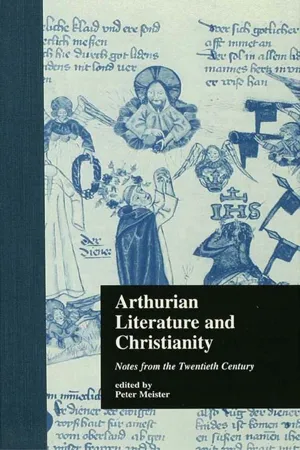
Intended as "the other bookend" to Jessie Weston's work some eighty years earlier, this essay collection provides a careful overview of recent scholarship on possible overlap between Arthurian literature and Christianity. From Ritual to romance and Notes, taken together, bracket contemporary inquiry into the relationship (if any) between Jesus and Arthur. T.S. Eliot's "The Waste Land" is here regarded as one strand joining this matter to many a recent literary riddle (such as the meaning of the term "postmodernism"). Without reprinting work readily available elsewhere and no longer subject to revision through dialogue with fellow contributors, Notes attempts to do justice to all sides in twentieth century exploration of christianity's contribution to an art form which is also grounded in early European polytheism ("paganism").
Trusted by 375,005 students
Access to over 1.5 million titles for a fair monthly price.
Study more efficiently using our study tools.
Information
CHAPTER 1
The Time of the Four Branches1
In 1839 Lady Charlotte Guest began publishing English translations of a medieval Welsh cycle to which she gave the name the Mabinogion (‘tales for children’), but which is now called the Mabinogi (‘tales of a hero's coming of age’).2 These annotated translations, which she refined and reissued throughout her life, contributed on the one hand to reviving pride in the indigenous Welsh tradition, and, on the other, to understanding the roots of Arthurian literature on the European continent. Whether inherently because of the material itself, or secondarily because of the nationalist emphasis in Guest's commentary, a dichotomy between “Celtic” and “Christian” came to be standard in Arthurian commentary on the Mabinogi. In this selection, most of the explicit instances of a Christian presence in the Four Branches are enumerated within the context of an attempt to date the narrative, both with regard to its actual composition and to the age in which the story purports to be taking place.
Whenever the story was shaped, the narrator situated its events in the past. He did not mention imaginary contemporaries, no matter how much of the coloring of his age is on them, but the old inhabitants of the country in times gone by. There are no Saxons or Normans to be seen anywhere, only Brân, the king of the whole island, with the crown of London on his head. The Romans haven't arrived either, but they are close by. When Bran was in Ireland, the island [Britain] was conquered by Caswallawn the son of Beli, which harks back to Casivellaunos, king of the Britons, who opposed Julius Caesar in 54 B.C. The era of the Mabinogi, therefore, in the mind of the narrator, was the era immediately before the first arrival of the Romans on the island.
The author of the Dream of Maxen3 conflated matters a bit in making Beli and his sons contemporaries of the emperor Maxen (Maximus), who was killed at the end of the fourth century A.D. (388): and yet, he kept something of the tradition, since Beli and his sons reigned here when the first Romans came to the island. Therefore, the narrator of the Mabinogi knew that it was about the pagan era before Christ that mention was to be made, and, to be fair to him, he succeeded rather well at keeping Christianity out of his material. He failed sometimes, nonetheless. His characters swear on their “confession to God,” the spear for killing Lieu is made when people are at Sunday Mass,4 a scholar, a priest and a bishop come to Manawydan, and he asks for their blessing: a name is given at the occasion of baptism, too, only here he remembered to add that it was the baptism that was done at that time.5
And yet, if he failed in these points, he succeeded in keeping Roman, Saxon and Norman out of his story. Some authors are surprised that he makes no mention of Arthur at all. But there would be more occasion for surprise and wonder and blame if he had brought Arthur in. Every storyteller knew that King Arthur was the hero who fought against the Saxons, and how could space be found for him in a story about the natives of Wales in the time before even the Romans had landed? The absence of Arthur from the picture doesn't prove that the story was completed before the story about Arthur became famous, any more than does the silence concerning the Saxons prove its composition before A.D. 400. All that is proved is that the storyteller, in this at least, was consistent in his idea about the era in which his characters lived. But who is responsible for the citations from the Triads in the Four Branches?6 It can be shown that that person knew a certain amount about Arthur too.
NOTES
1. This selection originally appeared in modern Welsh in the introduction to the medieval Welsh edition of The Four Branches of the Mabinogi (Pedeir Keinc Y Mabinogi). Section 5, pages xxii–xxiv. For commentary on this passage (or on this matter), see Sioned Davies 61 (and 34–5).
2. Loomis (Development) 23. He gives 1849 as the first publication date, and phrases the definition of the genre somewhat differently.
3. The Text of the Mabinogi from the Red Book of Hergest, 88.
4. Williams 86.
5. Williams 150–51. [Translator's note: In a note discussing the sentence “They had the boy baptized, according to the baptism which was done then” (“Peri a wnaethont bedydyaw y mab, o'r bedyd a wneit yna” p. 23), Williams observes: “… a suggestive sentence. The narrator feels that a mention of Christian baptism was not appropriate somehow in connection with persons like these; that it continued a certain vague remembrance of their antiquity, is doubtless, and a consciousness that such beings were rather pagan, although the name of God was in their oaths. And yet he could not think that there was not something of the sort in their history, or when did they get their names! To him the chief meaning of baptism was the giving of a name. Cf. English christening. Every time that baptism is mentioned the emphasis is on the naming, page 75, line 21; page 76, lines 7 and 19; page 83, line 26; and so here.”]
6. [Translator's note: The Triads (Trioedd) to which Williams refers here were widely circulated lists of legendary persons and events, arranged thematically by threes under such headings as “Three Stubborn Men,” “Three Lovers of the Island of Britain,” “Three Concealments and Three Disclosures of the Island of Britain,” etc. These were apparently intended to serve as catalogues or indices of bardic lore for the use of poets and story tellers. Arthur figures prominently in these legendary triads. Similar lists existed for other areas of learning, e.g., law and medicine. The largest and best known collection of legendary triads, The Triads of the Island of Britain (Trioedd Ynys Prydein), has been edited by Rachel Bromwich.]
CHAPTER 2
Parzival and the Grail1
The origin of the Grail saga may be counted among the most difficult problems in Arthurian research. Theories fall into the following groups: a Celtic origin, a Christian origin, an Oriental origin. The dominant view today (1997) combines Celtic origin with Christian influence.
The story of Parzival and the Grail belongs to the cycle of Celtic sagas about King Arthur and his Knights of the Round Table (“the Matter of Britain”).2 The history of this cycle is the object of international research. Today that research is based in French studies in America and France as well as in Celtic studies in Great Britain. German Arthurians, who at one time took the initiative in important ways, now play a quiet role. The main transmission question is whether French poets of the twelfth century owed their Arthurian tales in the main to Celtic tradition or whether these poets made them up for the most part, perhaps by freely combining inherited motifs.
The reason this question is so difficult is that Celtic tales of Arthur were for centuries passed on only orally and nothing is known of them except for scant traces recorded in Latin chronicles and hagiographies of the ninth through the twelfth centuries. Almost without exception the Celtic (Welsh) manuscripts are younger than the courtly epics. Since the French epic exerted a demonstrable return influence on Celtic tradition, we can never be sure which nationality is responsible for those motifs which they have in common. This problem is nowhere more intractable than for the most important group of Welsh texts, the so-called Mabinogi (“story or stories about a hero in his youth”).3 The Mabinogi are a collection of prose narratives, several about King Arthur. The dominant view today is that some of these narratives— “Kulhwch and Olwen” in particular, by coincidence the collection's most famous piece— preserve old Celtic sagas, while others borrow fairly faithfully from the French. An example of this second kind would be the Mabinogi about “Peredur,” which seems in the main to have been modeled on Chrétien's Story of the Grail (Conte du Graal).4
Whether or not there was an earlier Celtic saga of Parzival is not a matter on which scholars can agree. The hero's name is French. In Chrétien he is called Perceval, and medieval poets take that to mean “press on through the valley” (perce val). In Wolfram, similarly, Sigune translates: “the name means right through the middle”5 (140,17). In the Mabinogi the hero's name is Peredur. Our first attestation of this name is in Geoffrey of Monmouth's twelfth-century History of the Kings of England (Historia regum Britanniae), where a guest named Peredur appears at King Arthur's courtly festival.
Our oldest narrative about this hero is Chrétien's Conte du Graal (Story of the Grail), a work thought to date from about 1180–1190. Various figures and motifs in this work display typical traits of the Celtic world of legends and marvels, for example, the ugly Grail messenger, three drops of blood on a snowy field, the Bleeding Lance, the Fisher King, the Wondrous Bed (Lit de la Mervoille) among others. Romance scholars such as Jean Marx and Roger S. Loomis have tried to deduce the original plot of a Celtic saga of Parzival (or Peredur).6 At the heart of such a plot would have been the visit of a mortal to a Celtic Otherworld that had become barren because of a spell. A magical question, according to Marx and Loomis, would have dispelled this curse. Again, we have no way of knowing whether Chrétien de Troyes was familiar with a Celtic story whose plot elements combined in this particular way.
The major role which religious motifs play is the most important difference between the Parzival story and other Arthurian matter. Sin and repentance stand—in Chrétien's treatment as in Wolfram's— in the closest possible relation to the Grail. The origin of the Grail saga may be counted among the most difficult problems in Arthurian research. Three theories are still discussed:
- a Celtic origin. In most versions the Grail is pictured as a magic provider of food. This cornucopia function is not far from the magic pots and horns described in Celtic lore. The Grail is also associated with clearly Celtic motifs (the Bleeding Lance, the Fisher King).
- Christian origin. The Grail is by all accounts a sacred container.7 Eucharistie motifs arise in several versions. And the celebratory Grail procession is reminiscent of liturgical practice.
- an Oriental origin. This claim rests mainly on Wolfram, who describes the Grail as a stone. This stone has reminded some scholars of various Eastern stones.8 Given Wolfram's dependence on the French, however, his depiction of the Grail is clearly secondary.
The dominant view today is tha...
Table of contents
- Cover
- Half Title
- Full Title
- Copyright
- Dedication
- Contents
- Acknowledgments
- Preface
- Chapter 1: The Time of the Four Branches
- Chapter 2: Parzival and the Grail
- Chapter 3: From Germanic Warrior to Christian Knight: The Heliand Transformation
- Chapter 4: Romancing the Grail: Fiction and Theology in the Queste del Saint Graal
- Chapter 5: Grace and Salvation in Chrétien de Troyes
- Chapter 6: The Allegory of Adventure: An Approach to Chrétien's Romances
- Chapter 7: The Symbolic Use of a Turtledove for the Holy Spirit in Wolfram's Parzival
- Chapter 8: The Crusades and Wolfram's Parzival
- Chapter 9: Lady Love, King, Minstrel: Courtly Depictions of Jesus or God in Late-Medieval Vernacular Mystical Literature
- Contributors
- Works Cited
- Index
Frequently asked questions
Yes, you can cancel anytime from the Subscription tab in your account settings on the Perlego website. Your subscription will stay active until the end of your current billing period. Learn how to cancel your subscription
No, books cannot be downloaded as external files, such as PDFs, for use outside of Perlego. However, you can download books within the Perlego app for offline reading on mobile or tablet. Learn how to download books offline
We are an online textbook subscription service, where you can get access to an entire online library for less than the price of a single book per month. With over 1.5 million books across 990+ topics, we’ve got you covered! Learn about our mission
Look out for the read-aloud symbol on your next book to see if you can listen to it. The read-aloud tool reads text aloud for you, highlighting the text as it is being read. You can pause it, speed it up and slow it down. Learn more about Read Aloud
Yes! You can use the Perlego app on both iOS and Android devices to read anytime, anywhere — even offline. Perfect for commutes or when you’re on the go.
Please note we cannot support devices running on iOS 13 and Android 7 or earlier. Learn more about using the app
Please note we cannot support devices running on iOS 13 and Android 7 or earlier. Learn more about using the app
Yes, you can access Arthurian Literature and Christianity by Peter Meister in PDF and/or ePUB format, as well as other popular books in Letteratura & Critica letteraria. We have over 1.5 million books available in our catalogue for you to explore.