eBook - ePub
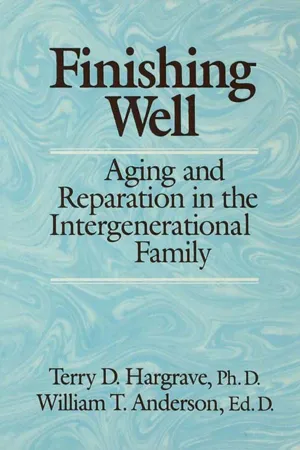
Finishing Well: Aging And Reparation In The Intergenerational Family
- 222 pages
- English
- ePUB (mobile friendly)
- Available on iOS & Android
eBook - ePub
Finishing Well: Aging And Reparation In The Intergenerational Family
About this book
Offers therapists guidance in helping multigenerational families with older members understand and cope with the myriad challenges they face. The text considers such issues as: confronting death; life validation; life review; and exoneration, forgiveness, and healing in the family.
Information
I
UNDERSTANDING AGING FAMILIES
1
THE INTERGENERATIONAL IMPACT OF AGING
Aging is not optional. Aging is like a vacuum; it eventually sucks all of us up. Despite medical advances and an ever-growing array of anti-aging lotions and potions, we all get old and we all die. This reality, no matter how hard we deny it, causes a tremendous amount of frustration. As we age, we lose physical and financial strength. We experience profound loss: job, role, status, friends, and spouse. Aging does not happen just to individuals, it happens to families right along with their elder members. The issues concerning relationships, the burden for care, and the stress of managing resources affect the family across the generations.
But even with the frustration and sense of loss that aging brings, the experience need not be entirely negative for the family. In the midst of the pain and the fear and the sadness, life gives the family one of the last great opportunities to resolve old issues and to empower one another with love and trust. The task of aging is not only for the family to survive the process, but to become stronger through the process.
MULTIGENERATIONAL FAMILIES
At family reunion picnics, often an intergenerational softball game is organized. Children, parents, grandparents, and maybe even great-grandparents play together. As each person comes to bat, most family members seem to root for each other. As the game proceeds, you usually observe an interesting phenomenon. The younger the family member at bat, the easier the pitcher tosses the ball. As each progressively older person comes to bat, the pitcher uses whatever finesse he or she can muster to try to strike the batter out. So young and old play at the same game, but the task of hitting the ball becomes more complex with age.
So it is with the intergenerational family ball game. Younger family members do not play in the minor leagues; they play right alongside the adults. Everyone aims for the same goals, but the tasks vary according to the age of the player. Developmental tasks for the younger children, while challenging to them, are easy for adults. The tasks become more complex and difficult with age. Just as in the game, adults and children take their “swings” at these tasks; sometimes they miss and sometimes they succeed. Members of stronger families stand beside one another, encouraging success. Weaker ones tend to blame players who are not up to par and give up easily. Young and old play at the same game. Each member has a turn at taking his or her “swings” at the appropriate times. The game gets tougher and more complex as the family ages. In our society, more and more extra innings are being added to the game.
“This is not only the century of old age, but the century of the multigenerational family” (Butler, 1985). As individuals age, families are carried along in the aging process. Aging touches every generation. In the therapeutic process with an older person, a therapist cannot afford to have a myopic, single-generation perspective. All families—but especially the aging family—present important issues of entitlement, care, security, trust, fairness, loyalty, and legacy across generational spans. Carter and McGoldrick (1988) reiterate this in their belief that the operative emotional field of the family at any given moment comprises the entire emotional system of three or more generations. When we talk about an aging family, we do not mean a family of a married older couple and one of their adult children. Aging families take in the entire multigenerational group. For therapists to understand aging and its presenting problems, they must consider the social, physical, and psychological impacts of each generation. In this chapter, we examine the normal family life cycle, the changes that aging forces in the family, the emotional bonds in the aging family, and the relationships between aging parents and adult children.
THE FAMILY LIFE CYCLE
Anderson and Hargrave (1990) describe how a hypothetical five-generation family of the 1990s might well look.
The 95-year-old great-great-grandmother has outlived her husband and many of her friends. She now faces the last stage of life and its ultimate challenge—letting go. Her 75-year-old widowed daughter is dealing with caring for her 95-year-old mother and her own need for independence. The daughter must deal with questions such as, “Where should I live?”, “When do I have to give up my drivers license?”, “Am I still an adult, even though my 50-year-old daughter has to provide some care for me?” The 50-year-old daughter, in turn, faces many challenges: helping her own adult children separate and establish themselves in occupations and homes, caring for her 75-year-old mother, working with her husband to prepare for retirement, and dealing with repressed sibling issues that tend to surface at this time. The 25-year-old son or daughter is looking for help to get started in life as they nurture small children, attempt to purchase a home, and wonder how they will be able to support the growing number of elderly. Finally, the young children of the fifth generation watch the intergenerational processes and absorb, albeit silently, the profound lessons being manifested across the five generations. (p. 311)
It is easy to see from this example that the multigenerational family deals with a multitude of concerns at any one time. Duvall and Hill (1948) were the first to propose eight stages of the family life cycle: (1) married couples; (2) families with small children; (3) families with preschool children; (4) families with school children; (5) families with adolescents; (6) families with young adult children; (7) middle-aged parents without children at home; and (8) aging family members. In a more systemic view, Carter and McGoldrick (1988) present the following developmental cycle of an intact middle-class American family, highlighting the processes and changes that must occur during the family's expansion, contraction, and realignment of relationships, in order to support each members development in functional ways. As the authors of this developmental cycle point out, it is imperative that therapists recognize the extent of change and variation in the norms of the family life course, compared with the family of the 1950s. Some family patterns and themes are common, but therapeutic thinking about the “normal” contemporary family life cycle must include positive conceptual frames about some of the following issues: two-paycheck marriages; permanent single-parent households; unmarried couples and remarried couples; single-parent adoptions; and women of all ages living alone (Carter & McGoldrick, 1988).
Leaving Home: The Launching of the Single Young Adult
In this first stage of the family life cycle, the key emotional process is the transition of the young adult accepting emotional and financial responsibility for self In order to implement this transition, several changes in the family system must occur. First, there has to be differentiation of the young adult in relation to the family of origin. It is important to realize that this differentiation is a shift to an adult-to-adult status, rather than an emotional cutoff as described by Bowen (1978). Second, the young adult must develop intimate relationships with peers. Finally, for the launching to be successful, the young adult must establish financial independence—usually through securing work with adequate pay.
The Joining of Families Through Marriage: The Couple
The key emotional process in this second stage is the inclusion in and commitment to a new family system. In this framework, two family systems are joined by an overlapping third subsystem. Each system needs to negotiate and respect emerging boundaries for the new family in order to ensure its viability. As a result, the family changes during this stage must include realignment of relationships with family and friends; above all, the family needs to include the new spouse. Formation of a marital dyad with secure boundaries is essential.
Families with Young Children
The third stage of the family life cycle requires that adults move up one generation in order to become caretakers for the youngest generation. The family must modify itself so that it can accommodate new members. The couple must adjust the marital dyad to make space for children while maintaining the integrity of the marriage. The family must take responsibility for the children by managing a secure emotional, financial, and physical environment. Finally, the family must realign relationships to include the extended family in new parenting and grandparenting roles.
Families with Adolescents
When the family reaches this fourth stage, parents must shift the boundaries in the family to allow for more flexibility. Parents no longer can be the supreme authorities or caretakers in the adolescents’ lives. Parents must now deal with the reality of their own parents’ aging and need for care and dependence on the family. Adolescents move in and out of the system, seeking varying degrees of independence, whereas the oldest generation moves in and out of the system, seeking varying degrees of affirmation and care. In addition, the couple in the middle generation must refocus on the marital dyad and career issues, apart from child-care responsibilities that dominated earlier years.
Families at Midlife: Launching Children and Moving On
Carter and McGoldrick (1988) identify this fifth stage as not only the newest and longest stage in the family life cycle, but also as the most problematic. As the birth rate has decreased in the United States, the life span has increased, and so it is now common for parents to launch their children some 20 years before the parents’ retirement. This requires the parents to find new life interests and activities. It may be the most problematic of all the stages because of the multiple exits from and entries into the family system. As children are launched, the couple must readjust the marital relationship to incorporate the evolving intimacy demands of being by themselves once again. The parents must now negotiate an adult-to-adult relationship with their children, shifting final authority, control, and responsibility to the offspring. As children move into new family relationships, the old family system must adapt to new relationships that now include in-laws and grandchildren.
Perhaps the newest and most difficult transition during this stage is dealing with aging parents. The family must adjust to dealing with the potential disabilities and inevitable death of the oldest generation. Responsibility for the care of the eldest family members most often falls on this middle, so-called sandwich generation (Dobson & Dobson, 1985).
The Family in Later Life
In this final stage, the family must accept the shifting generational roles and the shift of family power to the central and younger generations. As mentioned earlier, the individual member and the family must maintain optimal functioning in the face of physiological decline. This means providing care and nurturing for the older members without overfunctioning for them, and allowing them to make contributions to the family. The oldest generation must move into more of a support role for the middle generation; elder members need to be willing to serve the family by utilizing their own experience and wisdom. Finally, the family must prepare for the death of its eldest members. This includes life review and integration of real experiences with the past hopes and dreams.
THE IMPACT OF AGING ON THE LIFE CYCLE
It is easy to see how the aging process in the family multiplies the complexities of the family life cycle. Forty years ago, it was much less common for people to have living grandparents at the time when they started a family of procreation. With the increase in longevity, it is now rather common for a four-generation-family complex to exist. Along with the resources generated by the multigenerational family, the normative tasks and stresses put on each generation are made more difficult with each additional generation. The stresses that have an impact on the aging family include emotional issues, retirement, widowhood, grandparent-hood, and changing roles.
Emotional Issues
Older people experience feelings similar to those of their children and grandchildren, but in ways that are appropriate to their years. One overriding theme that colors those feelings in old age is that of loss. The aging parent has lived long enough to experience most of life's losses: death of a spouse, other relatives, or friends; reduced social status; diminished physical health; and lowered standard of living. Perhaps the greatest challenge to the elderly person is coming to grips with his or her own approaching death.
Butler and Lewis (1991) note some common emotional reactions that older people experience in this last stage of life. Among the most common of these reactions are grief and mourning for the many losses that the older person has sustained. Grief is usually most pronounced when a spouse dies, though it also shows itself in response to losses of health, job income, or status. There is little societal or familial support for the aging person grieving the loss of a spouse in the United States today. In our youth-oriented culture, talk about death is avoided. So the older person is left to do much of this grief work alone.
However, all families and generations eventually experience grief and loss, and the lessons of letting go and mourning taught by the eldest generation can be profound. When the family and the individual approach death from a perspective of strength, they give past events of life appropriate meaning. Old unsettled issues, now talked about openly, can be resolved. Grieving and loss, though painful, become essentially empowering to the family group. On the other hand, if the family experiences the grief and loss of aging as overwhelming, discussion of mortality is skirted. The meaning of past events is left unarticulated; unfinished business remains just that—unfinished. Death then becomes an end that brings little emotional resolution for the family.
Guilt is another prominent feature in old age. As one draws near to the end of life, it is normal to feel guilt—for past failings, for the “sins” of a long life. Yet the older person may feel unable to make amends for these real or imagined hurts. As the elder seeks to consolidate the perspective of meaning and wisdom across the life span, he or she ideally maintains a realistic balance of human feelings. It is quite reasonable to expect that old age brings with it feelings and experiences of despair. The older person recalls things he or she wishes could have been different, considers present circumstances that cause pain, or ponders aspects of the future that are frightening (Erikson, Erikson, & Kivnick, 1986). However, these feelings of guilt, regret, and despair can be beneficial to the family if they are used as signals to address family wounds that have not been dealt with. The family will only lose hope if these issues are ignored.
Butler (1991) notes that in our individualistic society, loneliness (fear of isolation) can easily be a difficult emotion to handle. Americans have been conditioned to be self-sufficient through much of their childhood and adult life. Now in old age, the person often attempts to carry on in the same way. The reality of aging, however, can prove to be a severe blow to that sense of self, since aging people tend to become more dependent on others than they have been for many years. A very small percentage of older people require institutionalization, but over 86 percent experience chronic health problems; these often require health services and caregiving for daily needs by family members (Zarit & Zarit, 1982).
The emotionally charged state of dependence is a primary source of conflict for the aging family. In order for the dilemma to be resolved, the older person must accept the physical limitations of age and allow the family to give care when needed. In addition, family members must take appropriate responsibility for what they need to do for the older person and what the older person should continue to do for himself or herself (Walsh, 1988). The family avoids maximum stress when it maintains a healthy balance of dependency needs. For instance, if an older person doggedly struggles to maintain independence beyond his or her capability, the family is burdened with compensating for the elderly persons decline in mental or physical capacity. The following narrative of an adult daughter offers a glimpse of such a situation.
Every time I would try to talk to mother about live-in help, she would cut me off. I would hire meal or cleaning services for he...
Table of contents
- Front Cover
- Half Title
- Title Page
- Copyright
- CONTENTS
- Preface
- PART I: UNDERSTANDING AGING FAMILIES
- PART II: THE BEGINNING STAGES OF THERAPY
- PART III: THERAPEUTIC INTERVENTIONS
- References
- Name Index
- Subject Index
Trusted by 375,005 students
Access to over 1.5 million titles for a fair monthly price.
Study more efficiently using our study tools.
Frequently asked questions
Yes, you can cancel anytime from the Subscription tab in your account settings on the Perlego website. Your subscription will stay active until the end of your current billing period. Learn how to cancel your subscription
No, books cannot be downloaded as external files, such as PDFs, for use outside of Perlego. However, you can download books within the Perlego app for offline reading on mobile or tablet. Learn how to download books offline
Perlego offers two plans: Essential and Complete
- Essential is ideal for learners and professionals who enjoy exploring a wide range of subjects. Access the Essential Library with 800,000+ trusted titles and best-sellers across business, personal growth, and the humanities. Includes unlimited reading time and Standard Read Aloud voice.
- Complete: Perfect for advanced learners and researchers needing full, unrestricted access. Unlock 1.5M+ books across hundreds of subjects, including academic and specialized titles. The Complete Plan also includes advanced features like Premium Read Aloud and Research Assistant.
We are an online textbook subscription service, where you can get access to an entire online library for less than the price of a single book per month. With over 1.5 million books across 990+ topics, we’ve got you covered! Learn about our mission
Look out for the read-aloud symbol on your next book to see if you can listen to it. The read-aloud tool reads text aloud for you, highlighting the text as it is being read. You can pause it, speed it up and slow it down. Learn more about Read Aloud
Yes! You can use the Perlego app on both iOS and Android devices to read anytime, anywhere — even offline. Perfect for commutes or when you’re on the go.
Please note we cannot support devices running on iOS 13 and Android 7 or earlier. Learn more about using the app
Please note we cannot support devices running on iOS 13 and Android 7 or earlier. Learn more about using the app
Yes, you can access Finishing Well: Aging And Reparation In The Intergenerational Family by Terry D. Hargrave,William T. Anderson in PDF and/or ePUB format, as well as other popular books in Psychology & Developmental Psychology. We have over 1.5 million books available in our catalogue for you to explore.