eBook - ePub
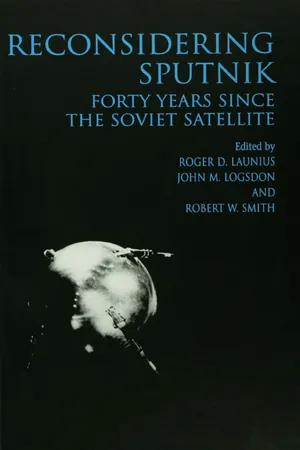
Reconsidering Sputnik
Forty Years Since the Soviet Satellite
- 464 pages
- English
- ePUB (mobile friendly)
- Available on iOS & Android
eBook - ePub
Reconsidering Sputnik
Forty Years Since the Soviet Satellite
About this book
This book explores Russia's stunning success of ushering in the space age by launching Sputnik and beating the United States into space. It also examines the formation of NASA, the race for human exploration of the moon, the reality of global satellite communications, and a new generation of scientific spacecraft that began exploring the universe. An introductory essay by Pulitzer Prize winner Walter A. McDougall sets the context for Sputnik and its significance at the end of the twentieth century.
PART 1—INTRODUCTION
Space Flight in the Soviet Union
Roger D. Launius
With the launch of Sputnik on October 4, 1957, a scrambling for explanations ensued about how the Soviets had suddenly bested the United States, arguably the most technically advanced civilization the world had ever known. In fact, as the essays in this part of this book demonstrate, the dream of space flight had enjoyed a long tradition in the Soviet Union. Beginning near the turn of the twentieth century two important developments converged in Russia that made possible Sputnik's extraordinary success: science fiction literature sparked the enthusiasm of a generation of engineers and technicians who longed for the possibility of actually going into space and exploring it firsthand, even as rocket technology began to mature and thereby brought a convergence of dream with likelihood.1
Peter Gorin traces the relationship of these two elements during the pre-Sputnik era in the Soviet Union. He begins with the roie of a small group of pioneers who developed the theoretical underpinnings and the technical capabilities of rocketry in the first half of this century. Four towering figures have been held up as the godfathers of modern space exploration, largely because of their work on rockets. Gorin finds that the the most significant for the Soviet Union, if not the earliest, was Konstantin E. Tsiolkovskiy. The others included the German Hermann Oberth, the American Robert H. Goddard, and the Frenchman Robert Esnault-Pelterie. Collectively, these men developed theories of rocketry for space exploration, experimented with their own rockets, and inspired others to follow in their footsteps.
Tsiolkovskiy, born on September 17, 1857, in the village of Izhevskoye, south of Moscow, had become enthralled with the possibilities of interplanetary travel as a boy by reading science fiction iiterature, and at age fourteen started independent study using books from his father's library on natural science and mathematics. He first started publishing on rocketry in 1903, and over the course of the next thirty years he described in depth the use of rockets for launching orbital spacecraft. Virtually unknown until after the Bolshevik revolution of 1917, in the 1920s the Soviet Union glorified his accomplishments in the theory of space flight as an offset to accomplishments in other nations around the world. After his death in 1935 Tsiolkovskiy's theoretical work came to influence later rocketeers mostly in his native land. While much less well known in the United States, Tsiolkovskiy's work enjoyed broad study in the 1950s and 1960s as Americans sought to understand how the Soviet Union had accomplished such unexpected success in its early efforts in space flight. American space scientists realized upon reading Tsiolkovskiy that his theoretical foundations had provided an important basis for the development of practical rocketry.2
Gorin posits the development of a “space boom” in the Soviet Union in the 1920s. The result of seeds about the possibilities of space flight sown earlier by such theorists as Tsiolkovskiy, coupled with the end of civil war and an opening of borders to outside influences, this boom influenced several engineers to explore the possibilities for themselves. Frederik Tsander, Nikolay A. Rynin, Sergey Korolev, and Valentin Glushko all caught the space flight “bug” during this period of openness. The first space club in the Soviet Union, the Society for the Study of Interplanetary Communications under the nominal aegis of the Moscow Air Fleet Academy, was organized during this period, and as with rocket societies in other nations it exerted an important influence on the space flight imperative in the nation.3
Gorin also discusses the overwhelmingly significant development of the Reactive Scientific Research Institute (RNII), which directed much of the rocketry research in the Soviet Union beginning in the 1930s. Funded by the Red Army, this organization became the spawning ground for Sputnikera aerospace leaders such as Korolev and Glushko. Hit hard in Stalin's purges of the late 1930s, the RNII barely survived. Korolev, for instance, spent nearly a decade in a Gulag. At no-time, Gorin concluded, did he give up on his goal of space flight and, with the coming of World War II and the advent of the missile era wrought by the V-2, Stalin put him and his colleagues to work on missile development. The result was that after the war the Soviet Union was well-placed to enter practical space travel.
Indeed, Gorin asserts that the twin development of science fiction, which fueled the Soviet imagination, and rocketry, which made possible actuai flight, combined to prepare a people for Sputnik. Indeed, the decade following the war brought a sea change in perceptions, as most Soviets went from skepticism about the pro-babilities of space flight to an acceptance of it as a near-term reality. An important shift in perceptions took place during that era, and it was largely the result of well-known advances in rocket technology coupled with a public relations campaign based on the real possibility of space flight.4
Gorin appropriately concluded that the combination of technolog-ical and scientific advance, political competition with the United States, and changes in popular opinion about space flight came together in a very specific way in the 1950s to affect public policy in favor of an aggressive space program. This found tangible expression in the 1950s when the International Council of Scientific Unions (ICSU) made a satellite a desired objective of the International Geophysical Year (IGY). The Soviet Union immediately announced plans to orbit an IGY satellite, virtually assuring that the United States would respond, and this, coupled with the military satellite program, set both the agenda and the stage for most space efforts through 1958.5
In the second essay in this section, Asif Siddiqi explores in depth the decisionmaking process that led to the Soviet support of a satellite effort for the IGY and of the place Sergey Korolev held in bringing it to fruition. Siddiqi describes for the first time the inner-workings of the policy-making apparatus in the Soviet Union that led to the decision to launch a satellite as part of the IGY. He finds that a similar approach to that seen in the United States took place as the emphasis bubbled up from individual interest groups, each with something to gain by supporting it. Essentially five major interest groups, broadly considered, pushed toward an aggressive effort in space. The first of these groups was a loose confederation of physicists, geodesists, and astronomers interested in advancing basic research and obtaining the funding support required to do so. The second group consisted of leaders of the armed services who wanted to use scientific understanding of space for military ends. The third group included engineers working in the state design bureaus who foresaw the opportunity to develop their fortunes. Fourth, there were the space flight enthusiasts who were eager to pursue exploration beyond the atmosphere because of the adventure it would provide and the rather protean idea of human destiny that it invoked. Finally, there were policymakers and government executives who pursued space activities because of a myriad of political ends that might be fostered. Those ends ranged from large-scale strategic victories in the cold war with the Unites States to the potential for garnering greater political power.
These major groups of advocates were by no means either monolithic or mutually exclusive, and members of one were often also members of another of the remaining four. Sometimes dedicated scientists, such as Academician Mstislav V. Keldysh, were also government leaders. Some advocates from the armed forces, such as army Col.-Engineer Aleksandr G. Mrykin, were also space flight enthusiasts. Technical people, regardless of their membership in other interest groups, were often adamant cold warriors. All of these groups came together in a loose coalition aimed at decisive space operations. The complex process of decision-making involved in this arena informs the Siddiqi study.
While present in the two essays already presented, Sergey Korolev takes center stage in the study by James Harford as the central actor in the accomplishment of the early Sputnik successes and how they affected the Soviet space program to move in a certain direction thereafter. Harford describes the details of the development of the first three Sputnik spacecraft. The Soviet Union's R-7 ballistic missile was the carrier for all three of these spacecraft, and its superior capability to hurl several tons into orbit ensured that Korolev could achieve his goals. He and other Soviet scientists planned to launch into orbit for the IGY a huge, sophisticated satellite with instruments that would greatly enhance understanding of the geophysical nature of the Earth. But this satellite fell behind schedule—either because of foot-dragging on the part of military officers or others who thought the IGY effort less important than other national priorities or because of normal technical difficulties. Accordingly, as 1957 entered the mid-year point, Korolev shelved this large spacecraft in favor of a more simple design that could be built and launched within a short period of time, regardless of the marginal scientific value of the data returned from it.
Harford quoted Georgiy Grechko, one of the Korolev design bureau engineers, about this matter. His comments would have been impossible to obtain just a few years ago, but provide a telling point about the Soviet effort. “These devices were not reliable enough so the scientists who created them asked us to delay the launch month by month,” he said. “We thought that if we postponed and post-poned we would be second to the U.S. in the space race so we made the simplest satellite, called just that—Prostreisbiy Sputnik, or ‘PS’. We made it in one month, with only one reason, to be first in space.”6 Not until May 15, 1958, did the Soviet Union launch the most sophisticated of these satellites, now named Sputnik 3, a weighty spacecraft of 1,327 kilograms.
In the interim Korolev had, perhaps through sheer force of will, launched Sputnik 1, a spherical satellite containing only a radio transmitter, batteries, and temperature measuring instruments, on November 3, 1957, and Sputnik 2 containing the dog Layka on November 3, 1957. These launches took place atop a rocket that had failed in five of its first six launch attempts. Korolev had made a nervy decision and it had paid off spectacularly for the Soviet Union. Soviet Premier Nikita Khrushchev, probably surprised at the reaction to Sputnik 1, nonetheless seized the initiative and demanded more of Korolev. Harford recounts the words of Khrushchev to Korolev: “We never thought that you would launch a Sputnik before the Americans. But you did it. Now please launch something new in space for the next anniversary of our revolution.” He did so, Sputnik 2 went up in commemoration of the 40th anniversary of the Bolshevik revolution.7
The essays of both Siddiqi and Harford provide detailed internal information that was not available before the end of the cold war. They show the complex decision-making process inside the Soviet bureaucracy and the nature of Krushchev's ad hoc leadership as he seized an opportunity. They also demonstrate that much of what we have believed about Soviet space policy has been in error. It was not, at least in the Sputnik era, rigorously thought out and formally thought through. Instead, it appears much more reactive than provocative and represents what some have called the art of muddling through. In this particular instance, the Soviet's appeared masterful to the outside world, thereby steeling an image of ominous technical capabihty that was an illusion.
To sustain that illusion the Soviet Union invested heavily in space flight technology, as the essay by William Barry demonstrates. He seeks to plow the depths of what he refers to as “an imp...
Table of contents
- Cover
- Half Title
- Full Title
- Copyright
- Contents
- Figures
- Preface and Acknowledgments
- Introduction Was Sputnik Really a Saltation?
- Part 1—Space Flight in the Soviet Union
- Part 2—A Setting for the International Geophysical Year
- Part 3—Ramifications and Reactions
- Epilogue: Sputnik and Technological Surprise
- List of Contributors
- Index
Trusted by 375,005 students
Access to over 1.5 million titles for a fair monthly price.
Study more efficiently using our study tools.
Frequently asked questions
Yes, you can cancel anytime from the Subscription tab in your account settings on the Perlego website. Your subscription will stay active until the end of your current billing period. Learn how to cancel your subscription
No, books cannot be downloaded as external files, such as PDFs, for use outside of Perlego. However, you can download books within the Perlego app for offline reading on mobile or tablet. Learn how to download books offline
Perlego offers two plans: Essential and Complete
- Essential is ideal for learners and professionals who enjoy exploring a wide range of subjects. Access the Essential Library with 800,000+ trusted titles and best-sellers across business, personal growth, and the humanities. Includes unlimited reading time and Standard Read Aloud voice.
- Complete: Perfect for advanced learners and researchers needing full, unrestricted access. Unlock 1.5M+ books across hundreds of subjects, including academic and specialized titles. The Complete Plan also includes advanced features like Premium Read Aloud and Research Assistant.
We are an online textbook subscription service, where you can get access to an entire online library for less than the price of a single book per month. With over 1.5 million books across 990+ topics, we’ve got you covered! Learn about our mission
Look out for the read-aloud symbol on your next book to see if you can listen to it. The read-aloud tool reads text aloud for you, highlighting the text as it is being read. You can pause it, speed it up and slow it down. Learn more about Read Aloud
Yes! You can use the Perlego app on both iOS and Android devices to read anytime, anywhere — even offline. Perfect for commutes or when you’re on the go.
Please note we cannot support devices running on iOS 13 and Android 7 or earlier. Learn more about using the app
Please note we cannot support devices running on iOS 13 and Android 7 or earlier. Learn more about using the app
Yes, you can access Reconsidering Sputnik by Roger D. Lanius,John M. Logsdon,Robert W. Smith in PDF and/or ePUB format, as well as other popular books in History & World History. We have over 1.5 million books available in our catalogue for you to explore.