Technology Transfer Out of Germany studies the movement of technology and scientists between East Germany and the Soviet Union, and West Germany and the Western Allies, using documented examples and case studies, and asks whether the confiscation of documents, equipment and scientists can really be considered to be a form of 'intellectual reparation.'
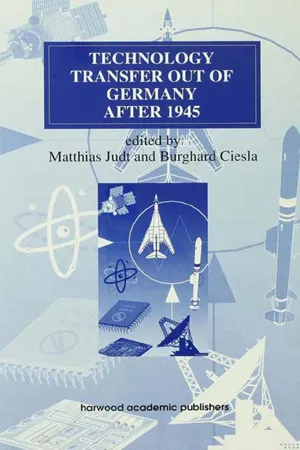
- 169 pages
- English
- ePUB (mobile friendly)
- Available on iOS & Android
eBook - ePub
Technology Transfer out of Germany after 1945
CHAPTER 1
Technology, Reparations, and the Export of Industrial Culture. Problems of the German-American Relationship, 1900–19501
The original impetus to hold this conference came from a book, entitled Science, Technology, and Reparations, Exploitation and Plunder in Postwar Germany, that the distinguished American historian John Gimbel published in 1990.2 This book encouraged a number of younger scholars to explore in greater depth the questions that he had raised. They were also keen to add the Soviet dimension to the picture, now that the relevant archives have become available for the first time.3 All this is meant to indicate that John Gimbel would have been at the center of this colloquium and his contributions to the discussion would have been invaluable. However, as we know, he is no longer with us. He died suddenly and all too prematurely on 16 July 1992 in his hometown of Areata in California, a day after he had returned from Halle in Germany where, supported by a Fulbright grant, he had been researching his next book.
Until his death, John Gimbel, who was born in Hazelton, N.D. in 1922, had had a distinguished academic career, receiving his doctorate from the University of Oregon in 1956 and starting off as an instructor at Luther College, before moving on to take up appointments at such major institutions as the universities of Maryland and Indiana at Bloomington.4 He also taught at two Canadian universities, Alberta and Saskatchewan, and finally settled for a professorship at Humboldt State University in California. He won many awards and distinctions, among them an honorary doctorate from Luther College and the Annual Book Prize of the AHA. He was named outstanding professor at Humboldt State and gained numerous research grants, among them from the ACLS, the NEH, the Rockefeller Foundation, and the Volkswagen-Stiftung. At age 70 and having retired from Humboldt State, he was still amazingly active and his fertile mind, I am sure, would have produced yet another important book. It was not to be. However, even if he was prevented from completing his life's work, he left us with what I would consider a very impressive oeuvre: a large number of articles and no less than four independent monographs, three of which were devoted to the history of Germany under Allied occupation after 1945. He ranks among the foremost experts on this period.
There is, to begin with, his The American Occupation of Germany, published in 1968,5 which I regard as a classic and a pioneering study, an early example of the genre of grass-roots history that would sweep the historical profession a decade later. In this book, John Gimbel demonstrated how the all-too muddled policies of the United States affected the Germans. In looking at their plight, he displays a good deal of sympathy for the latter and hints that the training they were given in developing and running a democratic system was rather poor.
His The Origins of the Marshall Plan, published in 1976,6 looked at the problem of reconstruction from a broader perspective and tried to explain how, with the unfolding of the Cold War, a liberal fear of fascism that had guided American policy in 1944–45 was replaced by a conservative fear of communism. Again, in the light of the proliferation of studies on the Marshall Plan during the 1980s, I think it is important to highlight the path-breaking role of this book.7
There is no doubt in my mind that John Gimbel has made an outstanding contribution to our understanding of what the United States intended to do, and did, in occupied Germany after World War II. He did so with a critical eye, possibly influenced by his first-hand experience as a young officer in postwar Germany. He questioned many of the myths about the politics and economics of the occupation period that had found their way into the autobiographies and memoirs of the major American actors. This is also true of his third monograph, Science, Technology and Reparations. Until he came along, the received wisdom had been that only the Soviets extracted heavy reparations from their zone of occupation. The Western Allies, by contrast, had learned the lesson from the post-1918 period and quickly abandoned the idea of forcing the Germans to make payments in cash and kind.8 John Gimbel pointed to ‘a much more comprehensive and systematic “intellectual reparations” program to exploit German scientific and technical know-how not only for military purposes, but also for the benefit of American science and industry.’9 That he wanted these — as he called them — ‘hidden’ or ‘creeping’ reparations to be taken seriously as a historical problem is indicated by the blunt sub-title of his book: ‘Exploitation and Plunder in Postwar Germany’.
To support his case, the author delved into the records of the US technical intelligence units which appeared in the factories and offices of German enterprises at the end of the war, searching for equipment, patents, lab test material and technical knowledge of potential usefulness to American industry. Although the conference will also deal with the ‘Hunt for Nazi scientists’, John Gimbel's study is more broadly based than Tom Bower's reproachful book on the so-called Paperclip Conspiracy.10 Now, I do not want to go into the details of Science, Technology and Reparations. I am sure it will be referred to many times in the course of this conference, while John Gimbel's oral contributions will be sorely missed.
I had the pleasure of meeting him only once at a conference some four years ago.11 What impressed me most about him on that occasion was his openmind-edness. As I indicated a moment ago, he never shied from going against the grain of received scholarship, and he clearly enjoyed the give-and-take of a good argument among historians. In the light of this, I am sure that he would have approved of my not stopping at this point, after I have celebrated his work and highlighted his achievements. Scholarship is an unending process. There are no final truths in historical writing; there is no definitive study of any topic of importance. We all make a contribution to an on-going debate. Some new findings will stand the test of criticism and time and hence join the increasingly complex pool of knowledge, providing a more sophisticated understanding of the problem at hand. Other arguments will be challenged and modified, if not even completely undermined by subsequent research.
It is in this spirit that I would now like to move a bit beyond Science, Technology and Reparations and raise some further questions that occurred to me as I re-read John Gimbel's work. I would like to suggest a framework within which the debates of this conference might fruitfully be seen. As I say this I see several worried faces, including that of Professor Abelshauser who, as you know, will be speaking about ‘Der alliierte Technologietransfer — nur eine geringe Belastung Westdeutschlands bei seiner Eingliederung in the Weltwirtschaft’. So, let me assure all of you that I am not about to steal anybody's clothes. He and others, I assume, will be concerned with the impact of ‘intellectual reparations’ on the German and American economy. Rather I would like to do two things:
- I would like to look at the pre-history to this conference's theme and examine the German-American technological relationship up to 1945.
- I would like to advance the hypothesis that neither the pre-1945 relationship between the two countries nor what happened afterwards can be understood without conceiving of the role of technology in modern industrial societies in much broader terms than patents and machines.
Let me start off with this latter point and explain what I am thinking about.
Economic historians have, of course, long been interested in the links between economic growth and prosperity, or what some scholars have called ‘economic progress’, on the one hand and technology and technological creativity, on the other.12 I am not reviving here the very old and basic debate concerning the difference between invention and innovation, the argument that the development of a machine by an ingenious individual will be futile unless it is seized upon by a dynamic innovator who applies the new technology and exploits it for commercial purposes.13 Nor do I wish to engage with another controversy relating to the question of whether technological innovation is propelled by demand or induced by supply and capability.
Rather my focus is on the problem of technological diffusion within a particular national economy and, above all, across frontiers from one industrialized country to another. One aspect of this problem is whether in a capitalist economy there is such a thing as a ‘free lunch’. Most economists, as you will know, have argued that there are no ‘free lunches’. Writing on ‘Economic Growth and Technological Progress’ — my topic — Joel Mokyr has recently maintained that ‘economic history is full of examples of free lunches as well as (more frequently) very cheap lunches’, although, he admits, there are also ‘endless instances of very expensive meals that ended up inedible and in some cases lethal’.14 John Gimbel's Science, Technology and Reparations would appear to fall into the former category. His underlying assumption is that, through ‘exploitation and plunder’ (his subtitle) American industry got a free lunch on captured German technology. Without wishing to anticipate the results of this conference, many of you may well feel that John Gimbel was right. But on further deliberation, it began to dawn on me that he may have presented no more than a very special case of limited historical significance.
Now, the first point to be considered here is that the ‘free lunch’ argument has been applied most frequently to the notion of late-comers in the process of industrialization.15 The assumption is that those ‘backward’ countries that were able to import technologies developed elsewhere reaped considerable advantages from their position of lesser development. They avoided the false starts and blind alleys of the technological leader; they saved on developments costs. At a time when Japan is often accused in the US of feasting without charge on American technologies and indeed is suspected of industrial espionage and ‘stealing’, it is well to remember that Jim Slater started his textile mill in Pawtucket, the cradle of the Industrial Revolution in America, with technologies that he had ‘stolen’ from Manchester in England.
Implicit in the notion of late-coming and technological diffusion is therefore the notion that there is a leading country whose superior position within the international economy triggers technological exports, legal or illegal, to more ‘backward’ nations, with the la...
Table of contents
- Cover
- Half Title
- Studies in the History of Science Technology and Medicine
- Full Title
- Copyright
- Contents
- Series Introduction
- Contributors
- Preface
- 1. Technology, Reparations, and the Export of Industrial Culture. Problems of the American–German Relationship, 1900–1950
- 2. Reparations and Intellectual Property
- 3. Exploitation by Integration? The Re-Orientation of the Two German Economies after 1945. The Impact of Scientific and Production Controls
- 4. The Nazification and Denazification of Physics
- 5. Denazifying Scientists and Science
- 6. Assessing the Damages: Forced Technology Transfer and the German Chemical Industry
- 7. German High Velocity Aerodynamics and their Significance for the US Air Force 1945–1952
- 8. Immaterial Reparations and the Reintegration of West Germany into the World Market
- 9. The Return of German “Specialists” from the Soviet Union to the German Democratic Republic: Integration and Impact
- 10. The Politics of Ambiguity: Reparations, Business Relations, Denazification, and the Allied Transfer of Technology
- Index
Trusted by 375,005 students
Access to over 1.5 million titles for a fair monthly price.
Study more efficiently using our study tools.
Frequently asked questions
Yes, you can cancel anytime from the Subscription tab in your account settings on the Perlego website. Your subscription will stay active until the end of your current billing period. Learn how to cancel your subscription
No, books cannot be downloaded as external files, such as PDFs, for use outside of Perlego. However, you can download books within the Perlego app for offline reading on mobile or tablet. Learn how to download books offline
Perlego offers two plans: Essential and Complete
- Essential is ideal for learners and professionals who enjoy exploring a wide range of subjects. Access the Essential Library with 800,000+ trusted titles and best-sellers across business, personal growth, and the humanities. Includes unlimited reading time and Standard Read Aloud voice.
- Complete: Perfect for advanced learners and researchers needing full, unrestricted access. Unlock 1.5M+ books across hundreds of subjects, including academic and specialized titles. The Complete Plan also includes advanced features like Premium Read Aloud and Research Assistant.
We are an online textbook subscription service, where you can get access to an entire online library for less than the price of a single book per month. With over 1.5 million books across 990+ topics, we’ve got you covered! Learn about our mission
Look out for the read-aloud symbol on your next book to see if you can listen to it. The read-aloud tool reads text aloud for you, highlighting the text as it is being read. You can pause it, speed it up and slow it down. Learn more about Read Aloud
Yes! You can use the Perlego app on both iOS and Android devices to read anytime, anywhere — even offline. Perfect for commutes or when you’re on the go.
Please note we cannot support devices running on iOS 13 and Android 7 or earlier. Learn more about using the app
Please note we cannot support devices running on iOS 13 and Android 7 or earlier. Learn more about using the app
Yes, you can access Technology Transfer out of Germany after 1945 by Burghard Ciesla,Matthias Judt in PDF and/or ePUB format, as well as other popular books in Business & Business General. We have over 1.5 million books available in our catalogue for you to explore.