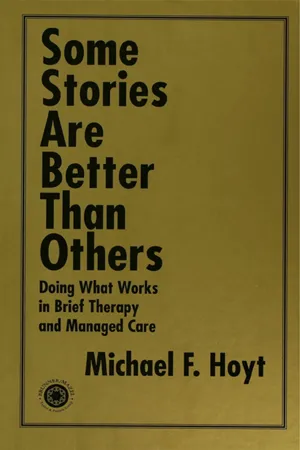
There are stories that we use to explain what happened to us twenty years ago or last wee, those we use to explain why the world works the way it does, and those that we sue to "fix" the world when it doesn't work the way other stories said it should. And as the author points out in this collection of essays and interviews, some of these stories are better than others. This book is an investigation into which might be the better stories and how they can help clients reach their goals in therapy. This book contains fifteen essays and interviews written or co-written by Michael Hoyt. The collection represents Dr. Hoyt's recent thinking on helping clients with the brief, future-orientated therapeutic approaches.
eBook - ePub
Some Stories are Better than Others
Doing What Works in Brief Therapy and Managed Care
- 340 pages
- English
- ePUB (mobile friendly)
- Available on iOS & Android
eBook - ePub
Some Stories are Better than Others
Doing What Works in Brief Therapy and Managed Care
About this book
Information
1
CHAPTER
It’s Not My Therapy—It’s the Client’s Therapy
Macbeth: | Canst thou not minister to a mind diseased, Pluck from the memory a rooted sorrow, Raze out the written troubles of the brain, And with some sweet oblivious antidote Cleanse the stuffed bosom of that perilous stuff Which weighs upon the heart? |
Doctor: | Therein the patient Must minister to himself. |
—William Shakespeare, Macbeth1
(Act V, Scene 3, lines 40–46)
(Act V, Scene 3, lines 40–46)
When I was a graduate student at Yale writing my doctoral dissertation in the mid-1970s, there was a large sign hanging in the medical library that read: “God Heals the Patient and the Doctor Takes the Fee.” (This was before managed care took the doctor’s fee—a recent phone call determined that the sign has since disappeared.) I spent a lot of time looking at those words. While not a theist nor particularly humble, I have come to appreciate more and more that, while a clinician can bring certain skills to bear, the power is in the patient—the client holds the keys. Hence, the title of this chapter, “It’s Not My Therapy—It’s the Client’s Therapy.” As therapists, our primary job is to help clients better help themselves. Our basic strategy should be to ignite their initiative; our basic responsibility is to get them to see and better use their “response-ability.” I like to help people see how they’re putting their story together and how they might do it in a way that gets them more of what they want.
My own development has taken me through many of the major systems of psychotherapy, and I keep going forward and recycling to new things. My current psychotherapy orientation (which continues to evolve) falls under the general theoretical rubrics of brief and narrative constructivist. These terms orient toward the explicit intention to be effective and efficient (“not one more session than necessary”), and toward the recognition that humans are meaning-makers who construct, not simply uncover, their psychological realities. My approach is based on the construction that we are constructive, on an “emergent” clinical epistemology that we are actively building a worldview (a story or narrative) that recursively influences our actions; that is, how we look determines what we see and what we see determines what we do, around and around.
My approach is technically eclectic and pragmatic. As described at length in The Handbook of Constructive Therapies (Hoyt, 1998) and its predecessors, Constructive Therapies, Volumes 1 and 2 (Hoyt, 1994a, 1996b; see also Budman, Hoyt, & Friedman, 1992; Hoyt, 1995a), therapists who draw from some of the specific theoretical models that can be gathered under the constructive therapies umbrella (such as solution-focused, narrative, Ericksonian, some forms of cognitive-behavioral and strategic-interactional, personal construct, even some psychodynamic aspects) especially appreciate the therapeutic possibilities that open when there is an emphasis on the enhancement of choice and the fuller utilization of clients’ competencies and resources.
The goal of constructive therapies is to bring about positive consequences in clients’ lives via attention to the social construction of preferred realities. We help them build—and live—better stories, ones that bring them more of what they prefer. The constructive therapist recognizes that we are looking through “lenses,” that we are “making history” and not just “taking history,” that it is hermeneutics more than engineering and poetics more than physics that are the fields of study which examine the warp and weft of human life. While not ignoring the painfulness of some situations, there is a shift away from pathologizing and toward a more optimistic view of people as unique and resourceful creators—for better or worse—of their own psychological realities.
I should make clear—and I hope help put a tiresome argument to rest—that constructivist approaches, as I understand and practice them, are not license for what Ken Wilbur (1998; see also 1996, pp. 57–68) has called the “postmodern excesses” of “nihilism and narcissism.” While constructivist approaches strongly emphasize the role of language and the idea that “reality” is mediated through awareness (“no knowing without a knower”), such approaches recognize that there is a there there. It is not “anything goes” or “everything is just an opinion.” All the constructivist talk about therapeutic conversations, cocreation, possibilities, belief systems, second-order change, reframing, deconstruction, externalization, preferred views, and the like does not obviate the vital truth that there are a physical universe and a world of social forces, some quite pernicious, that are more than “theoretical constructs” in their impact. Do not confuse social constructionism with hard realities.
The chairman of the symposium where this chapter was first presented asked my fellow panelists and me to limit ourselves to three (and only three) factors that enhance our therapeutic effectiveness. Wow! I thought of moments when I have been at my best with clients, when something particularly “good” happened; I thought of watching my mentors and some of my especially brilliant colleagues; I reviewed some of the literature on “common factors” and “unifying language”; I read and reread some of my copanelists’ excellent writings. I saw the importance of hope and creativity and honesty and empathy and good listening and clear thinking and skillful facilitation. With all this in mind, I call attention to the continuous and more-or-less simultaneous client-therapist cocreation of (1) alliance, (2) evocation of resourcefulness, and (3) achievable therapeutic goals.
The first, alliance, is the soil in which all else may take root. Constructive therapists attend assiduously to forming and maintaining a working relationship, gauging and attempting to match methods with client motivation and readiness (see Horvoth & Greenberg, 1994; Safran & Muran, 1998; Sexton & Whiston, 1994). While we know that we are helpers (or, at least, think that we are), clients may not. Imposition tends to generate opposition. I find such concepts as customer/complaint/visitor and precontemplation/contemplation/planning/action/maintenance useful (de Shazer, 1988; Norcross & Beutler, 1997; see also Chapter 14, this volume). My style tends to be personal and interactive, and somewhat directive and fairly provocative (read: symbolic-experiential). I try to maintain an awareness of the power dynamic and, at times, minimize hierarchy through practices of transparency and self-disclosure. Respectful collaboration is paramount and, when I am being effective, I think my clients have the clear sense that I am working with them.
The second point, evocation of resourcefulness, is closely related. While the therapist may have a lot to say, the client’s voice is genuinely respected. The client is the senior author. I am in search of their solutions, sparkling moments, exceptions, strengths, acquisitional learnings, and the cross-context transfer of their competencies. While not always, I generally have found that the harder I listen, the smarter the client gets. At the same time, it helps to keep a twinkle in one’s eye and to allow my own creativity to bubble.
Which brings me to the third feature, the cocreation of achievable therapeutic goals. What are their preferences? Their intentions? What would tell them that our work is done—and done well? Whose therapy is it, anyway? Negotiating (and, at times, renegotiating) achievable goals is empowering. Emphasizing choice actively involves the client from the beginning: It excites expectations, calls upon the client’s skills, highlights personal autonomy, and sets a template for our continuing client-therapist alliance.
It’s really our therapy. It’s about what can happen when there is connection—when client and therapist step up and are present. Beyond our constructions of three factors, three active ingredients, or three whatchamacallits, we are all in the wonderful business of going into small rooms with unhappy people and trying to talk them out of it. We need to stay in touch with and honor the ideals and purposes that led us into this crazy business: love, passion, compassion, reverence, heart, soul, service, caring, commitment, and so forth. We need to “re-member” (White, 1997) what invigorates us. For me, the magic is in the moment.

1All Shakespeare quotations throughout this volume are drawn from The Riverside Shakespeare (Evans, 1974).
This chapter originally was presented at a symposium (chaired by John C. Norcross), Three Things that Make My Psychotherapy Effective, at the American Psychological Association annual convention in San Francisco, August 1998. The other panelists were Laura S. Brown, Albert Ellis, Florence W. Kaslow, Alvin R. Mahrer, and Hans H. Strupp.
From “It’s Not My Therapy—It’s the Client’s Therapy,” by M. F. Hoyt, Psychotherapy Bulletin, 34(1), pp. 31–33. Copyright 1999. Adapted with permission of the publisher. The American Psychological Association.
2
CHAPTER
A Golfer’s Guide to Brief Therapy (With Footnotes for Baseball Fans)
It’s not what the teacher says, but what
the student hears that matters.
the student hears that matters.
—Harvey Penick (1993), And If You Play Golf,
You’re My Friend: Further Reflections
of a Grown Caddie
You’re My Friend: Further Reflections
of a Grown Caddie
In the name of Jack, Arnie, and the Australian
Shark. Amen.
Shark. Amen.
—Frank & Mike in the Morning (1995),
KNBR AM-Radio, San Francisco
KNBR AM-Radio, San Francisco
While Aristotle said, “The greatest thing by far is to have command of metaphor,” Korzybski (1933) also cautioned that “The map is not the territory.” I recognize that psychotherapy (or life) may not be an adequate symbol to capture the richness of golf (or baseball), but I hope that this chapter will suggest at least a few helpful resemblances. As golfers and ballplayers know, many a useful principle has been revealed on various fields of dreams.
1. When I was a teenager back in the early 1960s, I attended the Los Angeles Open. I followed Arnold Palmer around the course, and actually got to talk with him a number of times. On one hole, he drove deep into the rough. As he surveyed his next shot, there was a big tree and a long way between his ball and the hole. He walked down the fairway to check the location of the distant flag, and then came back. Standing about 10 feet from him, I asked, “Mr. Palmer, where are you going to hit it?” He looked back and forth several times, and then replied, “In the hole.” The ball did not go in on that shot, but it did wind up on the green, and I learned a useful lesson: It’s a long day on the course if you don’t know where the hole is. Have a specific goal and be purposeful on every stroke.
2. “Play it where it lies” is a basic rule (Watson, 1984). This is it, and the craft and art come when one appreciates the wind, the downhill lie, and the bunkers. “Setting up is 90% of shotmaking,” says Jack Nicklaus in Golf My Way (Nicklaus, 1974). He also advises a high tee, since the sky offers less resistance than the ground. The grip is where inner meets outer—where we and the world connect (Pressfield, 1995). This gets at the importance of alliance and utilization, with the key being to meet the client in his or her world and to use whatever is available to achieve therapeutic purpose. Blaming “resistance” is like cursing the ball or throwing your clubs.
3. Another basic rule is to take as few shots as necessary, since the winner is the one who plays the stipulated round (or hole) in the fewest strokes. This requires that we keep score to learn what works, lest the game devolve, as Mark Twain (quoted in Feinstein, 1995) rued, into “a good walk spoiled.” Fortunately, successful single-session therapy (Hoyt, 1995k; Talmon, 1990) is not as uncommon as a hole in one. Making the most of each session—efficiency—defines brief therapy.
4. A related point is to play in a timely manner. Being ready and being decisive are important, since slow play breaks tempo and results in frustrating delays for others who are ready to go forward.1 Although the old joke has it that players who dawdle and take innumerable strokes are “getting their money’s worth,” the truth is that courses with long backups and clinics with long waiting lists are not serving their members well.2 Don’t rush, but don’t tarry, either.
5. The venerable golf instructor Harvey Penick (1993) suggested that one can build a fair game around two or three clubs; and Lee Trevino once counseled the great woman golfer, Nancy Lopez (1979, p. 24), “You can’t argue with success. If you swing badly but still score well and win, don’t change a thing.” Bobby Jones (1960, p. 17) advised, “Learn by playing,” and said that his favorite swing key was “whatever worked best, last” (quoted in Snead, 1989, p. 34). These solution-oriented ideas appreciate existing abilities.3 One should also study and expand skills, of course, instead of simply relying on early training or natural talent. Both passion and discipline are required (Wallach, 1995). As Ben Hogan (quoted in Davis, 1994, p. 68) said, when asked about the role of luck, “The more I practice, the luckier I get.” Brief therapists use strengths and hone skills.
6. “Play the game one shot at a time” is basic advice. As Nancy Lopez (1979, p. 127) said, “If a wasted shot or a poor round keeps gnawing away at your mind and spirit, it’s going to affect your next shot or your next round. If you don’t let it, it won’t.” Sam Snead (Snead, 1989, p. 77) similarly recommended: “The key to concentrating properly is to play in the present tense. Don’t spend all your energies on something that just happened—either good or bad—and avoid thinking about what lies ahead.… I’ve always told people, you can’t do anything about the past, and you’ve got to play your way into the future.”4 The songwriter and ardent amateur golfer Willie Nelson (1998, p. 110) also counsels: “It’s a difficult game to learn. You can’t care too much. If you try too hard, you blow it. There’s too much and too little. That’s a good metaphor for a lot of things.” It is interesting to note that ...
Table of contents
- Cover
- Halftitle
- Title
- Copyright
- Dedication
- Contents
- Preface
- Acknowledgments
- 1 It’s Not My Therapy—It’s the Client’s Therapy
- 2 A Golfer’s Guide to Brief Therapy (With Footnotes for Baseball Fans)
- 3 Some Stories Are Better Than Others: A Postmodern Pastiche
- 4 Likely Future Trends and Attendant Ethical Concerns Regarding Managed Mental Health Care
- 5 Dilemmas of Postmodern Practice Under Managed Care and Some Pragmatics for Increasing the Likelihood of Treatment Authorization
- 6 Interview I: Brief Therapy and Managed Care
- 7 Interview II: Autologue: Reflections on Brief Therapy, Social Constructionism, and Managed Care
- 8 Solution-Focused Couple Therapy: Helping Clients Construct Self-Fulfilling Realities
- 9 Solution-ku
- 10 A Single-Session Therapy Retold: Evolving and Restoried Understandings
- 11 What Can We Learn From Milton Erickson’s Therapeutic Failures?
- 12 Unmuddying the Waters: A “Common Ground” Conference
- 13 The Joy of Narrative: An Exercise for Learning From Our Internalized Clients
- 14 Stage-Appropriate Change-Oriented Brief Therapy Strategies
- 15 The Last Session in Brief Therapy: Why and How to Say “When”
- References
- About the Author
- About the Co-Authors
- Credits
- Index
Trusted by 375,005 students
Access to over 1.5 million titles for a fair monthly price.
Study more efficiently using our study tools.
Frequently asked questions
Yes, you can cancel anytime from the Subscription tab in your account settings on the Perlego website. Your subscription will stay active until the end of your current billing period. Learn how to cancel your subscription
No, books cannot be downloaded as external files, such as PDFs, for use outside of Perlego. However, you can download books within the Perlego app for offline reading on mobile or tablet. Learn how to download books offline
Perlego offers two plans: Essential and Complete
- Essential is ideal for learners and professionals who enjoy exploring a wide range of subjects. Access the Essential Library with 800,000+ trusted titles and best-sellers across business, personal growth, and the humanities. Includes unlimited reading time and Standard Read Aloud voice.
- Complete: Perfect for advanced learners and researchers needing full, unrestricted access. Unlock 1.5M+ books across hundreds of subjects, including academic and specialized titles. The Complete Plan also includes advanced features like Premium Read Aloud and Research Assistant.
We are an online textbook subscription service, where you can get access to an entire online library for less than the price of a single book per month. With over 1.5 million books across 990+ topics, we’ve got you covered! Learn about our mission
Look out for the read-aloud symbol on your next book to see if you can listen to it. The read-aloud tool reads text aloud for you, highlighting the text as it is being read. You can pause it, speed it up and slow it down. Learn more about Read Aloud
Yes! You can use the Perlego app on both iOS and Android devices to read anytime, anywhere — even offline. Perfect for commutes or when you’re on the go.
Please note we cannot support devices running on iOS 13 and Android 7 or earlier. Learn more about using the app
Please note we cannot support devices running on iOS 13 and Android 7 or earlier. Learn more about using the app
Yes, you can access Some Stories are Better than Others by Michael F. Hoyt in PDF and/or ePUB format, as well as other popular books in Psychology & Mental Health in Psychology. We have over 1.5 million books available in our catalogue for you to explore.