- 316 pages
- English
- ePUB (mobile friendly)
- Available on iOS & Android
eBook - ePub
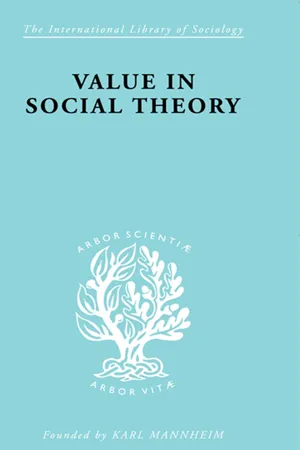
Value in Social Theory
About this book
This is Volume XXI of twenty-two in a series on Social Theory and Methodology. First published in 1958, this is a selection of essays on practical methodology when trying to answer the question of what are the new presuppositions of social thought which can do justice to the changes in social organisation. Mydral attempts to illustrate his repeated attempts to explore the logical, political and moral foundations of social thought and action, as he pursued diverse academic and political activities.
Information

CHAPTER THREE
INTRODUCTION TO THE STUDY THE NEGRO PROBLEM1
1. THE NEGRO PROBLEM AS A MORAL ISSUE
THERE is a ‘Negro problem’ in the United States and most Americans are aware of it, although it assumes varying forms and intensity in different regions of the country and among diverse groups of the American people. Americans have to react to it, politically as citizens and, where there are Negroes present in the community, privately as neighbours.
To the great majority of white Americans the Negro problem has distinctly negative connotations. It suggests something difficult to settle and equally difficult to leave alone. It is embarrassing. It makes for moral uneasiness. The very presence of the Negro in America;2 his fate in that country through slavery, Civil War and Reconstruction; his recent career and his present status; his accommodation; his protest and his aspiration; in fact his entire biological, historical, and social existence as a participant American represent to the ordinary white man in the North as well as in the South an anomaly in the very structure of American society. To many, this takes on the proportion of a menace–biological, economic, social, cultural, and, at times, political. This anxiety may be mingled with a feeling of individual and collective guilt. A few see the problem as a challenge to statesmanship. To all it is a trouble.
These and many other mutually inconsistent attitudes are blended into none too logical a scheme which, in turn, may be quite inconsistent with the wider personal, moral, religious, and civic sentiments and ideas of the Americans. Now and then, even the least sophisticated individual becomes aware of his own confusion and the contradiction in his attitudes. Occasionally he may recognize, even if only for a moment, the incongruity of his state of mind and find it so intolerable that the whole organization of his moral precepts is shaken. But most people, most of the time, suppress such threats to their moral integrity together with all the confusion, the ambiguity, and inconsistency which lurks in the basement of man’s soul. This, however, is rarely accomplished without mental strain. Out of the strain comes a sense of uneasiness and awkwardness which always seems attached to the Negro problem.
The strain is increased in democratic America by the freedom left open—even in the South, to a considerable extent— for the advocates of the Negro, his rights and welfare. All ‘pro- Negro’forces in American society, whether organized or not, and irrespective of their wide differences in both strategy and tactics, sense that this is the situation. They all work on the national conscience. They all seek to fix everybody’s attention on the suppressed moral conflict. No wonder that they are often regarded as public nuisances, or worse—even when they succeed in getting grudging concessions to Negro rights and welfare.
At this point it must be observed that America, relative to all the other branches of Western civilization, is moralistic and ‘moral-conscious’. The ordinary American is the opposite of a cynic. He is on the average more of a believer and a defender of the faith in humanity than the rest of the Occidentals. It is a relatively important matter to him to be true to his own ideals and to carry them out in actual life. We recognize the American, wherever we meet him, as a practical idealist. Compared with members of other nations of Western civilization, the ordinary American is a rationalistic being, and there are close relations between his moralism and his rationalism. Even romanticism, transcendentalism, and mysticism tend to be, in the American culture, rational, pragmatic and optimistic. American civilization early acquired a flavour of enlightenment which has affccted the ordinary American’s whole personality and especially his conception of how ideas and ideals ought to ‘click’. He has never developed that particular brand of tired mysticism and romanticism which finds delight in the inextricable confusion in the order of things and in ineffectually of the human mind. He finds such leanings intellectually perverse.
These generalizations might seem venturesome and questionable to the reflective American himself, who, naturally enough, has his attention directed more on the dissimilarities than on the similarities within his culture. What is common is usually not obvious, and it never becomes striking. But to the stranger it is obvious and even striking. In the social sciences, for instance, the American has, more courageously than anyone else on the globe, started to measure, not only human intelligence, aptitudes, and personality traits, but moral leanings and the ‘goodness’ of communities. He is a rationalist; he wants intellectual order in his moral set-up; he wants to pursue his own inclinations into their hidden haunts; and he is likely to expose himself and his kind in a most undiplomatic manner.
In hasty strokes we are now depicting the essentials of the American ethos. This moralism and rationalism are to many of us—among them the author of this book—the glory of the nation, its youthful strength, perhaps the salvation of mankind. The analysis of this ‘American Creed’ and its implications have an important place in our inquiry. While on the one hand, to such a moralistic and rationalistic being as the ordinary American, the Negro problem and his own confused and contradictory attitudes toward it must be disturbing, on the other hand, the very mass of unsettled problems in his heterogeneous and changing culture, and the inherited liberalistic trust that things will ultimately take care of themselves and get settled in one way or another, enable the ordinary American to live on happily, with recognized contradictions around him and within him, in a kind of bright fatalism which is unmatched in the rest of the Western world. This fatalism also belongs to the national ethos.
The American Negro problem is a problem in the heart of the American. It is there that the interracial tension has its focus. It is there that the decisive struggle goes on. This is the central viewpoint of thistreatise. Though our study includes economic, social, and political race relations, ¿z¿ bottom our problem is the moral dilemma of the American— the conflict between his moral valuations on various levels of consciousness and generality. The ‘American Dilemma’, referred to in the title of this book, is the ever-raging conflict between, on the one hand, the valuations preserved on the general plane which we shall call the ‘American Creed’ where the American thinks, talks, and acts under the influence of high national and Christian precepts, and, on the other hand, the valuations on specific planes of individual and group living, where personal and local interests, economic, social, and sexual jealousies, considerations of community prestige and conformity, group prejudice against particular persons or types of people, and all sorts of miscellaneous wants, impulses and habits dominate his outlook.
The American philosopher John Dewey, whose immense influence is to be explained by his rare gift for projecting faithfully the aspirations and possibilities of the culture he was born into, in the maturity of age and wisdom has written a book on Freedom and Culture, in which he says :
Anything that obscures the fundamentally moral nature of the social problem is harmful, no matter whether it proceeds from the side of physical or of psychological theory. Any doctrine that eliminates or even obscures the function of choice of values and enlistment of desires and emotions in behalf of those chosen weakens personal responsibility for judgment and for action. It thus helps create the attitudes that welcome and support the totalitarian state.3
We shall attempt to follow through Dewey’s conception of what a social problem really is.
2. VALUATIONS AND BELIEFCS
The Negro problem in America would be of a different nature, and, indeed, would be simpler to handle scientifically, if the moral conflict raged only between valuations held by different persons and groups of persons. The essence of the moral situation is, however, that the conflicting valuations are also held by the same person. The moral struggle goes on within people and not only between them. As people’s valuations are conflicting, behaviour normally becomes a moral compromise. There are no homogeneous ‘attitudes’ behind human behaviour but a mesh of struggling inclinations, interests, and ideals, some held conscious and some sup- pressed for long intervals but all active in bending behaviour in their direction.
The unity of a culture consists in the fact that all valuations are mutually shared in some degree. We shall find that even a poor and uneducated white person in some isolated and backward rural region in the Deep South, who is violently prejudiced against the Negro and intent upon depriving him of civic rights and human independence, has also a whole compartment in his valuation sphere housing the entire American Creed of liberty, equality, justice, and fair opportunity for everybody. He is actually also a good Christian and honestly devoted to the ideals of human brotherhood and the Golden Rule. And these more general valuations—more general in the sense that they refer to all human beings—are, to some extent, effective in shaping his behaviour. Indeed, it would be impossible to understand why the Negro does not fare worse in some regions of America if it were not constantly kept in mind that behaviour is the outcome of a compromise between valuations, among which the equalitarian ideal is one. At the other end, there are few liberals, even in New England, who have not a well-furnished compartment of race prejudice, even if it is usually suppressed from conscious attention. Even the American Negroes share in this community of valuations: they have eagerly imbibed the American Creed and the revolutionary Christian teaching of common brotherhood; under closer study, they usually reveal also that they hold something of the majority prejudice against their own kind and its characteristics.
The intensities and proportions in which these conflicting valuations are present vary considerably from one American to another, and within the same individual, from one situation to another. The cultural unity of the nation consists, however, in the fact that most Americans have most valuations in common though they are arranged differently in the sphere of valuations of different individuals and groups and have different intensities. This cultural unity is the indispensable basis for discussion between persons and groups. It is the floor upon which the democratic process goes on.
In America as everywhere else people agree, as an abstract proposition, that the more general valuations—those which refer to man as such and not to any particular group or temporary situation— are morally higher. These valuations are also given the sanction of religion and national legislation. They are incorporated into the American Creed. The other valuations—which refer to various smaller groups of mankind, or to particular occasions— are commonly referred to as ‘irrational’ or ‘prejudiced’, sometimes even by people who express and stress them. They are defended in terms of tradition, expediency, or utility.
Trying to defend their behaviour to others, and primarily to themselves, people will attempt to conceal the conflict between their different valuations of what is desirable and undesirable, right or wrong, by keeping away some valuations from awareness and by focusing attention on others. For the same opportune purpose, people will twist and mutilate their beliefs of what social reality actually is. In our study we encounter whole systems of firmly entrenched popular beliefs concerning the Negro and his relations to the larger society, which are blatantly false and which can only be understood when we remember the opportunistic ad hoc purposes they serve. These ‘popular theories’, because of the rationalizing function they serve, are heavily loaded with emotions. But people also want to be rational. Scientific truth-seeking and education are slowly rectifying the beliefs and thereby also influencing the valuations. In a rationalistic civilization it is not only that the beliefs are shaped by the valuations, but also that the valuations depend upon the beliefs.4
Our task in this inquiry is to ascertain social reality as it is. We shall seek to depict the actual living conditions of the American Negro people and their manifold relations to the larger American society. We must describe, in as much detail as our observations and space here allow, who the American Negro is, and how he fares. Whenever possible, we shall present quantitative indices of his existence and of the material conditions of his existence. But this is not all and, from our point of view, not even the most important part of social reality. We must go further and attempt to discover and dissect the doctrines and ideologies, valuations and beliefs, embedded in the minds of white and Negro Americans. We want to follow through W. I. Thomas’s theme, namely, that when people define situations as real, they are real.5 We shall try to remember throughout our inquiry that material facts in large measure are the product of what people think, feel and believe. The actual conditions, as they are, indicate from this point of view the great disparities between the whites’ and the Negroes’ aspirations and realizations. The interrelations between the material facts and people’s valuations of and beliefs about these facts are precisely what make the Negro a social problem.
It is sometimes assumed to be the mark of ‘sound’ research to disregard the fact that people are moral beings and that they are struggling for their conscience. In our view, this is a bias and a blindness, dangerous to the possibility of enabling scientific study to arrive at true knowledge. Every social study must have its centre in an investigation of people’s conflicting valuations and their opportune beliefs. They are social facts and can be observed by direct and indirect manifestations. We are, of course, also interested in discovering how these inclinations and loyalties came about and what the factors are upon which they rest. We want to keep free, however, at least at the outset, from any preconceived doctrine or theory, whether of the type making biological characteristics, or economic interests, sexual complexes, power relations, or anything else, the ‘ultimate’ or ‘basic’ cause of these valuations. We hope to come out with a type of systematic understanding as eclectic as common sense itself when it is open-minded.
When we thus choose to view the Negro problem as primarily a moral issue, we are in line with popular thinking. It is as a moral issue that this problem presents itself in the daily life of ordinary people; it is as a moral issue that they brood over it in their thoughtful moments. It is in terms of conflicting moral valuations that it is discussed in church and school, in the family circle, in the workshop, on the street corner, as well as in the press, over the radio, in trade union meetings, in the state legislatures, the Congress, and the Supreme Court. The social scientist, in his effort to lay bare concealed truths and to be useful in guiding practical and political action, is prudent when, in the approach to a problem, he sticks as closely as possible to the common man’s ideas and formulations, even though he knows that further investigation will carry him into tracts uncharted in the popular consciousness. There is a pragmatic common sense in people’s ideas about themselves and their worries, which we cannot afford to miss when we start out to explore social reality. Otherwise we are often too easily distracted by our learned arbitrariness and our pet theories, concepts, and hypotheses, not to mention our barbarous terminology, which we generally are tempted to mistake for something more than mere words. Throughout this study we shall constantly take our starting point in the ordinary man’s own ideas, doctrines, theories and mental constructs.
In approaching the Negro problem as primarily a moral issue of conflicting valuations, it is not implied, of course, that ours is the prerogative of pronouncing on a priori grounds which values are ‘right’ and which are ‘wrong’. In fact, such judgments are outside the realm of social science, and will not be attempted in this inquiry. Our investigation will naturally be an analysis of morals and not in morals. In so far as we make our own judgments of value, they will be based on explicitly stated value premises, selected from among those valuations actually observed in the minds of the white and Negro Americans and tested as to their social and political relevance and significance. Our value judgments are thus derived and have no greater validity than the value premises postulated.
3. FURTHER NOTES ON THE SCOPE AND DIRECTION OF THIS STUDY
This book is an analysis, not a description. It presents facts only for the sake of their meaning in the interpretation. Since, however, an attempt at a comprehensive analysis was made, the scope of the facts, even when compressed into...
Table of contents
- Cover
- Half Title
- Fm
- Title
- Copyright
- Content
- Introduction
- Part1
- Part2
- Part3
- Postscripts
- Notes
- Index
Trusted by 375,005 students
Access to over 1.5 million titles for a fair monthly price.
Study more efficiently using our study tools.
Frequently asked questions
Yes, you can cancel anytime from the Subscription tab in your account settings on the Perlego website. Your subscription will stay active until the end of your current billing period. Learn how to cancel your subscription
No, books cannot be downloaded as external files, such as PDFs, for use outside of Perlego. However, you can download books within the Perlego app for offline reading on mobile or tablet. Learn how to download books offline
Perlego offers two plans: Essential and Complete
- Essential is ideal for learners and professionals who enjoy exploring a wide range of subjects. Access the Essential Library with 800,000+ trusted titles and best-sellers across business, personal growth, and the humanities. Includes unlimited reading time and Standard Read Aloud voice.
- Complete: Perfect for advanced learners and researchers needing full, unrestricted access. Unlock 1.5M+ books across hundreds of subjects, including academic and specialized titles. The Complete Plan also includes advanced features like Premium Read Aloud and Research Assistant.
We are an online textbook subscription service, where you can get access to an entire online library for less than the price of a single book per month. With over 1.5 million books across 990+ topics, we’ve got you covered! Learn about our mission
Look out for the read-aloud symbol on your next book to see if you can listen to it. The read-aloud tool reads text aloud for you, highlighting the text as it is being read. You can pause it, speed it up and slow it down. Learn more about Read Aloud
Yes! You can use the Perlego app on both iOS and Android devices to read anytime, anywhere — even offline. Perfect for commutes or when you’re on the go.
Please note we cannot support devices running on iOS 13 and Android 7 or earlier. Learn more about using the app
Please note we cannot support devices running on iOS 13 and Android 7 or earlier. Learn more about using the app
Yes, you can access Value in Social Theory by Paul Streeten in PDF and/or ePUB format, as well as other popular books in Social Sciences & Sociology. We have over 1.5 million books available in our catalogue for you to explore.