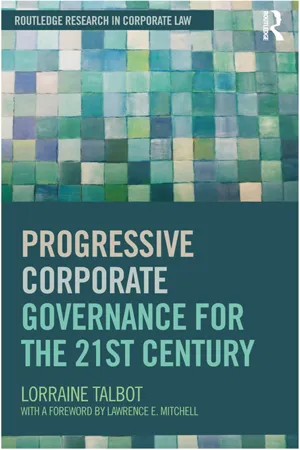
Progressive Corporate Governance for the 21st Century is a wide ranging and ambitious study of why corporate governance is the shape that it is, and how it can be better. The book sets out the emergence of shareholder primacy orientated corporate governance using a study of historical developments in the United Kingdom and the United States. Talbot sees shareholder primacy as a political choice made by governments, not a 'natural' feature of the inevitable market. She describes the periods of progressive corporate governance which governments promoted in the middle of the 20th century using a close examination of the theories of the company which then prevailed. She critically examines the rise of neoliberal theories on the company and corporate governance and argues that they have had a negative and regressive impact on social and economic development. In examining contemporary corporate governance she shows how regulatory styles as informed and described by prevailing regulatory theories, enables neoliberal outcomes. She illustrates how United Kingdom-derived corporate governance codes have informed the corporate governance initiatives of European and global institutions. From this she argues that neoliberalism has re-entered ex command transition economies through those United Kingdom and OECD inspired corporate governance Codes over a decade after the earlier failed and destructive neoliberal prescriptions for transition had been rejected. Throughout, Talbot argues that shareholder primacy has socially regressive outcomes and firmly takes a stand against current initiatives to enhance shareholder voting in such issues as director remuneration. The book concludes with a series of proposals to recalibrate the power between those involved in company activity; shareholders, directors and employees so that the public company can begin to work for the public and not shareholders.
- 240 pages
- English
- ePUB (mobile friendly)
- Available on iOS & Android
eBook - ePub
Progressive Corporate Governance for the 21st Century
About this book
Information
1 Progressive thought and the historical emergence of the company in England 1770-1900
Preamble. On how Adam Smith’s economic and social theories dominated thinking on the economy throughout the late 18th century up until the latter part of the 19th century. How his labour theory of value did not seek progressive normative voice in policy. How instead investor entitlement was promoted. How the judiciary and the government were divided on the issue in the early 19th century. How the Bubble Act encouraged a proliferation of unincorporated associations acting as a vehicle for outside investment and how the judiciary subsequently utilised the Act to stop large unincorporated associations selling freely transferable shares. How parliament responded by repealing the Bubble Act in 1825 and passed a number of Company Acts to accommodate outside investors including the Limited Liability Act 1855 and the Companies Act 1867. How manufacturing businesses eschewed this legislation and continued to operate as partnerships or as quasi-partnership companies that retained large uncalled capital. How overproduction and global competition forced down prices and how British capitalists responded with business mergers to reduce competition. How in so doing they finally embraced the legal structure of the company originally introduced to facilitate investor capitalism and to protect investor capitalists. How the use of the corporate form individualised roles in production as shareholders (with limited liability), directors and workers which obfuscated the underlying dynamics of production and profit and the key role of labour in making profit.
Introduction
From the late 18th century and the work of Adam Smith until the last quarter of the 19th century labour was understood to be the source of value creation and capitalism to be a particular and efficient way of organising and extracting that value. Later in the 19th century an intellectual schism occurred in which the alternative ‘market price’ conceptualisation of the economy, or neoclassical economics came to dominate mainstream thought, relegating labour to a cost of production. The labour theory of value, widely held by economists at the time, originates with Adam Smith and ends with Karl Marx. The economy in which Smith was writing was one which was highly labour intensive; companies were a rarity and unincorporated associations were the most common way to organise business. The economy in which Marx was latterly writing was more industrialised and companies were more frequently utilised. However, although Marx was writing in the context of a more developed market economy than Smith his work anticipates future developments such as the increasing tendency for companies to grow in size and for the role of management to be separated from control.
This period is also characterised by a disjuncture between economic views and normative values. Smith believed labour to be the source of value but did not support labour’s claim to a greater portion of the wealth they created. Indeed, Smith’s chief criticism of slavery was that it was an inefficient way of exploiting labour. Bentham’s The Principles of Morals and Legislation published in 1789 provided an alternative way to view the value of commodities which did not posit labour as the source of value. Despite this, his normative position was more egalitarian and progressive in that he sought to produce social outcomes that created the greatest happiness for all. Mill’s development of Bentham’s approach similarly rejected labour as the source of value but adopted a normative position, which likewise prioritised society’s best interest. At heart, Bentham and Mill focused on the usefulness of production and indeed of social action per se for members of a society. In assessing the value of a commodity they asked: how is this value positively experienced by the individual who buys and enjoys it? With this approach they shifted the focus of value away from the inherent value of embodied labour, to the utility of a commodity as experienced by the individual.
For Bentham the state’s role in reform and the law was properly to calculate how best to increase this positive experience for all individuals. In contrast, for Mill, the role of the state was to facilitate individual liberty so that the individual could choose his own experience and that which may make him happy. So for Mill, the value of a commodity is determined by the preference of the buyer in a free economy where the state’s role was to ensure that freedom. Political liberty, which was the more profound intention of Mill’s work, must necessarily find expression in economic liberty, or freedom from state interference. Mill’s economic liberty found voice in the successful campaign against the Corn Laws and in Cobden’s less successful campaign for national and international free trade. In the context of business organisations, the idea of economic liberty found voice in the government instigated legal reconceptualisation of the company as a private organisation to which the state devolved legal and economic power. Indeed, Mill’s work anticipates the micro-economic theory based on price or neoclassical economics.
Neoclassical economics informs our contemporary understanding of economic behaviour and, by extension, the governance and role of the company. It became the mainstream interpretation of the economy and the company from around the last quarter of the 19th century. And, aside from a short period from the 1930s to the 1970s when institutional economics dominated it has remained so. Labour theory economics fell from mainstream thought on the economy and the company with the success of the neoclassical model. It was never, however, a theory that resulted in privileging labour in the governance of companies because the exploitation of labour was seen as necessary for economic growth. However, by placing labour at the centre of production it is a theory that has potential to provide a humanistic and progressive model. Thus Marx translated the theory of labour value into a normative position which aimed to elevate the position of workers. In this, it correlates with the neoliberal claim of investor entitlement to corporate governance goals based on the assumption that investment creates value.
The purpose of this chapter is to examine the development of company law and corporate governance from the late 18th century to the early 19th century in the context of economic developments and the dominant economic theories of the time. Following this introduction, in the first section I assess the role of the South Sea Company’s collapse in facilitating the rise of private unincorporated associations acting as corporations without the control of a charter. In the second section I examine Smith’s assessment of corporations and his theory that labour was the source of productive value. In the third section I assess the judiciary’s condemnation of unincorporated associations who were acting like corporations. It examines the courts’ use of the Bubble Act to thwart the activities of associations as investment vehicles and parliament’s pro-investor legislative response. In the fourth section I examine the emergence of laissez-faire economics, which was galvanised by the repeal of the Corn Law and henceforth determined company law. In the fifth section I examine the pro-investor legislation passed by the government from 1855–1867 and how company law encapsulated a laissez-faire approach by constructing a legal environment in which all company players from investors to creditors were charged with weighing up their personal risk in dealing with a limited liability company. In the final section the effects of the Great Depression are assessed in order to show that the shift by manufacturing industry from operating as partnerships to operating as large companies was prompted by economic failure. The chapter concludes with an assessment of Marx’s project to reassert labour as the source of value in the context of an increasingly financialised economy.
This period also shows that it is not just all economics — law did matter and did play a crucial part in facilitating investor capitalism, although frequently not before business required it. First, the courts actively protected the ownership claims of shareholders, ensuring the stability of investment. Secondly, successive parliaments passed legislation from the Bubble Act onwards, the purpose being to protect the value of investors’ property and thus ensuring that share ownership by outside investors was credible and desirable. By strengthening the rights of outsider investors per se, the law limited the ability of corporate insiders to raid corporate assets. The law throughout the 19th century enabled a market in shares, often in advance of the demands of industrial capitalists. It is the purpose of this chapter therefore to show that the investor orientated corporate governance that we have today arises from a combination of economic failure and political choice frequently expressed in law.
How both unincorporated and incorporated associations were called ‘companies’ and were treated similarly in law. How they differed in that incorporated companies (charter companies) were closely connected to the state and how this connection was exploited by the South Sea Company and led to the long term prohibitions held in the Bubble Act
The rudimentary beginnings of company law posited on the legal construction of a body corporate can be traced to the 18th century. Before that time, whilst the process of becoming incorporated entailed distinct legal mechanisms, being incorporated did not in law designate a business that was particularly distinct from an unincorporated association.1 Incorporation was achieved through the grant of a charter by the crown2 or, after the Civil War, by an Act of parliament.3 Statutes were also used to extend the powers of the royal prerogative so that they could grant charters with enhanced privileges.4 Unincorporated associations, in contrast, were formed through differing levels of informal understandings. However, in terms of their post-formation characteristics, there were no significant differences between the two forms. They were legally conceived as organisations of members with ownership claims in the business and they were both known as companies.
Furthermore, there was a great deal of cross-fertilisation between the two, so that unincorporated associations frequently existed within incorporated ones. When the East India Company was incorporated in 1600 its membership was a mix of sole traders and partnerships investing in joint stock with joint liability which terminated upon the completion of a particular voyage.5 By 1652, permanent joint stock (which bound the owner to the profits and liabilities of the stock until the company ceased to exist), was introduced, but this coexisted with private trading until 1692, when the latter practice was discontinued.6 During this period the incorporated body had an identity,7 namely the East India Company, but this acted as an umbrella for a number of different commercial arrangements between persons. Thus, unlike the modern company, it really did exist as a nexus of contracts.8
The lack of significant distinction between unincorporated companies and incorporated companies came to an end with the passage of the Bubble Act 17209 and the activities of the South Sea Company. In April 1720 the government approved the South Sea Company’s plan to reduce government debt.10 The company’s plan consisted of a scheme to buy government debt by persuading the hol...
Table of contents
- Cover
- Title
- Copyright
- Contents
- Table of cases
- Table of statutes
- Corporate governance codes
- Acknowledgements
- Foreword
- Introduction: progressive corporate governance: what it is and what it isn't
- 1 Progressive thought and the historical emergence of the company in England 1770-1900
- 2 Corporate governance in the United Kingdom in the 20th century: including a period of progressive governance
- 3 The United States and progressive governance: the historical development of the American corporation 1790-1944
- 4 The managerialists' progressive corporation and the rise of neoliberal corporate governance
- 5 The retreat from progress: modern corporate governance, substance and form
- 6 The march to anti-progressiveness: neoliberalism and transition economies
- And in conclusion: towards a progressive corporate governance
- Author index
- General index
Trusted by 375,005 students
Access to over 1.5 million titles for a fair monthly price.
Study more efficiently using our study tools.
Frequently asked questions
Yes, you can cancel anytime from the Subscription tab in your account settings on the Perlego website. Your subscription will stay active until the end of your current billing period. Learn how to cancel your subscription
No, books cannot be downloaded as external files, such as PDFs, for use outside of Perlego. However, you can download books within the Perlego app for offline reading on mobile or tablet. Learn how to download books offline
Perlego offers two plans: Essential and Complete
- Essential is ideal for learners and professionals who enjoy exploring a wide range of subjects. Access the Essential Library with 800,000+ trusted titles and best-sellers across business, personal growth, and the humanities. Includes unlimited reading time and Standard Read Aloud voice.
- Complete: Perfect for advanced learners and researchers needing full, unrestricted access. Unlock 1.5M+ books across hundreds of subjects, including academic and specialized titles. The Complete Plan also includes advanced features like Premium Read Aloud and Research Assistant.
We are an online textbook subscription service, where you can get access to an entire online library for less than the price of a single book per month. With over 1.5 million books across 990+ topics, we’ve got you covered! Learn about our mission
Look out for the read-aloud symbol on your next book to see if you can listen to it. The read-aloud tool reads text aloud for you, highlighting the text as it is being read. You can pause it, speed it up and slow it down. Learn more about Read Aloud
Yes! You can use the Perlego app on both iOS and Android devices to read anytime, anywhere — even offline. Perfect for commutes or when you’re on the go.
Please note we cannot support devices running on iOS 13 and Android 7 or earlier. Learn more about using the app
Please note we cannot support devices running on iOS 13 and Android 7 or earlier. Learn more about using the app
Yes, you can access Progressive Corporate Governance for the 21st Century by Lorraine Talbot in PDF and/or ePUB format, as well as other popular books in Droit & Droit des affaires. We have over 1.5 million books available in our catalogue for you to explore.