eBook - ePub
Children's Literature
Developing Good Readers
- 204 pages
- English
- ePUB (mobile friendly)
- Available on iOS & Android
eBook - ePub
About this book
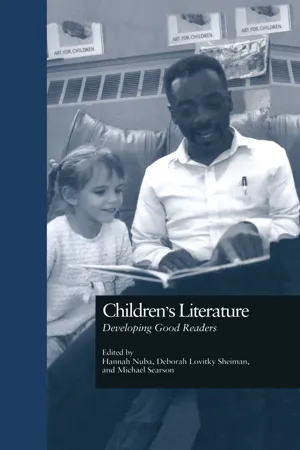
This chronological guide to the developmental stages, and corresponding literary needs and preferences, of early childhood is hte unique result of combinging the expertise of educational professionals with that of a children's librarian. Each chapter describes a developmental stage of childhood and presents appropriate books for that reading level, providing expert guidance in today's crowded children's book market.
Information
Part I
The History and Definition of Children’s Literature
Chapter One
A Brief History of Children’s Literature
In the 1980s the U.S. government set out to prove what most teachers and many parents had suspected, the importance of reading to children. U.S. Department of Education researchers explored what parents of academically successful children do that sets these children apart from their less able peers. Using sophisticated research methods, they found that what works is the most basic of enrichment techniques, reading to children (U.S. Department of Education 1987). Extensive research has revealed that it does not matter whether a family is wealthy or poor; if parents read to their children regularly, starting at an early age, the children benefit from the academic enhancement for years to come. Educators have long contended that parents who foster reading encourage and enhance their children’s education. In essence, reading to a child will inspire a child to read.
This commonsense approach to learning success is not new. Before the formal advocacy of early education, Comenius believed that language provided the foundation for all later learning. To further his theory he designed books especially for children. These books appeared in the beginning of the 1600s and are among the earliest specifically made for young people. Johann Pestalozzi, Friedrich Froebel, Maria Montessori, and John Dewey all stressed the importance of reading to children and children’s reading. In the United States alone, early children’s reading materials ranged from the Bible to adult literature suitable for the young.
Further investigation into the historical and philosophical roots of children’s literature has shown that the arrival of printing presses fostered opportunities for children’s learning. Printing presses made children’s books less expensive. Early primers called hornbooks appeared. These early children’s books were usually religious in nature, but secular instruction books that taught the alphabet and hygiene were also common.
The rise of Puritanism in the United States influenced the number of books available for young people. Under the Puritan doctrine children were considered miniature adults in need of salvation. As writings became a means to rescue children from sin, the numbers of books appropriate for children expanded. Instructional volumes customarily contained religious messages and illustrations. Morality, religious obligations, and reverence for God were at the heart of Puritan children’s literature. Nonreligious reading materials were thought to be frivolous and the work of the devil.
By the end of the seventeenth century the tide of somber religious writings began to change. Books still familiar today, such as Mother Goose (Anderson 1873) and Little Red Riding Hood (Perrault 1821) became popular. Chapbooks, the forerunner of contemporary comic books, suited the tastes of the young in the late 1600s. These crudely illustrated and printed action adventure stories delighted children and disturbed adults. Nevertheless, they were as much a childhood favorite of this era as they are today.
In the eighteenth century, writings for children reflected changing perspectives. Children were no longer believed to be miniature adults but to be developing youngsters in need of adult attention and nurturing. Religious instruction ceased to be the primary aim of children’s literature. New views on children’s maturation promoted books that stimulated the child’s sense of fantasy and imagination. Books originally intended for adult audiences trickled down to children.
Literature as entertainment quickly replaced literature as religious instruction. The first major publisher to realize the potential of the children’s book category was John Newbery. One of the most notable prizes in children’s literature was ultimately named after him—the Newbery Book Awards are still coveted today. Following Newbery’s lead, publishing houses opened in major cities such as Boston, New York, and Philadelphia. The number of books intended for the child audience swelled as America entered the golden age of children’s literature, the nineteenth century.
The Victorian age of the nineteenth century promoted literature as an amusement and diversion from work, study, or responsibility. Authors of children’s literature became famous, and their work is still cherished by children today. The books of Louis Carroll, Kate Greenaway, and Robert Louis Stevenson were and still are outstanding. The fairy tales and folklore of Hans Christian Andersen and the Grimm brothers aroused the child’s imagination, while Horatio Alger stories spiritually motivated older children to work hard and succeed. Adventures like Treasure Island (Stevenson 1883) and Alice in Wonderland (Carroll 1866) filled the pages of children’s books. The introduction of science fiction brought such immortal titles as Twenty Thousand Leagues under the Sea (Verne 1870). Stories of life in distant countries—like Heidi (Spyri 1880) and Little Lord Fauntleroy (Burnett 1886)—opened up new worlds to children living in rural and urban America.
Similarly during this period, illustration in children’s literature took on importance. Contemporary thought suggests that children’s books, especially those written for the very young, are not complete without a visual component. However, illustrated children’s books did not become the norm until Randolph Caldecott delighted audiences with his carefree drawings. Today the Caldecott Medal for illustration in children’s literature is a revered prize. Even the children’s magazine market rocketed in this new era. Publications such as the Youth’s Companion and The Riverside Magazine, both now defunct, provided hours of enjoyable activity with crossword puzzles, stories, and helpful articles.
The innovations in children’s literature of the 1800s carried into the twentieth century. Many of the same trends continued and flourished and matured. Library departments developed solely to provide suitable reading materials for the young. A new specialist, the children’s librarian, came into existence. Children’s literary criticism emerged in 1924 with The Horn Book Magazine, published in Boston, which continues today. Similarly during this time, publishing houses hired editors whose sole focus was children’s literature.
Wide distribution of inexpensive books helped to establish the popularity of reading. From drugstore racks to grocery store shelves, parents treated their youngsters to the favorably priced and still published Golden Book series. Golden Book subjects ranged from fairy tales to stories about counting elves. For years they have been a source of colorful and well-illustrated reading for the very young. Other ries such as the Bobbsey Twins (Hope 1921), the Hardy Boys (Dixon 1923), and Nancy Drew (Keene 1930) provided pleasurable reading material for school-age boys and girls. Today it is hard to find an American child who has not encountered The Berenstain Bears (Berenstain and Berenstain 1964), The Sesame Street Book (Children’s Television Workshop 1970), or Where’s Waldo? (Handford 1987). From the sensational stories of pulp fiction to the fantasies of Dr. Seuss, children in the twentieth century have become independent consumers of literature.
The success of children’s books has created an industry in itself. In the United States alone, it accounts for over a billion dollars a year. The writing, publishing, and distribution of books appropriate for all children have been helped by groups such as the Council on Interracial Books for Children, the American Library Association, and the Children’s Book Council. These organizations have worked to see that there are adequate books available that appeal and relate to the needs of all children in this country. Fictional and nonfictional books celebrate the lives and cultures of diverse peoples. Today, books written about and illustrating minorities are an accepted part of mainstream publishing and reading.
As the twentieth century ends, a second golden age in children’s literature has emerged. New categories of children’s books abound. From the oversized picture book to the toy book to informational nonfiction series, there are innumerable volumes available to meet the needs and pleasures of all children. Children’s literature is an exciting and rewarding aspect of the spectrum of lifetime reading.
The Importance of Children’s Literature
Children’s literature is a powerful form of communication. Children, like adults, relate to books that give both meaning to their lives and understanding to their daily predicaments. Children eagerly seek out what helps them understand their world, and a good book can do just that.
Each book that a child experiences is an account of an event, whether real or fictional. This event is the veneer. It supplies a medium for the idea behind the story. For example, the story might be about a child’s bedtime ritual of being tucked in by his mother, who never leaves the room without first turning on a small light. The message behind this tale is that it is acceptable to be afraid of the dark. Ideas underlying a story can send powerful emotional messages to children who lack the practice and verbal acumen to describe and evaluate their daily experiences.
The messages within a story help children interpret the complicated world as they grow up. Consolidating the messages of a book can provide a child with a fundamental abstract principle or insight that is important both to the story and to life in general. Insight helps children to explore their feelings. In the fear-of-the-dark example used earlier, a child can interpret the principle underlying the story to mean that other children, too, are frightened. The child then comes to understand that it is normal to be afraid of the dark and that he or she will eventually conquer the fear.
The events of a young child’s life are analogous to those of a well-written story. Each new event is wonderful and magical or scary and puzzling. Literature offers children the opportunity to rehearse and to relate to the past, present, and future. Whether through the literal interpretation of the story, through the message behind the story, or through the meaning and insight derived from the story, children gain valuable experience interpreting the complex emotions at the foundations of their personal worlds.
Children and adults absorb literature in significantly different ways. Message and meaning may be less conscious for a child who has yet to experience the array of situations that an adult has encountered. Abstractions are still to be formed in the child’s mind. Experiences are viewed from a concrete perspective. Occasionally the message and meaning of a story will rest in the back of a child’s mind until eventually a new situation brings them to the surface. It is then that the child’s own emotional needs match the message and become valuable in bringing meaning to a puzzling dilemma. For this reason an adult frequently finds a moral message in a story, whereas a child interprets the same story literally.
Children react to literature with all the passion of uninhibited emotion. Books are powerful tools in bringing out joy, hate, anger, fear, happiness, envy, love, sorrow, and enthusiasm. A good book can expand a child’s horizons, or limit their focus to a single important event or feeling. It can deepen their understanding of others or single out their sensitivities. A good book provides a child the opportunity to relate to a situation, express what they think and feel, and open a new window to the world in which they live. Part of what makes good children’s literature so worthwhile is the gentle sensitivity with which it introduces children to the essence of life.
The Importance of Reading to Children
It is hard to doubt the value of a good book. However, few of us ever really contemplate the significance of reading to children. What may appear on the surface to be twenty minutes of retelling someone else’s tale can have an effect on a child. Repeating this seemingly unimportant process many times over can have a lifelong impact.
Children are never too young to be read to, nor can nonreaders ever be read to too often. Sharing a book with a young child helps to develop not only literacy and vocabulary, but also an understanding of people and things. Additionally, the bonding that develops between the child and the reader can deepen knowledge, respect, love, and understanding. Since the benefits of reading to a child are so numerous, the following paragraphs will more carefully consider the relationship between reading and literacy development, and reading and emotional development.
Reading and Literacy Development
Literacy problems are besieging our country. The question of why Johnny can’t read can be easily answered—Johnny’s parents probably never read to him. Young children who are frequently read to seem to grasp the intricacies of reading sooner and comprehend more than children whose caregivers do not read to them. From the cradle to the grave, exposure to books creates a literate and informed person who enjoys and appreciates books.
Similarly, children who enjoy reading and who read often seem to be more successful in language development. Inherent in the process of reading is the learning experience. Repeatedly sharing a book creates exposure to words, and children learn the meaning of words by hearing them in the context of a story. Illustrated books, through visual aid, help further the child’s understanding of what he or she hears when being read to.
Books provide opportunities to use words that are not used in everyday conversation. An example is Richard Scarry’s illustrated edition of Mother Goose containing the familiar nursery rhyme “Little Miss Muffet” (Scarry 1988):
Little Miss Muffet
Sat on a tuffet
eating her curds and whey.
There came a big spider
who sat down beside her
and frightened Miss Muffet away.
Rare is the child who has not been exposed to that nursery rhyme. Rarer yet is the adult who commonly uses words like curds and whey in daily conversation. Literature opens the door to vocabulary that is not commonly used but which is easily understood through pictures and context.
Children listen and learn. Hearing groups of words together reinforces the idea of structure in our language. Words together make up sentences. How those words sound to the child suggest whether the sentence is asking a question or exclaiming a statement. What seems so apparent to the adult has yet to be learned by a young child. The easiest way for a child to learn is by hearing the words. The more words that children hear, the more they are able to decipher the finer meanings of their language.
Notwithstanding the child’s perception of language experience as a whole, the brain becomes sensitive to how the words sound and are put together. The child develops a sense of syntax; nuances of speech, diction, and tone are more easily perceived from hearing the language and seeing the printed word and illustrations. Books designed specifically for very young children are written to facilitate this learning experience. The words used in a book attract children with their rhythm, repetition, and lilt. This inspires children to ask questions about and to comment on what they have heard, which clarifies and reinforces the message of the book. American poet of humor and verse Ogden Nash embodied this tradition in his delightful children’s book, illustrated by Maurice Sendak, You Can’t Get There from Here (1957). Whether stimulating a child’s imagination with mental images of monsters and fairy godmothers, or broadening a child’s horizons with reflections of people and customs from a far off place or time, books facilitate the child’s language and cognitive development.
Reading and Emotional Development
Emotional development is nurtured by two people reading a book together. The cozy setting of a young child sitting on the lap of a caregiver creates a feeling of personal caring and responsiveness. Children learn to associate this enjoyment with reading. Gaining the...
Table of contents
- Cover
- Half Title
- Title Page
- Copyright Page
- Table of Contents
- Preface
- Part I: The History and Definition of Children’s Literature
- Part II: Voices of an Illustrator and a Writer
- Part III: Developing Good Readers
- Part IV: Resources for Children’s Literature
- Contributors
Trusted by 375,005 students
Access to over 1.5 million titles for a fair monthly price.
Study more efficiently using our study tools.
Frequently asked questions
Yes, you can cancel anytime from the Subscription tab in your account settings on the Perlego website. Your subscription will stay active until the end of your current billing period. Learn how to cancel your subscription
No, books cannot be downloaded as external files, such as PDFs, for use outside of Perlego. However, you can download books within the Perlego app for offline reading on mobile or tablet. Learn how to download books offline
Perlego offers two plans: Essential and Complete
- Essential is ideal for learners and professionals who enjoy exploring a wide range of subjects. Access the Essential Library with 800,000+ trusted titles and best-sellers across business, personal growth, and the humanities. Includes unlimited reading time and Standard Read Aloud voice.
- Complete: Perfect for advanced learners and researchers needing full, unrestricted access. Unlock 1.5M+ books across hundreds of subjects, including academic and specialized titles. The Complete Plan also includes advanced features like Premium Read Aloud and Research Assistant.
We are an online textbook subscription service, where you can get access to an entire online library for less than the price of a single book per month. With over 1.5 million books across 990+ topics, we’ve got you covered! Learn about our mission
Look out for the read-aloud symbol on your next book to see if you can listen to it. The read-aloud tool reads text aloud for you, highlighting the text as it is being read. You can pause it, speed it up and slow it down. Learn more about Read Aloud
Yes! You can use the Perlego app on both iOS and Android devices to read anytime, anywhere — even offline. Perfect for commutes or when you’re on the go.
Please note we cannot support devices running on iOS 13 and Android 7 or earlier. Learn more about using the app
Please note we cannot support devices running on iOS 13 and Android 7 or earlier. Learn more about using the app
Yes, you can access Children's Literature by Hannah Nuba,Michael Searson,Deborah Lovitky Sheiman in PDF and/or ePUB format, as well as other popular books in Education & Education General. We have over 1.5 million books available in our catalogue for you to explore.