![]()
Bruce Prideaux and Dallen J. Timothy
Cultural and Heritage Tourism in Asia and the Pacific is the result of lengthy discussions between the editors and colleagues in many countries and is based partially on a double special issue of the Asia Pacific Journal of Tourism Research. The call for papers for the special issue generated such a large response in submissions that two issues of the Journal (Vol. 9(3), Heritage in the Asia Pacific and Vol. 9(4), Cultural Tourism in the Asia Pacific) were required to publish some of the papers submitted. There were still a number of excellent papers remaining, and given that there is an ongoing debate occurring on many of the issues raised, the editors decided to publish the collection of papers from the special issue with a number of new chapters as a book. We believe that collectively the contributions provide a benchmark of current scholarly research into the main issues of heritage and culture in the Asia Pacific Region. While we acknowledge that the collection of chapters is not a definitive statement of the breath of research currently underway, it does provide a useful summary and highlights the ongoing nature of the issues that are the subject of scholarly debate.
The overall aim of the book is to create a collection of work that both enhances current understanding and provides a guide to future research. In developing this book the editors were mindful of the need to include chapters by scholars within the region, as well as those who observe from afar, to provide a range of contrasting perspectives. This introductory chapter outlines the structure of the book before undertaking a review of some of the many issues raised by contributing authors.
The Structure of the Book
Cultural and Heritage Tourism in Asia and the Pacific is organized into four parts that collectively contain 22 chapters. The book is organized in a format that introduces readers to many of the key questions, such as authenticity, before challenging them to consider how authenticity can be retained in the face of the demands of the tourism industry to manage and market cultural heritage. The first part of the book, Authenticity: The Search for the Real, consists of seven chapters that examine a range of issues that encompass the debate surrounding the meaning of authenticity and how this can be achieved in a changing world. The issues canvassed in this part of the book influence the structure of cultural heritage tourism and include themes that are examined in greater detail in this chapter.
In the second part of the book the impacts of tourism on heritage and culture are examined in five chapters. It is apparent that many of the issues surrounding the debate on retaining authenticity are dependent on the degree to which the contemporary world is changing and how that change affects traditional expressions of culture and uses of place. Even traditional music undergoes change when it is played by traditional instruments but in non-traditional settings, such as hotels and cultural centres. Similarly, the use of places that have strong heritage values is often contested, as new uses seek to supplant or replace traditional ones.
In Part 3, Planning, Managing and Enterprise, five chapters consider issues relating to managing cultural and heritage assets, as well as their planning, and for many organisations involved in bringing culture and heritage to the tourism industry their ability to engage in the establishment and running of successful sustainable businesses. Issues raised in this part of the book have strong links back to the issues raised about authenticity in Part 1, as well as the impacts that cultural exhibitionism may have on culture and heritage as noted in Part 2.
The book's final section deals with issues of marketing. In a competitive world where many attractions seek to maximize their returns from tourism dollars, marketing has become a key activity that organizations must understand and successfully engage in. Marketing in this sense includes promotion and engaging with the distribution system to maximize exposure to potential clients in market regions. The book concludes with a summary and synthesis of the major issues relating to heritage and culture, as well as the identification of some priorities for future research in this challenging area of tourism research.
The Significance of Heritage and Culture
In tourism settings, heritage and culture may be used for a variety of purposes, including entertainment, preservation, information, education, profit and propaganda. For the society whose culture and heritage is the object of presentation to visitors, the themes may be ordinary and familiar, but to visitors these same themes may be unique, exotic and extraordinary, and characterized by differentness from the visitors' own normal environment. Heritage and culture therefore serve a variety of purposes, and the study of these purposes is important both from the perspective of providing a focus for guests to learn about the hosts' culture and for the hosts as a means of preserving and sharing their unique past and way of life with others. In recent decades, as the pace of tourism has increased, heritage has become an important selling point, but it is often sold to buyers who have little real interest in, or concern for, the meaning of the culture they are gazing upon. This book examines a range of issues that impact on the use of heritage and culture by the tourism industry in the Asia Pacific region. This chapter introduces a new
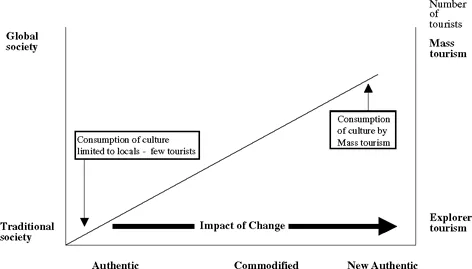
Figure 1 Impact on Culture as Tourism Moves from Small Scale to Mass Scale.
explanatory model that may be used to examine how culture is affected by tourism. Issues discussed in this chapter include authenticity, interpretation, heritage contestation, social exclusion, contested space, personal heritage, control and preservation. The heritage model, illustrated in Figure 1, may be used to classify heritage destinations and visitors using a spectrum that commences with the authentic and then plots the evolution of the authentic through commodification and ultimately the metamorphosis of the authentic into a new authenticity.
The breadth and depth of cultural heritage issues that communities in the Asia Pacific are involved with is enormous, evolving, and in some cases controversial. In many instances even the meaning of heritage and culture is disputed. In recent decades a substantial literature on heritage and cultural issues has emerged, paralleling the growth in recognition of the place that heritage and culture now hold in the tourism industry. The study region has an enormous variety of people who express themselves through their culture and reflect on their patrimony through both cultural expressions and preservation of relics of the past. The ensuing complex mosaic of cultural expressions has provided the tourism industry with a rich well of experiences on which to draw as an increasing number of countries, and regions within countries, recognize the potential of the tourism industry to create employment and wealth.
Tourism is, however, only one of many actors on the stage of national economic, social and cultural development. Tourism works best when uniqueness becomes a point of differentiation from competitors and creates an experience that is marketable because it is not easily substitutable by other places and events. Thus, for the tourism industry, heritage and culture must exhibit uniqueness and marketability; yet culture is rarely static, and the symbols of heritage may be needed for other more contemporary uses, creating tensions that must be resolved. Culture is a living expression of a way of life and people's relationships with each other, the environment in which they live, the religious expressions which give meaning to their life, and manners in which they cope with the forces of nature and politics.
Globalisation and its associated demands for modernisation offer many improvements in material welfare and health but often at the expense of traditional forms of economic organization and lifestyle. The process of globalization demands change and creates a tendency towards uniformity rather than diversity. Culture is often one of the victims of progress, and the rhythm of daily life that for millennia was determined by the demands of seasons must now change and be determined by a new rhythm created through membership in the global economy. As people migrate from the country to the city the need for harvest festivals and other symbols of rural life are replaced with more impersonal, globalised festivals. Thus, the impersonal experience of watching the soccer World Cup on a television set in one's lounge room has replaced the far more personal experience of participating in a harvest festival with one's neighbours. For these reasons culture is rarely static, as it responds by adapting to the many social, economic and political changes that shape and then reshape society. At which point in time a culture should be frozen to be packaged and exhibited to tourists is therefore an important question that will ultimately be decided by the major stakeholders and the level of demand by tourists for specific cultural experiences.
The dilemma facing communities attempting to attract visitors through their cultural uniqueness is that the changing nature of life is creating uniformity between diverse peoples on a global scale; however, the retention of uniqueness requires participation in traditional experiences that no longer reflect contemporary society. The arguments about authenticity thus take on new meanings because the present is often vastly different from the past. Tourism interest usually focuses on uniqueness, which was apparent in the past but which has been lost to the increasing uniformity of the present. Commodification thus becomes a necessity, and in the process authenticity is typically lost.
Against this background of cultural change communities must seek to build images and attractions that rely on cultural heritage and other elements of tourism interest to fashion a tourism experience. To model this process of change and provide a tool that can be used to measure change to culture quantitatively, Figure 1 illustrates how traditional culture, identified as authentic, undergoes a process of commodification as culture is adapted for exhibition to an increasingly mass tourism market. The left hand vertical axis represents the shift from traditional to global society while the horizontal axis measures change in consumption of culture from traditional forms of cultural expression that can be described as authentic to commodified forms of expression that appeal to mass markets. The curve illustrates the change in the consumptive pattern of culture. In its original form, where culture represented traditional values, tourism interest was low and confined to those who sort out unique cultures in their authentic form. As tourism grows the authentic undergoes change via a process of commodification to reach a new authenticity that represents the new form of cultural expression that is acceptable to the tourist and also fits into the newly globalised form of culture that the local community has adopted.
The patterns described here can be illustrated by examining cultural change in Bali. Traditional forms of dance such as the Legong and Sanghyang trance dances were central to village culture in the period before modernization and mass tourism. At that time tourists were able to view these dances but no allowances were made for the benefit of the tourist spectator. With modernization and the introduction of new entertainment media such as radio, motion film and television, the place once held by traditional forms of dance changed. Simultaneously, tourist interest in these forms of dance has increased with the presentations requiring considerable modification to fit the demands of tourism. Commodification occurred and the dance in a sense metamorphosed from a traditional form to a new tourist focused form.
As tourism reaches into more distant areas, bringing with it change and in some respects being changed, it is important for researchers, policy makers and the tourism industry to recognize the impacts that are occurring, to be conversant with strategies to manage change and to be sensitive to the needs of destination communities (Singh et al., 2003). This chapter explores some of these issues.
Several authors (e.g. Carter in this volume; Prideaux, 2003) have reported on aspects of the use and adaptation of national and regional heritage and culture in the Asia Pacific region. Carter for example models the impact of tourism as an agent for social and cultural change, noting that many communities face the temptation to trade cultural expression for the economic benefits that tourism can provide. The adaptation and elevation of elements of culture as marketing icons is one example of this trend. In Australia, Aboriginal dances and the didgeridoo, the Aborigines' unique musical instrument, have been largely removed from their tribal settings and promoted as an iconic expression but specifically packaged to meet the needs of the tourism industry. Conversely, cultures must adapt if they are to survive (Harrison, 1996), and to do otherwise may ultimately lead to extinction. In these and other ways discussed later in this chapter, national cultures and heritage are under pressure from the tourism industry. Some face the danger of trivialization and exploitation while others have responded by changing to meet the demands of the contemporary world. Without some form of education, tourists exposed to packaged culture and heritage experiences may return to their homes with little knowledge of the significance of the sites visited or of the cultures experienced.
Management of heritage and cultural sites has become an important issue in many nations as stakeholders have become aware of the difficulties of managing the preservation and development of sites while accommodating visitor needs and the interests of hosts (Vogt et al., this volume). Other issues that may occupy the attention of stakeholders include conflicting land uses, funding, ownership, interpretation and exhibition arrangements. Rejuvination and the need to build sustainable tourism industries are other issues that have received attention (Dredge and Carter in their respective chapters). Carter, for example, argues that a shift in tourism planning is required from outcome-focused to process-orientated where there is greater consideration between the market, product and destination community. The following discussion canvasses a range of issues that require extensive debate within destination communities, as well as in the commercial organizations that profit from these experiences and places.
Current Trends in Heritage Tourism
Authenticity
Despite its widespread popularity as a topic of debate in heritage tourism studies, authenticity is an elus...