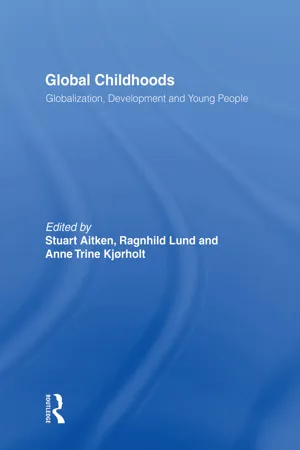
This astute book initiates a broad discussion from a variety of different disciplines about how we place children nationally, globally and within development discourses. Unlike other books of its kind, it does not seek to dwell solely on the abiding complexities of local comparisons. Rather, it elaborates larger concerns about the changing nature of childhood, young people's experiences, their citizenship and the embodiment of their political identities as they are embedded in the processes of national development and globalization. In particular, this book concentrates on three main issues: nation building and developing children, child participation and activism in the context of development, and globalization and children's live in the context of what has been called "the end of development." These are relatively broad research perspectives that find focus in what the authors term "reproducing and developing children" as a key issue of national and global concern. They further argue that understanding children and reproduction is key to understanding globalization.
- 200 pages
- English
- ePUB (mobile friendly)
- Available on iOS & Android
eBook - ePub
Why Children? Why Now?
We are inspired to write about children in our contemporary globalized moment for a variety of compelling reasons. Although evoking the notions of globalization and children's well-being may run the risk of pivoting discussion on terms that are over-used politically from both the left and right, they nonetheless suggests as a beginning a broader context for a discussion about how young lives are elaborated. As a process, globalization may have been around for a while, and yet today the term suggests rapid change and connectedness at a number of important levels. It seems that local economic, political and cultural contexts respond much more quickly to processes that arise elsewhere, market adjustments are close to instantaneous and, with regard to the ideas contained in this volume, in a world connected by flexible capital, mobile labor and transnational families, young people provide an important fulcrum of, and impetus for, change.
Adjustments in terms of the resiliencies, empowerments, oppressions, resistances and manipulations of young people in the face of social, cultural and economic structural transformation provide focus for this volume. Our writing is not about rescuing children, taking them out of labor and putting them in classrooms, or trying to raise the standard of well-being in those parts of the world that fall behind the so-called development curve, nor is it about creating a better world for the next generation; indeed, part of our dispute with these kinds of rhetorical arguments is that they are couched in problematic progressive and developmental terms that foist adult agendas on young people. Rather, the authors in this volume recognize the myriad contributions of young people to global processes and the many ways that those contributions are hidden, subverted, or contrived through adultist machinations at the global and local level. The volume is about re-setting the ways we understand these contributions from post-development perspectives, which challenge not only the conventional wisdom on how places and economies change but also how young people develop through and within these changes and how they too are agents of change.
The work that follows is based on discussions that began in San Diego, California in Fall 1998 and continued in Trondheim, Norway in Spring 2005. The focus of the San Diego discussions was on our understanding of the ways young people inter-relate with their social and spatial contexts (cf. Environment & Planning A, 2000; Holloway and Valentine, 2000; Aitken, 2001; Ruddick, 2003). At that time, the influences of globalization suggested an enduring and important context for the lives of young people and the extent of a myriad of global childhoods, and so these themes were taken up in the workshop that followed in Trondheim. The current volume collects together individual contributions that built upon the global childhoods discussions. Collectively, these papers turn on its head the idea that young people are merely the recipients of global progress. Rather, new ways of understanding reproduction and geographies of economic development suggest that the lives of young people are increasingly important for understanding larger notions of change. Furthermore, it is clear that children are actors and competent arbiters of change even in situations of exploitation. These new ways of understanding children in the world are slow to penetrate the seeming wisdom of adult solutions. It is clear that despite young people's dominance as a demographic category in the majority world—including their influence globally as a market niche and their importance as a focus of care and responsibility—they, and their voices, are still largely missing from larger academic debates on globalization.1 There is a tired inevitability to the progressive rhetoric of academics and policy-makers that, we argue, requires a re-setting, a complete turnaround, if you will, of the ways we come to know children and development in the world. The stark and oppressive outcomes of neo-liberal agendas and global corporate capitalism—such as the commodification of lifestyles, a global sex trade, new diasporas and wars that increasingly involve child soldiers—on the world's young people are not inevitable.
There are a number of recent texts that explore the global contexts of children and young people (Katz, 2004; Ansel, 2005; Goddard et al., 2005), but few address directly and critically the complex agendas that propel notions of both child development and economic development. The ways we come to know the so-called development of children and economic development are now significantly changed by perspectives that are collectively known as post-development studies. ‘Why children? Why now?’ is not just about noticing young people in the full ambiguity and complexity of global and local context (to use Buckingham's words in this volume), it is also about rethinking the global spaces of young people as grounded and lively, full of promise and surprise and, thus, open to the political.
The volume is organized into three parts. The first part, comprising essays by Gagen, Kjørholt and Buckingham, focuses on the ways that childhood is constructed in the north and then exported globally. The key issues are play, education, authenticity and representation. The second part, comprising essays by Bosco, Tatek Abebe, Punch and Aitken, focuses on the necessities of the global south and young people's creation of livelihoods. The key issues are child labor, and geographies of care and responsibility. The third part, comprising essays by Nieuwenhuys, Lund and Skelton but embracing much of the intent of the other essays in the volume, furthers the possibility of children's participation in, and construction of, a very different form of globalized (and yet intrinsically and materially local) development. With this structure for the essays set up as a pedagogic apparatus, we spend the rest of this introductory essay—Why Children? Why Now?—with the larger concepts that we believe this volume is radically rethinking, using the essays of the contributors as foils upon which we hope the current inevitability of global neoliberal progress loses its power.
Why Rethink Development?
We argue that a rethinking of economic (and cultural) development and its relations to global spaces is concomitantly a rethinking of progress through this thing that is called childhood. Our premise is that the two literatures of post-development studies focusing, on the one hand, on getting beyond traditional notions of economic development and, on the other, challenging child development as a series of stages need to come together if we are to confront the excesses of neoliberal capitalism and the disempowerment of children. This volume represents a halting and yet passionate attempt to bring together the notions of the development of children and economic development in a critique that finds coherency in its attack against a set of academic and policy enframements that, we argue, limit possible futures. It is a radical attempt to re-imagine young people in a less bounded world. The arguments are rehearsed in contemporary social, critical and post-development theory, but this is the first time they have been brought together in one volume. Briefly, the critique is against the notion of stages of development for either children or nations, and the problematic political results when the two are equated together.
We argue that progress and development are almost always the products of teleological closure. Interest in evolution, continuum and/or movement cannot be broken down into discrete stages. And yet, as Gagen and Nieuwenhuys show, there is a long history to this kind of project and its global mapping falls on the shoulders of the academic community in problematic ways. We are concerned about opening up the political for young people, and we believe that change is only possible with movement away from static time-slices and spatial emplacements elaborated by academics and embraced by policy-makers.
For the most part, we argue, developmental theory essentializes children to become-the-same (as us) with limited possible futures. Similarly, so-called developing nations are cajoled and coerced to become–the-same (as us); and this is a fantasy that remains unrealized from their peripheral and exploited positions in the world. These positions construct children's and nations' contexts as no different from ours, and it denies (or at least hides to a degree) our need for their relatively cheap labor and resources. In so doing, we deny them their own trajectories, their own histories, and futures that are different, and perhaps better, than ours. We deny them the possibility of becoming-other: they are merely at an earlier stage of the fantasy that we create, which, in actuality and solely, supports our rich lifestyles. What we just offered, of course, is yet another problematic framing and the papers by Lund, Aitken, Kjørholt and Bosco, in particular, are concerned about foundational and problematically dichotomized concepts such as us/them, local/global, global north/global south. As Lund points out, when the complexities of the local are looked at closely it is difficult to find a global south.
And so we are wary of framings that are encapsulated within traditional representations. In this sense, representation is reification, a static fixing of things. In the essays that follow—and particularly those of Buckingham, Skelton, Aitken and Bosco—there is a critique of this kind of boundedness, and an attempt to dislocate young people from spatial/historical framings that produce static representations. Instead, we introduce another set of ideas that focus on fluidity, movement, relationality, multiplicity and liveliness. It is an attempt to understand the worlds of young people as neither composed of monastic individuals, nor closed off in categories or stages. Rather, we look towards openness and incoherency as hallmarks of the radically political and the actively experimental.
Before embracing openness, it is important to understand the roots of our current framings. Child development and economic/cultural development are projects with long, complicated and inter-connected histories. In this volume, Gagen looks at development historically, taking us back to the beginnings of modernity with the nineteenth century's elaborated hegemony of empire, to a time when colonialism and imperialism expanded the control of so-called metropolitan heartlands to a colonial periphery. This expansion saw space as something to be controlled and history as a developmental given. Peripheral colonial spheres were to be civilized with the imposition of governmental, legal, economic and educational frames from the metropolitan heart. Gagen elaborates the way that the US, in the late nineteenth century, came into the realm of imperial exploitation. The link to notions of child development is clear here. The problematic spatial framing that Gagen elaborates focuses on domestic changes propelled by psychology's suggestion of ‘normal’ development. Of some considerable importance to the arguments that this volume makes is Gagen's suggestion that the infantilization of so-called primitive cultures is, in actuality, a discourse derived from the normative liberal developmentalism of psychology, which finds its beginning in a western bourgeois understanding of children as inherently primitive. Progressive attitudes to child development were not only instilled at home but they were also exported from the US to its imperial protectorates through the establishment of schools, physical education programs and playgrounds abroad. Gagen argues that these two strands of development—one internal and one external—are all part of the same imperial project. Like nascent colonies of the US, children had to move along a normalized path from underdevelopment to development. In the nineteenth century, the newly introduced science of child development paved this path. Importantly for what this volume is trying to do, Gagen points out that the notion of ‘underdevelopment’ was created on a geographical and temporal plane, co-constituting foreign protectorates and children to a universal state of pre-modern, primitive and in need of protection and paternalistic guidance.
These early notions of development are elaborated in the twentieth century by UCLA economist, Walter Rostow, who proclaimed in the 1960s a systematic and progressive view of national development from premodern, traditional societies through a series of transitional stages to what he called high consumerism. The Rostovian take-off model was criticized early on for an insular and locally embedded teleology that had little to say about global inequalities in access and resources and internal social injustice. Rostow's work nonetheless was celebrated as a tonic to Marx's progression to communism, and as an optimistic solution for so-called undeveloped and underdeveloped economies. As such, Rostow's work influenced a generation of economists, sociologists, demographers and geographers interested in development issues. Models such as the demographic transition theory similarly predicated development in terms a few causal variables and seemingly inevitable stages. Despite significant critiques (e.g., Teitelbaum, 1975), the demographic transition model continues to hold academic attention as a theory of world development (Dyson, 2001).
Kate Willis (2005) articulates a long chronology of approaches to understanding economic development, from modernist theory (e.g., Rostovian take-off theory) and neo-modernist/liberalist perspectives (including Wallerstein's 1980 influential world systems theory) to post-structural and post-development critiques that focus on grassroots activities and local level participation (e.g., Escobar, 1994), but also to the more recent post-modernist and post-colonial movements (Pieterse, 2001). In this volume, Lund tasks the appropriateness of alternative developmental models to issues that relate to child participation, which she calls an overstretched analytical and practical term.
There are important links between the varied ways of conceptualizing development that are quite troubling. Modernist perspectives dovetail with neoliberalism, for example, in that both suggest the inevitability of globalization and the hegemony of multi-national corporate agendas and consumerist ideals. Given this logic—which we decry as positing an inevitability that forecloses upon the political—then the pinnacle of development for both children and nations is a stage of high consumerism and, as such, Buckingham's essay provides an ironic elaboration of child/media relations with an understanding of global capital seeking to expand consumer niches globally towards the highest possible market gain. The context of the local and the global figures hugely in his concerns, and it highlights the broader concern of this volume on what constitutes the local as something more than defensible space and globalization as something inevitable and ‘out there’. On the one hand, and in relation to Gagen's historical account of imperialism emanating from the US, Buckingham focuses on theories of contemporary cultural imperialism from Hollywood. The hegemonic rise of Disney as an icon of representations for children, argues Buckingham, is not a sufficient account, because it implies that the local is powerless to resist ideological domination. He favors a notion of a globalization that enables local cultures to flourish. The question is thus raised of children's local cultures in the face of a global media onslaught. And yet this too is a limited view, because access is not universal. Citing the current rise of Japanese anime, the anxiety that Buckingham raises relates to possibly diminished cultural continuity and intergenerational socialization with increasingly homogenized global media for children. Importantly, Buckingham demonstrates the unpredictable and contested relationships between the local and global, and the consequences for children's culture.
Scale, Speed and Adjustment
It is important to note that discourses on development are tricky because they may be considered at different scales and rates of change, ranging from the individual, the local community, the on-track and the speeding, the regional, the tardy, the dismissed and the globally-connected. Willis (2005) points out that Keynesian approaches, for example, are structural state interventions to help regions and groups that are disadvantaged whereas dependency theories focus on global economic inequalities that are perpetrated on the periphery as a result of exploitation from the global north. Neo-liberal agendas are based on speedy private sector interventions that offset the seeming enervation of state interventions. The notions of liberal democracy embedded in these latter agendas, notes Willis, see the state as providing a regulatory framework that enhances the speed with which corporations and non-governmental agencies (NGOs) act. Unfortunately, as Lund shows, NGOs and CBOs (community-based organizations) very much represent a status quo and their transformative potential for children is limited. That said, she argues with Aitken and Punch that children arise as important agents of change in many contexts, including those that are potentially exploitative and abusive.
Buckingham notes that a large context of the so-called ‘modernization’ of nations and children is access to global media. The ties of young people to larger global representations are also a large part of the essays by Bosco and Aitken. Bosco is concerned about the ways that local contexts for children are rapidly ‘unhooked’ and appropriated by trans-local net...
Table of contents
- Cover
- Half Title
- Title Page
- Copyright Page
- Table of Contents
- Foreword
- 1. Why Children? Why Now?
- 2. Reflections of Primitivism: Development, Progress and Civilization in Imperial America, 1898–1914
- 3. Childhood as a Symbolic Space: Searching for Authentic Voices in the Era of Globalisation
- 4. Childhood in the Age of Global Media
- 5. Hungry Children and Networks of Aid in Argentina: Thinking about Geographies of Responsibility and Care
- 6. Changing Livelihoods, Changing Childhoods: Patterns of Children's Work in Rural Southern Ethiopia
- 7. Negotiating Migrant Identities: Young People in Bolivia and Argentina
- 8. Desarrollo Integral y Fronteras/Integral Development and Borderspaces
- 9. At the Interface of Development Studies and Child Research: Rethinking the Participating Child
- 10. Embedding the Global Womb: Global Child Labour and the New Policy Agenda
- 11. Children, Young People, UNICEF and Participation
- Index
Trusted by 375,005 students
Access to over 1.5 million titles for a fair monthly price.
Study more efficiently using our study tools.
Frequently asked questions
Yes, you can cancel anytime from the Subscription tab in your account settings on the Perlego website. Your subscription will stay active until the end of your current billing period. Learn how to cancel your subscription
No, books cannot be downloaded as external files, such as PDFs, for use outside of Perlego. However, you can download books within the Perlego app for offline reading on mobile or tablet. Learn how to download books offline
Perlego offers two plans: Essential and Complete
- Essential is ideal for learners and professionals who enjoy exploring a wide range of subjects. Access the Essential Library with 800,000+ trusted titles and best-sellers across business, personal growth, and the humanities. Includes unlimited reading time and Standard Read Aloud voice.
- Complete: Perfect for advanced learners and researchers needing full, unrestricted access. Unlock 1.5M+ books across hundreds of subjects, including academic and specialized titles. The Complete Plan also includes advanced features like Premium Read Aloud and Research Assistant.
We are an online textbook subscription service, where you can get access to an entire online library for less than the price of a single book per month. With over 1.5 million books across 990+ topics, we’ve got you covered! Learn about our mission
Look out for the read-aloud symbol on your next book to see if you can listen to it. The read-aloud tool reads text aloud for you, highlighting the text as it is being read. You can pause it, speed it up and slow it down. Learn more about Read Aloud
Yes! You can use the Perlego app on both iOS and Android devices to read anytime, anywhere — even offline. Perfect for commutes or when you’re on the go.
Please note we cannot support devices running on iOS 13 and Android 7 or earlier. Learn more about using the app
Please note we cannot support devices running on iOS 13 and Android 7 or earlier. Learn more about using the app
Yes, you can access Global Childhoods by Stuart Aitken in PDF and/or ePUB format, as well as other popular books in Physical Sciences & Geography. We have over 1.5 million books available in our catalogue for you to explore.