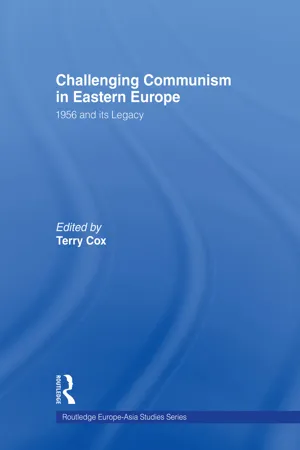
Marking the 50th anniversary of events in 1956, that were a major turning point in the history of communist-ruled Eastern Europe, this book contains a selection of some of the most recent research on those momentous events and their memory and legacy. The book contains edited contributions from historians and social scientists from Hungary, Poland the UK and the USA. Their contributions are the fruit of research which has only been possible since 1989. In the years since the fall of the communist regimes the state archives have been opened to researchers and it has been possible to collect the testimony of eye-witnesses without fear of repression and censorship. The outcome of 1956 led to Poland embarking on its own distinctive version of communist rule. Meanwhile 1956 in Hungary saw the first society-wide attempt to overthrow a ruling communist regime – only to be put down by Soviet military intervention. In both countries the events of 1956 had lasting repercussions for society and its relationship with the communist regime. In retrospect they can be seen as paving the way for the eventual fall of the communist regimes in East Central Europe in 1989.
- 204 pages
- English
- ePUB (mobile friendly)
- Available on iOS & Android
eBook - ePub
About this book
Information
1956: The Mid-Twentieth Century Seen from the Vantage Point of the Beginning of the Next Century
IN CALENDAR TERMS, 1956 LIES NEAR THE HALFWAY MARK OF THE TWENTIETH CENTURY. That remains true even if one follows Eric Hobsbawm and others in taking as a historical period a short twentieth century lasting from 1914 until the collapse of the Soviet world empire in 1989 – 1990 (Hobsbawm 1994). Using that periodisation, the (short) twentieth century is embraced by the Soviet-type attempt to apply a radical system of ideas, intended to redeem the world and make Marxism – Leninism come true. That framework applies in some respects, but it might be more accurate to refer to a post-Great War age of totalitarian responses, of which the Soviet system proved the most durable, certainly for East-Central Europeans and Hungarians. For to us, the history of the Soviet system was the longest stretch of history in the short twentieth century.
The 1956 Hungarian Revolution was actually part of that internal history, and seen in that light, its events deserve special attention in several respects.
- The 1956 Revolution was the biggest challenge to the Soviet Union from the peripheral (external) regions of its empire, or at least the biggest from Eastern Europe.1
- One cause of the outbreak of the revolution was the bankruptcy of the Stalinist version of the Soviet-type project [which János Kornai has called classical socialism (Kornai 1992)].
- As a result of 1956 there came into being one of the most viable reformed versions of the Soviet-type socialist system, for, to a significant extent, the Kádár system was a permanent reflection on 1956.
- During the years of Kádár’s rule, the memory of 1956 remained with people even if they could not refer to it openly.2
The short twentieth century told a story of the failure of Marxism and Soviet communism. From another point of view, it marked a crisis in the world order circumscribed in the long nineteenth century, in the western half of the northern hemisphere, by freely competitive capitalism, liberal democracy, and the nation-state. It may also be possible to view the twentieth century as a period of struggle against the totalitarian3 responses to the crisis; as a period of efforts to create self-generating structures of market coordination, political and human rights and freedoms, social solidarity, and new types of supra-national political and cultural integration; or as an attempt to salvage through reforms the legacies of the Enlightenment and the nineteenth century.
The question is whether these visions of the twentieth century are plausible ones and if so, how the 1956 Hungarian Revolution belongs in those constructions. This question is ultimately decided by the vantage point from which we view 1956 and the twentieth century, from the present-day horizon, the post-modern age of ceaseless doubt and constant relativisation. The previous century lends itself all too well to this. The 1956 Revolution cannot be expected to take such a place in collective memory as Hungary’s 1848 – 1849 has done. Although an anniversary is hardly the best moment to mention this, I consider that the deconstruction and erosion of the great history of 1956 will continue. I will try in what follows to outline from three angles how 1956 can be seen within the twentieth century, from the vantage point of the twenty-first.
Hungary and the world
‘Fifty-six’ was a world event. News of the revolution reached all parts of the world at almost the same time. The Revolution had a strong influence on Hungary’s image in the twentieth century. If people’s associations with the word Hungarian were examined, the 1956 Revolution would be prominent among them. It is perhaps the best known event in the country’s twentieth-century history, for obvious reasons. First of all, this is the one internationally significant event with a Hungarian dimension that has taken place within living memory. In the West, 1956 took place in the modern media age, so that it was a decisive experience for many important figures in today’s political, cultural and literary life.
It was also a positive experience, with appreciable significance, in contrast to the pre-revolutionary image of Hungary and the Hungarians, which had hardly been flattering. Indeed, Hungary’s image had tended to be unfavourable since the turn of the nineteenth and twentieth centuries (Jeszenszky 1986; Evans 2003; Molnár 2001); little occurred between the two world wars to improve it; and Hungary’s wartime alliance with Hitler had done it further damage. Although the Soviet occupation had made the country a victim, that did not alter the image of the Hungarians very much (any more than the praiseworthy efforts of the Hungarian democratic émigré community did).
What did result in a change to that image was the 1956 Hungarian Revolution. However, the picture was still one-sided: it now became quite positive but remained one of Hungary as perceived in 1956. The strongest signal that the subjugated societies of Eastern Europe were straining against the Soviet-type system had come from Budapest, but the kind of nationalism to breach the peace of the region did not emerge in 1956. (This had been a persistent, often unjust and exaggerated charge against the Hungarians in earlier decades.) Although the revolution failed, it brought clear victories later on: in the shape of a reformed, more human and liveable type of socialism. The detrimental side of the defeat, on the other hand, was soon forgotten, or remained concealed. The reprisals aroused widespread international outrage but this did not last long and was seldom mentioned after the amnesty of 1963. ‘Fifty-six’ made Hungary ‘different’ in the eyes of the West, distinguishing it from the seeming uniformity of ‘Eastern Europe’. Indeed, Hungary was different, but not as different as Poland, which revolted every 12 years. The 1956 Revolution was scored as a factor in favour of Hungarian society, even though there remained a nimbus around its post-1956 leader, János Kádár, who had defeated the revolution.4
Meanwhile Hungary itself saw the world differently, and more realistically after 1956 than it had before. On the one hand, 1956 opened the eyes of some people in Hungarian society; it made them more disillusioned and ended their hopes for a miracle, based on the expectation that the Hungarians had only to rise up for the democratic West to free them, or at least give them effective support. On the other hand, 1956 opened Hungary up inasmuch as the other side of the Iron Curtain became visible. Two hundred thousand people from all strata and groups in society had left Hungary, and then integrated into another world, of which they sent regular reports. This had followed a decade in which the Hungarian public had heard little about the outside world—years in which it had been able to gather only a distorted, fragmented picture of life on the far side of the Iron Curtain.
That isolation could not be sustained after the wave of emigration.5 Masses of people—relations, friends, acquaintances—were receiving regular information from the ‘other side’ on daily life there, initially in indirect, written reports, but from the mid-1960s onwards, often directly, in personal contacts. This information and experience usually told of success, due to various factors, including both the socio-psychological make-up of the émigrés and the exceptional supportiveness of the host populations, perhaps triggered by pangs of conscience. One thing was certain: thereafter, the socialist system in Hungary had little opportunity to claim it surpassed its capitalist adversary in all things.
Finally, in 1989, ‘fifty-six’ gained a new and more permanent place in history; the Hungarian Revolution became the forerunner, even the harbinger of the great changes of 1989 – 1991, Central and Eastern Europe’s ‘velvet revolution’ (Az 1956-os magyar forradalom 1993; Tőkés 1997). It now came to be seen as an early, heroic attempt, doomed to failure, that paved the way for what was finally achieved in 1989; as a sacrifice that gained sense and significance three-and-a-half decades later. The Kádárite spin on 1956 and Kádár’s warm reception and good contacts in the West came to be seen as mere fleeting episodes in Hungary’s history.
The ‘vision’ of 1956
The Hungarian Revolution of 1956 was a reaction to the attempted introduction of the classical, Stalinist type of Soviet system. It also harked back to the pre-war period, for the entrenched Soviet system failed to solve the underlying issues of the interwar period, or rather, offered only seemingly, short-term solutions to them (Romsics 1999). Its prescription for the problem of economic and political modernisation was forced industrialisation, a state command economy, and a high rate of mobility that levelled society downwards. As for the problems of the independence of the Hungarian nation-state and the revision of its international boundaries, it was claimed that these could be solved through the creation of a utopian Soviet-led internationalist community and the mutual harmony and agreement that this would create. In the longer term, rather than solving the issues, such ‘solutions’ only reproduced them in a graver form.
The aims and ideas of 1956 were a long time forming. Some were responses to challenges of the moment, but some—democratic transformation of the country and restoration of the independent nation-state—had preoccupied politically minded Hungarians for decades. The demands drawn up around 23 October showed a rare degree of unanimity over the common ground in Hungarian society.6 This included the negative programme of dismantling the communist political system; the achievement of national independence; the recovery and fostering of national traditions; respect for basic democratic rights and freedoms; the restoration of a multiparty system; and the holding of free elections. Most of the political programmes stated plainly that the new property relations that had developed since 1949 (land reform and the nationalisation of manufacturing, wholesale trade and the banking system) were not to be reversed: reprivatisation of the economy was firmly rejected. In other words, the revolutionary programme envisaged retaining state ownership and the state’s role of directing the economy, or as another, quite unclear solution, subjecting this to real socialisation (based on the collective ownership rights of the workers, exercised through the workers’ councils). The system of workers’ councils itself developed all over the country with astonishing speed, so that it was able to turn into an alternative base of power after 4 November.7
In this way the revolutionaries saw before them a kind of third-road ‘vision’: a political system based on representative democracy (with some direct, ‘self-managing’ forms as well) and a state-run welfare economy based on broad public ownership. Although Soviet socialism had very few advocates in 1956, socialism, especially Hungarian socialism, seems to have had quite a lot, for reasons that need to be sought mainly in the antecedents to the revolution. The political experience of the participants had been obtained under the pre-war and wartime system and in the coalition period of 1945 – 1946. The Horthy regime had been quite discredited by its ignominious end and the painful memories of it. Everyone was anxious to dissociate themselves from any ‘restoration’, while the coalition period could serve only as a starting point. No one wanted to return to the conditions that had prepared the way for the communist takeover.
The political programme of the revolution embraced the Western pattern of democracy, complete with its institutional and legal framework, but this Western democracy would have been peopled by Hungarians who seemed reluctant to make fundamental changes in the socio-economic arrangements typical of Stalinist socialism. Capitalism and the market economy were classed as a legacy of the past that was doomed to oblivion. Illusions about a state-run economy were also widespread in the West before the war and for decades afterwards. There were still, in 1956, very lively expectations of ‘socialism’, as a system that would approximate better than any before to the ideal of justice. It was as if people were thinking they could create their own Hungarian socialism once the country was independent again and not obliged to adopt Soviet patterns. The political and social programme of 1956 certainly seemed to have a third-road, democratic and left-wing character.
However, it is worth considering some special factors that can modify this picture. Political discourse and mass communications in the few short days when full freedom of speech applied were largely exercised by the Communist party opposition or its former members. The party opposition also had the best known politician: Imre Nagy (see Méray 1959; Molnár & Nagy 1959; Unwin 1991). The demands that gained publicity were so uniform because the new language of public discourse had been developed by the party intelligentsia and they, of course, were best at speaking it. The non-communist participants in political life had only just emerged from long years of oppression, or in many cases long prison sentences. They, understandably, spoke in a cautious or restrained tone if they said anything at all. The middle class of the interwar period had proved unable to rally after 1945. There was still an element of self-restraint and self-censorship in the revolution, on the grounds that an independent Hungary might be more acceptable to the Soviet Union if it was socialist at least, an idea probably influenced by the example of Tito’s Yugoslavia. The speed of events and short duration of the revolution left no time to work out demands in full, let alone thrash out opposing views. Everything that called for a longer period of elaboration was lacking. For instance, no detailed economic or economic-policy ideas were devised. Nor was there a foreign policy programme for 1956—withdrawal from the Warsaw Pact and the call for neutrality were just responses to preparations for the second Soviet invasion.
As for the ideology of the populist writers—the last great, specifically Hungarian current of political ideas (Borbándi 1976)—it had never shaped up into a coherent political programme. István Bibó, its most conscious representative, had tried to formulate a programme in 1945 – 1948, but the developing conditions of Stalinism had prevented him from completing it. However, Bibó’s political vision at the end of the 1940s was an anticipation of 1956 (Bibó 1991). A democrat with socialist features, closed to the right but open to the left, and with third-road ‘people’s’ ideas, he probably exerted the decisive influence on the most act...
Table of contents
- Cover
- Half Title
- Title Page
- Copyright Page
- Table of Contents
- 1956—Discoveries, Legacies and Memory
- 1. 1956: The Mid-Twentieth Century Seen from the Vantage Point of the Beginning of the Next Century
- 2. Memory and Discourse on the 1956 Hungarian Revolution
- 3. Antifascism, the 1956 Revolution and the Politics of Communist Autobiographies in Hungary 1944–2000
- 4. An Emblematic Picture of the Hungarian 1956 Revolution: Photojournalism during the Hungarian Revolution
- 5. Dethroning Stalin: Poland 1956 and its Legacy
- 6. The Polish–Soviet Confrontation in 1956 and the Attempted Soviet Military Intervention in Poland
- 7. The Main Provincial Centres of the 1956 Revolution: Győr and Miskolc
- 8. Re-emergence of Public Opinion in the Soviet Union: Khrushchev and Responses to the Secret Speech
- 9. The Fog of Hungary’s Negotiated Revolution
- Index
Trusted by 375,005 students
Access to over 1.5 million titles for a fair monthly price.
Study more efficiently using our study tools.
Frequently asked questions
Yes, you can cancel anytime from the Subscription tab in your account settings on the Perlego website. Your subscription will stay active until the end of your current billing period. Learn how to cancel your subscription
No, books cannot be downloaded as external files, such as PDFs, for use outside of Perlego. However, you can download books within the Perlego app for offline reading on mobile or tablet. Learn how to download books offline
Perlego offers two plans: Essential and Complete
- Essential is ideal for learners and professionals who enjoy exploring a wide range of subjects. Access the Essential Library with 800,000+ trusted titles and best-sellers across business, personal growth, and the humanities. Includes unlimited reading time and Standard Read Aloud voice.
- Complete: Perfect for advanced learners and researchers needing full, unrestricted access. Unlock 1.5M+ books across hundreds of subjects, including academic and specialized titles. The Complete Plan also includes advanced features like Premium Read Aloud and Research Assistant.
We are an online textbook subscription service, where you can get access to an entire online library for less than the price of a single book per month. With over 1.5 million books across 990+ topics, we’ve got you covered! Learn about our mission
Look out for the read-aloud symbol on your next book to see if you can listen to it. The read-aloud tool reads text aloud for you, highlighting the text as it is being read. You can pause it, speed it up and slow it down. Learn more about Read Aloud
Yes! You can use the Perlego app on both iOS and Android devices to read anytime, anywhere — even offline. Perfect for commutes or when you’re on the go.
Please note we cannot support devices running on iOS 13 and Android 7 or earlier. Learn more about using the app
Please note we cannot support devices running on iOS 13 and Android 7 or earlier. Learn more about using the app
Yes, you can access Challenging Communism in Eastern Europe by Terry Cox in PDF and/or ePUB format, as well as other popular books in Politics & International Relations & Politics. We have over 1.5 million books available in our catalogue for you to explore.