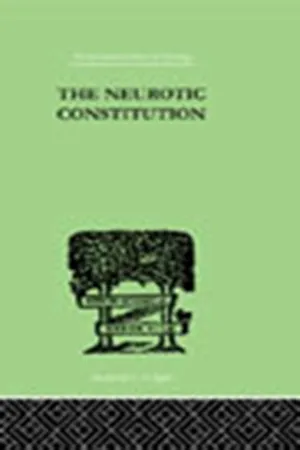
- 244 pages
- English
- ePUB (mobile friendly)
- Available on iOS & Android
eBook - ePub
The Neurotic Constitution
About this book
First Published in 1999. This is Volume II of twenty-one of the Individual Differences Psychology series. Written in 1921, this study outlines a comparative Individualistic Psychology and Psychotherapy.
Trusted by 375,005 students
Access to over 1.5 million titles for a fair monthly price.
Study more efficiently using our study tools.
Information
Topic
MedicineSubtopic
Health Care DeliveryPRACTICAL PART
CHAPTER I
AVARICE, SUSPICIOUSNESS, ENVY, CRUELTY, THE DEROGATORY CRITIQUE OF THE NEUROTIC, NEUROTIC APPERCEPTION, SENILE NEUROSES, CHANGES IN THE FORM AND INTENSITY OF THE FICTION. SOMATIC JARGON (ORGAN-JARGON)
I wish to speak first of those traits of character which may be demonstrated with a certain regularity in all neurotics, and which reach expression in the patient's striving with great eagerness, directly or circuitously, consciously or unconsciously, by means of purposive thinking and acting, or through an especial arrangement of symptoms, towards greater possession, towards a heightening of his power and influence, towards a degradation and belittling of others. All these forms of self-interest are most often found to coexist, and it is only after a better insight that one recognizes the mighty preponderance of those evasions by means of which the patient deceives himself and his environment. He even deceives also science.
While playing, for instance, the role of unselfishness, one finds again and again in his attacks, in his neurosis, moreover in the end result gained by means of the latter, that exaggerated eagerness of which we have spoken in the beginning : — He thus arouses the impression of a double-ego, of one suffering from a splitting of consciousness, and whereas a fictitious goal permits him to observe secretly more rigidly than does the normal person the scheme of avarice, envy, desire for mastery, malice, disputatiousness, and desire to please (coquetry), he is compelled in the open (perhaps also on account of his desire to please) to play the role of the benefactor and patron, of the pacifier and unselfish saint. Not that this play is usually without disastrous results, somewhat like Gregor Werles' truth— fanaticism in Ibsen's " Wild Duck." One cannot estimate strongly enough the neurotic's mania to desire possession of everything, his eagerness to wish to be the first one—cannot be over-stated—even though the obvious traits of character furnish the most contradictory picture. What really drives the patient onward is the overweening desire for absolute power ; and inasmuch as his ego-consciousness takes offence at many of his means—inasmuch as the power of others may prevent his triumph, he conceals the hindering traits of character from himself and others, and having full insight into his hostile impulses and their unpopularity, he allows himself to be guided in the open in his conscious activities by the ideal of virtue. Notwithstanding this, however, his heightened aggressive tendency betrays itself—namely in the dreams in uncontrolled acts, in his attitude, mimicry and gesture—and in that psychic being (" Geschehen ") the expression for which is the neurosis.
Concerning the question of transmissibility of such characteristics, yes, also their antagonistic arrangement, there as a rule develops that they have been acquired as secondary guiding principles after the pattern of the father, the mother, or representative persons and are in nowise inherited. The neurotic psyche finds it in its own or in some representative material, for the purpose of which the " double play "—the cleft consciousness of society—is utilized in many cases. It is then, however, the device of the neurosis, to conceal and change those hostile aggressive traits which are frequently unsuitable for the fictitious purpose of obtaining a heightening of the ego-consciousness—and to obtain the latter goal through a more intensive utilization of artifices—often by means of contrasting characteristics and neurotic symptoms. One readily becomes convinced that the generosity of such patients obeys the same goal of the " will to power " which the patient strives to approach also through the heightening of his aggressive tendency, his avarice and thriftiness.
One of my patients who came under my observation on account of stammering and depressive states, permitted to appear in his environment a detection only of his generosity. One day he made a voluntary bequest to a certain institute, and told me this story with an apparently directly associated statement that he felt unusually depressed that day. Along with this his stammering likewise became more pronounced. The exaggerated state of his neurosis showed itself to be a result of his generosity as result of which he feels himself degraded and one is justified in expecting a revelation of the real working of this individual in further acts, thoughts and dreams as running with the developing neurotic symptoms— not because he has repressed his avariciousness or a corresponding sexual impulse—but because he has deviated too far from his goal—namely, to increase his possessions. He must therefore do something which will bring him back to it. He tells me further, " It was already far after the dinner hour. I felt very hungry, and besides a friend awaited me in a restaurant where we were to dine together. I had to walk therefore the (long) distance to that place. My friend still waited. After dinner I felt somewhat better.'' This means that he began at once to save again and made the journey on foot, notwithstanding hunger, depression and rendezvous. Incidentally, he was able to let the friend wait, which is with many neurotics the concealed mode of asserting their desire for dominancy.
The very first manifestation, actions and communications of the patient in the presence of the physician, frequently contain the most important of the disease mechanism and character development. This is so because the patient is as yet not in possession of cautiousness in the presence of the physician. As the above quoted patient introduced himself to me, he told me casually, that his father was not well to do, and that he was unable to make great sacrifices for the treatment. After a certain time, there came of necessity to light that he deceived me in this respect in order to obtain a smaller charge. He showed himself to be avaricious also in many other respects, but at the same time he endeavored to deceive both himself and others in this respect. Both of these traits were also possessed by the father, and our patient was taught stinginess by the latter with special stress. He was often told " money is might, for money everything can be had." Thus it could not be avoided that our patient, who was already in childhood very ambitious and tyrannical, having later fallen into an uncertain situation and believing that he could not reach the paternal standard, through direct means, took refuge under the pressure of his ambitiousness, in the device to convince the father of his utter helplessness and of the other failures of his educational plans, by retaining this childhood defect, stammering. Through his stammering, he spoiled his father's play—because he was not able to be the first one, because he was not able to surpass th.e latter.
Our culture, however, agrees with those children who see in the amassing of fortune the road to power. Similarly led on, this " will to power " assumed the external form of stinginess and avarice in so far as he further developed these tendencies. It was only the contradiction between a vulgar avariciousness and the ego-ideal which forced him to a concealment of the impulse to avarice by means of which he wished to dominate his father, and forced him to the substitution of the stammering. In the further course of the analysis the origin of his desire for possession became evident. He suffered practically constantly in his infancy from stomach and intestinal disorders, which were the expression of a hereditary inferiority of the gastro-intestinal tract. In the family, stomach and intestinal disorders played an important role. The patient recalled very distinctly how he frequently had to deny himself appetizing food in spite of hunger and desire, whereas his parents and brothers and sisters consumed them with pleasure. Whenever he could he gathered foods, bonbons and fruits to be feasted upon later. In this tendency to gather, we already see the influence of the developing craving for security, which is constantly endeavoring to adjust in some way or other the feeling of degradation.
How far, however, this may reach may be shown by a constructed example which I am able to verify with analogies from our case. The eagerness for power, and through it for possession, may be stirred up by the feeling of inferiority to such a point that one finds it at phases of the psychic development when one would least expect it.
A small patient of this sort will at first, it is true, only desire to have the apple which is forbidden him, in seeing his father and brother eating the same. Envy will begin to stir itself, and after a brief period such a child may have reached the stage in his deliberateness and contemplation when out of the striving for equality he will attempt to prevent others from having anything before he has it. It will soon have reached so far in the elaboration of this albeit only slightly important idea, as to have at his disposal all sorts of preparations and facilities, it will, especially in the presence of an originally inferior muscular system, train itself for the whole year by climbing and jumping in order to be able to climb a tree as a master in the fall. The human psyche is not able to account always for fictitious goals, and thus the child may apparently free himself from his goal, employ his dexterity in sports and gymnastics in the service of other tendencies, which serve in a different manner his ego-consciousness somewhat like our modern States conduct our war preparations without even knowing the future enemy.
The father of our patient may have easily been taken by the boy as an incidental example because he excelled his environment in greatness, power, wealth and social standing. If the boy is to emerge out of his insecurity into which he has been plunged by his constitutional inferiority he must arrange his preparations for life in accordance with a set point of view as after a plan (blue print). A marked exhibition of the guiding principle toward the paternal ideal (Vaterideal) is in itself quite a neurotic trait, because in it we may comprehend the entire misery of the child who endeavors to emerge from his insecurity. The craving for security (Sicherungstendenz) of the neurosis leads the patient in this way out of the sphere of his own power and forces him into a path which leads away from reality, first because he takes for his object his fiction to be equal to his father or even to excel him and is therefore forced to formulate, arrange and influence his apperception of life under its compulsion, and second because one can never succeed in carrying out such a fiction in real life except in a psychosis.
In this way, there develops in the psyche of the child an intensive searching, weighing, and measuring tendency of which I shall have to say something more. That which is according to my experience primarily responsible for the too rigid assumption of the paternal guiding principles, may be discovered in an investigation into the sexual roles. The neurotically predisposed child, or as I may say, the child laboring under the pressure of a feeling of inferiority, desires to become a man, as soon as the neurosis develops, to be a man. In both instances he can only conduct himself in such a manner as if he were a man or shall become one. The exaggerated craving for security drives also in this instance the attitude of the developing neurotic into the ban of the fiction, so that in some instances even conscious simulation may come into play, and a girl for instance in order to escape a feeling of inferiority may in the beginning borrow in conscious imitation masculine gestures of her father. There is no reason for the assumption that because of this she must be in love with her father. The mere over-valuation of the masculine principle suffices for this, may nevertheless at times be taken as infatuation by the girl lierself as well as by her environment, should the preparations for the future playfully demand a hinting of love or a marriage. In our case the guiding line to the compensatory ego-ideal, transformed itself through a change of form and content into a craving to excel the father in wealth, esteem, and along with this, in manliness. The inquiry into his own sexual role, sets in intensively and typically as sexual curiosity, whereby the patient in his feeling of inferiority, apperceives the smallness of his infantile genitals as compared with the largeness of the paternal ones, as a bitter set-back, as a want of masculinity. His ambitiousness which shall enable him to rise out of his state of inferiority, compelled him to a heightening of his sense of shame, in order that his genitals may not be seen in the event of an exposure (in case he is nude). To this may be added that he was of Jewish descent. He had heard certain things about circumcision and harbored the idea that he was also (Verklirzt) belittled through the operation. His masculine protest drove him to a degradation of woman, as if he had to give proof to his superiority in this wise, and came into the most abominable relationship with his mother.
But also with respect to his father, whose preference for himself he gained through diplomatic adjustment, he harbored hostile thoughts which became especially prominent when the father over-emphasized his own superiority to do which he had a marked inclination. In this chaos of feelings the patient sought orientation, and found it only in the thought to become superior to his father, to become more manly than he.
He had, too, as often happens in such cases, undertaken attempts at enlarging his genitals or bringing about erection. This route, which leads to sexual precocity and masturbation, was soon abandoned by him, because his father warned him against it on numerous occasions. Thus there remained as a substitution for his masculine protest, only efforts to become richer, more honored and wiser than his father, and to degrade his environment.
His father placed great hopes in the patient's oratorical talents, which had shown themselves already in childhood, did not allow himself to be deceived by the mild stammering of the boy, and hoped he would make a law career. In this respect the patient was able to strike at the father's most vulnerable point, and thus he sank into a more pronounced stammering, a neurotic manifestation of the insurance against the superiority of the father, a manifestation whose inception was given him by a stammering home teacher. In the course of time, this symptom gained many other uses, for example, the one that through his stammering he always gained time in which to weigh his words, to avoid demands of the family, to utilize the confession of others as well as that prejudice because of which, only little was expected of him, which he then managed to fulfil easily. It is interesting that his quite apparent stammering was no obstacle to his courtship, that it even expedited matters, a fact which becomes quite comprehensible from our standpoint, according to which we assume the existence of a quite prevalent type of girl which cannot omit from the conditions of their love that the man of their choice must be beneath them, so that they may with certainty rule over him. Especially hostile feelings against his parents, brothers and sisters and the servants he put a stop to, through the development of a new guiding principle which was to make of him a benevolent man. This new evolution took place under a nightly confession through which he reproached himself for his wickedness and arranged qualms of conscience. His growing knowledge thus showed him the way, through a cultural subterfuge to a heightening of his ego-consciousness.
The want of a direct aggressiveness showed itself in thoughts and phantasies, albeit also in his good progress at school, so that he was victorious over all his classmates. A growing tendency towards sarcasm and exasperation of others was at this time the only manifest expression of his former often violent aggressiveness which gained for him the nickname of "blood-leech." His combative attitude played an important role in the cause of Judaism, which was reflected in an act of compulsion at the age of twelve. Whenever he entered a swimming pool he had to cover his genitals with his hands and immediately submerge his head under the water, where he kept it until he counted 49, so that he often came to the surface gasping for air and exhausted. The analysis revealed the mental content to be a striving of his phantasy to bring about an equality of genitalia*. The forty-ninth year is, according to the old Jewish laws, with which he had become acquainted shortly before, the year of the jubilee, in which all acres were again made equal. Ideas of this sort, and the simultaneous concealment of the genitalia showed the way to the interpretation. One may almost draw the conclusion that also his stammering was intended to make him quits with a superiority of his father, of all people, inasmuch as his stuttering was an obstacle to them, was even painful to them.
His avarice, his stinginess, were accordingly active in the same direction, namely, to clear the field of superiorities of others, to insure him against further degradation and belittling through poverty, thus he was Compelled markedly to expand these secondary directions and to formulate and evaluate his experiences according to them in order to reach the heightening of his ego-consciousness, his masculine protest. It was only under such circumstances where through revelation of these traits of character a lowering of his ego might arise that he suppressed their apparent activity.
It were an absurdity to wish to assume a normal standpoint in a medico-psychological question, to consider people like the above as morally inferior. Those who have an inclination in this direction I wish to remind of the very strong, compensatory traits of character, of a worthy nature, for the rest I wish to remind them of Rochefoucauld's wise sentence—viz : " I have never investigated the soul of a wicked man, but I once became acquainted with the soul of a good man : I was shocked/'
In another case, the nature of the avarice showed itself not as a safety device for the compensation of a feeling of degradation, but above all as an artifice in the service of the craving for security. A forty-five year old patient who suffered throughout life from psychic impotency, and was pursued by suicidal ideas, showed an especially marked tendency to degrade others.
We know this trait of character from the description of the previous case where it served as it always does to do away with one's own feeling of inferiority. With this tendency there is usually associated exaggerated mistrust and envy, which have for their object as neurotic-psychic dexterities, the falsification of the search and valuation of experiences. A tendency, too, to cause others bodily and psychic pain, will likewise know how to assert itself in an accentuated manner. The abstract, guiding point of view of the patient, to assure his dominating position, to be above, appeared to be obviously threatened, and compelled a strengthening of fictitious guiding principles. Reminiscences out of his infantile period were utilized in the neurosis, as result of which he came near being the victim of a homosexualist. He was raised as an only boy among his sisters, a situation which, according to my experience, frequently narrows the understanding of one's own sexual role.
Of importance was his attitude toward his father, because it likewise drove him to str...
Table of contents
- COVER
- TITLE PAGE
- COPYRIGHT PAGE
- PREFACE
- INTRODUCTION
- TABLE OF CONTENTS
- THE ORIGIN AND DEVELOPMENT OF THE FEELING OF INFERIORITY AND THE CONSEQUENCES THEREOF
- PSYCHIC COMPENSATION AND ITS SYNTHESIS
- THE ACCENTUATED FICTION AS THE GUIDING IDEA IN THE NEUROSIS
- CHAPTER I
- CHAPTER II
- CHAPTER III
- CHAPTER IV
- CHAPTER V
- CHAPTER VI
- CHAPTER VII
- CHAPTER VIII
- CHAPTER IX
- CHAPTER X
- CONCLUSION
- AUTHOR
- INDEX
Frequently asked questions
Yes, you can cancel anytime from the Subscription tab in your account settings on the Perlego website. Your subscription will stay active until the end of your current billing period. Learn how to cancel your subscription
No, books cannot be downloaded as external files, such as PDFs, for use outside of Perlego. However, you can download books within the Perlego app for offline reading on mobile or tablet. Learn how to download books offline
Perlego offers two plans: Essential and Complete
- Essential is ideal for learners and professionals who enjoy exploring a wide range of subjects. Access the Essential Library with 800,000+ trusted titles and best-sellers across business, personal growth, and the humanities. Includes unlimited reading time and Standard Read Aloud voice.
- Complete: Perfect for advanced learners and researchers needing full, unrestricted access. Unlock 1.5M+ books across hundreds of subjects, including academic and specialized titles. The Complete Plan also includes advanced features like Premium Read Aloud and Research Assistant.
We are an online textbook subscription service, where you can get access to an entire online library for less than the price of a single book per month. With over 1.5 million books across 990+ topics, we’ve got you covered! Learn about our mission
Look out for the read-aloud symbol on your next book to see if you can listen to it. The read-aloud tool reads text aloud for you, highlighting the text as it is being read. You can pause it, speed it up and slow it down. Learn more about Read Aloud
Yes! You can use the Perlego app on both iOS and Android devices to read anytime, anywhere — even offline. Perfect for commutes or when you’re on the go.
Please note we cannot support devices running on iOS 13 and Android 7 or earlier. Learn more about using the app
Please note we cannot support devices running on iOS 13 and Android 7 or earlier. Learn more about using the app
Yes, you can access The Neurotic Constitution by Alfred Adler in PDF and/or ePUB format, as well as other popular books in Medicine & Health Care Delivery. We have over 1.5 million books available in our catalogue for you to explore.