- 428 pages
- English
- ePUB (mobile friendly)
- Available on iOS & Android
eBook - ePub
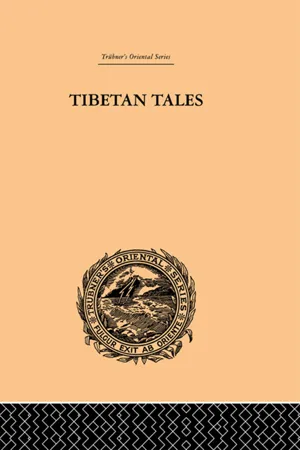
Tibetan Tales Derived from Indian Sources
About this book
This is Volume XVI of sixteen of the Oriental series looking at Buddhism. Initially published in 1906, this book presents a collection of Tibetan stories connected to Buddhism, taken from Indian sources and translated from the Kah-gyur and are Tibetan versions of Sanskrit writings.
Information
INTRODUCTION.
The tales contained in the sacred books of Tibet, it may be as well to remark at the outset, appear to have little that is specially Tibetan about them except their language. Stories possessing characteristic features and suffused with local colour may possibly live in the memories of the natives of that region of lofty and bleak table-lands, with which so few Europeans have had an opportunity of becoming familiar. But the legends and fables which the late Professor Schiefner has translated from the Kah-gyur are merely Tibetan versions of Sanskrit writings. No mention is made in them of those peculiarities of Tibetan Buddhism which have most struck the fancy of foreign observers. They never allude to the rosary of 108 beads which every Tibetan carries, “that he may keep a reckoning of his good words, which supply to him the place of good deeds;” the praying wheels, “ those curious machines which, filled with prayers, or charms, or passages from holy books, stand in the towns in every open place, are placed beside the footpaths and the roads, revolve in every stream, and even (by the help of sails like those of windmills) are turned by every breeze which blows o’er the thrice-sacred valleys of Tibet;” the “Trees of the Law,” the lofty flagstaffs from which flutter banners emblazoned with the sacred words, “Ah! the jewel is in the lotus,” the turning of which towards heaven by the wind counts as the utterance of a prayer capable of bringing down blessings upon the whole country-side; or of that Lamaism which “ bears outwardly, at least, a strong resemblance to Eomanism, in spite of the essential difference of its teachings and of its mode of thought.”1 There is, therefore, no present need to dwell at length upon the land into which the legends and doctrines were transplanted which had previously flourished on Indian soil, or the people by whom they have been religiously preserved, but whose actions and thoughts they do not by any means fully represent. “ At the present day,” says Mr. Ehys Davids, “the Buddhism of Nepal and Tibet differs from the Buddhism of Ceylon as much as the Christianity of Eome or of Moscow differs from that of Scotland or Wales. But,” he proceeds to say, “ the history of Buddhism from its commencement to its close is an epitome of the religious history of mankind. And we have not solved the problem of Buddhism when we have understood the faith of the early Buddhists. It is in this respect that the study of later Buddhism in Ceylon, Burma, and Siam, in Nepal and in Tibet, in China, Mongolia, and Japan, is only second in importance to the study of early Buddhism.”1
With regard to the introduction of Buddhism into Tibet, Emil Schlagintweit2 remarks that “the early history is involved in darkness and myth.” Sanang Setsen, in his “History of the East Mongols,”3 says that during the reign of King Hlatotori, who came to the throne in 367 A.D., four objects descended from heaven one day and lighted upon the golden terrace of his palace, “ namely, the image of two hands in the position of prayer, a golden pyramid-temple an ell high, a small coffer with a gem marked with the six fundamental syllables (Om-ma-ni-pad-me-hum), and the manual called Szamadok”*4 As the king did not understand the nature of the holy objects, he ordered them to be locked up in his treasury. While they lay there, “misfortune came upon the king. If children were born, they came into the world blind; fruits and grain came to nothing; cattle plague, famine, and pestilence prevailed; and of unavoidable misery was there much.” But after forty years had passed, there came five strangers to the king and said, “ Great king, how couldst thou let these objects, so mystic and powerful, be cast into the treasury ?” Having thus spoken, they suddenly disappeared. Therefore the king ordered the holy objects to be brought forth from the treasury, and to be attached to the points of standards, and treated with the utmost respect and reverence. After that all went well: the king became prosperous and long-lived, children were born beautiful, famine and pestilence came to an end, and in their place appeared happiness and welfare. With the date of this event Sanang Setsen connects the introduction of Buddhism into Tibet; but according to Tibetan historians, says Schlagintweit, “the earliest period of the propagation of Buddhism, which reached down till the end of the tenth century A.D., begins with King Srongtsan Gampo, who was born in the year 617 A.D., and died 698.” This king is said to have sent a mission to India in the year 632 A.D., the result of which was the invention of a Tibetan alphabet, based upon Devanagari characters, and the translation into Tibetan of Indian sacred books. In his introduction of Buddhism into his kingdom he is said to have been “most energetically supported by his two wives, one of whom was a Nepalese, the other a Chinese princess. Both of them, who throughout their lifetime proved most faithful votaries to the faith of Buddha, are worshipped either under the general name of Dolma (in Sanskrit Tara), or under the respective names of Dolkar and Doljang.” After making considerable progress during the reign of this monarch, the new religion lost ground under his immediate successors. “ But under one of them, Thisrong de tsan, . . . Buddhism began to revive, owing to the useful regulations proclaimed by this king. He it was who successfully crushed an attempt made by the chiefs during his minority to suppress the new creed, and it is principally due to him that the Buddhist faith became henceforth permanently established.”
Towards the end of the ninth century, continues Schlagintweit, Buddhism was strongly opposed by a ruler who “commanded all temples and monasteries to be demolished, the images to be destroyed, and the sacred books to be burnt;” and his son and successor is also said to have died “ without religion;” but his grandson was favourably inclined towards Buddhism, and rebuilt eight temples. “ With this period we have to connect * the second propagation of Buddhism;’ it received, especially from the year 971 A.D., a powerful impetus from the joint endeavours of the returned Tibetan priests (who had fled the country under the preceding kings), and of the learned Indian priest Pandita Atisha and his pupil Brom-ston. Shortly before Atisha came to Tibet, 1041 A.D., the Kala Chakra doctrine, or Tantrika mysticism, was introduced into Tibet, and in the twelfth and thirteenth centuries many Indian refugees settled in the country, who greatly assisted the Tibetans in the translation of Sanskrit books.” It is probably from this period that the Kah-gyur dates.
In the fourteenth century arose the reformer Tsonkhapa, who “imposed upon himself the difficult task of uniting and reconciling the dialectical and mystical schools which Tibetan Buddhism had brought forth, and also of eradicating the abuses gradually introduced by the priests.” Tradition asserts that he “ had some intercourse with a stranger from the West, who was remarkable for a long nose. Hue believes this stranger to have been a European missionary, and connects the resemblance of the religious service in Tibet to the Eoman Catholic ritual with the information which Tsonkhapa might have received from this Eoman Catholic priest. We are not yet able to decide the question as to how far Buddhism may have borrowed from Christianity; but the rites of the Buddhists enumerated by the French missionary can for the most part either be traced back to institutions peculiar to Buddhism, or they have sprung up in periods posterior to Tsonkhapa.”1
Mr. Ehys Davids has remarked that, “As in India, after the expulsion of Buddhism, the degrading worship of Siva and his dusky bride had been incorporated into Brahmanism from the wild and savage devil-worship of the dark η on-Aryan tribes, so as pure Buddhism died away in the North, the Tantra system, a mixture of magic and witchcraft and Siva-worship, was incorporated into the corrupted Buddhism.”1 Of this change for the worse, evidence about which there can be no mistake is supplied by the Tibetan sacred books. Dr. Malan, who has made himself acquainted with the contents of some of their volumes in the original, says,2 “ There are passages of great beauty and great good sense, the most abstruse metaphysics, and the most absurd and incredible stories; yet not worse than those told in the Talmud, which equal or even surpass them in absurdity.”
On New Year’s day 1820, a traveller started from Bucharest on an adventurous journey towards the East. His name was Alexander Csoma Korosi (or de Koros),3 and he was one of the sons of a Szekler military family of Eger-patak, in the Transylvanian circle of Hungary. In 1799, when he seems to have been about nine years old,4 he was sent to the Protestant College at Nagy-Enyed, where he studied for many years with the idea of taking orders. In 1815 he was sent to Germany, and there he studied for three years, chiefly at the University of Gottingen, where he attended the lectures of the celebrated Orientalist Johann Gottfried Eichhorn. After his return from Germany, he spent the greater part of the year 1819 in studying various Slavonic dialects, first at Temesvar in Lower Hungary, then at Agram in Croatia. But he soon resolved to apply himself to less-known tongues.
“Among other liberal pursuits/’ he wrote in 182s,1 “my favourite studies were philology,’ geography, and history. Although my eclesiastical studies had prepared me for an honourable employment in my native country, yet my inclination for the studies above-mentioned induced me to seek a wider field for their future cultivation. As my parents were dead, and my only brother did not want my assistance, I resolved to leave my native country and to come towards the East, and, by some means or other procuring subsistence, to devote my whole life to researches which may be afterwards useful in general to the learned world of Europe, and in particular may illustrate some obscure facts in ancient history.” Having no hope, he says, of obtaining “ an imperial passport” for his journey, he procured “ a printed Hungarian passport at Nagy-Enyed, to come on some pretended business to Bucharest,” intending to study Turkish there and then to go on to Constantinople. But he could obtain neither instruction in Turkish nor the means of going direct to Constantinople. So he set forth from Bucharest on the 1st of January 1820, and travelled with some Bulgarian companions to Philippopolis. Tidings of plague forced him to turn aside to the coast of the Archipelago, whence he sailed in a Greek ship to Alexandria. Driven from that city by the plague, he made his way by sea to the coast of Syria, and thence on foot to Aleppo. From that city he proceeded to Bagdad, which he reached in July, travelling part of the way on foot, “ with different caravans from various places, in an Asiatic dress,” and the rest “ by water on a raft.” In September he left Bagdad, travelling in European costume on horseback with a caravan, and in the middle of next month he arrived at Teheran. In the capital of Persia he spent four months. In March 1821 he again started with a caravan, travelling as an Armenian, and, after a stay of six months in Khora-san, arrived in the middle of November at Bokhara. There he intended to pass the winter; but at the end of five days, “ affrighted by frequent exaggerated reports of the approach of a numerous Eussian army,” he travelled with a caravan to Kabul, where he arrived early in January 1822. Atthe endof a fortnight he again set out with a caravan. Making acquaintance on the way with Eunjeet Sing’s French officers .Generals Allard and Ventura, he accompanied them to Lahore. By their aid he obtained permission to enter Kashmir, with the intention of proceeding to Yarkand ; but finding that the road was “ very difficult, expensive, and dangerous for a Christian,” he set out from Leh in Ladak, the farthest point he reached, to return to Lahore. On his way back, near the Kashmir frontier, he met Mr. Moorcroft and returned with him to Leh. There Mr. Moorcroft lent him the “Alphabetum Tibetanum,” the ponderous work published at Eome in 1762, compiled by Father Antonio Agostino Giorgi out of the materials sent from Tibet by the Capuchin Friars. Its perusal induced him to stay for some time at Leh in order to study Tibetan, profiting by “ the conversation and instruction of an intelligent person, who was well acquainted with the Tibetan and Persian languages.” During the winter, which he spent at Kashmir, he became so interested in Tibetan that he determined to devote himself to its study, so as to be able to “penetrate into those numerous and highly interesting volumes which are to be found in every large monastery.” He communicated his ideas to Mr. Moorcroft, who fully approved of his plan, and provided him with money and official recommendations. Starting afresh from Kashmir in May 1823, he reached Leh in the beginning of June. From that city, he says, “ travelling in a south-westerly direction, I arrived on the ninth day at Yangla, and from the 20th of June 1823 to the 22d of October 1824 I sojourned in Zanskar (thesouth-western province of Ladakh), where I applied myself to the Tibetan literature, assisted by the Lama.”
With the approach of winter he left Zanskar, and towards the end of November 1824 arrived at Sabathu. In the letter which he wrote during his stay there, in January 1825, he says,” At my first entrance to the British Indian territory, I was fully persuaded I should be received as a friend by the Government.” Nor was he disappointed. As at Bagdad and Teheran, so in India was the Hungarian pilgrim welcomed and assisted by the British authorities. In 1826 he seems (says Dr. Archibald Campbell1) to have paid a second visit to Western Tibet, and to have continued “ to study in the monasteries of that country, living in the poorest possible manner,” till 1831. In the autumn of that year Dr. Campbell met him at Simla, “ dressed in a coarse blue cloth loose gown, extending to his heels, and a small cloth cap of the same material. He wore a grizzly beard, shunned the society of Europeans, and passed his whole time in study.” It is much to be regretted that he has left no record of his residence in the monasteries in which he passed so long a time, in one of which, “ with the thermometer below zero for more than four months, he was precluded by the severity of the weather from stirring out of a room nine feet square. Yet in this situation he read from morning till evening without a fire, the ground forming his bed, and the walls of the building his protection against the rigours of the climate, and still he collected and arranged forty thousand words in the language of Tibet, and nearly completed his Dictionary and Grammar/’2 Day after day, says M. Pavie,3 he would sit in a wretched hut at the door of a monastery, reading aloud Buddhistic works with a Lama by his side. When a page was finished, the two readers would nudge each other’s elbows. The question was which of them was to turn over the leaf, thereby exposing his hand for the moment, unprotected by the long-furred sleeve, to the risk of being frost-bitten.
In May 1832 he went to Calcutta, where he met with great kindness from many scholars, especially Professor ?. H, Wilson and Mr. James Prinsep, and, after a time, he was appointed assistant-librarian to the Asiatic Society of Bengal. At Calcutta he spent many years, and there his two principal works, the “ Essay Towards a Dictionary, Tibetan and English,”1 and the “ Grammar of the Tibetan Language,” were brought out at the expense of Government in 1.834. “ In the beginning of 1836,” says Dr. Campbell, “ his anxiety to visit Lassa induced him to leave Calcutta for Titalya, in the hope of accomplishing his design through Bootan, Sikim, or Nipal.” Of his life in Titalya, where he seems to have spent more than a year, some account is given by Colonel G. W. A. Lloyd, who says, “ He would not remain in my house, as he thought his eating and living with me would cause him to be deprived of the familiarity and society of the natives, with whom it was his wish to be colloquially intimate, and I therefore got him a common native hut, and made it as comfortable as I could for him, but still he seemed to me to be miserably off. I also got him a servant, to whom he paid three or four rupees a month, and his living did not cost him more than four more.”
Towards the end of 1837 2 he returned to Calcutta. I have been favoured by a very accomplished linguist, the Eev. S. C. Malan, D.D., Rector of Broadwindsor, Dorset, who was at one time secretary to the Asiatic Society of Bengal, with an account of his acquaintance with Csoma Korosi during the Hungarian scholar’s second residence at Calcutta. Dr. Malan writes as follows:—
“ As regards Csoma de Koros, I never think of him without interest and gratitude. I had heard of him, and seen his Tibetan Grammar and Dictionary before leaving England. And one thing that used to make me think a five months’ voyage interminable was my longing to become acquainted with one who had prepared the way for the acquisition of a language of Asia, thought until then almost mythical. For neither Father Georgi’s nor Abel Eemusat’s treatises went very far to clear the mystery.
“One of my early visits, then, was to the Asiatic Society’s house [in Calcutta], where Csoma lived as under-librarian.1 I found him a man of middle stature, of somewhat strange expression and features, much weather-beaten from his travels, but kind, amiable, and Availing to impart all he knew. He was, however, very shy, and extremely disinterested. Although I had to cross the river to come to him, I requested him at once to give me one lesson a week in Tibetan, and he agreed to do so most readily. But I could not make him consent to take any money. He told me to come as often as I liked, on the condition that his teaching was to be free, for the pleasure and love of it. Of course this prevented me from visiting him as frequently as I should otherwise have...
Table of contents
- Cover Page
- Title Page
- Copyright
- Contents
- Introduction
- I. King Mandhatar
- II. Kusa Jataka
- III. Adarsamukha
- IV.The Clever Thief
- V. Sudhana Avadana
- VI. Prince Jlvaka
- VII. Visakha
- VIII. Mahaushadha and Visakha
- IX. Mahakasyapa and Bhadra
- X. Utpalavarna
- XI. Krisa Gautami
- XII. Susroni
- XIII. The Overreached Actor
- XIV. The Dumb Cripple
- XV. Kshyasringa
- XVI. Visvantara
- XVII. The Fulfilled Prophecy
- XVIII. The Two Brothers
- XIX. The Punishment of Avarice
- XX. The Magician’s Pupil
- XXI. How a Woman repays Love
- XXII. The Flight of the Beasts
- XXIII. The Five Lovers
- XXIV. The Virtuous Animals
- XXV. The Ichneumon, the Mouse, and the Snake
- XXVI. The Grateful Animals
- XXVII. The Ungrateful Lion
- XXVIII. The Tricked Elephant
- XXIX. The Wolf and the Sheep
- XXX. The Oxen as Witnesses
- XXXI. The Obstinate and Willing Oxen
- XXXII. The Ass as a Singer
- XXXIII. The Jackal as Calumniator
- XXXIV. The Two Otters and the Jackal
- XXXV. The Jackal saves the Lion
- XXXVI. The Blue Jackal
- XXXVII. The Jackal hanged by the Ox
- XXXVIII. The Jackal in the Elephant’s Traces
- XXXIX. The Guilty Dogs
- XL. The Hypocritical Cat
- XLI. The Gazelle and the Hunter
- XLII. The Monkeys saved from Death
- XLIII. Incredulity Punished
- XLIV. The Wise and Foolish Monkey Chiefs
- XLV. The Monkeys and the Moon
- XLVI. The Peacock as Bridegroom
- XLVII. The Crow with the Golden Cap
- XLVIII. The Eevengeful Crow
- XLIX. The United Pheasants
- L. Artist Anecdotes
- Index
Trusted by 375,005 students
Access to over 1.5 million titles for a fair monthly price.
Study more efficiently using our study tools.
Frequently asked questions
Yes, you can cancel anytime from the Subscription tab in your account settings on the Perlego website. Your subscription will stay active until the end of your current billing period. Learn how to cancel your subscription
No, books cannot be downloaded as external files, such as PDFs, for use outside of Perlego. However, you can download books within the Perlego app for offline reading on mobile or tablet. Learn how to download books offline
Perlego offers two plans: Essential and Complete
- Essential is ideal for learners and professionals who enjoy exploring a wide range of subjects. Access the Essential Library with 800,000+ trusted titles and best-sellers across business, personal growth, and the humanities. Includes unlimited reading time and Standard Read Aloud voice.
- Complete: Perfect for advanced learners and researchers needing full, unrestricted access. Unlock 1.5M+ books across hundreds of subjects, including academic and specialized titles. The Complete Plan also includes advanced features like Premium Read Aloud and Research Assistant.
We are an online textbook subscription service, where you can get access to an entire online library for less than the price of a single book per month. With over 1.5 million books across 990+ topics, we’ve got you covered! Learn about our mission
Look out for the read-aloud symbol on your next book to see if you can listen to it. The read-aloud tool reads text aloud for you, highlighting the text as it is being read. You can pause it, speed it up and slow it down. Learn more about Read Aloud
Yes! You can use the Perlego app on both iOS and Android devices to read anytime, anywhere — even offline. Perfect for commutes or when you’re on the go.
Please note we cannot support devices running on iOS 13 and Android 7 or earlier. Learn more about using the app
Please note we cannot support devices running on iOS 13 and Android 7 or earlier. Learn more about using the app
Yes, you can access Tibetan Tales Derived from Indian Sources by F. Anton von Schiefner in PDF and/or ePUB format, as well as other popular books in Social Sciences & Ethnic Studies. We have over 1.5 million books available in our catalogue for you to explore.