- 104 pages
- English
- ePUB (mobile friendly)
- Available on iOS & Android
eBook - ePub
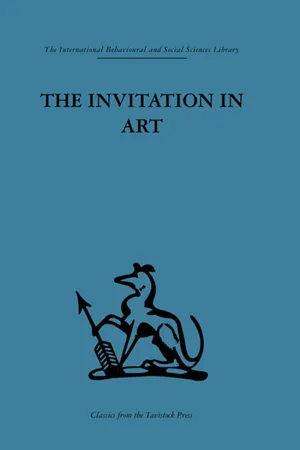
The Invitation in Art
About this book
Tavistock Press was established as a co-operative venture between the Tavistock Institute and Routledge & Kegan Paul (RKP) in the 1950s to produce a series of major contributions across the social sciences. This volume is part of a 2001 reissue of a selection of those important works which have since gone out of print, or are difficult to locate. Published by Routledge, 112 volumes in total are being brought together under the name The International Behavioural and Social Sciences Library: Classics from the Tavistock Press. Reproduced here in facsimile, this volume was originally published in 1965 and is available individually. The collection is also available in a number of themed mini-sets of between 5 and 13 volumes, or as a complete collection.
Information
Preface
I
It is to Freud’s essay on Leonardo da Vinci, which originally appeared as long ago as 1910, that most of the expectations we have about the kind of aid or illumination the study of art might look to from psycho-analysis can still ultimately be traced. Of course with the years the particular errors of fact to which Freud fell victim have become uncovered:1 most notably, the supposition that Leonardo remained in his mother’s house throughout the years of infancy, the identification of the bird in the infantile ‘memory’ with a vulture rather than a kite, Freud’s ignorance that there was already in existence in the late fifteenth century a developed cult of St. Anne, and the dating he gives to the motif of the ‘smile’ in Leonardo’s art. But these errors do not affect the validity of the method. It would be a crude mistake—though not too crude for there to be critics of Freud to make it—to conclude that because Freud was wrong in this particular case about some of the facts and therefore was led to form what is in some ways a misconceived hypothesis, therefore the kind of interpretation he was trying to make of the facts as he saw them is of impaired value: a mistake on a par with thinking in the case of a deductive argument that, if one or more of the premisses is false, the inference is invalid.
Nevertheless the method has its shortcomings : and if these do not derive from the particular errors of fact to which Freud was prone, they also transcend them. Even if Freud’s historical scholarship had been impeccable, even if there had been no mistakes of omission or commission in the collection of evidence, two criticisms would remain.
In the first place, the method would seem to presuppose that we have access to material which in the very nature of things we are unlikely to possess, or at any rate to possess to the requisite degree. And this is not just (as is often thought) a matter of biographical material, even biographical material of a kind that might have come to be suppressed through being held trivial or improper. For if that were all it was, later research might always hope to turn up the missing information: so that in time there would be as few ‘unsolved’ works of art as there are unsolved murders—where after all the initial hopes of success are also not always all that bright. But the problem is really somewhat different. For we are now in a position to see that perhaps Freud’s greatest discovery, from which our belief in the importance of the unconscious in biography is in part a derivation, was to realize that what is essential for our understanding of much human action is not just the facts of a man’s life—where he was born, how he was brought up, who his parents were, what they were like, what sensual experiences came his way and at what age—but how he felt these facts: the fantasies under which he subsumed them and through which they impinged upon him. (A child with the mildest and most permissive parents can, we now know, incorporate a corrosive, relentless superego.) We need to know, we might say, not so much a man’s biography, as its subjective structure. And it is hard to see how this can be elicited, to any serviceable extent, outside the actual process of analysis. For why else has psycho-analysis developed as it has?
And a second criticism, which is perhaps more serious still, is this: that the method, as we have it in Freud’s Leonardo, seems to leave the work of art qua work of art curiously untouched. There is, of course, a sort of disfiguring puritanism about any kind of criticism—and there are a number of them current nowadays—which is so extremely confident about where art begins and where it ends: this aspect is relevant, they say, that is purely historical, or purely technical, or purely decorative, or purely polemical, or purely literary. I feel, however, fairly clear about not falling into this type of error in charging a work like Freud’s Leonardo with a neglect of the ‘art’ aspect of the subject. For, after all, in this essay Freud sets out quite overtly and deliberately to explore the content (and no more) of a number of works of art. And by content Freud means something that a dream or a joke or a child’s game also has. And—and this is the important point—not merely does Freud think that these other phenomena have a content in the same sense as a work of art has, he thinks that they can actually have the same content. In other words, Freud’s exclusive concern with what a work of art says cannot be safely brought within the sphere of traditional art criticism by presupposing that works of art can be distinguished from other activities of the imagination by appeal to the special (or ‘higher’) character of what they say. For of this comforting but vulgar belief, Freud, typically, would hear nothing.
In his paper on the Moses in S. Pietro in Vincoli, after remarking that he had in his life obtained great pleasure from art though perhaps not always of a kind acceptable to aesthetes, Freud goes on to admit to what may seem a strange trait: that when confronted by a work of art whose effect upon him he cannot trace to something that the work asserts, he finds that this almost totally interferes with his appreciation of it. It might therefore seem plausible to suggest that Freud’s own writings on specific works of art should be regarded as so many attempts to deal with this kind of interference. And if they have come to be regarded as providing the paradigm for psycho-analytic writing about art, this is unfortunate. Indeed, in his more theoretical writings about art, Freud indicates quite clearly what else there is to be done. There he shows himself aware that just as, in the study of the artist, after the more particular questions have been answered about what he was doing when he painted this picture, or wrote that book, there remains the general question, How did he become an artist at all? How was he able to give this kind of expression, this form of articulation, to his wishes and desires?; so, in the study of art itself, when we have deciphered the content of this work or that, we cannot evade the further question, What makes it a work of art? Which is not, of course, to say that Freud’s own speculations, in terms of ‘fore-pleasure’, are anything but unacceptable.
II
The suggestion has, therefore, been made (and taken up) that a more fruitful method of applying analytic theory to the study of the arts would be to concentrate not upon content but upon the typical transformations that content undergoes as it is brought into the orbit of art. For, as we have seen, it is an implication of Freud’s own writings that art has a great deal in common with other human activities some of whose products may charm or gratify the mind, even to a high degree, but none of which goes by the name of art. The question therefore arises, Has psycho-analysis anything of interest to say about what is not common to works of art and these other objects? What are those modifications which content of a kind that might otherwise be found unacceptable necessarily undergoes in the course of earning what is society’s highest approbation? What is it for something, which might in other circumstances trickle out into play or fantasy, to be incorporated into art?
Perhaps the most succinct statement of this as the proper programme for the application of psycho-analysis to the study of art is to be found in a paper of Dr Hanna Segal’s, which originally appeared in 1952, with the title: ‘A Psycho-analytical Approach to Aesthetics’. But the most sustained attempt to realize or to execute such a programme is to be found in a series of books on which Adrian Stokes has been engaged since 1948 and of which the present book is the concluding volume. A great deal of the appeal of these books will be found to lie in the many personal and poetic touches that they exhibit, descriptions of hallowed places, of streets or street-corners that belong by now to the author’s own geography, of paintings or landscapes that have become annexed to the soul or internalized; but underlying this, or (rather) not underlying it but lying around it and linking it into a structure, is the resolve to write criticism of a very special kind. And this might be characterized by saying that it is criticism in which prime importance is attached to tracing the roots of cohesion or coherence in art, or, as it is most widely called, Form: where Form in effect embraces all the specifically artistic features that can be predicated of works of art.
But the point is still far from clear, and at least one possible cause of confusion needs to be removed. For, writing of the essay that has already engaged our attention, Freud on Leonardo, the late Ernst Kris, a theorist of the utmost distinction, said:
‘Our understanding of his [Leonardo’s] achievement would gain if, in addition to being able to demonstrate that the desire to unite the Christ with two mothers is rooted in his childhood experiences, we were able to find a similar root for the specific type of merging—for instance, the construction of a pyramidal unit into which the figures are made to fit’ (Kris, 1953, p. 22).
But despite the similarities in expression, I think that what Kris had in mind here is somewhat different from what I have attributed to Adrian Stokes as the guiding principle of his criticism. And this becomes clear when, in the next sentence, Kris cites as the ‘model’ of the kind of criticism he advocates Freud’s ‘translation of the formal characteristics of the dream into latent dream-thoughts’. For this shows that, so far from advocating any radical redirection of interest from content to form, Kris is merely arguing that the dividing line between these two aspects of a work of art can be somewhat differently drawn. Many elements of a picture that we regard (or, for that matter, that Freud regarded) as wholly formal can be reclassified as part of the content of the picture, and when this has been done, they become perfectly suitable objects for interpretation along traditional lines, along the lines originally laid down in connexion with dreams: that is, they can be shown, via the artist’s private associations or the equivalences set up in such public phenomena of the culture as myths or idioms, to be the expressions of repressed wishes or desires.
But if we examine Stokes’s criticism, we shall find (particularly if we exclude the volume on Michelangelo or the essay on Turner) very little of this kind of interpretation. The characteristics of works of art that engage his attention, and through his the reader’s, are, and remain, unrelentingly formal. I think of references to Piero’s ‘brotherly forms’, or to the representation of symbolic equivalences or concrete thinking in Cubism, or to the way aesthetic composition projects the desired co-ordination of what he has called ‘the ego figure’.
They are features—and this might be a more satisfactory way of putting the matter—that do not have a particular story to tell us. They do not directly recount to us the great dramas of infancy, with their endless scenes of love, cruelty, and fear. Nor do they embody for us, even with the utmost skill in concealment, the personae who enact these dramas: the seducing mother, the assaulted siblings, the parents locked in dangerous and frightening coition.
Of course the features of art on which Stokes concentrates—the features of art, as he would have us think of them, since they are distinctive of art—have something to say, to express; or, perhaps better still, to exhibit. ‘To exhibit’ is the word I favour, because it brings out the way in which we can see that which corresponds to the formal aspects of art in those aspects. The formal aspects have a certain kind of transparency, whereas in the very nature of the phenomenon it is not possible for someone to see the latent dream-thoughts in the manifest content of the dream. It is intrinsic to the dream-work that it is opaque. Dreams exhibit nothing.
That the formal aspects of art possess this kind of transparency is owing, it would seem, to a certain isomorphism that holds between the configurations of art and, indeed, of contemplated Nature, on the one hand, and ego-states on the other. And here in this last phrase we have a key to much of Stokes’s criticism. For not merely does he take as the object of his interpretation form rather than content, but the terminal points of his interpretations are no longer the passions and impulses of the id but the elaborate hierarchical organization of the ego.
Stokes’s criticism is deeply indebted to the work of Melanie Klein. But it is worth distinguishing, at the risk of some oversimplification, those aspects of her work on which he draws I would say most creatively. Following the later Freud, she assigned to the aggressive instincts a parity with the libidinal or sexual impulses. Basing herself on her own analytic work with children, she considerably antedated the crucial moments of infancy. But along with this extended picture of man’s instinctual endowments, there went, as a natural corollary, a far more elaborate conception of the ego and of the devices to which it must resort in order to obtain even the most transient or precarious balance. The Kleinian ego ceaselessly employs the mechanisms of splitting, projection, and introjection in its relations with the environment, and by these means becomes the hub of a whole inner world of objects and part-objects, some good, some bad, whose interrelations constitute certain recognizable psychic states or constellations. With their theoretical origins in the superego or the mourned object of Freudian theory, these inner objects far transcend their prototypes in complexity and in elaboration.
And it is to this aspect of Kleinian theory that most of Stokes’s criticism needs to be related. In so far as he concentrates upon the formal aspects of art and respects their formality, it is to this inner world of the psyche, either in its actual or potential condition, that he refers. Within his criticism the eye is led, as if without transition, from the organized configurations of art to the no less systematic relationships of the ego that they mirror.
III
At this point, however, an objection is likely to occur to the contemporary reader, that cannot be lightly dismissed.
In Art and Illusion, and again in a number of essays more specifically devoted to the problem and brought together under the title Meditations on a Hobby Horse, Ernst Gombrich has argued with great cogency and lucidity against a view which, in his opinion, has quite erroneously become dominant in the art theory of our day, and according to which an artist can, by means of purely expressive gestures, in paint or line, directly convey to the spectator the character of his inner state. Against this, Gombrich maintains that communication—under which he would subsume much of what misleadingly goes by the name of expression—cannot, that is logically cannot, occur outside a structured situation. To suppose that it could is not false, it is absurd.
The notion of a structured situation is, as used by Gombrich, a loose borrowing from communication theory, and roughly his point is that it is only where there is an established set of alternatives between which the artist must choose and with which the spectator could be acquainted, that we can think of a message passing from one to the other. For it is only in so far as it is a choice of this alternative in preference to that t...
Table of contents
- Cover
- Title page
- Copyright page
- Contents
- Preface by Richard Wollheim
- Author’s Note
- Introduction
- I. The Invitation in Art
- II. Gasometer and Tower
- III. Landscape, Art, and Ritual
Trusted by 375,005 students
Access to over 1.5 million titles for a fair monthly price.
Study more efficiently using our study tools.
Frequently asked questions
Yes, you can cancel anytime from the Subscription tab in your account settings on the Perlego website. Your subscription will stay active until the end of your current billing period. Learn how to cancel your subscription
No, books cannot be downloaded as external files, such as PDFs, for use outside of Perlego. However, you can download books within the Perlego app for offline reading on mobile or tablet. Learn how to download books offline
Perlego offers two plans: Essential and Complete
- Essential is ideal for learners and professionals who enjoy exploring a wide range of subjects. Access the Essential Library with 800,000+ trusted titles and best-sellers across business, personal growth, and the humanities. Includes unlimited reading time and Standard Read Aloud voice.
- Complete: Perfect for advanced learners and researchers needing full, unrestricted access. Unlock 1.5M+ books across hundreds of subjects, including academic and specialized titles. The Complete Plan also includes advanced features like Premium Read Aloud and Research Assistant.
We are an online textbook subscription service, where you can get access to an entire online library for less than the price of a single book per month. With over 1.5 million books across 990+ topics, we’ve got you covered! Learn about our mission
Look out for the read-aloud symbol on your next book to see if you can listen to it. The read-aloud tool reads text aloud for you, highlighting the text as it is being read. You can pause it, speed it up and slow it down. Learn more about Read Aloud
Yes! You can use the Perlego app on both iOS and Android devices to read anytime, anywhere — even offline. Perfect for commutes or when you’re on the go.
Please note we cannot support devices running on iOS 13 and Android 7 or earlier. Learn more about using the app
Please note we cannot support devices running on iOS 13 and Android 7 or earlier. Learn more about using the app
Yes, you can access The Invitation in Art by Adrian Stokes in PDF and/or ePUB format, as well as other popular books in Medicine & Health Care Delivery. We have over 1.5 million books available in our catalogue for you to explore.