- 168 pages
- English
- ePUB (mobile friendly)
- Available on iOS & Android
eBook - ePub
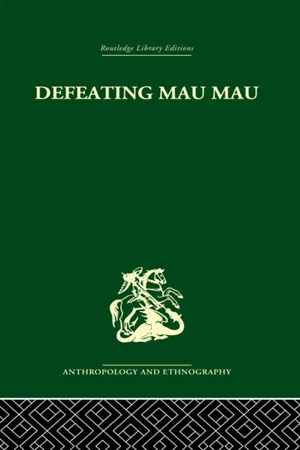
Defeating Mau Mau
About this book
The second of two important books by Louis Leakey, the renowned expert on the Kikuyu tribe. This book examines the organisation of the Mau Mau movement, its propaganda, the nature of its religious aspects and its oaths and the mistakes its leaders made as well as covering chapters on necessary reforms to prevent further outbreaks of a similar nature.
Information
V
MAU MAU PROPAGANDA
As I have already indicated, both in my earlier book and in the preceding chapters, the Kenya African Union, which started as a constitutional organisation pledged to provide a platform for the airing of genuine grievances and for seeking to persuade the Government to right genuine wrongs through constitutional channels, gradually, for the majority of the Kikuyu tribe, became a cover for Mau Mau activities. In fact, in about 1951, K.A.U. and Mau Mau became synonymous. Branches of K.A.U. whose local leaders were opposed to Mau Mau were either closed down, or the office bearers were dismissed and replaced by others who were willing to toe the line.
If, therefore, we want to study Mau Mau propaganda methods in the period leading up to the declaration of the State of Emergency in October 1952, it is the K.A.U. propaganda machine (in so far as it was directed towards the Kikuyu) that we want to examine. Mau Mau as such and the K.C.A. published nothing, for they were banned, and if they did so would at once attract attention to their underground activity.
The leaders of the Mau Mau movement, who were operating under cover of K.A.U., were quick to realise the very great opportunity which the Kikuyu love of hymn singing offered for propaganda purposes. In the first place propaganda in ‘hymn’ form and set to well-known tunes would be speedily learned by heart and sung over again and again and thus provide a most effective method of spreading the new ideas. The fact that such ‘hymns’ would be learned by heart, by those who could read them, and then taught to others, meant that they would soon also become well known to the illiterate members of the tribe. This was very important, for there were many who could not be reached by ordinary printed propaganda methods.
More important still, these propaganda messages could safely be sung in the presence of all but a very few Europeans, since the vast majority could not understand a word of Kikuyu and if they heard a large, or a small, group singing to the tune of ‘Onward Christian Soldiers’, ‘Abide with Me’, or any other well-known hymn, they were hardly likely to suspect that propaganda against themselves was going on under their very noses. They would be more likely to consider that a Christian revival was on its way.
The Kikuyu leaders of K.A.U. who were also running Mau Mau were most anxious to achieve three things: (i) to enlist as many Kikuyu as possible as members of K.A.U. and, through it, of Mau Mau; (ii) to prepare the minds of all Kikuyu for the day when Mau Mau would drive out the White Man and kill off all those Kikuyu who supported them; (iii) to ensure that no hint of the real link between K.A.U. and Mau Mau should leak out to those in authority.
The ‘hymns’, therefore, could and did contain frequent references to K.A.U. (on the face of it, a recognised peace-loving, constitutional body) and could openly appeal to all to join the body. At the same time, in order to achieve the second object, the ‘hymns’ must work up a deep hatred for the White Man and for the loyalists and must prepare the ground for violence. But since K.A.U. was ostensibly a peace-loving body pledged to use nothing but constitutional methods, the ‘hymn-books’ must in no circumstances be officially linked with K.A.U. If it should become necessary, it must be possible for K.A.U. leaders to deny all knowledge of the books and so keep the African Union in the clear. If any question were ever raised the leaders must be able to say that over-zealous followers had acted without their knowledge in writing and printing these ‘hymn-books’.
The ‘hymn-books’, therefore, while calling on people to join K.A.U. and extolling by name those K.A.U. Kikuyu leaders who were also the planners of Mau Mau, never appeared as official K.A.U. publications. Many of them were, however, distributed through K.A.U. head office and its branches, and the ‘hymns’ were regularly sung at K.A.U. meetings. In fact, to the masses, these books were known as ‘K.A.U. Hymn Books’.
The first of these so-called ‘hymn-books’ to appear in print was probably that compiled and edited by Kinuthia Mugia.1 It is undated, but neither in the introduction nor in the preface is there any reference to other similar ‘hymn-books’, whereas the prefaces of later books all refer to ‘earlier hymn-books’ that have appeared. The introduction to the book was written by the then editor of a Kikuyu newspaper called Mumenyereri. This preface is, I think, worth translating in full before I give translations of some of the actual ‘hymns’, since it is very revealing. It reads:
‘I am one of those who persuaded Mr. Kinuthia Mugia, the singer of these hymns2 to have them printed in book form. I have to admit that when I first heard some of them sung by him I felt a mixture of sorrow and joy in my heart, until my tears flowed, whether I liked it or not. When, therefore, he says in his preface that “hymns are a voice which penetrates quickly to the heart” I wholly support this opinion of his.
‘These hymns of his are connected with things that are taking place at the present time and when, therefore, they are sung at meetings3 they enter the hearts of the people gathered together, in an excellent way, and form, as it were, a foundation for the speeches of the leaders.
‘Another thing which Mr. Kinuthia has done, which is most valuable, is to write down some real Kikuyu hymns such as have been known to the Kikuyu from the beginning. Of these one is the one called “Kaari” which used to be sung by the warriors when they had conquered in battle, while another is the hymn of the cultivators which used to be sung to a lazy person in order to make him zealous in his work.
‘Therefore Mr. Kinuthia should be thanked by all Kikuyu people for having consented to have these hymns printed, so that they may reach all the many people now living, as well as those who will come after us, for as Gikuyu1 said “the spoken word is never lost”.’
The following extracts from Mr. Kinuthia’s own preface to the ‘hymns’ will also be of interest before we turn to the hymns themselves:
‘Hymns form a voice which reaches speedily not only the ears but also the very hearts of the people and if you think over this statement quietly you will realise how true it is.
‘Hymns are prayers which reach God quickly.
‘These hymns are a gift sent by God and revealed through one person and since an apostle is sent unto the masses, are you not one of the masses?’
We thus see that the method of propaganda via ‘hymns’ was especially chosen because it was a quick and effective way to reach the hearts of the people and to prepare them to receive the speeches and ideas of their leaders. The ‘hymns’ were, moreover, specifically announced as being the result of a special revelation by God and were thereby given the blessing and force of supernatural messages.
Since it would occupy too much space in this book to translate all Mr. Kinuthia’s thirty-eight ‘hymns’, I shall have to be content with giving enough extracts to indicate the nature of the propaganda which they contain.
The first hymn1 is by way of being a hymn of welcome, to be sung to those who have assembled at a K.A.U. meeting and it is immediately followed by No. 2 which consists of the most fulsome praise of Jomo Kenyatta. The hymn reads as follows:
‘God makes his covenant shine until it is brighter than the sun, so that neither hill nor darkness can prevent him coming to fulfil it, for God is known as the Conqueror.
‘He told Kenyatta in a vision “You shall multiply as the stars of heaven, nations will be blessed because of you”. And Kenyatta believed him and God swore to it by his mighty power.
‘Kenyatta will find happiness before God, for he is the foundation stone of the Kingdom. He has patiently suffered pain in his heart, he is moreover the Judge of the Kikuyu, and will dispense justice over the House of Mumbi.2
‘Kenyatta is the foundation stone of the Kingdom, his house shall never lack a light, nor will it ever lack a centre pole, provided for him by the God of the Kikuyu, namely justice.
‘Kenyatta made a Covenant with the Kikuyu saying he would devote his life to them, and would go to Europe to search for the power to rule, so as to be a judge over the House of Mumbi. I ask myself “Will we ever come out of this state of slavery?”
‘He went, he arrived there and he came back. He promised the Kikuyu “When I return M——shall go in order to arrange for the return of our land”. May God have mercy upon us.
‘When the day for his3 return comes he will come with the decisions about our land and the building which he said he would come to erect at Githunguri ya Wairera shall be the one in which our rule shall be established.’
The third hymn is in praise of education and calls upon the people to give their support to the Independent Schools, which of course were under Mau Mau control.
The fourth hymn is an attack on those who are alleged not to have the interests of their own peoples at heart, that is to say, those who work for the European interests.
The fifth hymn in the book is a lament for the lost Kikuyu lands, and the sixth a lament over the Kikuyu who were removed from the Olengernone settlement and taken to Yatta. Some comment on this event is necessary, for the alleged injustice over the Olengernone settlement is one of the many events that was selected by Mau Mau leaders as a major weapon to stir up ant...
Table of contents
- Cover
- Title Page
- Old Copyright Page
- New Copyright Page
- Preface
- Table of Contents
- I. The present position
- II. Mau Mau aims
- III. Mau Mau organisation
- IV. Mau Mau religion
- V. Mau Mau propaganda
- VI. Mau Mau oath ceremonies
- VII. Mau Mau methods
- VIII. Mau Mau and other tribes
- IX. Kikuyu ‘Loyalists’ and Home Guards
- X. The handicaps of the Security Forces
- XI. What must be done: Religious, educational, and economic reforms
- XII. What must be done: Social and political reforms
Trusted by 375,005 students
Access to over 1.5 million titles for a fair monthly price.
Study more efficiently using our study tools.
Frequently asked questions
Yes, you can cancel anytime from the Subscription tab in your account settings on the Perlego website. Your subscription will stay active until the end of your current billing period. Learn how to cancel your subscription
No, books cannot be downloaded as external files, such as PDFs, for use outside of Perlego. However, you can download books within the Perlego app for offline reading on mobile or tablet. Learn how to download books offline
Perlego offers two plans: Essential and Complete
- Essential is ideal for learners and professionals who enjoy exploring a wide range of subjects. Access the Essential Library with 800,000+ trusted titles and best-sellers across business, personal growth, and the humanities. Includes unlimited reading time and Standard Read Aloud voice.
- Complete: Perfect for advanced learners and researchers needing full, unrestricted access. Unlock 1.5M+ books across hundreds of subjects, including academic and specialized titles. The Complete Plan also includes advanced features like Premium Read Aloud and Research Assistant.
We are an online textbook subscription service, where you can get access to an entire online library for less than the price of a single book per month. With over 1.5 million books across 990+ topics, we’ve got you covered! Learn about our mission
Look out for the read-aloud symbol on your next book to see if you can listen to it. The read-aloud tool reads text aloud for you, highlighting the text as it is being read. You can pause it, speed it up and slow it down. Learn more about Read Aloud
Yes! You can use the Perlego app on both iOS and Android devices to read anytime, anywhere — even offline. Perfect for commutes or when you’re on the go.
Please note we cannot support devices running on iOS 13 and Android 7 or earlier. Learn more about using the app
Please note we cannot support devices running on iOS 13 and Android 7 or earlier. Learn more about using the app
Yes, you can access Defeating Mau Mau by Louis Leakey in PDF and/or ePUB format, as well as other popular books in Social Sciences & Anthropology. We have over 1.5 million books available in our catalogue for you to explore.