- 604 pages
- English
- ePUB (mobile friendly)
- Available on iOS & Android
eBook - ePub
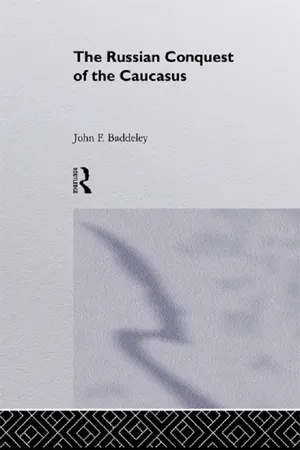
The Russian Conquest of the Caucasus
About this book
Reprint of Baddeley's classic and rare account of the resistance of the North Caucasians under Shamil against the expansion of Tsarist Russia, with a new introduction by Moshe Gammer. Highly relevant to recent developments in the region.
Information
THE RUSSIAN CONQUEST OF THE CAUCASUS
PART I
FROM THE EARLIEST TIMES TO 1829
CHAPTER I
The Russian approach to the Caucasus—First contact—Free Cossacks—Early relations with Georgia—First conflicts with the natives—Cossack colonisation—Formation of the great Cossack Line—First crossing of the mountain chain—Summary of events leading to the incorporation of Georgia in the Russian Empire
THE connection between Russia and the Caucasus goes back to the year A.D. 914, when a Varangian expedition from the mouth of the Dnieper reached the Caspian by way of the Don and the Volga, the ships or boats being dragged overland from the first to the second of those rivers. In 944, three years after Igor, Prince of Kieff’s attack on Constantinople, others of these “Russ” or “Ros” (Varangians, Variags) again made their appearance on the Caspian, invaded Persia, and captured from the Arabs the city of Berdaa, capital of Arran, now Karabágh.1 A little later the Grand Prince Sviátoslav extended his conquests to the river Koubán in the north-west Caucasus, and carried on war against the Yassi and the Kossogs, supposed to have been the ancestors of the modern Ossietines and Tcherkess (Circassians) ;2 and before the end of the same century these Variags, Russ or Russians, had established the Principality of Tmoutarakán, the Tamatarchia of the Greeks, on the peninsula opposite Kertch, now called Tamán, all notices of which cease, however, in the Russian chronicles from the year 1094.
The Grand Prince Vladeemir, who converted Russia to Christianity towards the end of the tenth century, on his death left Tmoutarakán to Mstislav, “ . . . the latter having acquired great fame from the wars with the Khazars, whom, with the aid of the Greek Emperor Basil II., he finally defeated, and with the Tcherkess, whose chieftain he slew in single combat.”3
Later we hear of Vladeemir Monomakh (1113–1125) obtaining great successes against the Tcherkessi and other tribes.
Without entering into the much-vexed question of the identity of the “Russ,” and merely noting that early in the thirteenth century the great Queen of Georgia, Tamára, married George, son of the Grand Prince Andrew Bogo-lioubsky, and that Mikhail of Tver was assassinated in 1319, near Derbend, by the renegade Románets at the instigation and under the eyes of the Grand Prince of Moscow, we may say that the contact of the Russians, as a people, with the tribes of the Caucasus—leading to the Russian conquest of that country—began with the Cossack invasion of the districts about the mouth of the Térek in the latter half of the sixteenth century.
The origin of the Cossacks themselves is involved in considerable obscurity, but they first appear in history as free and lawless communities on the south and east of the Polish and Moscovite dominions, such as were naturally engendered during the troublous times following the Tartar and Mongol invasions. Nomadic, probably, at first—mere roving bands—they afterwards settled down, as opportunity allowed, at favourable positions along the courses of various rivers; and eventually, as times grew more peaceful, added agriculture to the more primitive occupations of fishing and pasturage, without, however, abandoning their primary pursuit, the raiding warfare directed constantly against their Mussulman neighbours, occasionally against their fellow-Christians of Poland and Moscovy. Thus were formed, in turn, the Cossacks of the Don, the Volga, and the Ural, who, as the Russian princes reasserted or extended their sway, came, nominally at first, under their authority; and those of the Ukraine, or Little Russia, who owed a wavering allegiance to the Kings of Poland, until driven by the tyranny of that inept race of rulers, backed by Jesuit oppression and Jewish exaction, into the arms of their Moscovite rivals. Besides all these there were the Zaporózhians,4 who took their name (Zaporózhtsi) from the fact that they dwelt “beyond”—that is, below—the rapids (poróghi) of the Dnieper, their chief settlement being the sietcha, or fortified camp, established on an island in that river. These people differed considerably in their organisation from all other Cossack communities if, as alleged, they allowed no women in their camps, and formed, in fact, a sort of commonwealth, or republic, of warrior monks. In any case they succeeded in realising very thoroughly the ideal of the French Revolution—Liberty, Equality, Fraternity. They, too, owned at times the suzerainty of the Polish kings, but their allegiance sat so lightly on them that they engaged in constant warfare against the unbelievers, even when Poland was at peace with both Turk and Tartar. “They neither asked nor gave quarter, existed on the plunder of the Infidel, courted danger and martyrdom.”5 Little Russians by race, with some admixture of Lithuanian and Polish elements,6 they were zealous sons of the Holy Orthodox Church, not Sectarians or “Old Believers” like their cousins of the Don and the Volga. Thrust forward against the Crim Tartars and the Ottoman Turks, they formed the “vanguard of the vanguard” of the Russian Slavs, and in that perilous position maintained themselves, their liberty and privileges, against Christian and Infidel alike until Peter the Great captured their stronghold after Pultóva, whereupon they migrated to the Crimea, but were allowed by the Empress Anne to re-establish themselves on the Lower Dnieper. Meantime, however, many changes had taken place. The fierce, liberty-loving Zaporózhians scarcely recognised their former country in its altered conditions ; and, as their presence seemed incompatible with the security of the colonists who had taken their place, Catherine II. in 1775 finally extinguished the Republic. Potiomkin, by her orders, occupied and again destroyed their sietcha.7 The malcontents fled to the territory of the Sultan; the rest were organised and embodied as the Black Sea Cossack troops ; and in 1792 the Isle of Phanagoria and the eastern shore of the Sea of Ázoff were assigned them to dwell in.
In this way the Cossacks gradually occupied the whole of the debatable land east and south of Russia and Poland ; little by little drove back the Mussulman hordes ; and in the course of centuries added belt upon belt of fertile territory to their own possessions, and eventually to the Empire of the Tsars. As time went on, despite many vicissitudes, they steadily gravitated towards Russian allegiance ; but the process of absorption by the central power was a slow one ; and, at first, as some communities came under the aegis of the Princes and afterwards of the Tsars, others continued to form on the old lines from those individuals or classes to whom, for one reason or another, restraint was irksome, or life in their own homes intolerable. Such were the bold and adventurous spirits always numerous in time of trouble; fugitives from justice, from oppressive taxation, from religious persecutions, and, later—when by an edict of Feodor Ivánovitch (1584–1598) the peasantry had been ascribed to the glebe—runaway serfs in ever-increasing numbers. Nor were these the only sources of increment. The vast majority of those who joined the Cossack ranks were, naturally, men; and celibacy had no attraction for any of them, with the one exception already mentioned. Wives they must have, and, as a consequence, the capture of women formed a main incitement to their constant raids, a necessary condition, indeed, of their continued existence and prosperity. It follows that those who represent the Cossacks as almost entirely of Slav blood are just as wide of the mark as those who see in them, merely, the descendants of the Khazar and other Turk or Tartar tribes. If one thing is certain about them, it is that they are of mixed race; for if, as may fairly be inferred from the language and religion of their descendants, the men who formed the original bands were Slavs, their women, at first and for long afterwards, must have been drawn in great part from the tribes they warred against or settled amongst—and it is well known that male recruits from the same sources joined them from time to time in large numbers. In their earliest days raiders, spies, and frontier-guards—wary, bold, alert; later on, as their power increased, a rampart of ever-growing efficiency against the Infidel foemen ; and, eventually, settled, law – abiding colonists, holding a vast extent of land under military tenure, the Cossacks, notwithstanding all aberrations and defections, rendered very great service to Russia, at first quite unconsciously, with no intention of benefiting any but themselves, but later on as loyal subjects of the Tsar. In both cases—as free-lances, robbers, and pirates, and as military communities obedient to the central authority—they carried on with zeal and success the work of conquest and colonisation. Themselves the spontaneous outcome of circumstances, and guided only by their own uncurbed desires, they performed in their early days a work far beyond the power of any government then existing in Russia, and added a vast empire to the comparatively restricted domains of the Moscovite princes. True it is that before this consummation was arrived at their lawless and independent spirit gave constant cause for anxiety to their nominal or actual suzerains; embroiled them, times without number, with Turk and Tartar ; and more than once imperilled their dynasties and dominions. From the ranks of the Cossacks came the first and second of the false Dmeetris, and other pretenders. The rebellion of Stenka Razeen (executed 1671), that of 1706 under Boulávine, that of Mazeppa six years later, and, finally, the great rising under Pougatchéff in the timp of Catherine the Great, were one and all Cossack rebellions, and they deluged southern and eastern Russia with blood. But it must not be forgotten that this very lawlessness and independence of spirit had been an element of success, a factor craftily used on numberless occasions by the Moscovite princes, whose policy it was to egg on the borderers to harass and attack their Mussulman neighbours, profit by their efforts when successful, but repudiate all responsibility for their misdeeds when called to account by khan or sultan.
In course of time the Cossacks were brought directly and finally within the fold of the State, and the work of conquest and colonisation continued under the sagacious guidance of the central power with more definite aims than before, but hardly with greater success.
There is no necessity to describe here the growth and history of the Cossacks in general, but in the following sketch of what may be called—in terms of Veliameenoff’s comparison—the Russian approach to that vast fortress, the Caucasus, and later in more detail, we shall obtain glimpses of them in either phase of their development and under both aspects of their service.
According to one tradition, certain Cossacks of Riazán, fleeing from the wrath of Ivan III. (1462–1505), floated down the Don with their wives and children, their flocks and herds, and crossing over to the Volga, followed the course of that river to the Caspian, and thence reached the Térek. Here they found a settlement, semi-piratical, semi-commercial, called Tioumén; but continuing their flight inland, came to a halt at the confluence of the Argoun and Soundja, that is to say, not far from the present town of Grozny. From the ranges of hills in this neighbourhood they took the name of Grebéntsi,8 and in the time of Ivan IV. (the Terrible) sent a deputation to Moscow asking pardon, which was granted on condition that they built a fort at the mouth of the Soundja, and held it in his name.9
Here they came in contact not only with the local tribe, the Tchetchens, but with the Kabardán princes, who from their own land between the Térek and the Koubán had extended their authority eastward to the Koumuik plain. The Kabardáns were of the noble race of the Adeeghe, which included the Tcherkess or Circassians proper, and of Ivan the Terrible’s many wives one was Maria, a Tcherkess princess.
In 1579 Yermák and two other outlaws took counsel at the mouth of the Volga as to where they should seek refuge from the vengeance of the Tsar. Yermák went north and east, and eventually added Siberia to the Russian dominions. One of his companions, Andréya Shádrin, so the story goes, sailed south and fortified Terkee, apparently the same place as Tioumén, at the mouth of the Térek ; and a little later settled at Andreyevo, the present Enderee.
So far the Russian State was not immediately concerned, but in 1586 the Iberian10 Tsar, Alexander, sent ambassadors to Moscow asking help against the Shamkhal of Tarkou,11 with the result that a force under the Boyar Khvorostin, in 1594, attacked and captured the Shamkhal’s capital, but was afterwards driven out and, to the number of 7000 men, annihilated on the banks of the Soulák. The Tsar Feodor Ivánovitch, in spite of the ill-success of the Eussian arms, took to himself, prophetically, the additional titles of “ Lord of the Iberian land, of the Tsars of Georgia and of Kabardá, of the Tcherkess and Mountain princes.” In 1596 Moscovite ambassadors journeyed to Tifiis, returning in 1599, and five years later the Tsar Boris Godounóff sent two forces, from Kazán and Astrakhan,12 to avenge the insult and injury suffered, but with no better result. The promised co-operation of the Tsar Alexander failed—as it had before—and the Russian force, which had been joined by some of the Terkee and Grebéntsi Cossacks, was again cut to pieces by the Shamkhal’s troops.
These accounts rest partly on tradition, and the date of the first appearance of the Russians on the Térek remains an open question; but it is probable that about the middle of the sixteenth century Tioumén, afterwards Terkee, was really founded or fortified by a band of roving Cossacks or outlaws; that Shadrin led another band up the Térek to the Aktash and the Soundja ; and that from these two bands came the historical Grebéntsi and Térek Cossacks. It is certain that the former were found by the Government geologists Fitch and Herold in 1628 living in the foot-hills of Tchetchnia, and that about 1685 they retired northward to the Térek at Bragounee. Meantime the celebrated Stenka Razeen had, in 1668, attacked Tarkou, but, beaten off by the Shamkhal, had sailed south on his raid into Persia.
In 1707 the Térek Cossacks suffered defeat at the hands of the Khan of Koubá,13 and five years later the famous General-Admiral Apraxin, on his return from a successful expedition against the western tribes, finding the Grében Cossacks in their settlements on the south or right bank of the Térek, induced them to cross that river, establish themselves in stanitsas 14 on its left bank—where they dwell to this day—and hold it against all comers as loyal servants of the Tsar.
Apraxin in Peter’s name gave each man a rouble, and to the whole community or regiment a mace of honour, still religiously preserved, together with various trophies, including a banner of the Tsar Alexei Mikhailovitch (1645–1676), the possession of which is not so clearly accounted for.
In 1716–17 the Grebéntsi, who, it is quite evident, must have been living all this time on terms of amity, not to say friendship, with some of the Koumuik and Kabardán princes, furnished 800 men to Peter’s fatal Khivan expedition, commanded by Prince Békovitch-Tcherkásky, one of a family that had adopted the Orthodox religion and served Russia devotedly from generation to generation. Of the 800 only two came back to tell that tale of horror on the banks of the Térek. Békovitch-Tcherkásky was flayed alive, and his skin, stuffed with straw, was hung up over the principal gate of Khiva.
Six years later (1722) Peter himself headed an expedition to the Caucasus, and on his return from the capture of Derbend, founded the Holy Cross fort on the Soulák,15 afterwards (1735) abandoned in favour of Kizliar, which, up till 1763, was, so to speak, the Russian capital of the Caucasus.16 The Térek Cossacks retired to their old haunts on the lower course of the Térek, and Don Cossacks and others, to the number of 450 families, who had settled on the Agrakhán channel of the Soulák,17 filled up the gap between them and the Grebéntsi. These newcomers took the name of Térek-Seméiny (or family) Cossacks.
The number of aliens amongst the Térek Cossacks was very great, whole stanitsas being non-Christian; but the Grebéntsi admitted none but Christians, or those who consented to become such. Their own wives were of native birth, probably for the most part Tchetchens, with a mixture of Koumuiks, and to this it is said they owed their comparatively advanced agriculture and much else—for, be it remembered, this was not a case of contact between a civilised and a savage people. The Cossacks of that day were probably at most the equals in civilisation of the Tchetchens and Koumuiks, and certainly the inferiors of the Adeeghe, to whom belonged the Kabardán princes and people. “Kabardá served as lawgiver to the Grebéntsi in matters of fashion, and from there they took their light and convenient military equipment and arms, their method of warfare, djighitovka (feats of skill on horseback), &c.” 18 “. . . These people,” says M. Popko, “ lived at the expense of their neighbours, many of whose customs they introduced into their settlements, together with the spoils of war.”19 As regards the houses, the typical Russian izbá was forgotten, and instead appeared the Kabardán ouna, with its open gallery and its internal construction, arrangement, and decoration. All that remained of the Russian village was, externally, the street and, internally, the stove. The Russian teliéga (four-wheeled cart), draught-horse, and way of harnessing were likewise abandoned in favour of two-wheeled arbas, oxen and yoke. The Kabar-dáns were an agricultural people, and the newcomers were wise enough to follow their example in matters wherein they had been eminently successful. Two kinds of culture, however—both new to the Russians—were more probably borrowed from the Koumuiks, those, namely, of the vine and of the silkworm, which flourish on the banks of the Térek to this day, having doubtless been supported through times of trouble and danger by the Cossack’s passion for drink and his wife’s delight in finery. The Grebéntsi women...
Table of contents
- Cover
- Halftitle
- Title Page
- Copyright Page
- Foreword
- Preface
- Table of Contents
- Illustrations
- PART I FROM THE EARLIEST TIMES TO 1829
- PART II THE MURID WAR
- APPENDIX
- INDEX
Trusted by 375,005 students
Access to over 1.5 million titles for a fair monthly price.
Study more efficiently using our study tools.
Frequently asked questions
Yes, you can cancel anytime from the Subscription tab in your account settings on the Perlego website. Your subscription will stay active until the end of your current billing period. Learn how to cancel your subscription
No, books cannot be downloaded as external files, such as PDFs, for use outside of Perlego. However, you can download books within the Perlego app for offline reading on mobile or tablet. Learn how to download books offline
Perlego offers two plans: Essential and Complete
- Essential is ideal for learners and professionals who enjoy exploring a wide range of subjects. Access the Essential Library with 800,000+ trusted titles and best-sellers across business, personal growth, and the humanities. Includes unlimited reading time and Standard Read Aloud voice.
- Complete: Perfect for advanced learners and researchers needing full, unrestricted access. Unlock 1.5M+ books across hundreds of subjects, including academic and specialized titles. The Complete Plan also includes advanced features like Premium Read Aloud and Research Assistant.
We are an online textbook subscription service, where you can get access to an entire online library for less than the price of a single book per month. With over 1.5 million books across 990+ topics, we’ve got you covered! Learn about our mission
Look out for the read-aloud symbol on your next book to see if you can listen to it. The read-aloud tool reads text aloud for you, highlighting the text as it is being read. You can pause it, speed it up and slow it down. Learn more about Read Aloud
Yes! You can use the Perlego app on both iOS and Android devices to read anytime, anywhere — even offline. Perfect for commutes or when you’re on the go.
Please note we cannot support devices running on iOS 13 and Android 7 or earlier. Learn more about using the app
Please note we cannot support devices running on iOS 13 and Android 7 or earlier. Learn more about using the app
Yes, you can access The Russian Conquest of the Caucasus by J. F. Baddeley in PDF and/or ePUB format, as well as other popular books in Social Sciences & Ethnic Studies. We have over 1.5 million books available in our catalogue for you to explore.