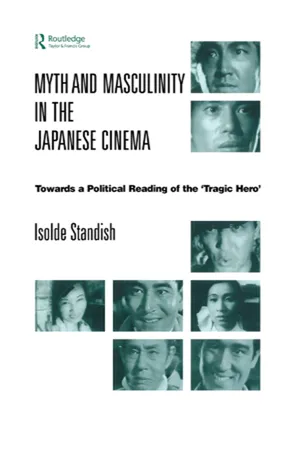
eBook - ePub
Myth and Masculinity in the Japanese Cinema
Towards a Political Reading of the Tragic Hero
- 242 pages
- English
- ePUB (mobile friendly)
- Available on iOS & Android
eBook - ePub
Myth and Masculinity in the Japanese Cinema
Towards a Political Reading of the Tragic Hero
About this book
This study argues that in Japanese popular cinema the 'tragic hero' narrative is an archetypal plot-structure upon which male genres, such as the war-retro and yakuza films are based. Two central questions in relation to these post-war Japanese film genres and historical consciousness are addressed: What is the relationship between history, myth and memory? And how are individual subjectivities defined in relation to the past? The book examines the role of the 'tragic hero' narrative as a figurative structure through which the Japanese people could interpret the events of World War II and defeat, offering spectators an avenue of exculpation from a foreign-imposed sense of guilt. Also considered is the fantasy world of the nagare-mono (drifter) or yakuza film. It is suggested that one of the reasons for the great popularity of these films in the 1960s and 1970s lay in their ability to offer men meanings that could help them understand the contradictions between the reality of their everyday experiences and the ideological construction of masculinity.
Information
CHAPTER 1
Backgrounds
The Invention of the Kokutai and Early Cinema
Nationalism - the principle of homogenous cultural units as the foundation of political life, and the obligatory cultural unity of rulers and ruled - is indeed inscribed neither in the nature of things, nor in the hearts of men, nor in the pre-conditions of social life in general, and the contention that it is so inscribed is a falsehood which nationalist doctrine has succeeded in presenting as self evident. (Gellner 1990:125)
In Japan, the connection between a person and his . . . ie, [household] is at the same time the link between the individual and the nation. Today, if we but probe a little, we realise that the faithful subjects and loyal retainers of history are our ancestors, and we are aware, not just vaguely but in a concrete way, of the intentions of our ancestors. The awareness that our ancestors have lived and served under the imperial family for thousands of generations forms the surest basis for the feelings of loyalty and patriotism (chūkun aikokushin). If the ie were to disappear, it might even be difficult for us to explain to ourselves why we should be Japanese. As our individualism flourished, we would come to view our history no differently from the way we view that of foreign countries, (from a speech made by Yanagita Kunio to the Greater Japan Agricultural Association in 1906, quoted in Irokawa 1985:288)
Lévi-Strauss, through the deconstruction of the mythology of the Indians of South America, concluded that a binary opposition of nature/culture underlined these myths. Thus he saw them as offering a solution to ‘the philosophical problems arising from the introduction of an agricultural mode of life’ (1990:186). This study suggests that a similar binary opposition based on nature/culture is inherent in Chūshingura; nature as defined in nativist ideologies of the kokutai (national polity)15 and family state (kazoku kokka) is contrasted with the ‘corrupting’ influences associated with the introduction of western culture.16 Furthermore, I shall argue that the adoption of Chūshingura into the collective tradition of modern Japanese mythology in the form of the ‘tragic hero’ was precisely because it offered a solution to some of the philosophical problems arising from the development of a market economy in the latter half of the Tokugawa period (1615-1867) and the subsequent introduction of western technology in the Meiji period (1868-1912). Beasley stated that in eighteenth-century Japan ‘feudalism was facing a crisis in that its political forms had outlived its economic base’ (Beasley 1973:72). This crisis17 is evident in the historical events upon which the narratives of Chūshingura are ostensibly based. The Confucian scholar Ogyū Sorai’s (1666-1724) assessment and solution to the problem posed by the actions of Ōishi Kuranosuke and his followers was an attempt to reach a compromise between the old ideologies of political legitimacy and the new rule of law emerging as Japan was entering the period of transition from a feudal to a market economy. Ogyū Sorai posed the question, ‘If a private principle predominates over a public principle, how can the law of the world stand?’ (quoted in Ikegami 1995:233). As Beasley points out ‘by 1700 Japan’s merchants were already highly specialized’ (Beasley 1973:43). Their economic advance not only threatened the samurai class financially, but also challenged the Confucian-based status divisions upon which the society was founded. The sankin kōtai18 (alternative attendance) system was in part responsible for the advanced state of the economy in the major towns at this time. The daimyō (feudal lords) and samurai who were forced into maintaining expensive homes in the capital stimulated market activities that contributed to the moneterisation of the economy.
To understand the ideological roots of the nature/culture binary discourse inherent in the ‘tragic hero’ myth, it is necessary to turn to a discussion of the Meiji period and the emergence of the kokutai as a concept comprised of several unifying ideologies which ultimately developed at the time of the Russo-Japanese war of 1904-1905 into popular nationalism.
Yoshino (1995) in his study Cultural Nationalism in Contemporary Japan argues that the reason for the emergence of cultural nationalism as manifested in concepts of the kokutai and the nihonjinron was a need to ‘regenerate the national community’ by creating and/or strengthening a people’s cultural identity when it is threatened. Hobsbawm raises a central question which must be addressed if one is to come to terms with the role and function of myths and ideologies of nationalism in social life.
Why and how could a concept so remote from the real experience of most human beings as ‘national patriotism’ become such a powerful political force so quickly? It is plainly not enough to appeal to the universal experience of human beings who belong to groups recognizing one another as members of collectivities or communities, and therefore recognizing others as strangers. (Hobsbawm 1992c:46)
Gellner (1990) in part answers this question by tracing in theoretical terms the birth of nationalism from the agrarian (or feudal) stage of development to the industrial phase. His hypothesis is that, contrary to popular thought, a sense of nationalism is the precursor of the birth of the nation and not the other way round. He argues that the conditions for the growth of nationalism are inherent in the social relations required by industrialisation. These are mobility and universal education. Agro-literate societies tended to be sedentary and ‘inward-turned’ communities dominated by an elite who through the legitimate use of violence maintained order and who were purveyors of the ‘official wisdom of the society’. At this stage of social development, Gellner states, ‘both for the ruling stratum as a whole, and for the various sub-strata within it, there is a great stress on cultural differentiation rather than on homogeneity’ (1990:10). In the Tokugawa period, this ideological differentiation was codified in the four Confucian social divisions of samurai, peasant, artisan and merchant. This system of social ordering was dependent on the maintenance of these social groups as static. However, the growth of the economy ultimately led to an increase in wealthy merchants and, combined with peasant unrest, facilitated the eventual disintegration of the Confucian social order. Ikegami tells us that the factors encouraging economic growth were the reclamation of arable land which led to an accumulation of an economic surplus in many villages; the sankin kōtai system; improvements in agricultural technology; and ‘the most important factor stimulating a market economy’, the taxation system, whereby tax revenue was paid in rice which was sold for cash in the market place. As Ikegami explains,
The establishment of a decentralized yet highly integrated political system encouraged economic growth and facilitated the development of a market economy on a national scale. The subsequent social developments stimulated by these gradual economic changes encouraged population and commodity mobility. This new fluidity in turn generated serious problems in many areas for the bakuhan system of domination. (Ikegami 1995:172)
The effects of the economic changes were an increasingly mobile population, urbanisation and labour migration. By the mid-eighteenth century, five to seven percent of the population lived in one of the three major cities of Edo, Osaka or Kyoto (Ikegami 1995:173) and between 1897 and 1916 the population of Osaka doubled to 1.5 million and in 1911 only forty percent of Tokyo’s population had in fact been born there (Gluck 1985: 33). Relatively stable agricultural communities of the early Tokugawa period, characterised by social differentiation of vertical status divisions and geographically isolated from historical links, were replaced over a period of several hundred years by new urban societies in a state of constant change and flux.
The reproduction of agrarian society was rooted in an educational system that was both localised and intimate. Families passed skills down from one generation to the next. In contrast, industrial labour relations are dependent on a generic core of education transmitted to all potential workers. Skill flexibility is concomitant with mobility, therefore, even though at one level, industrial society is highly specialised ‘its educational system is unquestionably the least specialized, the most universally standardized, that has ever existed’ (Gellner 1990:27). It is the state, in industrial society, which has the monopoly of legitimate education. Gellner explains that as the economy industrialises, it is the education monopoly which becomes more important than the monopoly on violence19 for the maintenance of social order.20 To sum up, industrial society requires its workers to be both mobile and flexible and to have a generic training which allows for communication through standard idioms between individuals who do not necessarily know each other. Therefore, in Japan it was in the industrialising phase of development that the Confucian social divisions were eroded (the bakumatsu period), and cultural homogeneity, perpetuated through the advent of universal education introduced during the Meiji period, became the dominant theme as nationalist sentiments came to the fore.
Anderson made a similar point when he stated that ‘nationalism has to be understood by aligning it, not with self-consciously held political ideologies, but with the large cultural systems that preceded it, out of which - as well as against which - it came into being’ (Anderson 1993:12). Therefore Gellner speaks of a cultural hegemony as being the most pervasive form of social control in modern societies; that is, a common culture disseminated through a centralised education system, and I would add, increasingly through centralised mass media.
Therefore an answer to the question of how concepts of the nation-state, which differed in size and scale from the agrarian communities with which individuals had identified, are inculcated in people’s minds as real concepts, must lie in the dissemination of the dominant culture. In the early phase of Japanese industrialisation the introduction of universal education in 1872 and conscription in 1873, combined with the standardisation of the language, facilitated the dissemination of the dominant culture to the lower levels of society. The state mobilisation of the population through these institutions, combined with the needs of industry for a mobile and flexible labour force, led to a degree of cultural homogenisation and even social equality. This equality was, theoretically, institutionalised in the Five Articles of the Imperial Charter Oath (Go-kajō no Seimon) of April 1868 which, among other things, stipulated that ‘high and low would be of one heart in carrying out national policy’, that ‘merchants and peasants would achieve their ambitions’ and that ‘uncivilized customs of the past would be abandoned’ (Lehmann 1982:185). The Charter Oath encouraged the subsequent use of phrases such as shimin byōdō (the equality of all citizens) and ikkun banmin (one ruler, many subjects). Both phrases emphasised the abolition of the Confucian class structure and promoted the equality of all subjects within the kokutai. This is still reflected today in the Japanese almost universal belief that they are middle-class.21 As Gellner explains:
Men can tolerate terrible inequalities, if they are stable and hallowed by custom. But in a hectically mobile society, custom has no time to hallow anything . . . Stratification and inequality do exist, and sometimes in extreme form; nevertheless they have a muted and discreet quality, attenuated by a kind of gradualness of the distinctions of wealth and standing, a lack of social distance and a convergence of life-styles, a kind of statistical or probabilistic quality of the differences (as opposed to the rigid, absolutized, chasm-like differences typical of agrarian society), and by the illusion or reality of social mobility. (Gellner 1990:25)
The latter half of the Tokugawa period saw the beginnings of the homogenisation of the traditional social class divisions which continued into the Meiji period with the abolition of the samurai class and the inception of universal conscription in 1873. This included the dissemination of what had been an exclusive dominant culture to the lower echelons of Japanese society. Lehmann 0982) refers to this process as the ‘samurai-isation’ of the lower classes. The ideals and values of the samurai class were disseminated throughout the entire population by means of, for example, the Imperial Rescript to Soldiers and Sailors of 1882 (Gunjin Chokuyu) and the Imperial Rescript on Education of 1890. Lehmann explains:
For reasons of internal development and defence against perceived external pressures the government required docile and well-disciplined peasants, workers, soldiers and sailors: to achieve that end, it was best not to instill in the hearts and minds of the populace liberal bourgeois values, but rather those samurai virtues of loyalty and obedience. (Lehmann 1982:159)
The ‘samurai-isation’ of the lower echelons of Japanese society was carried out through a process of deliberate ideological engineering through such mechanisms as the two rescripts which sought to establish the individual’s ‘personal’ relationship with the Emperor. This was part of a policy which Gluck (1985) calls the ‘denaturing of politics’. Simultaneously, the Civil Codes of 1898 and 1912 legally established the family as the basic unit of the nation-state and not the individual as in western judicial law. The effect of these combined processes was to situate the individual in a clearly defined, non-abstract position vis-à-vis authority and, by extension, the national kokutai.22
The process of delineating between the corrupting influences of politics and westernisation and the inherently superior qualities of a traditional Japanese ethos rooted in ‘nature’ goes back to the Meiji period. This delineation can now be seen as a clear-cut divide in films made during the Second World War and in various other forms in the post-war cinema. Gluck has demonstrated that the oligarchs viewed party politics as inherently divisive, therefore, in an effort simultaneously to secure their own power base and encourage unity vis-à-vis the foreign threat, they suppressed popular participation in politics.23 The call of Itō Hirobumi (1841-1909) and Kuroda Kiyotaka (1840-1900) for ‘transcendental cabinets’ reinforced the view that party politics were associated with western bourgeois rationalism and therefore partisan. His Majesty the Emperor’s government should be, they argued, comprised of an elite who theoretically represented a non-partisan neutrality. The suppression of politics as a legitimate area of public interest combined with the negative image of political candidates in the popular press had the effect of debasing notions of popular participation which were ultimately subsumed in national sentiments and patriotism.
The Civil Code of 1898 legally codified the customs and traditions of the samurai family as the legal philosophy of the society, applying to all equally. The Code safeguarded filial piety, primogeniture and the subservience of wives to husbands. The revised Civil Code of 1912 further secured the family as the central unit of Japanese society. The power of the male head of the ie (house) was now absolute. The family came to represent the ‘microcosm’ of the Japanese state. ‘The power of the ie-head was a reflection of the power that the tennō [Emperor] should exercise over his children, namely the subjects of the Japanese Empire’ (Lehmann 1982:258). The Diet had rejected an earlier draft code compiled by Gustave Émile Boissonade de Fontarbie (1825-1910), which had been based on the Napoleonic Code, as this was seen to be overtly concerned with the rights of the individual and therefore, not compatible with Japanese traditions. The Constitution of 1889 had guaranteed some basic rights to Japanese citizens; however, these ‘were granted only within the framework of the law’ (Lehmann 1982:259). Therefore, these rights were but privileges that the government could rescind through legislation.
It is clear . . . that in matters of jurisprudence the state appropriated to itself the role of an absolute central authority. It is also clear that by insisting on the autocratic and hierarchic nature of the family according to the provisions of the civil code, the government intended that this basic social unit should serve as the cornerstone for the kokutai. (Lehmann 1982:259)
The government was clearly engaged in deliberate ideological engineering through both the Imperial Rescripts and the Civil Code, but, as Hobsbawm points out when examining aspects of a national consciousness, it ‘would be a mistake to see these exercises as pure manipulation ...
Table of contents
- Cover Page
- Half Title page
- Title Page
- Copyright Page
- Contents
- List of Illustrations
- Acknowledgements
- Notes on Japanese Names and the Romanisation of Japanese Words
- Introduction
- Chapter 1 Backgrounds
- Chapter 2 The Kamikaze Film and the Politics of the Collective
- Chapter 3 Uniformed Politicians: The Enemy Within
- Chapter 4 Facts, Fictions and Fantasy
- Conclusions
- Notes
- Bibliography
- Index
Trusted by 375,005 students
Access to over 1.5 million titles for a fair monthly price.
Study more efficiently using our study tools.
Frequently asked questions
Yes, you can cancel anytime from the Subscription tab in your account settings on the Perlego website. Your subscription will stay active until the end of your current billing period. Learn how to cancel your subscription
No, books cannot be downloaded as external files, such as PDFs, for use outside of Perlego. However, you can download books within the Perlego app for offline reading on mobile or tablet. Learn how to download books offline
Perlego offers two plans: Essential and Complete
- Essential is ideal for learners and professionals who enjoy exploring a wide range of subjects. Access the Essential Library with 800,000+ trusted titles and best-sellers across business, personal growth, and the humanities. Includes unlimited reading time and Standard Read Aloud voice.
- Complete: Perfect for advanced learners and researchers needing full, unrestricted access. Unlock 1.5M+ books across hundreds of subjects, including academic and specialized titles. The Complete Plan also includes advanced features like Premium Read Aloud and Research Assistant.
We are an online textbook subscription service, where you can get access to an entire online library for less than the price of a single book per month. With over 1.5 million books across 990+ topics, we’ve got you covered! Learn about our mission
Look out for the read-aloud symbol on your next book to see if you can listen to it. The read-aloud tool reads text aloud for you, highlighting the text as it is being read. You can pause it, speed it up and slow it down. Learn more about Read Aloud
Yes! You can use the Perlego app on both iOS and Android devices to read anytime, anywhere — even offline. Perfect for commutes or when you’re on the go.
Please note we cannot support devices running on iOS 13 and Android 7 or earlier. Learn more about using the app
Please note we cannot support devices running on iOS 13 and Android 7 or earlier. Learn more about using the app
Yes, you can access Myth and Masculinity in the Japanese Cinema by Isolde Standish in PDF and/or ePUB format, as well as other popular books in Social Sciences & Ethnic Studies. We have over 1.5 million books available in our catalogue for you to explore.