- 266 pages
- English
- ePUB (mobile friendly)
- Available on iOS & Android
eBook - ePub
About this book
This volume brings together for the first time a significant body of Professor Barnes' scholarly writing on early Korean state formation, integrated so that successive topics form a coherent overview of the problems and solutions in peninsular state formation.
Information
Chapter One
Early Korean States: A Review of Historical Interpretation*
Abstract
This opening chapter lays out the chronology and processes of state formation on the Korean peninsula. Seven case studies of states as recognized in the Korean historical literature are reviewed and evaluated against a framework of Western anthropological theory of chiefdom-state transformation. The mainstream historical perspective based on the concept of walled city (guo) as a basic definition of an Eastern state is clarified and challenged anthropologically. With this framework in place, the different periods of state formation can be archaeologically assessed in succeeding chapters. The review, first written and published in 1990, has been revised and brought up to date through 1999. Western-language works on Korean state formation are given in an extensive bibliography (Appendix 1B) and are bolstered by references to Korean- and Western-language background works in the chapter references, marked in the text as [in Ref. List]. A chronological chart for state events is given in Appendix 1A.
Introduction
Instances of state formation on the Korean peninsula between 500 bc and ad 500 (see Table 1) were multiple and varied in character. All, however, were secondary states which formed at the periphery of the more powerful large states of China. References to some of the earlier of the Korean entities occur in the Chinese dynastic histories, where the character guo is used to describe them.1 Guo was the term applied to the Zhou-period polities in China (1st millennium bc) and is usually translated as “state”; many of these Zhou polities became “principalities” under the succeeding Han Dynasty (206 bc-ad 220). The character guo as applied in Chinese works to early Korean polities has been conceptualized in a similar manner by Korean and Japanese scholars: all but a few dissenters translate it into English specifically as “state”.
Thus, some of the earlier members of the universe of Korean “states” studied by historians are assigned to that category by virtue of the use of guo in describing them, not by any internal criteria of organization or archaeological evidence of developmental status. Others are included by virtue of the fact that they are known from Korean, Chinese and Japanese historical sources as well as archaeological evidence to have become powerful, centralized polities which played crucial roles in the political relations of 5th- and 6th-century East Asia. In two cases, the origins of these states are traced back to particular guo mentioned in the Chinese histories, so some sort of developmental continuity through time is assumed.
Much of the basic data on Korean state formation resides in the Chinese dynastic chronicles and historical treatises. The most relevant of these are:
1.the Shiji, written by Sima Qian (145–c. 90 bc) during the Han Dynasty (206 bc–ad 220) but covering Zhou-period China (1027–221 bc) and its peripheral relations;
2.the Weizhi (Chronicles of the Wei Dynasty), compiled by Zhen Shou (233–297) as a record of events during the Wei Dynasty (ad 220–265). The Weizhi exists as part of the Sanguozhi (Chronicles of the Three Kingdoms), the official histories of the Chinese dynasties of Wei (220-265), Shu Han (221–263), and Wu (222–258) which comprised the Chinese Three Kingdoms period (220–280).
The original Korean accounts of the states’ early histories, however, have not survived, and only later works incorporating this material cover these periods retrospectively. These works are the 12th-century Samguk Sagi (Kim P.S. 1145 [in Ref. List]; Yi H.D. 1962; Gardiner 1970; Ch’oe J.S. 1987 [in Ref. List])2 and the Samguk Yusa, written by the monk Iryon (1206–89) in the 13th century. The latter has been translated into English (Ha & Mintz 1972; Yi P.D. 1975); and the flavour of the former can be known from Rufus (1946) and Gardiner (1982b) and from translations or paraphrases of Yi Dynasty (1392–1910) histories based on the Samguk Sagi, published serially in the earliest volumes of the journals Korean Repository (from 1892) and The Korean Review (from 1901). All of these basic historical sources are reviewed briefly by Gardiner (1966), and research problems deriving from these sources are discussed by Yi H.J. (1987) and Yi P.D. (1985).
3.the Houhanshu (Chronicles of the Later Han Dynasty, ad 23–220), compiled between 398 and 445 and based on the Weizhi despite the Han Dynasty having occurred earlier than the Wei. These records were all written approximately contemporaneously with the phenomena on the Korean peninsula which they describe.
The historical data found in these sources have been woven into differing versions of individual state origins by scholars in the field. Some of these have engendered extreme reactions in nationalistic contexts (cf. Centre for East Asian Cultural Studies 1963; Lee S.K. 1967; Kim C.C. 1970a; Lee S.K. et al. 1967). It is the present-day variation in interpretation that will concern us here. Each case of state formation will be examined for the ways in which it has been treated and, especially, presented to the Western audience. Some attempt will then be made to give an anthropological assessment of the developmental status of these societies according to the social evolutionary framework used in anthropological archaeology.
Issues in Korean state formation
Four major and several minor syntheses of Korean history are reviewed here,3 revealing three extremely controversial issues that are relevant to state formation on the peninsula. These issues are: the developmental status of the early polities; whether they were created by foreign populations or developed as native institutions; and the main technological or organizational factors in the emergence of these societies. In this section, each of these issues shall be inspected in turn to provide a broad background of approaches against which individual studies of state formation can be contrasted.
Developmental status
The Samguk Sagi, relied upon by many Korean scholars as a true version of history, gives founding dates for the Korean “Three Kingdoms” of Silla, Koguryŏ and Paekche (Figure 1.1) as 57, 37 and 18 bc, respectively, and it gives king lists from those dates onwards (Grayson 1976; Best 1979; Li O. 1981, 1986). The state of Silla subsequently conquered Paekche (in 660) and Koguryŏ (in 668), thus unifying the peninsula as United Silla (668–935). Whether the Three Kingdoms existed as early as their putative founding dates imply, however, is a matter of great divergence of opinion – especially since archaeological evidence for social stratification, in the form of sumptuously furnished mounded tombs, does not appear until the 4th century ad. The attributes of longevity and coherence bestowed on these early states by the Samguk Sagi may be understood from the historical milieu in which these records were compiled. Rodgers (1988) writes of the compiler’s need to create a native identity for his own Koryŏ Dynasty (935–1392), the successor state to United Silla, because of the fragmentation of the Chinese state which had previously been relied upon for Koryŏ’s legitimization. By elevating the status of Silla, partially by fixing its founding date earliest among the Three Kingdoms almost exactly twelve sexagenary cycles backwards from the pacification of Paekche (cf. Gardiner 1966: 87), Kim Pu-sik (1075-1151) as compiler of the history was able to create a legitimate native ancestry for the Koryŏ state – an ancestry which has been adopted by modern scholars.
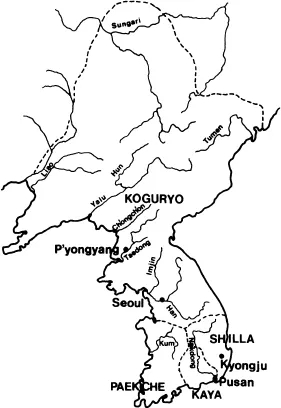
Figure 1.1 Hypothetical territories of the Three Kingdoms and Kaya at the height of Koguryŏ power in the late 5th century ad with modern city and river names (after Han W.K. 1970)
Following the Samguk Sagi, some scholars attribute full-fledged state status to these Three Kingdoms from their designated founding dates. Recently, some efforts have been made to define developmental stages within these societies; in particular, the notion of “tribe” (K. pujok)4 has been employed in contrast to or in conjunction with “state”. In most ofthese cases, however, the word “tribe” is left undefined (e.g. Henthorn 1971); the same is true of the term “tribal state” (K. pujok kukka), which is in common use among historians (Hatada 1969; Sohn et al. 1970).
According to the Treatise on Period Divisions in Korean History, published by the Society for Korean Economic History (1970 [in Ref. List]), the term “tribal state” was introduced into the scholarly literature by Paek N.M. in 1933. It did not come into regular usage until 1948 when employed by Son C.T. in his Outline of Korean Ethnic History. In this and subsequent works, the designation “tribal state” was generally applied to Korean Bronze Age society (ca. 1st millennium bc), whose dolmens were thought to be tangible indications of status enjoyed by Bronze Age rulers.
In 1964 Kim C.C. proposed an evolutionary sequence from “tribal states” to “tribal leagues” (K. chebujok nyŏnmaeng wangguk) – in other words, a confederation of several tribal states. Kim C.C. was the first to offer a systematic explanation of what this form of organization consisted of: primogeniture in the ruling clan, collection of taxes, mobilization of labour, redistribution of crops, reallocation of land, control of ritual, and the use of imported iron and other products. This evolutionary scheme was modified by Han W.K. (1970: 25) who proposed that “tribal leagues” grew out of “tribal society” (K. pujok sahoe) and went on to become “kingdoms” (K. kodae kukka, lit. “archaic states”). Han thus originally eliminated the “tribal state” stage. However, in the revised edition of his work (Han W.K. 1986) he has added a large section on the “tribal state” in place of his “tribal society” – just when other authors are backing away from the tribal concept altogether.
In 1976 Ch’eon K.W., writing in Korean, created the terms sŏngup kukka (lit. “walled-town state”) and nyŏngyŏk kukka (lit. “regional state”) to describe the stage of development of some of the polities mentioned in the Korean chronicles before they adopted the Chinese territorial system of government. The historian Lee K.B. has seized upon the idea of “walled-town state” as an antidote to the concept of “tribe”. He makes the former his first evolutionary stage (1984: 13) and eliminates “tribal” from the second stage by naming it “confederated kingdoms” (K. nyŏnmaeng wangguk) instead of “tribal leagues” (K. chebujok nyŏnmaeng wangguk). His last stage is the same as Han W.K.’s kodae kukka, though it is translated into English as “aristocratic state” rather than “kingdom”. Lee K.B.’s emphasis on the settlement as the focus of the early “state” reflects his assumption that a walled town was occupied by the ruling elites, with commoners living outside. He considers the walled-town stage of polity formation to have been characteristic of Bronze Age society in Korea, with dolmens fulfilling the same status-indicating function as envisioned by Son C.T. for his “tribal states”.
Kim J.B. (1974, 1987) also takes issue with all authors who use “tribal” in connection with the early Korean polities. He cites Western anthropological wo...
Table of contents
- Cover Page
- Half Title page
- Series Page
- Title Page
- Copyright Page
- Contents
- Foreword
- Preface
- List of Tables
- List of Figures
- Chapter One Early Korean States: A Review of Historical Interpretation
- Chapter Two Thoughts on Pre-state Cultural Development on the Korean Peninsula from an Archaeological Point of View
- Chapter Three The Development of Stoneware Technology in Southern Korea
- Chapter Four A Technological Study of Earthenware and Stoneware in Southern Korea
- Chapter Five Discoveries of Iron Armour on the Korean Peninsula
- Chapter Six Walled Sites in Three Kingdoms Society
- Chapter Seven Introducing Kaya History and Archaeology
- Chapter Eight The Emergence and Expansion of Silla from an Archaeological Perspective
- Index
Trusted by 375,005 students
Access to over 1.5 million titles for a fair monthly price.
Study more efficiently using our study tools.
Frequently asked questions
Yes, you can cancel anytime from the Subscription tab in your account settings on the Perlego website. Your subscription will stay active until the end of your current billing period. Learn how to cancel your subscription
No, books cannot be downloaded as external files, such as PDFs, for use outside of Perlego. However, you can download books within the Perlego app for offline reading on mobile or tablet. Learn how to download books offline
Perlego offers two plans: Essential and Complete
- Essential is ideal for learners and professionals who enjoy exploring a wide range of subjects. Access the Essential Library with 800,000+ trusted titles and best-sellers across business, personal growth, and the humanities. Includes unlimited reading time and Standard Read Aloud voice.
- Complete: Perfect for advanced learners and researchers needing full, unrestricted access. Unlock 1.5M+ books across hundreds of subjects, including academic and specialized titles. The Complete Plan also includes advanced features like Premium Read Aloud and Research Assistant.
We are an online textbook subscription service, where you can get access to an entire online library for less than the price of a single book per month. With over 1.5 million books across 990+ topics, we’ve got you covered! Learn about our mission
Look out for the read-aloud symbol on your next book to see if you can listen to it. The read-aloud tool reads text aloud for you, highlighting the text as it is being read. You can pause it, speed it up and slow it down. Learn more about Read Aloud
Yes! You can use the Perlego app on both iOS and Android devices to read anytime, anywhere — even offline. Perfect for commutes or when you’re on the go.
Please note we cannot support devices running on iOS 13 and Android 7 or earlier. Learn more about using the app
Please note we cannot support devices running on iOS 13 and Android 7 or earlier. Learn more about using the app
Yes, you can access State Formation in Korea by Gina Barnes in PDF and/or ePUB format, as well as other popular books in Social Sciences & Ethnic Studies. We have over 1.5 million books available in our catalogue for you to explore.