Prices and wages are the social phenomena most susceptible of objective statistical record over long periods of time. They reflect and measure the influence of changes in population, in supply of precious metals, in industrial structure and agricultural methods, in trade and transport, in consumption and in the technical arts. Forming part of publications of the International Committee on Price History, this is Volume I of data from the twelfth to the nineteenth century. It was originally published in 1939 and almost the entire stock was destroyed during an air-raid. The present volume is a facsimile of that edition. This volume looks at the Mercantile era.
- 832 pages
- English
- ePUB (mobile friendly)
- Available on iOS & Android
eBook - ePub
Prices and Wages in England
LORD STEWARD’S DEPARTMENT
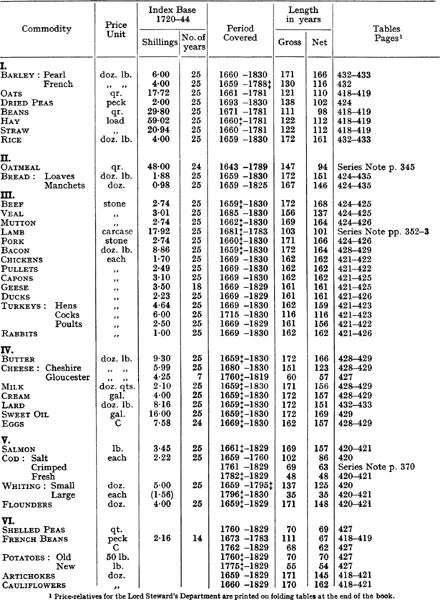
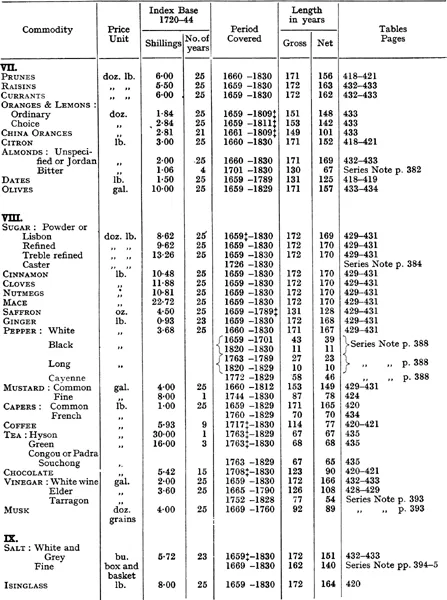
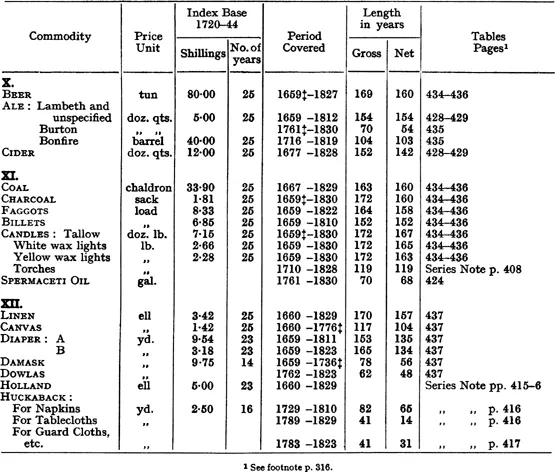
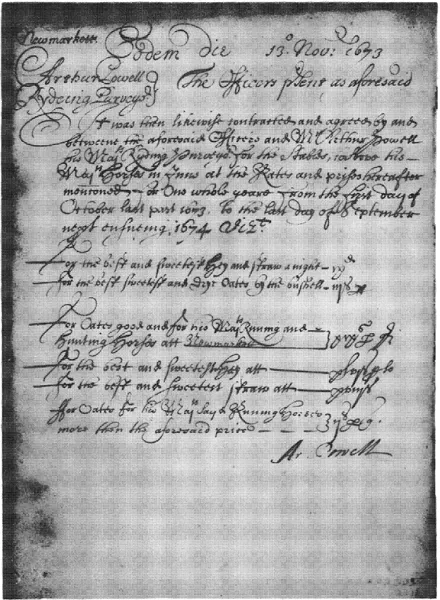
BOARD OF GREENCLOTH CONTRACT: FODDER FOR CHARLES II’S HORSES, November 1673 (P.R.O. LS 13/17)
INTRODUCTION
THE Lord Steward’s Department became a separate office of the Royal Household by the end of the fifteenth century, and accounts of its expenditure on provisions for the Household are available from early times. But, until the Civil War, the bulk of these provisions were obtained either by the direct exercise of the royal prerogative of “ purveyance,” that is, of buying goods for the king by forced purchase at low static rates, or under the alternative of “ composition,” that is an agreement to deliver stated quantities at stated prices below the market rate, in order to be free from purveyance. In each, case the sale was a forced sale and the price artificial.
With the Restoration and the re-assembling in May 1660 of the Royal Household the king received a parliamentary grant for life of issues from the customs and excise, in return for his abandoning the prerogative of purveyance.1 Thereafter the Royal Household was supplied under annual contracts made freely with the suppliers. During the first two years of the reign the Household was maintained on the former scale, but, as the king’s revenue proved insufficient, a new Establishment was made in 1662 whereby expenditure was reduced. The chief reductions effected were in the Bakehouse and Acatry.2 Whereas in the years 1659–61 contracts were made with several dealers to supply wheat to the Bakehouse, from 1662 little was purchased and bread was provided under one to three contracts to December 1760. Similarly oxen and sheep were delivered alive to the Slaughterhouse by a number of dealers before 1662, but from that date nearly all the meat was supplied by the pound or joint by one to four firms of butchers.
The Lord Steward, presiding over the Board of Green-cloth, continued to administer the Department, and contracts were made between the Board and suppliers, who were still described as purveyors, though the term had lost its technical meaning.
Prices from the Lord Steward’s Department, accordingly, have been tabulated only from 1659 or later. The price tables are continued, where information is available, up to 1830 and could be carried further.
Market prices are recorded sporadically in the accounts before the Civil War and present interesting contrasts to the prices under purveyance and composition. The more important of these earlier prices will be given in a general account of the dealings of the Lord Steward’s Department before the Civil War, which it is proposed to print in a later volume.
Prices tabulated are taken from the contracts entered in the Board of Greencloth Records1 1659–68 and in Contract Books from 1669 together with the Comptroller’s accounts, detailing monthly incidental expenses, and the Extraordinary Creditors’ Books.2 From 1760 the Creditors’ Books, containing copies of tradesmen’s monthly bills covered by ordinary expenditure, have been used in preference to Contract Books, since they record actual deliveries.3 Bills for drink, foodstuffs not requiring cooking, lights and fuel were included under Household Creditors ; foodstuffs to be cooked came under Kitchen Creditors and linen, utensils, stationery, china, cutlery and glass under Incidental Creditors. From 1812 no contract books are available and the method of supply is uncertain.
While prices are given in the tables for most commodities from 1659 to 1830, there are two dates in this period at which changes in the methods of supply or the records affect the comparability of the prices before and after. At the beginning of the new reign in 1760, financial provision for the Royal Household was placed on a new basis under the statute 1 G. III, c. 1 ; the accompanying changes in methods of supply to the Household included changes in the class of purveyors, in the period of supply, and in allowances for carriage as well as abolition of fees previously charged to the purveyors. After the beginning of the Regency, the bulk of the supplies in London (after May 1811) are for Carlton House, at rates in some eases much above those for other palaces. At or about each of these two dates accordingly—1760 and 1811—a half-line is drawn where necessary across the tables ; the degree to which comparability of the prices before and after is affected at these dates is not the same for all commodities and must be considered for each of them in the light of the information given below and in the series notes.
In addition, the prices were affected at certain periods by the promptitude or the reverse with which purveyors could obtain payment and by the allowance of additional payments to purveyors who found themselves in difficulties under their contracts. Each of the matters mentioned above as affecting prices, namely, class of purveyor, period of supply, charges for delivery, fees, delays in payment and supplementary payments, is considered in order below.
From January 1813 the system of granting additional payments to supplement contract rates was abolished and subsequent prices were at inclusive rates, but this change does not seem to have appreciably affected the level of prices.
Each accession of a new monarch seems to have had a certain influence on the continuity of contracts and the level of prices, but except for the two periods of important change mentioned above, it is not sufficiently great to render the series discomparable or justify the insertion of a warning in the tables. Special coronation purchases at low prices in 1688 and 1727 have been discarded.
CLASS OF PURVEYOR
For a hundred years after the Restoration, contracts for supply to the Royal Household were made by the Board of Greencloth with two distinct classes of purveyors : with tradesmen direct and with officers of the Household. In many cases, particular officers claimed a right in virtue of their offices to supply certain goods ; in others, their selection appears to have been dictated by the convenience of getting an inclusive rate covering all charges for delivery, while contracts with tradesmen sometimes left delivery to be paid for as an extra. The persons claiming places as purveyors to the Household were often more numerous than the places and a rotary system was introduced whereby each purveyor served in turn with others, sometimes for a month and sometimes for a quarter at a time. The officer-purveyors, no doubt, made sub-contracts with the tradesmen.
The table below shows for each commodity the class, description and number of purveyors at each period from the Restoration to the end of 1812. It will be seen that a few articles were supplied by tradesmen direct throughout the period while others were transferred from officers to tradesmen during the period. In the case of oil, olives, capers, French beans and vinegar, 1685–88, there occurred a reverse transference from tradesmen to officers. The officers holding contracts were mainly those connected with the Bakehouse, Buttery, Spicery, Kitchen and Wood-yard. From January 1761 all contracts are with tradesmen and none with officers of the Household.
Articles excluded from the price series are omitted from the table.
METHOD OF SUPPLY TO THE ROYAL HOUSEHOLD MAY 1660 TO DECEMBER 1812
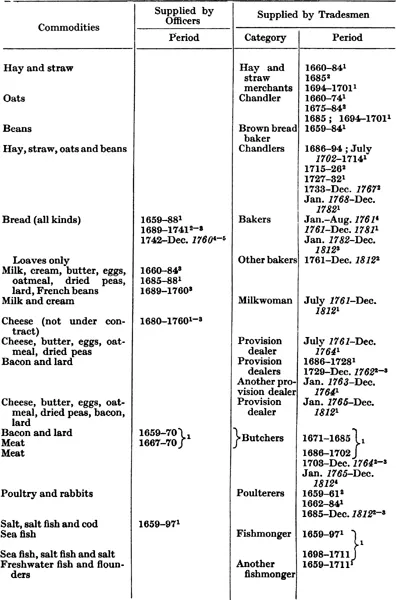
METHOD OF SUPPLY TO THE ROYAL HOUSEHOLD MAY 1660 TO DECEMBER 1812
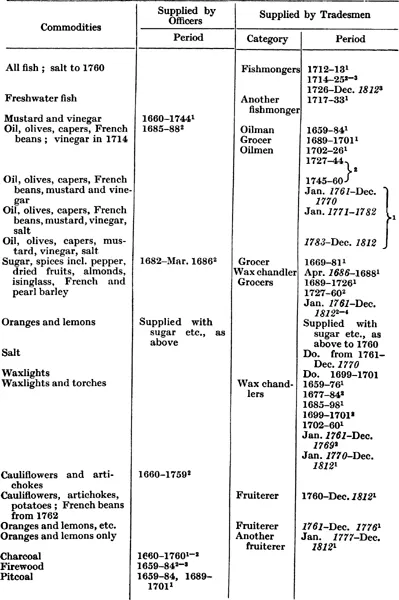
METHOD OF SUPPLY TO THE ROYAL HOUSEHOLD MAY 1660 TO DECEMBER 1812
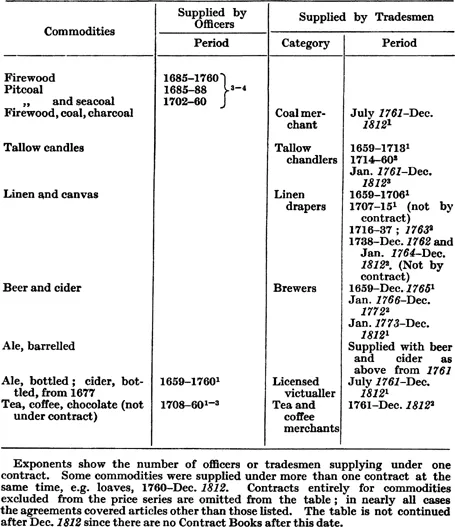
PERIOD OF SUPPLY
The contracts from which the prices from 1659 have been derived were signed at a meeting of the Board of Greencloth held annually between November and January. Up to 1760 the contracts covered the year of account October to September, so that the period of supply antedated the contract by one to four months. This had the incidental advantage of making it possible for contract rates to be fixed with some knowledge of the market conditions. Imprests were received by most of the purveyors in advance of the contract and it was sufficient if the new contract rates could be agreed and certified before the first quarterly settlement. After 1760, contracts were made as a rule to cover the calendar year, but owing to the system of monthly bills it has been possible in the tables to continue to give prices as for harvest years. For one or two articles, such as fodder, contracts were made by the quarter. A single price was made for the year for most commodities but seasonal rates were paid for some kinds of dairy produce, fruit and vegetables. When prices of actual purchases are not available, contract rates, distinguished by square brackets, have been used in the tables, usually not later than 1789, however, by which date the contract price usually represented only a basic rate, subject to additional allowances to cope with rising prices.
CHARGES FOR DELIVERY
The tabulated prices do not include charges for delivery, where recorded as an addition to the contract price.
From 1659 to 1760 contracts covered supply to all the royal residences, but in many cases special clauses were included for delivery beyond St. James’ Palace. St. James replaced Whitehall as the sovereign’s principal London palace from 1685 and Kensington Palace was occupied by the royal family for part of every year in the period 1689–1760. Windsor Castle was little used between 1714 and 1760, but Richmond was an occasional summer residence from 1727 to the end of the century, though from 1774 Kew was preferred. Hampton Court was rarely occupied after 1760. In general, contracts with officers of the Household only provided for special delivery charges on supplies to Kensington or beyond,1 but allowances for carriage to St. James were paid to tradesmen supplying bulky provisions to 1701 and in a few cases later. The system of carriage allowances was extended in the late seventeenth century, owing to demands of purveyors when payment was in arrears, but no allowances were paid for delivery of bread, linen, candles and wax.2
From ...
Table of contents
- Cover
- Title Page
- Copyright Page
- Preface
- Contents
- GENERAL INTRODUCTION
- READER’S GUIDE TO VOL. I (with explanation of printing signs)
- Winchester College
- Eton College
- Westminster (School and Abbey)
- Charterhouse
- Sandwich (St. Bartholomew’s Hospital)
- Greenwich Hospital
- Chelsea Hospital
- Lord Steward’s Department
- Lord Chamberlain’s Department
- Office of Works
- Navy Victualling
- Naval Stores
- SECONDARY MATERIAL :
- LIST OF SOURCES AND TRANSCRIPTIONS
- INDEX OF COMMODITIES
Trusted by 375,005 students
Access to over 1.5 million titles for a fair monthly price.
Study more efficiently using our study tools.
Frequently asked questions
Yes, you can cancel anytime from the Subscription tab in your account settings on the Perlego website. Your subscription will stay active until the end of your current billing period. Learn how to cancel your subscription
No, books cannot be downloaded as external files, such as PDFs, for use outside of Perlego. However, you can download books within the Perlego app for offline reading on mobile or tablet. Learn how to download books offline
Perlego offers two plans: Essential and Complete
- Essential is ideal for learners and professionals who enjoy exploring a wide range of subjects. Access the Essential Library with 800,000+ trusted titles and best-sellers across business, personal growth, and the humanities. Includes unlimited reading time and Standard Read Aloud voice.
- Complete: Perfect for advanced learners and researchers needing full, unrestricted access. Unlock 1.5M+ books across hundreds of subjects, including academic and specialized titles. The Complete Plan also includes advanced features like Premium Read Aloud and Research Assistant.
We are an online textbook subscription service, where you can get access to an entire online library for less than the price of a single book per month. With over 1.5 million books across 990+ topics, we’ve got you covered! Learn about our mission
Look out for the read-aloud symbol on your next book to see if you can listen to it. The read-aloud tool reads text aloud for you, highlighting the text as it is being read. You can pause it, speed it up and slow it down. Learn more about Read Aloud
Yes! You can use the Perlego app on both iOS and Android devices to read anytime, anywhere — even offline. Perfect for commutes or when you’re on the go.
Please note we cannot support devices running on iOS 13 and Android 7 or earlier. Learn more about using the app
Please note we cannot support devices running on iOS 13 and Android 7 or earlier. Learn more about using the app
Yes, you can access Prices and Wages in England by William Beveridge in PDF and/or ePUB format, as well as other popular books in Business & Business General. We have over 1.5 million books available in our catalogue for you to explore.