This history, first published in 1823, also includes a 'disproval of the claim of Sir Richard Arkwright to the invention of its ingenious machinery'. It includes sections on the national and general importance of cotton manufacture, developments in the methods of spinning and weaving, key inventions, and the changes in the character of the cotton workers.
National and General Importance of the Cotton Manufacture.
THE present age is distinguished beyond all others by the rapid progress of human discovery. Man respired the air of his atmosphere for many ages, before he discovered it to be a substance possessing weight and the other properties of material bodies; but it was reserved for our own times to ascertain that it and the other æriform fluids, which from their subtlety and invisibility would seem to elude human scrutiny, were chiefly compound bodies susceptible of Analysis and Classification. The science of Aerostation—the means of enabling miners to work in safety in the midst of an inflammable atmosphere, and the illuminating of our Streets and Houses with subterraneous fire, have followed. Water and Fire have been brought to flow in peaceful association under the feet of the inhabitants of our towns, to administer to their wants and promote their pleasures. The double condensing Steam Engine, and its application to Navigation, may almost claim the merit of original inventions, and will in their consequences to Man, perhaps not be second to the boast of former ages—the discoveries of the Magnet, of Gunpowder, and of Printing. They have subjected to Man a Giant, by whose assistance he can obtain the treasures of mines hitherto unapproachable by reason of subterraneous waters—draw ponderous loads of fuel, limestone or other substances, along rail ways without the help of beasts—set in motion machinery, to which mere human strength was unequal—cross the seas independent, and even in despite of winds and tides, and with a rapidity before unknown. To these might be added the Voltaic Pile, Vaccination and others equally splendid and original.
One, however, which would seem to merit the attention of the Philosopher from its ingenuity, the Englishman from its having brought an immense increase of wealth and population to his territory, and all from its economizing human labour and enabling many articles of clothing to be obtained at a less expensive
rate, has obtained comparatively little attention. While admiration has been unboundedly lavished on other triumphs of the mind, the successive inventions and improvements of the Machinery employed in the Cotton Manufacture, have obtained neither the notice which their own ingenuity, nor their national importance required. They have been the great means of increasing the population of the county of Lancaster, in the first ten years of the present century, from 672,731 to 810,539, and, in the subsequent ten years, from that number to 1,052,859, (a rate of more than doubling itself in half a century,) and of producing a corresponding increase of wealth and intelligence. Under the influence of the manufacture of which they have been the promoters, the town of Manchester has, from an unimportant provincial town, become the second in extent and population in England, and Liverpool has become in opulence, magnitude, elegance and commerce, the second Seaport in Europe. That Liverpool is a consequence of the Cotton Manufacture, and indebted to Manchester and its dependencies for its greatness, is evident on general principles. The origin of a Manufacturing town is this: a Manufactory is established, a number of labourers and artizans are collected—these have wants which must be supplied by the Corn Dealer, the Butcher, the Builder, the Shopkeeper—the latter when added to the Colony have themselves need of the Draper, the Grocer, &c. Fresh multitudes of every various trade and business, whether conducive to the wants or luxury of the inhabitants, are superadded, and thus is the Manufacturing town formed. The causes of its increase and greatness rest within itself—they are primary and original. But the formation and increase of a Seaport town, proceed from secondary causes. A commercial Seaport pre-supposes, that the inhabitants of the interior have wants to be supplied through it, or that they have a superfluity of their own productions to exchange for the commodities of other nations. The Seaport may decline without injuring the Manufacturing town, but if the demand of the Manufacturing town for foreign produce should diminish, or if it should no longer have productions of its own to export, or if that commerce of which it is the cause and the nucleus, should flow into another channel, the business of the Seaport is at an end. These two great Towns, then, which, with their connections and dependencies, are almost an equipoize to the Metropolis, are a consequence of the Cotton Manufacture.
The Machinery employed in the Cotton Manufacture is little known except to the manufacturers themselves, and the History of its progressive improvements, perhaps, scarcely to them. For the greatest improvements we are indebted to a man in humble life, whose poverty and want of patronage prevented him from
either reaping the pecuniary benefit, or establishing his claims to that fame to which his ingenuity entitled him. By borrowing his ingenious inventions the late Sir Richard Arkwright lived to acquire a princely fortune, and died with the reputation of being one of the most eminent of those individuals, who have enlarged the resources of their native country, and made her manufactures and machinery the wonder of surrounding nations; while the man to whose painful labours and ingenious contrivances Sir Richard was indebted for these honours, lived in obscurity, and died in indigence:
Sic vos non vobis mellificatis apes,
Sic vos non vobis fertis aratra boves.—Virgil.
To him Sir Richard in his greatness held out no fostering hand—he not only reaped the harvest himself, but assumed the reputation of having sown the grain; and whether from shame, from vanity, or indifference, left the author of his fame to languish in his original poverty.
CHAPTER II.
Early Modes of Spinning and Weaving.
The original Mode of converting the fleecy contents of the fruit of the cotton tree into Thread, for the purpose of being woven into Cloth, was the distaff and spindle, and this mode is still used in Hindostan.* The distaff is a wooden rod, with a bundle or fleece of cotton wool tied loosely round the top of it.
The spinner holds the distaff between the left arm and the body, his left hand is nearer to the distaff than the right, the hands are kept about two inches asunder, and pull from the fleece a continuous lock of cotton wool, the right hand drawing out and twisting so much of the lock as is between it and the left hand into a fine thread, which is farther twisted by a pendent spindle, or bobbin, which is kept constantly twirling round, and on which the thread is afterwards wound. See plate 1.
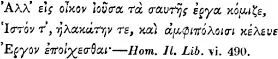
This tedious process was the one used from the earliest ages, and might be the occupation to which Hector sends Andromache:
The general likeness between a mast, which is another sense of
, and the distaff, favours the supposition.†
The state of the Cotton Manufacture in the county of Lancaster, at the commencement of the last century, was as follows: The warp, or longitudinal threads of the cloth, was linen yarn, imported in the hank or bundle, from Germany. The weaver bought it himself, and prepared it for the Loom by arranging it in parallel lines: this operation, called warping, was done upon pegs fastened into a wall; the warps were from twelve to twenty-five yards long, and were warped or arranged in parallel lines, a single thread at a time, by passing the yarn round the pegs. See plate 2. The threads were also divided into two equal parts, each alternate thread being in the upper half of the warp, and the other threads in the lower half, and this division, called the lesse, was carefully preserved during the weaving, the upper half passing through one heald, and the lower through another. The weft, or transverse threads of the cloth, was made from Cotton, which was also bought by the weaver.
The Cotton was beaten, picked and cleaned from dirt and impurities, and then carded, or brushed with coarse wire brushes. The carding was done by hand cards about twelve inches long, and five inches wide; the carder holding one in each hand. See plate 3, figure. 1. The Cotton, after being picked and cleaned, was spread upon one of these cards, and was brushed, scraped or combed with the other, until the fibres of the cotton were all disposed in one direction; it was then taken off in soft fleecy rolls, about twelve inches long, and three quarters of an inch in diameter. These rolls, called cardings, were converted into a coarse thread or roving, by twisting one end to the spindle of a hand wheel, turning the wheel which moved the spindle with the right hand, and at the same time drawing out the carding horizontally with the left. See plate 3, figure 2. The motion thus communicated to the carding twisted it spirally; when twisted, it was wound upon the spindle, another carding was attached to it, drawn out and twisted: thus was formed a continued coarse thread or roving. The rovings were then taken to the spinner to be converted into weft. The hand wheel was again used for this purpose, and the rovings were drawn out into weft nearly in the same manner as the cardings were made into rovings. See plate 3, figure 3.
The double operations of roving and spinning were requisite, because the cardings could not at once be drawn out into a level and even thread, fine enough for the loom; roving or coarse spinning reduced the carding to the thickness of a quill, and the spinner afterwards drew out and twisted the roving into weft fine enough for the weaver. The warp was placed between two beams about five feet asunder; half way between the beams the warp passed through a frame work of looped threads, called healds, each alternate thread of the warp going through one heald, and the other threads through the other heald. The healds were worked by two treddles, which upon one being put down by the foot, raised one half of the healds and every second thread of the warp; the shuttle which contained the weft was then thrown by the right hand between the threads which were at rest, and the second or alternate threads raised by the treddle and the healds; the shuttle was caught on the other side by the left hand, and the weft thus transversely shot between the threads of the warp was driven by the reed close to the cloth made by former casts of the shuttle. The other treddle was then put down, which raised the other healds and the threads of the warp, which had before been at rest; the shuttle was thrown by the left hand to the right, leaving another transverse thread, which was again driven by the reed close to the former one. See plate 4, fig. 1. In weaving cloth above thirty-six inches broad, two men were required to one loom, because one man could not extend his arms sufficiently to throw the shuttle through the warp from one hand to the other; two were consequently necessary, one on each side of the loom, to receive and throw back the shuttle. The goods thus manufactured were called Fustians, and were sold in the grey by the weavers to the Manchester merchants.
It was not until 1740, that the Manchester merchants began to give out warps and raw cotton to the weavers, receiving them back in cloth, and paying for the carding, roving, spinning and weaving. After the fustians were manufactured the merchants dyed them, and then carried them to the principal towns in the kingdom on pack-horses, opening their packs and selling to the shopkeepers as they went along.
In 1733 a Mr. Wyatt, of Litchfield, invented a machine for spinning cotton, and two factories were built and filled with his machines, one at Birmingham, and one at Northampton. Both these undertakings failed; the machines have long ago perished, and no model or description of them remains. We find no farther attempts to spin by machines until 1764.
In 1738 Mr. John Kay, a native of Bury, in Lancashire, but at that time residing at Colchester, invented a new mode of throwing the shuttle. By this invention the lathe was extended a foot on each side of the warp, in which foot an impetus was given to the shuttle, by means of the picking peg held by the weaver in his right hand, which drove it across the warp and back again, without being thrown by the workman’s hands. See plate 4, fig. 2 and 3. This plan of throwing the shuttle, the one now in use, enabled the weaver to make nearly double the quantity of cloth he could have made on the old system, and enabled one man to weave the widest cloth. Mr. Kay brought this ingenious invention to his native town, and introduced it among the woollen weavers in the same year, but it was not much used among the cotton weavers until 1760. In that year Mr. Robert Kay, of Bury, son of Mr. John Kay, invented the drop box, by means of which the weaver can at pleasure use any one of three shuttles, each containing a different coloured weft, without the trouble of taking them from and replacing them in the lathe. About this time, also, the warping mill was introduced into the cotton manufacture. The warping mill is a prismatic reel about six yards in circumference, and six or seven feet in height. This reel is turned round on a vertical axis by a band, from a pully or wheel, which is turned by the warper. The bobbins which contain the yarn are placed on a frame a yard or two distant from the reel, and the threads from them pass through a slide which moves perpendicularly up and down an upright piece of wood; this slide is suspended by a cord coiled round the axis of the reel. After dividing, crossing, and wrapping the threads round wooden pins placed at the top of the reel, the reel is turned, the slide descends by the uncoiling of the cord from the axis, and the threads are wound about the reel. When one hundred, or one hundred and twenty yards, according to the length of the warp required, are wound upon the reel, the threads are crossed and wrapped round other wooden pins placed at the bottom of the reel. The reel is then turned the contrary way, the cord coils round the axis, the slide ascends, and the threads are again wound about the reel. These operations are repeated until the requisite number of threads are arranged upon the reel. See plate 5.
* The superiority of texture and the durability of the India Nankeens, and Long Cloths, are owing to this mode of spinning, which disposes the fibres of the cotton more evenly, and twists ...
Table of contents
Cover Page
Half Title page
Series Page
Title Page
Copyright Page
Original Title Page
Contents
Chapter I National and General Importance of the Cotton Manufacture.
Chapter II Early Modes of Spinning and Weaving.
Chapter III Improved Methods of Management and Disposal of Manufactured Goods.
Chapter IV Invention of the Spinning Jenny.
Chapter V Invention of the Water Frame, or Throstle.
Chapter VI The Carding Engine.
Chapter VII Some Account of the Life of Sir Richard Arkwright.
Chapter VIII Mis-statements of the foregoing Facts.
Chapter IX Invention of the Mule and Exportation of Twist.
Chapter X Change of Character and Manners, in the Population, superinduced by the extension of the Cotton Manufacture.
Chapter XI Moral and Religious Character of Weavers.
Chapter XII The Steam Loom.
Appendix
Explanations Of The Plates.
Trusted by 375,005 students
Access to over 1.5 million titles for a fair monthly price.
Study more efficiently using our study tools.
Frequently asked questions
Yes, you can cancel anytime from the Subscription tab in your account settings on the Perlego website. Your subscription will stay active until the end of your current billing period. Learn how to cancel your subscription
No, books cannot be downloaded as external files, such as PDFs, for use outside of Perlego. However, you can download books within the Perlego app for offline reading on mobile or tablet. Learn how to download books offline
Perlego offers two plans: Essential and Complete
Essential is ideal for learners and professionals who enjoy exploring a wide range of subjects. Access the Essential Library with 800,000+ trusted titles and best-sellers across business, personal growth, and the humanities. Includes unlimited reading time and Standard Read Aloud voice.
Complete: Perfect for advanced learners and researchers needing full, unrestricted access. Unlock 1.5M+ books across hundreds of subjects, including academic and specialized titles. The Complete Plan also includes advanced features like Premium Read Aloud and Research Assistant.
Both plans are available with monthly, semester, or annual billing cycles.
We are an online textbook subscription service, where you can get access to an entire online library for less than the price of a single book per month. With over 1.5 million books across 990+ topics, we’ve got you covered! Learn about our mission
Look out for the read-aloud symbol on your next book to see if you can listen to it. The read-aloud tool reads text aloud for you, highlighting the text as it is being read. You can pause it, speed it up and slow it down. Learn more about Read Aloud
Yes! You can use the Perlego app on both iOS and Android devices to read anytime, anywhere — even offline. Perfect for commutes or when you’re on the go. Please note we cannot support devices running on iOS 13 and Android 7 or earlier. Learn more about using the app
Yes, you can access A Compendious History of Cotton Manufacture by Richard Guest in PDF and/or ePUB format, as well as other popular books in Business & Business General. We have over 1.5 million books available in our catalogue for you to explore.