eBook - ePub
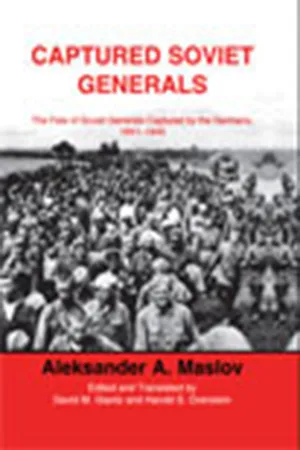
Captured Soviet Generals
The Fate of Soviet Generals Captured in Combat 1941-45
- 346 pages
- English
- ePUB (mobile friendly)
- Available on iOS & Android
eBook - ePub
About this book
The true story of the fate of the captured Russian Generals after World War II, explaining how these officers endured horrific prison conditions and were then tried and executed when they returned home.
1
Soviet Generals Who Perished in Fascist Captivity
GENERAL
Only recently has the tragic fate of Soviet soldiers taken prisoner by the enemy during the Great Patriotic War (1941–45) begun to attract the attention it so richly deserves. While there are compelling reasons why military historians in Russia and other countries of the Commonwealth of Independent States (CIS) should investigate this matter, the peoples of these states too should demand an explanation of their soldiers’ fate, since virtually everyone lost close relatives in the bloody war. Academics and historians have an obligation to investigate this topic, both because of its enforced obscurity and intrinsic interest and because Soviet authorities imposed a draconian silence about the subject for decades after the war’s end. In fact, throughout the ensuing 50 years, official Soviet historiography simply ignored and even failed to recognize the many millions of Red Army soldiers taken captive during the war, many of whom fell into German hands during the disastrous initial days and weeks of the war.
‘Why then did this tragedy occur?’ ‘What conditions contributed to the Red Army’s massive human losses?’ and, more importantly, ‘How could such a rare phenomenon have occurred in military history?’. Given that such a catastrophe did occur, ‘How many Red Army soldiers were taken captive?’, ‘How many of these souls perished in captivity?’, and ‘In what circumstances did they perish?’. Accepting their loss and ultimate sacrifice, ‘What contributions, if any, did these captive Soviet soldiers make to the ultimate achievement of victory over fascism?’ And finally, ‘What was the moral state of these prisoners-of-war?’ and ‘How did those who survived do so?’. These and other burning questions associated with such a vast, difficult, and obscure, but absolutely vital topic, are virtually endless. What is abundantly clear is that these questions represent the core issues associated with the fate of millions of Soviet prisoners-of-war, and they demand an answer – if not for the relatives of those who suffered, then for the nation in whose name they suffered.
Although not an end in itself, this book nevertheless represents the culmination of a process begun several years ago, whose beginnings were recorded in the pages of the Journal of Slavic Military Studies. The process sought to describe in detail the tragic fate of Soviet general officers who fell into enemy hands during the Great Patriotic War.4
During the chaotic initial days of the war along the Soviet Union’s western borders, the advancing German army encircled many hundreds of thousands of Red Army troops, primarily common soldiers, sergeants, and officers, but also senior commanders of general officer rank, in numerous flaming ‘cauldrons’, both large and small. Many of the encircled troops fell in combat, often heroically, amidst incredibly severe and chaotic fighting conditions. Although thousands of soldiers perished, many others succeeded in breaking out of the encirclement ‘cauldrons’ and escaped into the forests, where they joined and served in the popular partisan movement. The majority of those soldiers who survived, however, suffered a sadder lot by falling captive to the Nazis. Subsequently, many of these died in captivity far from their homeland. Red Army senior commanders and command cadre frequently shared the harrowing fate of their encircled troops. While tens of Red Army general officers fell captive, primarily to the Germans, the exact number of these unfortunate commanders remains unknown despite strenuous efforts by Russian military historians to determine their fate. This task has been particularly difficult, largely because of the vexing problems encountered when trying to obtain pertinent documents from responsible Russian administrative organs, specifically the Office of the Military Procurator, the Supreme Court, and the Federal Security Service (FSO) (the former KGB) of the Russian Federation.
Sadly, the Russian population at large is aware of the names of only a precious few Red Army general officers who fell captive to the Germans, such as General D. M. Karbyshev. As for the majority of those who fell captive, pervasive official suspicion and an oppressive cloak of silence and utter anonymity have surrounded them and concealed their fate from public view. In short, official Soviet military organs and historians have written little or nothing about them or the circumstances surrounding their capture. This was the case for several reasons. First, reflecting the paranoia of their leader, Stalin, Soviet officialdom tended to treat prisoners-of-war as little better than traitors to their homeland because they failed to die for their cause. Second, immediately after war’s end, the dominant theory in Soviet military historiography trumpeted ‘the outstanding victory that Stalin’s military genius achieved over the fascist enemy’. This theory prevented historians from investigating or even mentioning any of the unpleasant warts or blemishes on Stalin’s and the Red Army’s military record. To the present day, a predominant corollary to this theory has been the so-called theory of the ‘active defense by Red Army forces’ during the initial period of the war, which supposedly culminated in strategic victory over the German Plan Barbarossa at Moscow in late 1941. Nor was there room for any unsightly blemishes on this theory. One of the most vivid of these unsightly and embarrassing blemishes was the presence of millions of Red Army soldiers together with their vanquished commanders in German captivity.
THE INITIAL PERIOD OF WAR (JUNE–DECEMBER 1941)
Major-General I. S. Nikitin
The first Red Army general officer to fall captive to the Germans did so during the final few days of June 1941, less than a week after hostilities commenced. This unfortunate senior officer was Major-General I. S. Nikitin, Commander of the Western Front’s 6th Cavalry Corps, who was taken prisoner by German forces during the chaotic fighting near Belostok in western Belorussia. General Nikitin was an experienced and decisive leader who had led a distinguished life and military career. A native of the village of Dubrovka in Briansk oblast’ (district), he was the son of a worker who became accustomed to hard work early in his life. Nikitin began his military service in 1916 when he joined the Tsarist Army. When the Russian Civil War broke out, he joined the Red Army and rose rapidly from a private in a cavalry squadron to full command of the squadron. Displaying a talent for command, in 1920 he received command of a cavalry regiment in the Southern Front and led that regiment with considerable distinction in the fighting against the White forces of General Baron Wrangel. During the campaign against Wrangel’s forces, Nikitin displayed extraordinary command presence while his forces were struggling for possession of the city of Maikop in the northern Caucasus. In recognition of his prowess Nikitin was awarded the prized gift of a ‘Mauser’ revolver.5
The young Nikitin’s military horizons were considerably broadened by his subsequent three years of sustained study at the Red Army’s Frunze Military Academy. After his graduation from the academy in the mid-1920s, later in the decade and during the early 1930s, Nikitin served in a variety of command and staff assignments, where he continued to display exceptional competence as a field commander. In March 1935 Kombrig (Brigade Commander) Nikitin, then commander of the 5th Cavalry Division, was dispatched on an official mission to Mongolia as a military adviser to that country’s army. He apparently dealt with his new responsibilities in outstanding fashion and, accordingly, the People’s Commissariat of Defense (NKO) awarded him the Order of the Red Star in January 1937.
Characteristic of that period, however, in October 1937 Nikitin received an order recalling him from Mongolia ahead of schedule. Prepared by Army Commissar 1st Rank P. A. Smirnov, Deputy People’s Commissar of Defense of the USSR and Chief of the Red Army’s Main Political Directorate, the order recalled Nikitin, ostensibly for ‘not having managed to cope with his work’.6 The surprised Nikitin later learned why this occurred. Virtually simultaneously with his recall, Nikitin and Moscow authorities received his periodic Communist Party evaluation. Signed by Regimental Commissar Sorokin, Deputy Chief of the Red Army’s 9th Directorate (Intelligence), the evaluation criticized Nikitin, stating, ‘While a member of a bureau of the instructor’s collective, Comrade Nikitin failed to criticize the disgraceful practices of Vainer and his circle’.7 Corps Commander L. Ia. Vainer, the chief Red Army military adviser to the Mongolian People’s Army High Command, was one of many Soviet officers who had already been caught up in the ongoing purges. Vainer was arrested on 15 August 1937 and condemned shortly thereafter. By association alone, the fallen Vainer implicated Nikitin.
After returning to Moscow, Nikitin continued to live for almost two years in a virtual limbo of suspicion and official disgrace. Although he survived the gruesome fate of thousands of his colleagues, throughout this entire period, he was denied work and remained virtually idle in the Red Army’s Cadre Directorate’s reserve. In August 1938, however, Nikitin’s fortunes suddenly changed for the better. At that time the Communist Party’s Control Board decided to reclassify him from a full member of the Communist Party to candidate membership ‘for one year because of his lack of party vigilance and his conciliatory relationship with the sabotage-like leadership [of Vainer] in the training of his forces’.8
Nikitin, however, kept his composure and, consequently, his head. He responded to the Communist Party’s reprimand by writing a letter requesting that they carefully reconsider the facts that had brought shame upon him. At about the same time, the Communist Party Central Committee received 11 positive evaluations of him written by his former colleagues and supporters. For example, I. Kh. Bagramian and A. I. Eremenko, both future Marshals of the Soviet Union, provided glowing evaluations of the disgraced officer. The former wrote, ‘I can say without exaggeration that Comrade Nikitin is one of the most capable and talented commanders of our Red cavalry’.9 Likewise, Eremenko wrote, ‘If I were asked to cite the name of the most model communist in all respects, I would be obliged to name Comrade Nikitin, Ivan Semenovich’.10
At the same time that his friends were submitting letters of support in his behalf, the Special Department (Osobyi otdel’ – OO) of the NKVD, the organ responsible for rooting out supposed subversion and sabotage within the military and other state institutions, thoroughly investigated Nikitin’s past and current activities. Its investigation concluded, ‘There are no compromising materials’.11 Consequently, in November 1939 the Communist Party Bureau altered its earlier decision regarding Nikitin and issued a new decree, stating, ‘Restore as member of the Communist Party and register the issuance of a [new] Party card’.12
In June 1940 the People’s Commissariat of Defense (NKO) recognized Nikitin’s full rehabilitation and assigned him command of the 6th Cavalry Corps in the Belorussian Military District, a position of considerable responsibility. His subsequent personal assessments [fitness or efficiency reports] amply justified the action. For example, as early as December 1940, D. G. Pavlov, the commander of the Special Western Military District, verified in a periodic assessment that corps commander Nikitin was, ‘fully suited to the position of corps commander. Can be appointed assistant to the military district commander for cavalry. Include him on the candidates’ list for the duty of army commander.’13
Certainly, it was clear that this high evaluation of Nikitin’s capabilities and performance did not mean that all of the unpleasantness that he and other military leaders who found themselves in similar circumstances had experienced during the final prewar years passed without a trace. Inescapably, the black marks on their records and the lingering threat of repression adversely affected their morale, military qualifications, and performance while in command. Nikitin himself, for example, had been torn away from military service, professional education, and military science for two whole years at a time when significant changes were taking place in the latter. Worse, he sat idly by while the Red Army began a massive expansion and transformation that was designed to convert it into a modern mobile force. Worse still, when he returned to command, he did so in the somewhat anachronistic cavalry arm.
After war began on 22 June 1941, Nikitin led his trusted corps in combat for a period of only several days before both he and his force were utterly swept away by the torrent of Blitzkrieg war. Thus, he was driven from the ‘game’ early on, well before he had the opportunity to display any of his combat capabilities. There were, of course, genuine objective and subjective military reasons why Nikitin failed to display his full combat potential other than his intimidating encounter with the NKVD.
Before war broke out, forces of General Pavlov’s Western Special Military District (Western Front on 22 June) defended the so-called Belostok salient, which jutted westward west of Minsk into German-occupied Poland. In addition to the 10th Army and 6th Cavalry Corps, Pavlov’s defending force grouping consisted of two other armies (the 3d and 4th) and four mechanized corps (the 6th, 11th, 13th, and 14th). Geographically speaking, even before hostilities commenced, this entire Soviet force grouping was already essentially half encircled by menacing enemy shock groups formed around the nucleus of German Army Group Center’s Second and Third Panzer Groups. These enemy shock groups, which planned to exploit the extremely favorable configuration of the state borders to achieve their offensive aims, were poised and ready to attack deep into the rear of Soviet forces deployed in the Belostok salient.14
During the six-month period prior to the launch of Operation Barbarossa (January–June 1941), Major-General Nikitin’s 6th Cavalry Corps’ units carried out intensive combat training. The training included the development of plans for close cooperation between cavalry and tanks, the conduct of night marches, and the coordination of cavalry operations with fire support by artillery and mortar subunits. During this period, the cavalry corps’ division and regimental command cadre and staffs developed plans to cooperate closely with adjacent border guards forces and, at the same time, intensely studied the terrain in the border regions with East Prussia. By June 1941 the 6th Cavalry Corps’ subordinate 6th and 36th Cavalry Divisions numbered 18,540 men and 15,552 horses. Each division consisted of four cavalry regiments and one tank regiment equipped with BT (bystrokhodnyi – fast-moving) light tanks. The artillery battalions organic to the two cavalry divisions were armed with 45mm, 76mm, and 122mm guns, and each of the divisions’ antiaircraft battalions had three 37mm guns and several four-barrel machine guns. In comparison with many of the 10th Army’s divisions, which were considerably under-strength, the 6th Cavalry Corps was almost fully manned and equipped and, supposedly, was well prepared to conduct active combat operations.
By mid-June 1941, the situation in the corps’ sector as well as in the sector of the Lomza Border Guards Detachment, which was cooperating with it, sharply worsened because of ever-increasing pr...
Table of contents
- Cover
- Title Page
- Copyright
- Contents
- Series Editor’s Foreword
- Introduction
- Glossary and Abbreviations
- 1. SOVIET GENERALS WHO PERISHED IN FASCIST CAPTIVITY
- 2. FORGIVEN BY STALIN: SOVIET GENERALS WHO SURVIVEDCAPTIVITY AND WERE REHABILITATED
- 3. TRIED FOR TREASON AGAINST THE MOTHERLAND:SOVIET GENERALS CONDEMNED AFTER RELEASE FROMGERMAN CAPTIVITY
- 4. THERE WERE SUCH GENERALS: THE RIDDLE OF THEFATE OF RED ARMY GENERALS M. B. SALIKHOV, B. S. RIKHTER AND M. M. SHAPOVALOV
- 5. THE PLIGHT OF CAPTIVITY TOUCHED THEM AS WELL
- Conclusions
- Appendices
- 2. Published Materials about the Lives and Combat Activities of Soviet Generals Captured, 1941–45
- 3. Brief Biographical Information about Soviet Generals Captured, 1941–45
- Index
Trusted by 375,005 students
Access to over 1.5 million titles for a fair monthly price.
Study more efficiently using our study tools.
Frequently asked questions
Yes, you can cancel anytime from the Subscription tab in your account settings on the Perlego website. Your subscription will stay active until the end of your current billing period. Learn how to cancel your subscription
No, books cannot be downloaded as external files, such as PDFs, for use outside of Perlego. However, you can download books within the Perlego app for offline reading on mobile or tablet. Learn how to download books offline
Perlego offers two plans: Essential and Complete
- Essential is ideal for learners and professionals who enjoy exploring a wide range of subjects. Access the Essential Library with 800,000+ trusted titles and best-sellers across business, personal growth, and the humanities. Includes unlimited reading time and Standard Read Aloud voice.
- Complete: Perfect for advanced learners and researchers needing full, unrestricted access. Unlock 1.5M+ books across hundreds of subjects, including academic and specialized titles. The Complete Plan also includes advanced features like Premium Read Aloud and Research Assistant.
We are an online textbook subscription service, where you can get access to an entire online library for less than the price of a single book per month. With over 1.5 million books across 990+ topics, we’ve got you covered! Learn about our mission
Look out for the read-aloud symbol on your next book to see if you can listen to it. The read-aloud tool reads text aloud for you, highlighting the text as it is being read. You can pause it, speed it up and slow it down. Learn more about Read Aloud
Yes! You can use the Perlego app on both iOS and Android devices to read anytime, anywhere — even offline. Perfect for commutes or when you’re on the go.
Please note we cannot support devices running on iOS 13 and Android 7 or earlier. Learn more about using the app
Please note we cannot support devices running on iOS 13 and Android 7 or earlier. Learn more about using the app
Yes, you can access Captured Soviet Generals by A.A. Maslov in PDF and/or ePUB format, as well as other popular books in History & Military & Maritime History. We have over 1.5 million books available in our catalogue for you to explore.