- 620 pages
- English
- ePUB (mobile friendly)
- Available on iOS & Android
eBook - ePub
About this book
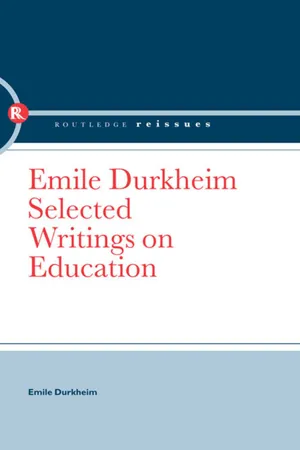
Emile Durkheim is widely lauded as one of the founding fathers of modern Sociology and for his substantial contribution to the sociology of education. This set brings some of his most important writings on the subject together for the first time.
Information
Topic
EducationSubtopic
Education Generalpart one

Introduction
by W. S. F. Pickering
Durkheim’s sociological approach to morals and moral systems has always aroused considerable interest, be it by way of criticism or praise. Two notable contributions to the subject have recently appeared in English, that of Ernest Wallwork, Durkheim: Morality and Milieu (1972), and relevant chapters in Steven Lukes’s Émile Durkheim (1972). Mention should also be made of the work of the French philosopher, J. Henriot (1967). An introduction such as this cannot hope to emulate these and other commendable studies, or even offer résumés of them. Its purpose must be quite different. The subjects within the area of moral life which Durkheim raised were many and complex and provoked much discussion amongst both sociologists and philosophers. The items which have been selected for translation are intended to bring to the attention of readers certain aspects of Durkheim’s sociology of morals, which need further documentation for the English-speaking world, or which have not received adequate attention up to now. Therefore, only those aspects of Durkheim’s thought of which the items make mention will be dealt with, albeit briefly. The topics that will be covered are the definition of the subject matter, moral reality, the science of morality, the obligatory nature of moral facts, relativism, rationality, and so on. The intention is not to present a comprehensive or overall introduction to Durkheim’s sociology of morals. The raising of these topics, it is hoped however, will provide an outline of much of Durkheim’s moral thought, and at the same time will demonstrate the reason for the selection of the items which have been translated. They will not be considered individually, because certain topics are to be found in more than one item.
Having said that, the principle is momentarily broken by referring at the very outset, and again at the end, to the importance of Durkheim’s ‘Introduction to ethics’ (1920a), which could be seen as the most significant item in this small collection. It is important for many reasons. It was amongst the last things that he wrote just before he died. In the face of alleged changes in his thought, one may conclude that it represents his mind at its most developed point, although, as the title suggests, it forms but part of an introduction to a comprehensive study of morals. Although the Elementary Forms of the Religious Life (1912a) stands as his masterpiece, his ambition was to crown it with something greater, something closer to his heart, a sociological study of moral behaviour. He was a wholly moral person and this fact projected into his academic interests, and as Davy, a close disciple of Durkheim, said, no one could understand his work unless he was seen as a moralist (1920:71–2). However, he had never written anything systematic on morality, but he had planned such a work. Marcel Mauss, his nephew, wrote: ‘Morale was the goal of his existence, the centre point of his intellect’ (AS, 1925, n.s., I:9). The years 1914–18, which meant the redirection of his energies to more pressing, practical concerns in supporting France’s war effort, prevented him from embarking on his quest. Accelerated by the death of his beloved son André, killed on the eastern front, his health began to fail and as the end drew near, all he could produce was the opening chapter of the introductory section of La Morale. In such circumstances Mauss described Durkheim’s endeavours as ‘a supreme act of faith’ (ibid.). Durkheim wrote the introduction in Paris and in Fontainebleau during the summer before he died in 1917 at the age of only fifty-nine. He departed life a sad man, sad because of the loss of so many of his disciples who died in the war, sad perhaps at the apparent failure of that form of humanism in which he believed; and sad also, it might be said, by his unfulfilled ambition to write a definitive book on ethics.
Defining morality
There is merit in referring at the outset to Durkheim’s ‘Introduction to ethics’ since nowhere else does he so clearly attempt to define the area covered by morality. As a conceptualist Durkheim was convinced that it was necessary to begin any systematic study with a statement of definition. According to him, the French word morale implies one of two possibilities – it means moral actions, decisions, judgments, virtues; but it also relates to reasoning and speculation about such actions, decisions, judgments and virtues. The contrast between the two meanings is to be seen in that the first is associated with what is spontaneous, whereas the second is reflective, involving rational principles and speculation, even a doctrine of man. Further, the moralist, working within the limits of the second meaning, may criticize moral actions and attitudes within the first meaning and may even suggest changes. In modern terminology, the first meaning might be said to correspond to descriptive ethics, based on observed action and attitude. The second roughly corresponds to traditional ethics, or as the French in Durkheim’s day called it, la morale théorique. Today this might be subdivided into normative ethics related to reasoning about right action – what is moral and what is not; and metaethics which deals with the ultimate nature of moral action and discourse (see Nielsen 1967:118ff.).
Moral reality
There are also two major theses on which Durkheim’s study of morals is based. The first is that there exists what is called moral reality; and second, that this reality constitutes the subject matter of a valid scientific analysis.
There is a moral reality, as indicated in the word morale, because it is generally agreed that in history, in everyday life, there are institutions, laws, customs, modes of behaviour and thought, individual and collective, which are associated with the word moral. They constitute a set of facts or data which have an existence and stand outside the individual (see 1905b, translated here). They do not have to be constructed or deduced by the moralist. Acts of honour, loyalty, duty, are in society for everyone to see. Since the point of commencement has to be with moral behaviour as it is actually practised, Durkheim saw that speculation about the ultimate nature of what is moral or what is desirable is never legitimate as a first stage of the enquiry (see 1920a; also 1925a:133ff./t.1961a:116ff.). Morality has its own reality independent of any thories which might be used to justify it or describe its essence (1907a(3):356). It is little wonder therefore that Durkheim attacked every piece of abstract or platitudinous reasoning about morals. Such arguments could form no basis to develop a study of moral facts of a given society because those who used the arguments never began at the point of action or fact. Durkheim’s attitude in this matter is patently clear in the debates in which he was involved in the Société Française de Philosophie which have been translated in the pages ahead (see especially 1909a(2)). The point of commencement can never be moral action in general: but must be specific actions – practices as they are found in concrete societies. His attack was often levelled against idealist tendencies, such as appeared in the arguments of Delvolvé (ibid.). Likewise Durkheim supported critics of Guyau who put forward an approach to morals, in which he made much use of a basic concept, which was akin to poetic intuition, ‘the principle of life’ (1906f).
A scientific discipline
The other thesis, basic to Durkheim’s analysis of morality, is that the reality circumscribed as moral should be the subject of scientific investigation. His commitment to science as a means of acquiring knowledge and understanding in the world of human and social behaviour, as much as in the physical world, hardly needs to be emphasized. It is apparent in many of the pieces translated here, as well as in nearly all his major works (see, for example, 1893b; 1895 a). He saw science as a discipline armed with a superior method to that of philosophers, artists or theologians. So many of their conclusions, stemming from a priori, not empirical methods, turned out to be unsatisfactory. His commitment was epitomized in his vocation to sociology – a subject he so skilfully developed. His interest in applying the scientific method to morality has probably deep and complex roots but it may well have been strengthened when he visited Germany in the academic year 1885/6 and listened to the lectures of such thinkers as Wundt and Post, whose approach to ethics was of a positivist kind (see 1887c).
Durkheim’s plea for a scientific approach to the study of morals was evident throughout his academic life but it reached its clearest expression in the important paper he gave to the Société Francaise de Philosophie, ‘La Détermination du fait moral’ (1906b (see also its close parallel to L’Éducation morale 1925a)). Durkheim held that the science of morality has a proper place within the province of sociology, since sociology itself consists of a scientific analysis of social facts, and moral facts are part of the category of social facts (see also 1895a). One of the difficulties Durkheim saw in applying the scientific method to morality, which raises more problems than in other areas of human behaviour, is that it contains a strong component of the ‘ought’. The ‘is’ must always be dissociated from the ‘ought’, that is, what people actually do in the realm of moral behaviour must be rigidly differentiated from what they ought to do. The difficulty is that moral action and belief are impregnated with the concept of the ‘ought’. The problem can be said to be largely of Durkheim’s own making since by definition he held that morality was concerned with the ‘ought’. But the main methodological point is that the sociology of morals, which concentrates on moral behaviour as it is practised, is to be contrasted with the more traditional discipline where the starting point is theoretical morality, or what traditionalists have sometimes called normative science, which for Durkheim was a contradiction in terms. Speculation about morality has its place, but philosophers are to be criticized because, at the very outset of their studies, they fail to liberate moral behaviour from sentiment and prejudice (1907a(3):356). It must be said with great emphasis that support for upholding a scientific procedure is evident in Durkheim’s thought in the items translated. At no point did he ever abandon what he held to be the necessity of an initial scientific approach to the study of moral and social behaviour.
All the items translated in this Part, except ‘Introduction to ethics’, were published between 1904 and 1910. They were years not only marked by great activity on the part of Durkheim but they also witnessed the publication of a number of books on the subject of positive ethics, which caused considerable academic stir. It should never be thought therefore that Durkheim was alone in propounding a scientific or sociological approach to morality. There were many writers in this period who were fully convinced that traditional ethics or la morale théorique was no longer tenable in the face of increasing knowledge and new ways of thought about the universe. For these reasons if for no other, they explored the possibility of positive ethics. Some of them attributed much of their thinking to Durkheim himself, having been influenced by his early works (see Bibliography, Durkheim on Morals). Reference should be made to A. Landry, Principes de morale rationnelle (1906); A. Fouillée, Les Éléments sociologiques de la morale (1905); articles by G. Belot, ‘En Quête d’une morale positive’ (1905–6) and later a book, Études de morale positive (1907). (See reviews by Durkheim, 1907a(3)(4)(5).) There was also the book by Albert Bayet, La Morale scientifique: essai sur les applications morales des sciences sociologiques (1905) (reviewed by Durkheim, 1906a(11), translated here). Pleased though Durkheim was that he had had such an influence on thinkers of the day, his point of criticism was that as philosophers, as indeed most of them were, they had failed to apply a rigorous scientific method to the subject on hand and that they had developed their thought in ways which were not in keeping with such procedure. In Britain the philosopher and sociologist, Edward Westermarck, perhaps influenced by Wundt, had written The Origin and Development of the Moral Ideas (1906) and this was also criticized by Durkheim for its lack of scientific rigour (see 1907a(10), translated here). Amidst other books which were published on the subject at the time, one stood out in Durkheim’s view, and indeed if continued editions is a criterion, stands as a classic. It was Lucien Lévy-Bruhl’s La Morale et la science des moeurs (1903). Lévy-Bruhl, then lecturer in philosophy at the Sorbonne, attempted to justify and develop the concept of a scientific and sociological approach to morals. In this he was much influenced by both Comte and Durkheim. However, there is another side to the coin, for Lévy-Bruhl in turn influenced Durkheim (see below). He was never one of Durkheim’s close followers and disciples who helped in the production of the important journal L’Année sociologique. He was very sympathetic to the new sociological school which was developing at the time but stood no further than on its periphery. Durkheim’s review of the book just mentioned (1904a(5), translated here) is of measured admiration, although at least one of Durkheim’s disciples, Paul Fauconnet, was critical (1904). Durkheim used the opportunity of reviewing the book as an occasion not only of supporting Lévy-Bruhl but of expanding his own ideas and implying that they were similar to those of the author. Lévy-Bruhl had two specific aims – to challenge the legitimacy of theoretical ethics and to develop the idea of rational moral art (see below). But over and above such particularities he argued strongly for the rightness of a positive or scientific approach to the study of morality – la science des moeurs or a sociology of moral actions, habits, customs, norms, such as Durkheim advocated, and indeed he used such phrases as la science des moeurs or le physique des moeurs. The book gave rise to much contention, especially among philosophers some of whose names have just been mentioned, and the result was that Lévy-Bruhl was forced to defend himself publicly (1906). (For an analysis of Lévy-Bruhl 1903, see Gurvitch 1937b and 1939.)
Whilst the sociology of morals or la science des moeurs was the source of considerable debate, relatively little controversy waged over the actual application of the scientific method to moral reality in terms of comparative studies or particular societies (e.g. Parodi 1910:ch.2). Rather, the points at issue in France were more of a theoretical kind, dealing with the nature of moral reality – its definition and characteristics, along with the possible application of the findings of the science once they had been established. In passing it should be noted that Durkheim argued that his critics attacked him at the level of theory rather than in the way he approached specific issues in such works as Division of Labour (1893b) or Suicide (1897a). The commendability of science lies not in its theory or in its philosophy but in the results it achieves in practice in the understanding of the data with which it deals. (For Durkheim’s methodology of morals, see 1907a(3).)
Moral forces and moral facts
To emphasize the fact that morals constitute a reality to which the scientific method could be legitimately applied, Durkheim frequently called components of society ‘forces’. He was well aware of the dangers of trying to use too literally the concept of force, common enough in physics. Nevertheless he felt it was valuable to use the word, not least to demonstrate the existence in experience of the data to which he was pointing. On numberless occasions he referred to religion, morality, and law as exerting force. This is another idea that remained with him from beginning to end. In his notes on Rousseau’s Émile (translated in the section on Education) which date from the same period as his ‘Introduction to ethics’, he wrote: ‘If the citizen is to be natural, he must feel that he is under the sway of a moral force, comparable in strength to a physical force’ (1919a). Durkheim stated that social forces of course could not be physical forces but were mental or moral ones, derived from représentations or states of conscience (1910b).
But if the concept of force within morals is open to criticism so is that of fact. Is it legitimate to refer to moral actions as facts? Belot, a philosopher within the rationalist school, disagreed with Durkheim over what constituted the data of the science of morals. Durkheim’s insistence on facts, rather than say personal action, caused Belot to retort that facts were like dead things (1908a(2), translated here). Durkheim remained unmoved. To the very end of his days he held that ‘a science of morality, if it is not to be other than a matter of mere common sense, can only be arrived at by the scientific study of moral facts’ (1920a). He wished to hammer home two points ...
Table of contents
- Cover
- Author biography
- Title page
- Copyright page
- Contents
- Acknowledgments
- The translations
- Notation and bibliographies
- Abbreviations
- Preface
- Part I Morals
- Introduction by W. S. F. Pickering
- 1 1904a(5) Review ‘Lévy-Bruhl, La Morale et la science des moeurs’
- 2 1905b Contribution to ‘Morality without God: an attempt to find a collectivist solution’
- 3 1906a(11) Review ‘Albert Bayet, La Morale scientifique: essai sur les applications morales des sciences sociologiques’
- 4 1907a(10) Review ‘Westermarck, The Origin and Development of the Moral Ideas, vol. I’
- 5 1908a(2) A discussion on positive morality: the issue of rationality in ethics
- 6 1910b A discussion on the notion of social equality
- 7 1920a ‘Introduction to ethics’
- Part II Education
- Introduction by W. S. F. Pickering
- 8 1904a(40) and (41) Review ‘Durkheim, “Pédagogie et sociologie” and Paul Barth, “Die Geschichte der Erziehung in soziologischer Beleuchtung”’
- 9 1909a(2) A discussion on the effectiveness of moral doctrines
- 10 1911a A discussion on sex education
- 11 1911c(2) ‘Childhood’
- 12 1912b A discussion on the boarding school and the New School
- 13 1916c ‘The moral greatness of France and the school of the future’
- 14 1919a ‘Rousseau on educational theory’
- Bibliography
- Morals
- Name Index
- Subject Index
- Author biography
- Dedication page
- Acknowledgments
- Introduction to the French edition
- Translator’s introduction
- Translator’s apologia
- part one
- 1 The history of secondary education in France
- 2 The early Church and education (I)
- 3 The early Church and education (II)
- 4 The Carolingian Renaissance (I)
- 5 The Carolingian Renaissance (II)
- 6 The origins of the universities
- 7 The birth of the University
- 8 The meaning of the word universitas
- 9 The arts faculty
- 10 The colleges (concluded)
- 11 Teaching at the arts faculty
- 12 The teaching of dialectic in the universities
- 13 Dialectic and debate
- 14 Conclusions regarding the University
- part two
- 15 The Renaissance (I)
- 16 The Renaissance (II)
- 17 Educational theory in the sixteenth century
- 18 The educational thought of the Renaissance
- 19 The Jesuits (I)
- 20 The Jesuits (II)
- 21 The Jesuits’ system and that of the University
- 22 Conclusion on classical education
- 23 The educational theory of the Realists
- 24 The Revolution
- 25 Variations in the curriculum in the nineteenth century
- 26 Conclusion (I)
- 27 Conclusion (II)
- Index
Trusted by 375,005 students
Access to over 1.5 million titles for a fair monthly price.
Study more efficiently using our study tools.
Frequently asked questions
Yes, you can cancel anytime from the Subscription tab in your account settings on the Perlego website. Your subscription will stay active until the end of your current billing period. Learn how to cancel your subscription
No, books cannot be downloaded as external files, such as PDFs, for use outside of Perlego. However, you can download books within the Perlego app for offline reading on mobile or tablet. Learn how to download books offline
Perlego offers two plans: Essential and Complete
- Essential is ideal for learners and professionals who enjoy exploring a wide range of subjects. Access the Essential Library with 800,000+ trusted titles and best-sellers across business, personal growth, and the humanities. Includes unlimited reading time and Standard Read Aloud voice.
- Complete: Perfect for advanced learners and researchers needing full, unrestricted access. Unlock 1.5M+ books across hundreds of subjects, including academic and specialized titles. The Complete Plan also includes advanced features like Premium Read Aloud and Research Assistant.
We are an online textbook subscription service, where you can get access to an entire online library for less than the price of a single book per month. With over 1.5 million books across 990+ topics, we’ve got you covered! Learn about our mission
Look out for the read-aloud symbol on your next book to see if you can listen to it. The read-aloud tool reads text aloud for you, highlighting the text as it is being read. You can pause it, speed it up and slow it down. Learn more about Read Aloud
Yes! You can use the Perlego app on both iOS and Android devices to read anytime, anywhere — even offline. Perfect for commutes or when you’re on the go.
Please note we cannot support devices running on iOS 13 and Android 7 or earlier. Learn more about using the app
Please note we cannot support devices running on iOS 13 and Android 7 or earlier. Learn more about using the app
Yes, you can access Emile Durkheim by W.S.F Pickering in PDF and/or ePUB format, as well as other popular books in Education & Education General. We have over 1.5 million books available in our catalogue for you to explore.