eBook - ePub
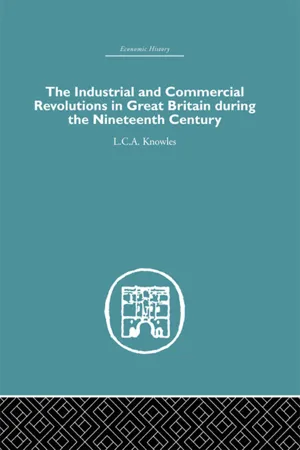
The Industrial & Commercial Revolutions in Great Britain During the Nineteenth Century
- 440 pages
- English
- ePUB (mobile friendly)
- Available on iOS & Android
eBook - ePub
The Industrial & Commercial Revolutions in Great Britain During the Nineteenth Century
About this book
First Published in 2005. In this book, the author seeks to bring out the causes which led to the coming of machinery and which made Great Britain the workshop of the world for a large part of the nineteenth century. Knowles especially stresses the world position of the United Kingdom during the past century owing to the developments of mechanical transport which were the inevitable outcome of the mass production by machines. This title also aims to account for the great change in public opinion after 1870, which led to the growth of State control, not merely in industry, but in commerce, agriculture, transport and imperial relations.
Industrial and Commercial Revolutions
in Great Britain
during the Nineteenth Century
in Great Britain
during the Nineteenth Century

PART I
INTRODUCTION
THE PRINCIPAL FEATURES OF NINETEENTH CENTURY ECONOMIC DEVELOPMENT
SYNOPSIS
THE nineteenth century is an outcome of the French achievement and advertisement of personal freedom combined with the new mechanical inventions which emanated from England. The result was the simultaneous removal of legal and physical disabilities.
The five characteristics of the economic development of the century are (1) freedom of movement and the consequent agricultural revolution; (2) the coming of machinery, creating a new industrial class and a new labour movement; (3) mechanical transport, producing a revolution in the relative importance of countries, in commerce and social life; (4) the development of new national economic policies, leading to an increasing State control of industry and commerce and of (5) a new effort of race expansion which inaugurated a new colonial era, making for world inter-dependence and world rivalry.
THE period which falls between the French Revolution of 1789 and the outbreak of the European War in 1914 may be styled the nineteenth century. It witnessed the general application of mechanical power to manufacture, transport and mining and was therefore a period of momentous economic change. The new inventions not merely altered all the old methods of production and distribution but the human factor in that production and distribution, man, was powerfully affected by machinery which enlarged his capacities and potentialities and by railways and steamships which increased his mobility. A revolution in ideas inevitably accompanied such far-reaching changes in the physical world, A new conception of personal liberty emerged and the mass of the population of Europe became free in the nineteenth century as it had never been free before. Governments had to face new classes and new problems and a new conception of national policy also emerged. The new methods of manufacture and transport created new demands for raw materials and food, new areas were opened up, new wants created and new markets developed, so that by the end of the period the whole globe was knit up in a world economy of world interdependence and exchange and world rivalry.
The only century that can compare with the nineteenth for the rapidity and fundamental nature of its changes is the sixteenth. In this latter century the enormous importance of the discovery of the sea route to India and the two Americas became evident in new trade routes, new commercial and colonial rivalries, new struggles among nations, a new merchant class and a considerable acceleration of the growth of capital with all that it implied in the reorganisation of industrial and agricultural life. The linking up of Europe with the Indies and the New World was followed by the revolution in economic thought brought about by the Reformation and the substitution of the royal and secular governments for the Church as the directing power in economic life.
Of the five countries that may be styled “Great Powers” in the nineteenth century, viz., England, France, Germany, Russia and the United States,* only the first two counted as important economic entities in the sixteenth century.
The two “Great Powers” of that period were those that had made the discoveries referred to, Portugal with her Eastern Empire and the rich spice trade, Spain with the New World and its silver mines. When in 1580 Spain absorbed Portugal and controlled both bullion and spices she seemed to be a colossus astride the narrow world. The economic dominance of this great Catholic power was challenged by Protestant Holland and England. Between them they shattered the sea-power of Spain and nothing then stood in the way of the expansion of the English race in North America. The foundations of the United States were accordingly laid by English merchants combining in chartered companies partly to break the power of Spain, partly to build up a self-sufficing Empire on the basis of tobacco and sugar for which the English had hitherto depended on “the courtesy of strangers.” Just as the sixteenth century belonged to Spain and Portugal, the seventeenth belonged to Holland. She became the great sea-power of that century with a world-wide trade and Amsterdam was the exchange place of Europe. The Dutch maritime superiority then excited as much jealousy in the English mind as had the overwhelming economic resources of Spain in the previous century. The result was Dutch wars and Navigation Acts and a conscious imitation of Holland by England ending up with a Dutch king, William III.
France was the great industrial country of the seventeenth and eighteenth centuries with a population estimated at twenty millions in 1700, and Paris with its 600,000–720,000 persons was the most populous city of Europe.* No other European town, except London, which numbered about 600,000 persons, had over 200,000 inhabitants.† At that time the Dutch numbered about three millions, the English five-and-a-half and the Spaniards about seven millions. France was, moreover, expanding rapidly at the end of the century in the two richest regions of the world, namely, India and the West Indies. She had also settlements on the continent of North America, which stretched down from Canada to Louisiana, hemming in the English. Indeed were she to obtain the crown of Spain, as seemed likely at the end of the seventeenth century, she would also become the heir of the Spanish dominions in Central and South America. She, in her turn, would then be as great an economic menace to the world as Spain had been earlier.
England ranked in the seventeenth century after both France and Holland in economic importance. She was in 1700 a prosperous agricultural island with a considerable woollen industry but no other manufactures of any importance. She had some settlements fringing the Atlantic in North America, she held some islands in the West Indies and some trading posts in India and Africa. She had been driven out of the spice islands by the Dutch and was as inferior to them in shipping and wealth as she was to the French in industry.
In the struggle for colonies and trade which took place during the seventeenth and eighteenth centuries Germany was not a competitor. The effect of the discoveries was to make the Atlantic the great highway for commerce and to bring into prominence the countries bordering that ocean. The inland seas such as the Baltic and the Mediterranean ceased to be the main arteries of trade and the important commercial towns bordering those seas also declined. The Hanse League—the great federation of towns in North Germany—suffered enormously from the diversion of routes. The once flourishing cities of South Germany which had been the intermediaries of the traffic between the two seas were also affected by the decline in importance of Venice and Genoa. Spices which used to be distributed by Augsburg were distributed via Lisbon and Antwerp after the Portuguese made their footing good in India.
Finally, the destruction of German economic life was completed by the devastation of the Thirty Years’ War (1618-1648) which paralysed German economic development. For the next two centuries and a half Germany remained both politically and economically a mediæval state. At the beginning of the nineteenth century she was an agglomeration of over three hundred states separated from one another by tolls and tariffs, with many different coinages, weights and measures and laws, while communications were hampered by almost impassable roads. She was still a country of serfs and mediaeval gilds in 1800.
Russia had been submerged by the Tartar invasions for two hundred years. Only at the end of the fifteenth century was that alien domination thrown off. In the sixteenth century she was only connected with Western Europe by the English merchants of the Muscovy Company who, greatly daring, explored the country via Archangel and connected barbaric Russia with Western civilisation. Russia was, therefore, in no position to compete for the Indies or the New World. Not till the reign of Peter the Great (1682-1725) did she really become part of Europe. She was even more mediæval and primitive than Germany at the beginning of the nineteenth century.
By the eighteenth century the Dutch Republic had begun to decline, while Spain and Portugal had ceased to be great powers. France was by far the most important economic power of the eighteenth century, England ranked second. The challenge of the growing economic dominance of France was taken up by England, now re-enforced by Scotland. She fought the War of the Spanish succession to prevent France joining Central and South America to her extensive possessions in India, the West Indies and North America. The two great powers of the eighteenth century thus joined issue and the great land power, France, with her teeming population fought the great sea power, Britain, inferior by far in numbers but better organized as regards finance, with the result that Britain increased her colonies and dependencies at the expense of France. From these two rivals were to emanate the new inventions which revolutionized physical conditions and the new ideas which revolutionized the position of man as a human being.
Great Britain was responsible for the successful development of steam power during the eighteenth century, while from France were to spread those ideas of personal liberty which, differently applied in different countries were, in combination with the steam engine and machinery, to transform Europe and by way of Europe the economy of the rest of the world. The nineteenth century is the outcome of French ideas and English technique.
The reason for the revolutionary effect of the steam engine is to be found in the fact that it provides a power independent of climate or geography which can be applied to an infinite number of different purposes. It can be used to drain mines, drive machinery in factories, work flour mills, bore tunnels, build houses, construct dams, empty ships, haul masses of goods from place to place, or cross oceans, deserts, or mountains. It is a power that can be applied in any country that can supply it with the necessary fuel. Feed it with coal and water, and it will economize labour and work night and day in cold or heat. Invented by Newcomen in 1710 to pump water out of coal mines, it could be worked away from the pit’s mouth owing to the economies in fuel made possible by Watt in 1776, and came gradually into use in England from 1782 onwards, when it was applied to work machines and create the blast for the new iron furnaces. From England it spread to the continent with greater or less rapidity, according to the country, after 1815, and gained fresh conquests by proving itself the effective motive power of rapid transport during that century. Prior to the introduction of steam, man had been almost helpless before the forces of Nature, such as floods, storms and droughts. He was hemmed in by mountain barriers and deserts and limited by climatic conditions and sheer distance. The steam engine enabled him to surmount these phenomena and became the great instrument of man’s control over Nature.
The French Revolution had so far-reaching an effect because it introduced suddenly into France a degree of personal freedom never before experienced in Europe, except in England. The ideas of the French Revolution were comprised in the words, “Liberty, Equality, Fraternity.” This meant in the economic sphere the abolition of the rights of one man over another, the equalization of taxation, the right to move from one place to another, the abolition of internal hindrances to the movement of people and goods, free choice of an occupation and equality before the law. After 1789 the individual Frenchman was legally free to change his abode or manner of living, he could choose his occupation in life without let or hindrance from feudal superior or from gilds, he could cultivate his land in the manner that suited him best, he could buy and sell in the same manner as everyone else, while he paid no more than his fair share of taxation. All these things were new in France for the bulk of the population. They had previously been enjoyed only by a limited and privileged class. The Frenchman became independent, self-dependent and possessed of the rights of equal citizenship. In their characteristic method of effecting change by means of revolution rather than by gradual reform, the French swept away in one night, August 4th, 1789, many of the feudal limitations which had been undergoing the slow dissolution of the centuries in other countries. France advertised by one tremendous event that personal liberty which even then existed in Great Britain but which had barely been appreciated by other countries because it had come so slowly.
The French Revolution seemed to crystallize into actual fact and make possible all the ideas of those who in other countries had maintained that serfdom and slavery were anomalies but who felt unable to handle the enormous problems that a change to freedom would involve. Where the French armies went they spread this new gospel of the economic liberty of the individual and the abolition of restrictions and privilege. The result was that during the nineteenth century the countries of Central and Eastern Europe freed their serfs and reconstructed their agricultural methods, legal systems and administration.
The combination of steam and liberty of movement was momentous in its results in spite of the reaction that followed the excesses of the Revolution. When economic freedom had been accomplished the bulk of Europe became legally free to move, free to grow rich, free to starve. Then came the railway and the steamship, making possible a degree of mobility hitherto undreamt of. Legal and physical disabilities were removed almost simultaneously. At the very time when men found themselves free to choose their means of livelihood, new instruments of production in machines lay to their hands and new occupations opened out on every side. The result was new peoples, new classes, new policies, new problems, new Empires.
The three other “Great Powers” of the nineteenth century—Germany, Russia and the United States—were the outcome of the new inventions and new ideas. The application of steam to land transport produced the railway which opened up the interiors of these three Continental countries, hampered hitherto by the difficulties of land transport. They developed into economic powers of the first rank because the railways facilitated their agricultural exports, brought their iron and coal together and distributed their products at cheap rates over large land areas. Ease of distribution had hitherto been a monopoly of the sea powers bordering the Atlantic.
While they were indebted for the new technique to Great Britain, these new powers drew their inspiration as to the proper relations of human beings from France. The influence of French revolutionary ideas is to be seen in the fact that both Russia and Germany freed their millions of unfree cultivators and the United States emancipated her slaves.
By the beginning of the nineteenth century only Great Britain and France could be reckoned as great economic powers: by the end of the century the mediæval countries of Germany and Russia had become modern states developing their resources with free men. The thirteen revolting colonies of England had survived a civil war lasting four years and had expanded over a continent and had also joined the ranks of the great powers.
It is thus easy to see why the nineteenth century begins in 1789. It was the starting point of the new ideas of personal freedom in continental Europe. It was also in that decade that the steam engine, the new motive power that was to revolutionize human capacity and mobility, came into use for other purposes than pumping water out of mines. Watt invented in 1782 the rotary movement of the steam engine which made it possible to utilize steam to drive machinery. He had already in 1776 made steam a cheap power by his modifications of the old “fire engine” which had been very extravagant in the use of coal and this enabled steam to be widely used.
The new mechanism and the new liberty thus arrive within six years of each other. Within the same period, 1782-1789, i.e., in 1783 the independence of the United States was recognized and they started their national career apart from Great Britain. The economic ruin of France during the ten years after 1789 produced Napoleon I., who not merely reorganized economic life along modern lines in his own country but, was the creator of modern Germany.
It is also clear that the nineteenth century ends in 1914 with the economic eclipse, temporary or permanent, of the German Empire and Russia, two of the great economic forces of the past century. No great war leaves the economic condition of a country as it found it. The historian of the future will be able to judge whether 1914 be the opening of a new period of the economic federation of Europe, of new economic powers delegated to the State, whether it has inaugurated a new era with regard to transport in the air which will minimize the importance of access to the coast and further facilitate the opening of interiors and whether it has proved to be the beginning of a new epoch with regard to labour questions.
While nothing is ever really absolutely new in economic evolution there is often such an accentuated pace of evolution that the whole conditions of life are radically changed. This is the reason that the nineteenth century is so clearly marked off from the eighteenth. The accumulation of changes, shadowed before but quite definite after 1789, make the following century the age of mechanism and personal mobility.
The main outstanding features of the economic development of the great European powers and the United States as a result of this new mechanism and the new idea of personal liberty, are five in number.
There is first the abolition of restrictions on personal freedom comprised in the sweeping away of serfdom and all the mediaeval and feudal limitations on free movement. The whole economy of the great agricultural estates of Central and Eastern Europe, based as it was on keeping a supply of labour fixed to a definite spot, had to be readjusted, and a new agriculture, working with free labour and carrying out individual instead of communal agriculture and intensive instead of extensive cultivation, had to be initiated. Personal liberty meant for Europe an agricultural revolution as did also the freeing of the slaves for the Southern States...
Table of contents
- Cover
- Title Page
- Copyright Page
- Preface
- Contents
- Part I: Introduction
- Part II: The Industrial Revolution Caused by Machinery
- Part III: Industrial and Commercial Policy in Great Britain During the Nineteenth Century
- Part IV: The Commercial Revolution Caused by Mechanical Transport
- Part V: The Development of Mechanical Transport in Great Britain and the Problem of State Control of Transport
- Part VI: The Industrial and Commercial Revolutions and the New Constructive Imperialism
- Part VII: The Effect of the Development of Mechanical Transport on British and Irish Agriculture
- Conclusion
- Appendix
- Index
Trusted by 375,005 students
Access to over 1.5 million titles for a fair monthly price.
Study more efficiently using our study tools.
Frequently asked questions
Yes, you can cancel anytime from the Subscription tab in your account settings on the Perlego website. Your subscription will stay active until the end of your current billing period. Learn how to cancel your subscription
No, books cannot be downloaded as external files, such as PDFs, for use outside of Perlego. However, you can download books within the Perlego app for offline reading on mobile or tablet. Learn how to download books offline
Perlego offers two plans: Essential and Complete
- Essential is ideal for learners and professionals who enjoy exploring a wide range of subjects. Access the Essential Library with 800,000+ trusted titles and best-sellers across business, personal growth, and the humanities. Includes unlimited reading time and Standard Read Aloud voice.
- Complete: Perfect for advanced learners and researchers needing full, unrestricted access. Unlock 1.5M+ books across hundreds of subjects, including academic and specialized titles. The Complete Plan also includes advanced features like Premium Read Aloud and Research Assistant.
We are an online textbook subscription service, where you can get access to an entire online library for less than the price of a single book per month. With over 1.5 million books across 990+ topics, we’ve got you covered! Learn about our mission
Look out for the read-aloud symbol on your next book to see if you can listen to it. The read-aloud tool reads text aloud for you, highlighting the text as it is being read. You can pause it, speed it up and slow it down. Learn more about Read Aloud
Yes! You can use the Perlego app on both iOS and Android devices to read anytime, anywhere — even offline. Perfect for commutes or when you’re on the go.
Please note we cannot support devices running on iOS 13 and Android 7 or earlier. Learn more about using the app
Please note we cannot support devices running on iOS 13 and Android 7 or earlier. Learn more about using the app
Yes, you can access The Industrial & Commercial Revolutions in Great Britain During the Nineteenth Century by L.C.A Knowles in PDF and/or ePUB format, as well as other popular books in Business & Business General. We have over 1.5 million books available in our catalogue for you to explore.