- 296 pages
- English
- ePUB (mobile friendly)
- Available on iOS & Android
eBook - ePub
An Economic History of the United States Since 1783
About this book
First Published in 2005. This is Volume two of a series on the Economic History of the USA. This book provides a summary of the phases of economic growth. It presents in succinct form and in the most common organization the essential facts about the economic development of the American people. While prepared as a summary or digest of the subject, suitable for study and review in conjunction with any standard text, the book has a unity and an organization which permit its independent use.
Trusted by 375,005 students
Access to over 1.5 million titles for a fair monthly price.
Study more efficiently using our study tools.
Information
1
THE PHYSICAL BASIS OF UNITED STATES ECONOMIC HISTORY
The American physical scene, however wealthy, has not by itself provided for all the needs of the people. Americans have therefore labored to adapt the gifts of nature in order to supply their needs better. United States economic history is the story not only of man’s conquest of nature but also of nature’s influence on man.
PHYSIOGRAPHIC INFLUENCES
Physical factors have been of importance throughout our economic development. Early settlements were located along the harbors and rivers of the Atlantic Coast; river valleys and mountain gaps pointed the way westward; natural resources facilitated the development of, and often determined the location of, certain economic activities. The struggle with nature left its mark upon the original European settlers of America and contributed to the development of the American character. Political, social, and economic attitudes have frequently reflected the physical environment; concern with the conquest of nature has produced a pragmatic and utilitarian outlook on life; extensive resources have encouraged tenacious optimism.
GEOGRAPHIC REGIONS AND CLIMATE
The United States occupies that part of North America lying roughly between the 25th and 49th parallels, an area of 3,026,789 square miles. (In addition to Continental United States, there are territories and other non-contiguous areas containing about 600,000 square miles.)
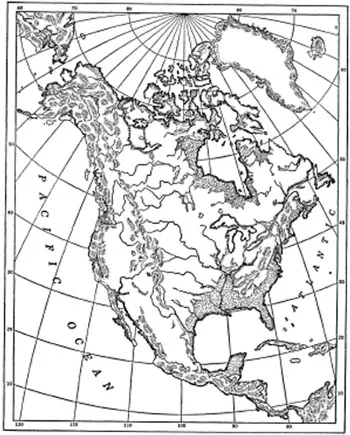
Physical Map of North America
Geographic Regions. There are five main geographical divisions, or natural regions of the United States.
The eastern coastal plain lies between the Atlantic Ocean and the Appalachian Mountains. Numerous rivers cross this plain, but few, except the Delaware and the Hudson, are navigable far inland. The eastern coast is interrupted by many bays, inlets, and excellent harbors. Agriculture was of some significance in this region in the early period, but commerce, business, and finance are now most important.
The Appalachian highland, just west of the coastal plain, extends from northern New England to Alabama, and is roughly 300 miles wide. It includes much good upland farm land as well as numerous fertile valleys, both east and west of the mountains. Rapid rivers provide water power, and mineral and oil deposits have facilitated the rise of industry.
The Mississippi Valley reaches from the Appalachian highland to the eastern edge of the Rocky Mountains. The central portion, the granary of America, is fed and drained by the mighty Mississippi River and its many tributaries. On the Great Plains, just east of the Rockies, the scarcity of rainfall makes agriculture difficult or impossible. Iron deposits in the western Great Lakes area have permitted the rise of manufacturing.
The Cordillera region extends from the Rocky Mountains westward to the Sierra Nevada and Cascade ranges, with an intervening arid plateau. Rainfall is insufficient to support agriculture, and dry farming and irrigation are able to make only a small fraction of the region arable. There are highly valuable deposits of copper, gold, silver, iron, coal, and uranium.
A narrow section along the Pacific Coast is made up of low mountains and a thin plain. A few rapid rivers are sources of water for irrigation and hydroelectric power. Until the recent growth of industry, this region was chiefly noted for its fruits, vegetables, timber, and fish.
Climate. All of the United States lies within the Temperate Zone and therefore enjoys the type of climate best suited to human effort. Average temperatures range from 40 to 70 degrees, insuring climatic conditions conducive to great physical and mental exertion. Conditions are similar to those of Europe, where other highly civilized societies have developed, and the conquest of the North American continent has produced a hardy, energetic, extremely self-reliant people. The average annual rainfall is 26.6 inches, with the amount in different areas varying from 5 inches in Utah to 60 inches in parts of California and the Gulf states. (The amount ordinarily essential for agriculture is 20 inches.) Conditions for agriculture are best east of the 100th meridian where rainfall averages between 20 and 60 inches annually. The arid Great Plains and the Cordillera region have less than 20 inches. Lack of rainfall is geographically the most important single factor in the economic history of the Great Plains.
NATURAL RESOURCES
The United States is blessed with abundant and diversified natural resources. These include productive soil, forests, minerals, fish and game, and water power.
Soil. Soil, the most basic resource, is varied. About 40 per cent of the land is arable, but differences in soil and climate permit the raising of a wide variety of crops. Alluvial soil along southern rivers is very fertile. Throughout northern and eastern North America, as far south as the Ohio River, glacial action did much to determine the type of soil. Glaciers sometimes scraped off the surface soil and covered the land with boulders as in New England, but at other times left very fertile land behind as in the corn belt of the Midwest, where the mixture of topsoil and subsoil resulted in highly productive land.
Forests. The luxuriant forests of the United States have been an invaluable asset throughout American history. Originally almost all of the land east of the Mississippi River was covered by thick forests. In the north the softwoods are most prevalent, but some hardwoods are found. A central hardwood belt stretches from the Great Lakes to northern Alabama, and along the Gulf of Mexico the forests produce mixed woods. West of the Mississippi River, except for scattered parts of the Cordillera region, the land is barren of trees. Along the northern Pacific Coast there is a heavy growth of valuable fir trees.
Minerals. The United States has vast supplies of the mineral resources needed in modern industrial society. Petroleum, the most valuable mineral, is found in three main areas: the Ohio Valley and midcontinent fields; the coastal region of Louisiana and Texas; and California. Coal is second in value among minerals. The anthracite of Pennsylvania is the most important known anthracite resource in the world. Bituminous deposits have been found in the Appalachian area from Pennsylvania to Alabama and in several Mississippi Valley states. Bituminous is mined in 28 states. Known iron resources almost equal those of the rest of the world. Iron is found in every state, but the Lake Superior region produces nine-tenths of United States iron ore. The region of Birmingham, Alabama, ranks second in the production of iron. The greatest supply of copper is found in Arizona, but there are substantial deposits in many western states. Other mineral resources include zinc, lead, aluminum, gold, silver, and uranium.
Fish and Game. Abundant fish and wild game were of greater importance in our earlier history than at the present time. In the colonial period fish was the most important staple product of New England. Plentiful supplies of fish are still available in both the north Atlantic and the north Pacific. Bison and deer were once useful for their hides and as food; beaver and other fur-bearing animals were hunted for their pelts. Today we depend upon domesticated animals for meat and hides, and wild animals, greatly reduced in numbers, are valued chiefly for their furs.
Water Power. The numerous waterways of the United States have been important highways of commerce, and they also have provided an inexhaustible source of power. In early manufacturing, water power was widely used, and in the twentieth century it is being increasingly used to generate electricity.
REVIEW QUESTIONS
1.How has the physical environment proved advantageous in our economic development? In what ways has it proved disadvantageous?
2.Describe the main geographical divisions of the United States.
3.What effect have climatic conditions had on our economic life?
4.Describe and locate by regions the natural resources of the United States: soil, forests, minerals, fish, wild game, waterways.
2
THE EUROPEAN BACKGROUND OF AMERICAN ECONOMIC HISTORY
On the eve of the discovery of America, western Europe was going through a great transition period wherein medieval institutions were being transformed into early modern institutions. There were profound changes in every sphere of life—political, social, intellectual, religious, and economic.
THE TRANSITION FROM MEDIEVAL TO MODERN TIMES
Politically, the nation-state system replaced feudal localism. Socially, free society developed, and a new class, the bourgeoisie, emerged. Intellectually, the significant changes were a revival of ancient learning and a questioning of medieval authorities. In religion, the Protestant Reformation split the western Christian world in the sixteenth century. Economically, modern capitalism resulted from increased trade and business.
Revival of Trade. In the late Middle Ages (1100-1500) there was a general revival of trade and business. After the fall of the Roman Empire in the fifth century, trade and city life had declined greatly, and economic localism had characterized western Europe for at least five centuries. During this period contact with the eastern Mediterranean world had been irregular. From about 1100 on, however, there was increased interest in the East. This was stimulated by the Crusades and the tales of travelers. Although the Crusades (a series of armed pilgrimages, between 1100 and 1300, to reconquer the Holy Land from the Turks) failed in their ostensible purpose, they increased trade and helped to revive the stagnant economy of Europe. Accounts of travel by Carpini, Rubruquis, and Marco Polo, which appeared in the thirteenth and fourteenth centuries, added to the geographical knowledge of Europeans and excited interest in the fabulous East. There developed a European market for Oriental luxuries such as spices, rugs, cutlery, gems, fabrics, and glass. In return Europe shipped woolens, tin, copper, arsenic, quicksilver, lead, gold, and silver to the East.
With the increase in trade came the rise of towns. Mediterranean cities, especially the strategically located Italian cities, led the way in the growing commercial activity. Important trading centers also developed in northern Europe. The Italian cities were logical starting places for the Crusades; Venice, Pisa, and Genoa handled much of the trade with the East. Overland passes through the Alps permitted the shipment of goods to northern Europe, but early in the fourteenth century Italian merchants began trading by an all-water route with English and Flemish towns.
Rise of Capitalism. Modern capitalism was born largely as a result of accumulation of wealth from increased trade. Surplus capital was used to open new trade routes, to subsidize nation-states, and to exploit the New World. In order to combine resources and to obtain greater protection against pirates, robbers, and unfriendly princes, merchants organized joint-stock companies (partnerships in which each partner was responsible for all debts). In these early days of capitalism, merchant princes performed many functions now associated with banking : they were the money-changers, moneylenders, and money-carriers.
Merchant capitalism found strength and support in two quarters: the nation-state and the new Protestant churches. National monarchs relied upon the wealth of the bourgeoisie to combat the influence of feudalism and the medieval Church. Capitalism derived immense benefits from the alliance with the nation-state, for the integrated state provided a wider domestic market, and protected and regularized trade. In time the public policy of mercantilism arose to strengthen capitalism as well as the nation-state. The Protestant churches contributed to the development of capitalism by providing an ethic which was compatible with the evolving economy of Europe. Many hard-working bourgeois, not content merely with reward in the next life, were attracted to the Protestant churches, which gave their blessing to capitalistic virtues.
DISCOVERY OF AMERICA
Competition for control of trade with the Orient motivated western European nations to sponsor numerous voyages of discovery and exploration.
Oriental Trade. The discovery of America was an inevitable result of the economic expansion of Europe in the late Middle Ages. Trade with the East by the Mediterranean route was expensive. The fall of Constantinople to the Turks in 1453 did not create the barrier to trade that historians formerly conceived, but it did add to the cost of trade. Merchants of Portugal, Spain, France, and England wished to trade directly with the Orient rather than through Italian and Turkish middlemen.
International Rivalry. Successful national monarchs were eager to engage in overseas ventures. Portugal, under the guidance of Prince Henry the Navigator, led in the voyages of discovery and exploration in the late fifteenth century. In 1486 Diaz rounded the Cape of Good Hope, at the southern tip of Africa; in 1497-1498 da Gama reached India. With this initial advantage and a favorable geographic location, the Portuguese created a great empire in the Far East. Spain followed the lead of Portugal and sponsored the westward voyage of Columbus in 1492. Instead of reaching Asia, Columbus discovered America. Within a few years explorers had established a magnificent Spanish empire in South, Central and North America. Navigators of other powers joined in the exploration of the New World, but in the sixteenth century Spain had a virtual monopoly in the exploitation of America. John Cabot’s voyage to Newfoundland in 1497 laid the basis of England’s claim to North America. France’s claim rested on the voyages of Verrazano in 1524 and Cartier in 1534 and 1535.
REVIEW QUESTIONS
1.Why can the period 1200 to 1500...
Table of contents
- Cover
- Title page
- Copyright page
- About the Author
- Table of Contents
- Preface
- Tabulated Bibliography of Standard Textbooks
- Quick Reference Table to Standard Textbooks
- 1. The Physical Basis of United States Economic History
- 2. The European Background of American Economic History
- 3. The Colonization of North America
- 4. Production in Colonial America
- 5. Colonial Commerce
- 6. Economic Aspects of the Revolutionary Period
- 7. Public Finance and Fiscal Policy, 1789 to 1860
- 8. Agriculture before 1860
- 9. Population and Labor before the Civil War
- 10. Transportation Developments before the Civil War
- 11. Westward Expansion before the Civil War
- 12. Beginnings of American Industrialism
- 13. Foreign Trade and Maritime Industries, 1789-1860
- 14. Money and Banking, 1789-1860
- 15. Performance of the American Economy, 1789-1860
- 16. Economic Aspects of the Civil War
- 17. Passing of the Frontier
- 18. Changing Agriculture, 1860-1914
- 19. History of Transportation and Communication to 1914
- 20. The Industrial Revolution
- 21. Industrial Consolidation and the Antitrust Movement
- 22. The Labor Movement, 1860-1914
- 23. Domestic and Foreign Commerce
- 24. Financial History, 1865-1914
- 25. The Performance of the American Economy, 1865¬1914
- 26. Economic Imperialism
- 27. World War I and the American Economy
- 28. The Prosperous Twenties
- 29. The Great Depression
- 30. The New Deal
- 31. America and World Economics
- 32. Economic Problems of World War II and Postwar Developments
- Final Examination
- Index
Frequently asked questions
Yes, you can cancel anytime from the Subscription tab in your account settings on the Perlego website. Your subscription will stay active until the end of your current billing period. Learn how to cancel your subscription
No, books cannot be downloaded as external files, such as PDFs, for use outside of Perlego. However, you can download books within the Perlego app for offline reading on mobile or tablet. Learn how to download books offline
Perlego offers two plans: Essential and Complete
- Essential is ideal for learners and professionals who enjoy exploring a wide range of subjects. Access the Essential Library with 800,000+ trusted titles and best-sellers across business, personal growth, and the humanities. Includes unlimited reading time and Standard Read Aloud voice.
- Complete: Perfect for advanced learners and researchers needing full, unrestricted access. Unlock 1.5M+ books across hundreds of subjects, including academic and specialized titles. The Complete Plan also includes advanced features like Premium Read Aloud and Research Assistant.
We are an online textbook subscription service, where you can get access to an entire online library for less than the price of a single book per month. With over 1.5 million books across 990+ topics, we’ve got you covered! Learn about our mission
Look out for the read-aloud symbol on your next book to see if you can listen to it. The read-aloud tool reads text aloud for you, highlighting the text as it is being read. You can pause it, speed it up and slow it down. Learn more about Read Aloud
Yes! You can use the Perlego app on both iOS and Android devices to read anytime, anywhere — even offline. Perfect for commutes or when you’re on the go.
Please note we cannot support devices running on iOS 13 and Android 7 or earlier. Learn more about using the app
Please note we cannot support devices running on iOS 13 and Android 7 or earlier. Learn more about using the app
Yes, you can access An Economic History of the United States Since 1783 by Francis G. Walett in PDF and/or ePUB format, as well as other popular books in Business & Business General. We have over 1.5 million books available in our catalogue for you to explore.