eBook - ePub
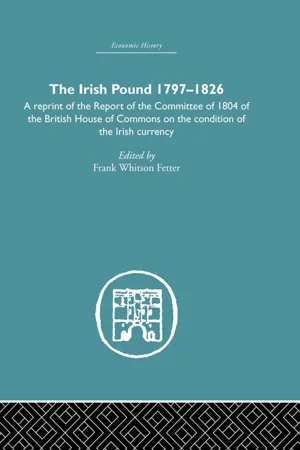
The Irish Pound, 1797-1826
A Reprint of the Report of the Committee of 1804 of the House of Commons on the Condition of the Irish Currency
- 144 pages
- English
- ePUB (mobile friendly)
- Available on iOS & Android
eBook - ePub
The Irish Pound, 1797-1826
A Reprint of the Report of the Committee of 1804 of the House of Commons on the Condition of the Irish Currency
About this book
First Published in 2005. The Irish Report is a scarce document, known to comparatively few economists. This reprint of the Report and of portions of the Minutes of Evidence, set against the historical background, will not only be of interest to the student of monetary theory and of monetary history, but also help to give perspective on some present-day problems of monetary and exchange policy, particularly in the countries of the sterling area. The Irish Report was frequently cited in the pamphlet literature of the time, and in Parliamentary debate, and discussed in detail the exchange situation between Ireland and England.
INTRODUCTION
Early Monetary Standard of Ireland
Early History of Irish Banking
Irish Monetary and Banking Situation in 1797
Restriction of Specie Payments
Monetary and Banking Situation Resulting from the Restriction
Exchange Rates under the Restriction
Public Controversy on the Irish Exchange
Appointment of the Parliamentary Committee of 1804
Hearings of the Committee
Causes of Exchange Fluctuation
Bank of Ireland’s Influence on The Monetary Supply
Proposals for Exchange Stabilization
Report of the Committee
The Small Coin Crisis in Ireland
Improvement in the Irish Exchange
Parliamentary Action on Irish Monetary Situation: 1805—1816
Resumption of Cash Payments in 1821
Assimilation of Irish and English Currencies in 1826
WHEN the Bank of England suspended specie payments in February, 1797, Ireland had a separate monetary system, with the specie value of the Irish pound 12/13ths of the specie value of the British pound. The notes of the Bank of Ireland, like the notes of the Bank of England, had been redeemable in specie, which in practice was gold, as a result of the fact that the mint ratio of approximately 1 : 15·2 set by the decree of 1717 had over-valued gold, and had driven out of circulation almost all full weight silver in England1 and Ireland. Although the Bank of Ireland had not been subject to the run that had forced the Bank of England to suspend payments, the British Government also compelled the Bank of Ireland to stop redemption of its notes. This situation for the next twenty-four years under the Bank Restrictions, of independent inconvertible paper currencies within the same political sovereignty,2 raised significant issues in monetary theory, as well as important questions of monetary policy. These developments after 1797 can best be understood against a background of the monetary and banking situation of Ireland before the Restriction.
EARLY MONETARY STANDARD OF IRELAND
At the time of the early English invasions Ireland had only a rudimentary monetary economy, and barter continued in most parts of the country long after the use of money had become general in England, and in rural districts in Ireland was common until well into the nineteenth century.3 The English invasions brought in English coins, but through a development similar to that in the American colonies, whereby their pounds had a value different from the pounds of England, the monies of Ireland, although called pounds, shillings and pence, were not equal to the English units. The situation previous to 1701 is not clear, but at least since 1689 gold and silver coins had passed in Ireland at a higher valuation than in England. A proclamation of 1701 had given the English shilling a valuation of 1s. 1d. Irish, and a proclamation of 1737, fixing the guinea, worth 21s. English, at 22s. 9d. Irish, had in effect tied together the English and Irish monetary systems on a gold basis, with 13 Irish units equal to 12 English units.4 This situation continued up to the suspension of payments in 1797. Hence the exchanges were considered at par when the premium on English currency in terms of Irish currency was 8 1/3%, and both in London and in Dublin it was customary to quote exchange on the basis of the number of Irish pounds in excess of 100 that exchanged for £100 English.
The real monetary problems of Ireland throughout most of the eighteenth century were those of the shortage of silver and copper coins. No Irish silver had been minted since 1649 and the silver circulation consisted almost exclusively of badly worn English coins. There were several mintings of copper for Ireland, including the Wood half-pence made famous by the satirical and not always technically accurate writings of Jonathan Swift, but at times large quantities of private brass tokens, and even private I. O. U.’s, were in circulation. James Simon wrote in 1749: “What silver is now left, is some English money, not worth melting, shilling pieces hardly worth nine pence or ten pence, and six-penny pieces not worth a groat.”5 A witness before the Committee of 1804, in answer to a question as to whether the silver coin in Ireland was inferior to that in England prior to the Restriction, replied: “It was ever since I knew the Silver Coin of Ireland.”6
EARLY HISTORY OF IRISH BANKING
Bank note issues developed in Ireland in much the same way that they had developed in England, out of the giving of receipts by goldsmiths and others for money deposited with them, and as a sideline of trade and commerce. Before the establishment of the Bank of Ireland in 1783 all Irish note issuing agencies were unincorporated, practically free from control and supervision except as an incident of tax legislation. By the middle of the eighteenth century bank notes were widely used in Dublin,7 but apparently there was little circulation of Dublin bank notes in the country, and any issue of bank notes outside of Dublin was on a very limited scale. As a result of a panic in 1754 all but two of the Dublin banks failed, and these two retired their notes, so that for a brief time no paper money circulated in Ireland.8 Soon afterwards private banks again started to issue circulating paper in Dublin, and notes were also issued in some of the provincial cities. The North of Ireland, however, had almost no paper circulation until 1808. A bank was established in Belfast in 1752 but lasted only five years, and another Belfast bank established in 1784 closed its doors in 1798.
In 1783 the Bank of Ireland, the first incorporated bank in the country, opened under an exclusive charter which forbade any other company with over six partners from issuing circulating notes. Until 1799 there were no legal restrictions in Ireland on the issue, either by the Bank of Ireland or by private banks, of notes of small denominations. No accurate figures are available as to the number of private bankers in Ireland before 1797, or the amount of their issues, but a Dublin banker, John Claudius Beresford, testifying before the Committee of 1804,9 believed that the issue of the Dublin private bankers was about £700,000 in 1797. In 1797 the Bank of Ireland had outstanding notes of less than £700,000,10 most of which circulated in Dublin. As compared with a gold circulation estimated at about £5,000,00011 in addition to the silver and copper coins, the bank note circulation of Ireland made up but a small fraction of the total means of payment in the country in 1797.
IRISH MONETARY AND BANKING SITUATION IN 1797
The Bank of Ireland, which had been established less than fifteen years at the time of the Restriction, held a different relationship to the other banks of Ireland than the Bank of England held to the other banks of Great Britain. Dublin was not a financial clearing house for the rest of Ireland in the way that London was for Great Britain. Its relation to the rest of Ireland was more that of a large provincial English city to the surrounding countryside. There was no foreign exchange market in Dublin and all financial dealings with the continent cleared through London, except for very limited transactions with Portugal. Not only did Belfast deal directly with London, but apparently there was also some direct dealing between smaller Irish cities and London.12
Information on banking practices in Ireland in 1797 is meagre,13 but it seems clear that Bank of Ireland funds did not have the reserve significance for the Irish banks that Bank of England funds had for British banks. There is no evidence that either the Dublin bankers or the country bankers kept balances with the Bank of Ireland. Irish banks, in addition to gold, held part of their reserves in Bank of Ireland notes, but they never regarded the Bank of Ireland as enjoying the special position that the Bank of England held in the British banking system, and the Bank of Ireland had much less control over the Irish banks than the Bank of England had over the British banks. The Bank of Ireland had by law a monopoly in Ireland comparable to that of the Bank of England in Great Britain, but the difference in the age of the two institutions and in banking practices in the two countries made functional relationships between the “Bank” and private banks quite different on the opposite sides of the Irish Sea. The Dublin bankers issued notes that circulated in competition in Dublin with Bank of Ireland notes; and Bank of Ireland notes, and to a limited degree the notes of the Dublin bankers, circulated in the country in competition with the issues of local banks.
Henry Thornton, with his rare combination of familiarity with the details of banking practice and the ability to appraise the larger significance of those details, said in the Parliamentary debate of 1804, shortly before the appointment of the Irish Currency Committee:
“There was a material difference . . . between the banks of England and Ireland: In Ireland there was no bank that took upon itself to manage and regulate the circulation of the country; whereas, in England it was perfectly well known, that the Bank commanded the whole paper circulation of the metropolis, and regulated that of the kingdom.”14
RESTRICTION OF SPECIE PAYMENTS
The immediate circumstances that forced the Bank of Ireland to suspend specie payments were different from those that had caused the English Bank Restriction. Ireland, probably because its economy was more tied up with agriculture, and its banking system less developed, had largely escaped the financial crisis that England had suffered in 1793. Although the Irish Government had substantial deficits after 1793 as a result of the war with France, the problems of war finance did not create the difficulties for the Bank of Ireland that they had for the Bank of England. A part of the Irish government deficit was covered by borrowing in England, and there were large imports of gold and silver into Ireland in the years 1795 to 1797, both on private account and for the Bank of Ireland.15 No figures are available as to the specie reserve of the Bank of Ireland in the years before 1797, at the time of the suspension of payments,16 or at any time during the Restriction. There was some internal drain of gold in Ireland in February, 1797,17 but it appears to have been far less severe than in England.
In view of the dependence of the Bank of Ireland upon the Bank of England as a source of gold in time of crisis, there is serious question as to how long the Bank of Ireland could have continued specie payments had it not been able to obtain gold freely from the Bank of England. Not until 1821 did the Bank of Ireland open an account with the Bank of England, but even before 1797 it had, through its London agents, turned to the Bank of England as the final source of gold in time of crisis. Whatever the law or the directors of the Bank of Ireland might say, the economic realities were, in the words of the Lords Committee of Secrecy of 1797:
“The Bank of England . . . is subject . . . to be called on for Cash, directly or indirectly, by those who are in Want of it, and is necessarily sensible of every material Failure or Distress, which arises from any Deficiency of Want of Coin, in every Part of this Kingdom or Ireland.”18
The Bank of England, whose reserve position had been seriously weakened in 1795 and 1796, largely as the result of loans and subsidies to Great Britain’s continental allies, but partly because of the flow of specie to Ireland, faced an alarming internal run in February, 1797. Pitt secured an Order in Council, ordering the Bank to suspend specie payments when it opened for business on Monday morning, February 26. This Order was confirmed by the Bank Restriction Act of May 3, 1797,19 which with its numerous extensions prolonged the suspension of specie payments until 1821. The Order in Council and the subsequent Restriction Act had applied only to the Bank of England, but the English country banks and the Scottish Banks, although making occasional payments in specie in the early years of the Restriction, were tacitly given the right to pay in Bank of England notes, thus in effect linking up the whole British currency system with the Bank of England note.20
The legal situation in Ireland, with its separate Parliament, was quite different. The Bank of Ireland as well as the private banks continued for nearly a week after the English suspension to make payments in specie, and there was no run that made necessary a suspension of payments at the moment. But the British Government for reasons of policy wished to extend the Restriction to Ireland and on March 2, 1797, the Lord Lieutenant of Ireland sent a message to the Irish House of Commons that:
“. . . he had, by the advice of the privy council, issued an order to the governor and company of the bank of Ireland . . . similar to an order issued by the privy council of Great Britain, to the governor and company of the bank of England, directing them, for the present, to discontinue payments in specie.”21
Both as a matter of economic policy and as a question of the prerogatives of the Irish Parliament the action of the Council aroused opposition. Henry Grattan, in line with a view that he had expressed many times before on other issues involving the authority of the Irish Parliament, criticized the Privy Council for issuing an order while the Irish Parliament was in session without first submitting the matter to the Parliament.22 In the debate in the Commons, Thomas Pelham stated that:
“The measure had been adopted here; not through any sort of inability on the part of the bank to answer its engagements, for the measure was not adopted at the desire of the bank directors; on the contrary, it was against their wishes; but it was pressed on them by government, as a necessary measure, in consequence of a similar one adopted in England.”23
But on April 20, 1797, the Irish Commons voted “that it is the opinion of this House, that it is necessary to confirm and continue the measures taken by the bank of Ireland,”24 and after approval by the Lords, the Irish Restriction became law on July 3, 1797.25
The Irish Restriction Act did not apply to banks other than the Bank of Ireland, but in line with the situation in England all Irish Banks in practice were relieved of the obligation to pay in specie. However some Irish banks continued for a time to make payments in specie,26 and one leading Dublin bank, apparently in protest against the Restriction, redeemed all of its outstanding notes in gold and issued no m...
Table of contents
- Cover
- Half Title
- Title Page
- Copyright Page
- Original Title Page
- Original Copyright Page
- Contents
- Preface
- Introduction
- Text OF the Report of 1804
- Selections from the Minutes of Evidence
- Extract From The Bullion Report Relating To The Report of The Irish Currency Committee of 1804 and To The Exchange Relations of Ireland and England
- Appendices
Trusted by 375,005 students
Access to over 1.5 million titles for a fair monthly price.
Study more efficiently using our study tools.
Frequently asked questions
Yes, you can cancel anytime from the Subscription tab in your account settings on the Perlego website. Your subscription will stay active until the end of your current billing period. Learn how to cancel your subscription
No, books cannot be downloaded as external files, such as PDFs, for use outside of Perlego. However, you can download books within the Perlego app for offline reading on mobile or tablet. Learn how to download books offline
We are an online textbook subscription service, where you can get access to an entire online library for less than the price of a single book per month. With over 1.5 million books across 990+ topics, we’ve got you covered! Learn about our mission
Look out for the read-aloud symbol on your next book to see if you can listen to it. The read-aloud tool reads text aloud for you, highlighting the text as it is being read. You can pause it, speed it up and slow it down. Learn more about Read Aloud
Yes! You can use the Perlego app on both iOS and Android devices to read anytime, anywhere — even offline. Perfect for commutes or when you’re on the go.
Please note we cannot support devices running on iOS 13 and Android 7 or earlier. Learn more about using the app
Please note we cannot support devices running on iOS 13 and Android 7 or earlier. Learn more about using the app
Yes, you can access The Irish Pound, 1797-1826 by Frank W. Fetter in PDF and/or ePUB format, as well as other popular books in Business & Business General. We have over 1.5 million books available in our catalogue for you to explore.