- 432 pages
- English
- ePUB (mobile friendly)
- Available on iOS & Android
eBook - ePub
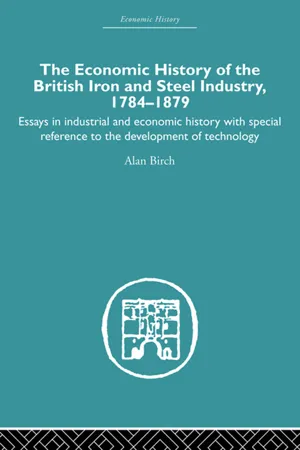
Economic HIstory of the British Iron and Steel Industry
About this book
This book was first published in 1967. This volume explores the history of the British iron and steel industry from 1760, tracking its development, relationship with the British economy, regional hubs, technological developments and the final triumph of steel over iron.
Information
Part I
CHAPTER I
The British Iron and Steel Industry 1760–1879
Astraightforward economic history of the iron industry—and here one is thinking of the coke-iron industry during the period from 1760 (when Dowlais and Carron, the two giants of the modern industry, came into production) to 1870 when the age of steel comes into being—would treat the following subjects:
(i)......Technology.
(ii)Growth—output, location, markets.
(iii)Organisation and integration, large firms, associations.
(iv)Labour in the industry.
This approach is compartmental and, of course, is open to the objection that, since the economic historian is as much concerned with the process of change as with the results, the task of the historian is to trace and show the interaction, the movements between the factors of production. The springs of this movement have traditionally been sought in technological advances—coke smelting, the puddling and steam-driven rolling processes and the successive improvement on these. Conversely, although this has not so clearly been shown, the motive force of supersession could well be demonstrated as forging the structure and location of the industry.1 It is true that this appears to take us back to Schumpeter’s concept of innovation (involving creative destruction by the new leaders of industry), particularly as a production function.2 As Schumpeter sets it out:
‘This function describes the way in which quantity of products varies of quantity of factors vary. If,instead of quantities of factors, we vary the form of funcntion, we have an innovation.’3
However, as has been pointed out, Schumpeter has given explicit attention to the process by which innovation—technological and organisational change—is generated. The problem of invention, which may be said to spark off the process of innovation, is a fascinating one and it would be tempting to dwell on A. P. Usher’s theories about this. The implications of accepting Usher’s ‘accumulative synthesis approach’,4 which is not incompatible with Schum-peter’s work on the effects of innovation on economic development, reinforces Schumpeter’s emphasis upon the practical application of innovations in technology and in economic innovation.
It is this practical application of technological advances which Professor Habakkuk examines in his recent book and which bears directly on the British experience in the iron and steel industry. The iron industry affords, in the case of the long time-interval between the early experiments in coke smelting in the early part of the seventeenth century and Abraham Darby’s success in Coalbrookdale —and then the still slow adoption of the new process through the eighteenth century, a classic instance of the process of innovation. It is essentially this problem of determining the factors retarding or hastening innovation in its full sense which Habakkuk analyses.5 One of his starting-points is the statement:
‘Technical progress has a logic of its own; one invention raises problems intellectual and mechanical, which require time and effort for their solution and which, being solved, suggest new lines of advance. At any moment, only certain lines of advance are technically possible, and with the best will in the world one can only go a certain distance. At some periods, for purely autonomous reasons, the technical knowledge available to be incorporated into practice is richer than at others.’
Another feature of technical progress, a fact of common experience to industrial researchers but now only being recognised by historians of technology, is the need for the researcher to go back to former experiments written off as failures or inconclusive. This applies to theoretical and applied knowledge; industry aided with new fundamental techniques of analysis—I am thinking of the statistical approach—and new means of control and investigation, must learn from the past in this way.
Habakkuk incidentally illustrates this line of development:
‘Compared with the last forty years of the eighteenth century’, he says, ‘the first half of the nineteenth was not a period of major technological breakthroughs in English industry. Down to the mid-century and indeed well beyond, the principal advances sprang from remedying imperfections in the basic inventions of the industrial revolution and applying the principles involved in them to new fields. It was not until the 1870s or 1880s that additions to fundamental knowledge assumed technological significance.’6
Apart from the stream of know-how available to the industrialist, he must also take into account the economics of supplying capital for the machine or even research and the economics of labour, which the innovation may utilise more efficiently, giving greater productivity. However, the ironmaster has to give priority to the problem of fuel and power. We would agree with Habakkuk that a shortage of both was an incentive to invention in England.7 The problem of timber supplies for the forges and furnaces of the eighteenth century, we have come to learn with the guidance of Michael Flinn, and other scholars, must not be considered in absolute terms of scarcity. And though this is not the place to discuss at length this much-vexed fuel problem, we recognise that taking into account the possibility of securing crops of wood at increasing costs; of tapping new virgin areas of woodland in Furness and Scotland, and per contra the increased demand for iron from the growing Black Country metal industries; there was pressure on the ironmaster to seek a substitute for charcoal.8 Further, as we shall see, when the use of coal had been proved to be a technical success,9 and even when it appeared to be relatively cheap and inexhaustible, the incentive to fuel economy—from the hot blast of J. B. Neilson to the Bessemer process—continued to be a most powerful active force behind technological innovation.
The plant in an iron and steel works was certainly capital-intensive and here again is a problem of substitution of machinery for skilled and unskilled labour. Nevertheless, the degree of possibility of substituting the factors of production in the iron and steel industry in the nineteenth century was far more restricted than it is today. Moreover, the cheapness of pauper labour was said to be an explanation of the backwardness of the iron industry in Britain.10 Nevertheless, there were abortive attempts to introduce some mechanisation in the wrought iron branch of the industry, e.g. mechanical puddling from the 1830s onwards. Here, humanitarian as well as economic reasons were apparent.11 When, in the later 1860s, the technical problems were overcome, then the strength of union resistance to mechanisation was able to cancel out its advantages. The outcome of this situation vis-à-vis capital and labour was that during the period great improvements were made in the blast furnace to give greater production, higher efficiency, greater regularity and longer periods of productivity. Here capital expenditure could yield returns free from the traditional impost of labour.
The historian, and particularly the business historian, asks who were the entrepreneurs on whose judgment depended the critical decision as to the timing and the scale of any technological innovations. Of course, for any single industry numbering a large number of firms over a longish period of time this is very difficult or next to impossible to determine. ‘It would demand’ (I quote from Miss Erickson, who has faced this problem for her study of British business leaders) ‘intimate details of how decisions were actually made within the individual firm... ,’12 The adoption of the Bessemer and open-hearth processes which created the heavy steel industry in the years 1856–79 does, however, constitute a major innovation involving the entire structure of the industry. It provides, too, a testing ground to ask the following questions:13
Was the innovator ‘almost as often’ an inventor as he was a capitalist?
Where did he obtain capital for making changes?
Did the innovators as a class come from virtually all ranks of society?
Whether or not firms which first adopted the new methods of making steel amassed the ‘surplus gains’ which Schumpeter regarded as the ‘distinctive’ returns on the exercise of the function of entrepreneurship ?
As Miss Erickson suggests, ‘it seems likely that during the critical phase of the modern steel industry, when new firms, new areas and new processes were going into production, a different class of men would have been attracted to it and would have found more opportunities in it than in later phases, when the industry was more conservative. . . .’ This assumption that such differences would be found has been made by historians of the industry.14 ‘Is it true,’ she asks, ‘that there was an opportunity for bold and able men to overcome a want of the relatively large amount of capital for a small Bessemer converter plant ?’ Alfred Marshall, we are reminded, taught us to expect to find such cases of strikingly successful careers in the face of heavy odds during periods of revolutionary change in industry The history of the steel industry offers an opportunity to test this hypothesis Miss Erickson’s conclusions may be set out briefly:15
(i)The relatively young firms appeared most frequently among the Bessemer innovators.
(ii)Most of these firms had developed markets for heavy steel products; connections with the railway and armaments industries were of the greatest importance.
(iii)All the Bessemer and open-hearth leaders had large internal capital resources before embarking on the innovation.
(iv)Conversely, reliance on the outside capital market led to ‘the most conspicuous abortive attempts to enter the steel trade’.16
(v)Innovation proved risky, leading to a high mortality rate. Of the group of 31 firms studied in this particular phase of the research, 14 had failed and sold out to new companies by 1900.
When we look at the results of Miss Erickson’s studies for the light they throw on the connection of technical experts with the innovating steel firms, we find that although the founders of these companies were mainly commercial in origin (the founders had received their apprenticeship in a merchant’s counting house followed by a venture with independent business), necessarily there was a technical expert in a leading position. As one would expect, the technical demands of perfecting and controlling the new processes, depending more and more on chemical and metallurgical knowledge, made this association a critical condition of success. The career patterns and technical experience of these men were clearly directed towards the emergence of the professional salaried expert.17
These conclusions possibly need some development—one would like to know more, for instance, about the reasons for the failure of this significantly large group of innovatory firms. Besides the risks of the technical innovation, the steel industry also experienced the impact of a financial reorganisation of its capital through the adoption of the limited liability company structure. The influence of investors was reflected, for instance, in the number of ‘outside’ directors with and without executive experience. But the problem of the retention of family control of firms through the generations has been present from the beginnings of the industrial dynasties in the eighteenth century. In this survey of recent literature, and particularly the business histories which will now be examined, this problem is exhibited in its most acute forms.
Michael Flinn has given us a remarkable example of how to write a business history without the records of the firm.18 The author has assembled a detailed structure out of a widely scattered array of external sources, among them the rich Swedish travel diaries of Angerstein and his successors. It is both a biography of the Crowley family and a study of the commercial and industrial organization of a highly integrated business (but which excluded blast furnaces).19 Flinn is able to assemble evidence to indicate the reasons behind the decision to locate the headquarters of the business in the North-east of England; the policies determining the role of the various branches of the firm in the North and the Midlands; the problems of obtaining raw material—timber, charcoal and iron—from England and overseas; and most important, the marketing of the products of the forges and slitting-mills from the factories and from the London warehouse; again for an inland and overseas trade. Above all, Flinn is able to assess the significance of Ambrose Crowley III’s decision to establish the main centre of the firm in the North-east in the context of the national economy at the time. ‘Ambrose III’s supreme stroke of genius’, we are told, ‘had been to appreciate the advantages of the North-east under the transport and market conditions of the late seventeenth century.’20 Again, the decline of the firm is linked with the rise of a native wrought-iron industry ‘The centres of consumption had shifted to the Midlands; the replacement of Swedish and Russian iron by a superior and cheaper native product after the technical advances of the eighteenth century destroyed the advantages of Newcastle’s convenience for the Baltic trade; while improved inland transport lifted the last barrier to the economic advance of the Midlands ’21 This is the setting for this valuable account of an outstanding enterprise.
Yet, as Flinn is the first to admit, the lack of certain kinds of records inevitably leaves unanswered many questions an economic historian wishes to ask and which, in the main, can only be answered from a firm’s own records. Lacking regular accounts, of course, there can be no close examination of how the capital of the enterprise was deployed, nor of its profitability in response to the changing conditions of the market. The composition of the firm’s assets is revealed when a Crowley dies or when a marriage settlement has to be arranged. But, fortunate as this may be for the historian, these natural terms of family interest spell also the decline of family control. In 1782, when Theodosia died, after a twenty-year period as head of the Crowley family, Isaiah Millington, ‘the last of a succession of salaried managers’, entered into a partnership with the Crowleys. Millingtons administered the business from 1782 until its final collapse in 1863.22 and it is from this period local competition comes into the picture and here Flinn ...
Table of contents
- Cover
- Half Title
- Title Page
- Copyright Page
- Table of Contents
- Illustration
- Acknowledgements
- Preface
- Part I
- PART II
- PART III
- APPENDICES
- Index
Trusted by 375,005 students
Access to over 1.5 million titles for a fair monthly price.
Study more efficiently using our study tools.
Frequently asked questions
Yes, you can cancel anytime from the Subscription tab in your account settings on the Perlego website. Your subscription will stay active until the end of your current billing period. Learn how to cancel your subscription
No, books cannot be downloaded as external files, such as PDFs, for use outside of Perlego. However, you can download books within the Perlego app for offline reading on mobile or tablet. Learn how to download books offline
Perlego offers two plans: Essential and Complete
- Essential is ideal for learners and professionals who enjoy exploring a wide range of subjects. Access the Essential Library with 800,000+ trusted titles and best-sellers across business, personal growth, and the humanities. Includes unlimited reading time and Standard Read Aloud voice.
- Complete: Perfect for advanced learners and researchers needing full, unrestricted access. Unlock 1.5M+ books across hundreds of subjects, including academic and specialized titles. The Complete Plan also includes advanced features like Premium Read Aloud and Research Assistant.
We are an online textbook subscription service, where you can get access to an entire online library for less than the price of a single book per month. With over 1.5 million books across 990+ topics, we’ve got you covered! Learn about our mission
Look out for the read-aloud symbol on your next book to see if you can listen to it. The read-aloud tool reads text aloud for you, highlighting the text as it is being read. You can pause it, speed it up and slow it down. Learn more about Read Aloud
Yes! You can use the Perlego app on both iOS and Android devices to read anytime, anywhere — even offline. Perfect for commutes or when you’re on the go.
Please note we cannot support devices running on iOS 13 and Android 7 or earlier. Learn more about using the app
Please note we cannot support devices running on iOS 13 and Android 7 or earlier. Learn more about using the app
Yes, you can access Economic HIstory of the British Iron and Steel Industry by Alan Birch in PDF and/or ePUB format, as well as other popular books in Negocios y empresa & Negocios en general. We have over 1.5 million books available in our catalogue for you to explore.