eBook - ePub
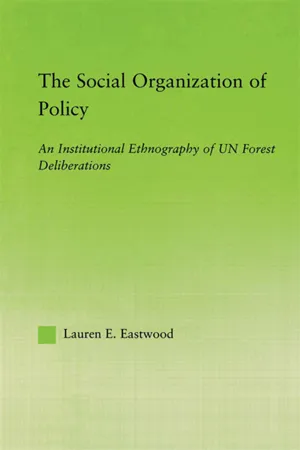
The Social Organization of Policy
An Institutional Ethnography of UN Forest Deliberations
- 160 pages
- English
- ePUB (mobile friendly)
- Available on iOS & Android
eBook - ePub
The Social Organization of Policy
An Institutional Ethnography of UN Forest Deliberations
About this book
This book provides a specific case study--based upon direct research with UN processes--which enables the reader to situate larger theoretical arguments regarding civil society, globalization, and sustainable development within the context of the actual activities of practitioners working within the UN forest policy-making arena.
Information
Chapter One
Civil Society, NGOs and Transnational Corporations: Setting the Stage for International Environmental Policy Negotiations
[T]he success of the people in not allowing the successful completion of the WTO Ministerial Meeting at Seattle, USA, during December 1999 . . . showed that citizens of the world are increasingly marshalling their forces against the agents of globalization. More so, the successes associated with peoples’ struggles in various parts of the world in challenging and defeating such outcomes . . . are pointers towards the fact that the current system based on neoliberal principles can be rolled back.
—Diverse Women for Diversity
I start this book with a quotation taken from a “statement of concern” written “to discuss the implications of various instruments/agreements under the realm of the General Agreement on Tariffs and Trade (GATT 1994) and the World Trade Organisation (WTO)” and disseminated via e-mail by a group called “Diverse Women for Diversity,” who, in their words, represent a segment of civil society (Diverse Women for Diversity, 2000). According to their website, Diverse Women for Diversity constitutes “[a] Southern initiative to build an international coalition of women to respond to globalisation and its impacts by creating diverse solutions at the local level and a common defense at the global level” (Diverse Women for Diversity, 2001). The statement quoted above encapsulates multiple issues of current importance for the arguments I make in this book as well as for activism taking place in relation to current mechanisms of economic globalization.
I use this piece of text from Diverse Women for Diversity for how it signifies the trans-local aspects of the discursive terrain that circumscribes all activism associated with the global justice movement. Various otherwise unrelated locations are interconnected by the larger discourses which serve to organize the work of those operating within these locations. Not only can nearly identical wording be found in “statements of concern” written by other NGO groups, such as one called a “Malabe Statement of Concern” that was presented as a position of the “Asian NGOs Statement” on the 1999 WTO negotiations of an Agreement on Agriculture (Asian NGOs 2001), but the terminology used taps into a particular pre-established conceptual currency (Graham, Kamini 1999). In other words, while multiple groups constituting civil society are clearly linked by virtue of their interconnected activism, they are also linked by virtue of the fact that certain concepts hold currency within the context of the current discursive terrain.
As is articulated in the text by Diverse Women for Diversity quoted above, as self-named representatives of civil society, there is a conscious recognition of global forces, or “agents of globalization,” that are being contested and re-thought. Several members of Diverse Women for Diversity have participated actively in the meetings of the United Nations Convention on Biological Diversity. However, it is not only their active participation that ties them into the larger policy-making arena in important ways. It is also crucial to analyze the ways in which such groups engage with, contest, and re-work the conceptual and ideological terrain of such policy-making processes.
Within the context of this study, I speak to the importance of looking closely at the ways that terminology has been taken up within what George Smith has termed “politico-administrative regimes” (Smith, George 1990). For example, one of the arguments that I make in this book is that current use of the term “civil society” is one that merits attention. While there is a plethora of work being done on the term, as will be discussed later, attempts to define it based on academic theoretical frameworks are inadequate. An analysis of the manner in which ruling relations are absorbing and re-constituting articulations of inclusion and participation is crucial at this current juncture of economic globalization and concomitant global justice activism. There is clearly a dialectic relationship between the academic treatments of the concept and the practical, everyday use of the term. As I address at various points in the chapters to follow, both realms serve to organize the ways in which actual people get incorporated into (or disenfranchised from) the policy making process.
Beyond pointing to the notion of “civil society” as it is constituted by activists organizing their forces in opposition to current mechanisms of globalization, the quotation starting this chapter explicitly draws our attention to two other important elements regarding the arguments that will follow throughout this book. First, the text clearly asserts that there are powerful agents that are responsible for affecting globalization. This contests the popular notion that globalization is a teleological, self-generating force in its own right. Second, the statement unequivocally argues that these forces can be contested. This is crucial in light of the fact that “anti-globalization” activists are often construed as being naively misguided. If globalization is characterized as being inevitable, than contesting it is futile. Partly in response to this argument, and demonstrative of the fact that global justice movement activists are keenly aware of the power of rhetoric, the term “anti-globalization” itself is one that is currently in the stages of being challenged and reconstituted by the activists themselves. According to those involved in such activism,1 a better characterization of the objectives of the movement is captured in the term “responsible globalization,” or “global justice movement.” As is asserted by Diverse Women for Diversity, the identification of globalization as being attributable to actual agents rather than beyond human control reinstates the possibility of social change. In viewing globalization as being associated with the actual activities of identifiable individuals, an active sense of intentional agency replaces the common perception of “anti-globalization” activism as being naively useless and misdirected.
The utility of this argument is illustrated throughout the chapters that follow. The global dynamics that have been abstracted ideologically into concepts such as “globalization” and “development,” seemingly forces operating without human control (or at least uncritically taken to be beneficial by definition) can be re-attached to actual activities being carried out by actual people. Part of the project presented here involves unveiling the ideological nature of these concepts—the ways in which the terms themselves have become abstracted in the first place, and the implications of that abstraction. It is, however, also crucial that we make the actions, activities and actors concrete as a basis for an effective oppositional stance. In other words, it is critical to make visible the activities that have systematically been made invisible through the abstraction affected by such terms as “globalization.” As long as the concepts remain distinct from the actual activities, the effectiveness of opposition to the on-the-ground realities of “globalization,” “development,” or “militarization,” for example, is undermined.
Following on work that is also based on specifying the actualities of globalization, such as that collected in Nancy Naples and Manisha Desai’s volume entitled Women’s Activism and Globalization: Linking Local Struggles and Transnational Politics, this book attempts to demonstrate how, in Naples’ terms, “globalization must be understood as a process generated from the everyday activities and negotiations of diverse individuals, communities, governmental bodies, and transnational coalitions” (Naples and Desai 2002:8). Readers will note that this is very much in line with Diverse Women for Diversity’s project. In the chapters that follow, I use a specific case to illustrate the ways in which actual activities can be seen as generating the larger forces that are currently characterized as constituting “globalization,” “development,” and forest “management.”
SCOPE OF THE STUDY
While any number of cases could be used to illustrate the ways in which activities become abstracted into discourse (and the implications of that abstraction), this book primarily examines the Intergovernmental Forum on Forests (IFF). The IFF was created under the auspices of the United Nations with a two-year mandate to discuss particular elements regarding forest policy. With institutional connections to the 1992 United Nations Conference on Environment and Development (UNCED), the IFF was structurally, doc-umentarily, and discursively connected to multiple UN policy-making processes. The case analyzed here also includes the transformation of the IFF into the United Nations Forum on Forests (UNFF), which is currently (2004) a standing body within the UN.
Specifically, I used ethnographic research methods to investigate the work of delegates of nongovernmental organizations (NGOs) and Indigenous Peoples Organizations (IPOs) in contributing to the IFF and UNFF processes. In my analysis, I situate that work within the context of the ways that it gets taken up by those who (institutionally) appear to have a more powerful position within the process, namely government delegates and representatives of specific UN agencies and subsidiary bodies.
Moving beyond traditional ethnographic methods, I also situate the work of delegates within the context of larger social relations that serve to organize that work. This approach is epitomized by George Smith in his “Political Activist as Ethnographer,” as he
... sets out a method of using grass-roots political organizing as a means of describing how people’s lives are determined from beyond the scope of their everyday world. In doing so [he] provides a way of exploring, from their standpoint, how the world works and how it is put together, with a view to helping them change it.” (Smith, George 1990:629)
While I did not adopt the same “grass-roots” standpoint used by George Smith in that I gathered data within the context of the politico administrative regime itself, the spirit of his methodology is at the heart of my approach. As I discuss at length in chapter three, the methodology used here is based on the “reflexive-materialist” (Smith, George 1990:629) method developed by Dorothy E. Smith, which has come to be known as institutional ethnography (Campbell and Gregor 2002, De Vault 1999; Grahame, Peter 1998; Smith, Dorothy 1987). Readers finding terminology such as “abstraction,” “discourse,” “ideology,” and “social relations” confusing will be pleased to know that these terms are explicated in greater detail in chapter three when I discuss the methodology used in this project. As with any methodology, institutional ethnography is inseparable from its on-tological underpinnings. In other words, I chose to use institutional ethnography as a methodology due to the types of questions I was able to formulate under an institutional ethnographic rubric. If one sees the world through a lens that makes ideology identifiable and visible, one needs a methodology that is in line with that view. As will be made more explicit in chapter three, institutional ethnography begins from the same point of departure as I do in terms of a general understanding of how everyday social life works.
ACCESS AND STANDPOINT
In executing the research that generated the data for this project, I gained access to the UN meetings that I attended as a delegate of an NGO called “The Association of Third World Studies” (ATWS). Thus, I came to understand the process through the perspective of NGOs and IPOs involved in the forest policy negotiations. In some fairly minor ways, I eventually came to contribute to the work of NGOs in the process of the IFF and UNFF, and certainly became engaged in the concerns that NGOs and IPOs bring to the meetings. Broadly, these concerns can be characterized as involving the environmental and social justice issues surrounding forests themselves, as well as the structural dynamics involved in the process of gaining inclusion into the arenas of international policy making. As a participant in the process and a researcher of the process, I began to develop a sense of the ways in which NGO and IPO participation “worked” within the IFF and UNFF. I came to realize that, in many ways, the official inclusion of NGOs into the process of forest policy negotiations represents a shift to incorporate the interests of civil society into traditionally intergovernmental dialogues. However, the manner in which the method of incorporation actually works has not been adequately studied and analyzed. While much more work is needed, this book is intended to provide a step in the direction of filling that gap.
My research also further supports the argument that the term “NGO” should not be left unspecified. Some of the important complexities will be discussed in subsequent chapters. However, I have come to assume a particular standpoint in relation to the policy negotiations when using the term “NGO.” While not all NGOs had the same perspective on forest policy issues, and often times NGO representatives disagreed with one another on a multitude of topics, my experience with the policy negotiating process has indicated that the term “NGO” is used by those involved in the forest policy-making process to signify a particular environmental and social justice position within forest policy debates. The very structure of the United Nations system, as I will discuss in greater detail later, demarcates NGOs from government delegates in significant ways. This is to be expected, given the fact that the United Nations was created to be an organization where sovereign nation states debate issues amongst themselves. While setting NGOs up against governments is problematic in that it serves to gloss over many of the important distinctions amongst NGOs, I observed that the use of the term “NGO” in the IFF arena designated a particular group of people with a particular set of (albeit shifting) values and interests regarding the policy making process. It was not unusual to hear government delegates stating that “NGOs would not be happy” with such-and-such a decision, or that “NGOs would want to be included” in particular discussions.
Indeed, from an institutional position, NGO representatives occupy a contradictory role in the UN negotiations. They are simultaneously important voices of “civil society” and, in many ways, delegates non grata. My intent is not to lump all NGOs into a homogenous category from which we can infer such things as how representatives will respond to particular forest policy issues. Instead, the very explicitly contradictory nature of the inclusion of NGOs into the UN negotiating fora presents an interesting point for analysis. I have found it useful to use the term “activist NGO” for those NGOs who I talk about throughout the book as having similarities in terms of their political concerns about environmental and social justice issues. Furthermore, using the term “NGO” in line with Spivak’s notion of “strategic essentialism” (1987:205) posits a critique of the essentializing nature of the category while maintaining a recognition of the political and strategic utility of that same category. While this is easier said than accomplished, it is my intent in using the term “NGO” throughout this work.
Part of this grouping of activist NGO as a politicized category harkens back to the parallel event held by NGOs at the United Nations Conference on Environment and Development (UNCED) in Rio de Janeiro in 1992. As will be discussed at greater length in chapter two, the results of that process were that NGOs became more networked and organized around the issues being taken up in international environmental policy-making arenas. Simultaneously, NGOs became more prominent in the UN environmental policy-making fora. However, an important point for analysis is that NGOs are not signatories to the agreements negotiated in the various fora, and therefore do not have to be directly negotiated with by governments. In light of this structural dynamic, many NGOs have become quite savvy as to the ways in which they can influence the process. As this research demonstrates, the engagement with texts in the UN arena presents a way for NGOs to gain power and influence. This engagement with the process through the actual texts, however, is organized in important ways by larger social relations with significant implications for the manner in which NGOs are incorporated into the process.
A major underlying theme of this book stems from a concern that we who constitute the members of (what is currently being defined as) civil society may find that we are ill equipped to negotiate the forces against which we position ourselves. In part, the incorporation of civil society into the ruling apparatus2 may signal a transformation in the agenda of these institutions to include interests other than simply corporate and government ones. However, it also represents a move that, depending on how it is enacted, could ultimately serve to undermine the potentially progressive power of the interests of civil society. The institutionalization of the term “civil society” and, concomitantly, of the participation of members of civil society within the organizations that are currently positioned to have very powerful global impacts, could point to a redefinition of the meaning of civil society—one which has more than semantic consequences. While this point may seem obvious to those who are currently working (through activism, paid employment or both) in spheres that are designated as constituting/speaking for civil society, it is nonetheless worthy of articulation.
Furthermore, the ways in which this redefining actually happens are important to map out. As an academic writing a manuscript, I currently occupy a position that affords me the time to chart out the complexity of the current globalizing dynamics in terms of the institutionalization of elements of civil society. Many members of NGOs, and certainly members of Indigenous Peoples Organizations, on the other hand, are working long hours for little or no pay simply to keep up with the shifting terrain of policy making. Additionally, in the case of NGOs and IPOs working for environmental and social justice (such as land tenure) issues in particular, there is a certain urgency to their work. Many have the sense that, with environmental issues, those fighting the degradation and deforestation can only lose once. As long as a forest stands, logging, mining and dam projects can be advocated for repeatedly. If, however, the forest is cut, the loss is irreparable if it happens, for example, to comprise the homelands of indigenous peoples such as the Orang Asli, or habitat to endangered species, such as the Malayan tapir. These are two very specific examples of current resource struggles that are not hypothetical.
This points to a related theme that provides a backdrop for this work; my concern about social justice issues that are associated with the processes of deforestation. This is not because I feel a sense of romanticized good in the middle of a forest that I have been unable to feel in any city. Indeed, the work that I am doing is more strongly informed by a desire to deconstruct the discursive and conceptual terrain that constitutes the popular understanding of the issues involved in deforestation. Gramsci’s use of the term “common sense” (Gramsci: 1971 )3 is particularly apt here. Rather than used in the typical way as meaning good “street sense,” Gramsci’s notion points us toward the unexamined ideas that get wrapped up in particular social facts, “which,” Himani Bannerji writes, “simply put, might be seen as the submerged part of the iceberg that is visible to us as ideology” (Bannerji, 1995:44). Gr...
Table of contents
- Cover
- Original Title Page
- Title Page
- Copyright Page
- Table of Contents
- Acknowledgments
- Acronyms
- Chapter One : Civil Society, NGOs and Transnational Corporations: Setting the Stage for International Environmental Policy Negotiations
- Chapter Two : The UN: Organizational Structure and Forest Negotiations
- Chapter Three : Theoretical and Methodological Framework/Data Collection
- Chapter Four : Reform Discourses vs. Local Actualities
- Chapter Five : Trade and Environment
- Chapter Six : The Activation of the Text: Conceptual Resources at Work
- Chapter Seven : NGOs and the Struggle for Inclusion
- Notes
- Bibliography
- Index
Trusted by 375,005 students
Access to over 1.5 million titles for a fair monthly price.
Study more efficiently using our study tools.
Frequently asked questions
Yes, you can cancel anytime from the Subscription tab in your account settings on the Perlego website. Your subscription will stay active until the end of your current billing period. Learn how to cancel your subscription
No, books cannot be downloaded as external files, such as PDFs, for use outside of Perlego. However, you can download books within the Perlego app for offline reading on mobile or tablet. Learn how to download books offline
Perlego offers two plans: Essential and Complete
- Essential is ideal for learners and professionals who enjoy exploring a wide range of subjects. Access the Essential Library with 800,000+ trusted titles and best-sellers across business, personal growth, and the humanities. Includes unlimited reading time and Standard Read Aloud voice.
- Complete: Perfect for advanced learners and researchers needing full, unrestricted access. Unlock 1.5M+ books across hundreds of subjects, including academic and specialized titles. The Complete Plan also includes advanced features like Premium Read Aloud and Research Assistant.
We are an online textbook subscription service, where you can get access to an entire online library for less than the price of a single book per month. With over 1.5 million books across 990+ topics, we’ve got you covered! Learn about our mission
Look out for the read-aloud symbol on your next book to see if you can listen to it. The read-aloud tool reads text aloud for you, highlighting the text as it is being read. You can pause it, speed it up and slow it down. Learn more about Read Aloud
Yes! You can use the Perlego app on both iOS and Android devices to read anytime, anywhere — even offline. Perfect for commutes or when you’re on the go.
Please note we cannot support devices running on iOS 13 and Android 7 or earlier. Learn more about using the app
Please note we cannot support devices running on iOS 13 and Android 7 or earlier. Learn more about using the app
Yes, you can access The Social Organization of Policy by Lauren E. Eastwood in PDF and/or ePUB format, as well as other popular books in Biological Sciences & Environmental Science. We have over 1.5 million books available in our catalogue for you to explore.