eBook - ePub
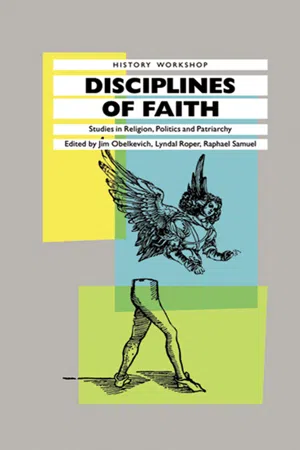
Disciplines of Faith
Studies in Religion, Politics and Patriarchy
- 581 pages
- English
- ePUB (mobile friendly)
- Available on iOS & Android
eBook - ePub
About this book
First Published in 1987. This volume has its remote origins in the 'Religion and Society' group - one of the feeders for 'History Workshop' - which began meeting at Nuffield College Oxford in 1965. The Group, which contained a number of people who were to become 'History Workshop' editors and contributors, began from a radical dissatisfaction at the exclusion of religion, as a central subject for enquiry, from the Oxford history course. The Workshop from which this volume is drawn covered three days and involved a vast range of papers, only a fraction of which are included here.
1 Introduction
1
Introduction
I
That Religion and Society should be the theme of a volume associated with the Left may seem surprising. Hostility to organized religion is – or at least was, until very recently – a leitmotif of the socialist movement, as of the various forms of popular radicalism from which it drew its original strength. As the child, albeit a rebellious one, of the eighteenth-century Enlightenment, socialism took its stand on the side of reason against revelation, science against superstition, and it was only too ready to equate religion with ‘mysticism’, ‘obscurantism’ and backwardness of all kinds. Socialists followed their radical forebears in championing freedom of thought; in equating priestcraft with feudal and monarchical tyranny, and in looking to education as the great engine of emancipation. In Catholic Europe, anticlericalism was a major component of the socialist idea, down to the 1914 war and beyond. A startling late example of this would be the burning of the monasteries during the Spanish Rising of 1931. In the Protestant countries of northern Europe relations between socialism and Christianity were more ambiguous, but taking a tilt at the clergy – or even, as readers of The Ragged Trousered Philanthropist will know, the ‘shining light’ chapels of the small-town bourgeoisie – was a stock in trade of socialist advocacy.
These hostilities were reciprocated. For Robert Owen’s clerical opponents of the 1830s and 1840s, ‘socialist’ and ‘atheist’ were interchangeable terms; while the ‘godlessness’ of socialism was the prime target of those Christian-Social movements which, in the 1880s and 1890s, were one of reaction’s principal weapons against the rising socialist movements of Central Europe.
In the 1920s and 1930s – as the articles on Italy and Spain in this volume may remind us – anticlericalism was given a new lease of life by the open way in which Catholicism allied itself with reaction in resisting the revolutionary tide, while the leading role of the Vatican and of Christian democracy in the building of an anti-communist alliance in the Cold War inflamed historic suspicions of the Church as an international conspiracy against progress in Labour and Communist movements.
Yet socialism, as a doctrine, is closely wedded to religious modes of thought, espousing a secular version of millenarianism and promising a world in which all things will be made anew. The reappearance of impossibilism in the post-1968 feminist and socialist movements has made for a much greater receptivity to the proto-religious elements in early socialism. Recent historians such as Barbara Taylor have enabled us to recognize not only socialism’s debt to religious paradigms and values, but also the broad range of early socialist interests, encompassing not only material relations, but also questions such as the division of labour between men and women, and the reorganization of domestic life. These religious influences should not be regarded as a deformation of a true, secular socialism; nor should early socialism’s broad range of preoccupations be seen as diversionary. Socialism, after all, was utopian before it was scientific.
As a political movement, socialism has been only too apt to mobilize its supporters behind ritualized sets of beliefs, while its advocates, whether evolutionists or revolutionists, utopian or scientific, have commonly conceived themselves as an aristocracy of the Spirit, carrying light into dark places, and enjoying privileged access to the higher truths. The socialist idea first made its appearance, in the 1830s and 1840s, as a secular religion – what Saint Simon called the ‘new Christianity’, and Weitling ‘Christian Communism’. The Communist Manifesto, when Marx and Engels began drafting it for the workers of the German diaspora, was initially cast in the form of a catechism, and at every point in the nineteenth century when socialism touched a popular constituency, its message was typically cast in religious or proto-religious forms. Pamphlets took the form of tracts; and in the period when socialism emerged as a mass movement in the Italian countryside of the 1890s, arguments were often advanced in the form of parables, speeches and addresses, concerned to paint word-pictures of the socialist future.
When in the 1880s, socialism revived in Britain, it quickly took on the character of a ‘religion of socialism’, whose converts entered a ‘new life’, indeed found a new purpose in life, serving their fellow men and women, joining in comradeship with other socialists, experiencing some of the joy and fulfilment that awaited all mankind with the advent of socialism. For some, socialism was the practical application of their existing Christian faith (Anglican as well as Nonconformist); for others, sceptical of the traditional faiths, it was a new religion in itself. And it was not only the ‘soft Left’ of the ILP that had a religious character, but the hard Left of the SDF, where the educated few preserved the faith in its purity, like the early Church, in the face of indifference and persecution. In its period of greatest dynamism and vitality, British socialism was religious.
In Germany, the Social Democrats of the 1890s and 1900s, and later the Communists, set themselves up as a kind of anti-Church, offering their followers a whole range of counter-religious ceremonial and an alternative mental universe in which to live. ‘Cosmic mooning’, as E.P. Thompson has sarcastically named it – or the idea of socialism as a new life – was a fundamental component of the socialist appeal to its followers: the ‘gleam of socialism’, owing more to Christian eschatology than to a more secular reformism, was the stock in trade of the platform orators.
This close, if unofficial, engagement with religion, is nowhere more apparent than in socialist writings on history. The Primitive Church was a subject of fascinated attention of the early socialists – like Primitive Communism, another favourite object of historical reflection, it provided socialism with a historical pedigree. Belfort Bax’s three-decker The Social Side of the German Reformation – an account of the Anabaptists – is the first English-language work of historical writing in a Marxist tradition, and it prefigured what was to be a major theme of later work by socialist historians, most famously in Tawney’s Religion and the Rise of Capitalism and more recently in the writings of Christopher Hill. Later socialist historians, taking their cue from Eric Hobsbawm’s Primitive Rebels – a work itself much indebted to the anthropology of religion – have been no less concerned with popular messianism (a riveting chapter in E.P. Thompson’s Making of the English Working Class is the rescue of the Southcottians from the ‘enormous condescension’ of posterity), or with the place of ritual in labour movements. Similarly, and most recently, a fascinated attention to the magical underpinning of scientific experiment and of the millennial components of ‘rationalist’ thought is emerging as a leitmotif of contemporary socialist work in the history of ideas (Logie Barrow’s History Workshop volume on plebeian spiritualism is a case in point).
II
The Religion and Society History Workshop started out from a recognition of the power of religion as a shaping force of politics in the contemporary world. Such an acknowledgment is uncomfortable for socialists who have traditionally anticipated the eventual triumph of reason over superstition, as it is for sociologists with their paradigms of secularization and rationalization, allegedly characteristic of the modern world. The power and extraordinary destiny of the Revolution in Iran; the bitterness of the war in Northern Ireland; the disturbing transformations effected by Jewish identity and consciousness in Israel; the role of the Catholic church in the solidarity movements in Poland; all show the inadequacy of such firmly held convictions as the commonplace that the modern world belongs to a post-religious epoch. (Speculatively, the hesitations of the British labour and trade union movement in welcoming Solidarity and the Polish October came from an unease at the salience of a Catholic faith amongst insurgent Polish workers: photographs of Gdansk shipyard workers kneeling to the Madonna and taking communion were disturbing images for anyone brought up either in Protestant or in free thought traditions, and they fitted with none of the iconographies of proletarian struggle.) Even in the heart of the most advanced capitalist economy in the world, the United States of America, we are confronted by the recrudescence of the moral majority and the political mobilization of born-again Christianity. James Ault’s ‘The Shawmut Valley Baptist Church’ in this volume analyses that political presence at local level, and points, too, to its roots in family needs and disturbance. Yet what these and other examples suggest is that the role of religion in contemporary political struggle is no simple one: if it is reactionary it is also sometimes progressive, and often a mixture of the two. The churches’ recent interventions in British politics are another reminder.
But it is changes in Roman Catholicism which have done most to affect the Left’s views on religion. The liberalization of the Catholic church initiated by Vatican II, the rise of radical and sometimes revolutionary movements among Catholics, notably Liberation Theology in Latin America, the role of Catholics in peace movements, the Christian-Marxist dialogue, and the shift in its centre of gravity from Europe and North America to the third World, have all made it increasingly difficult to conceive of the Church as a monolithic bloc; while the renewed vitality of the Catholic church has made it impossible to go on regarding it – in the manner of freethought propaganda no less than that of Protestant bigotry – as a survival of feudal barbarism. Nearer home, the influx of ex-Catholics into the feminist and student movements of the 1960s and 1970s has made Catholicism a less alien phenomenon to the British Left, if not necessarily a more sympathetic one.
When we started planning for this workshop, our first thought was deliberately to confront work drawn from the study of Catholic religious practice and Catholic cultural formation with a more traditional English left-wing preoccupation with radical nonconformity. The Workshop was intended to subvert – or at any rate to question – the routine anti-Catholicism of the British Left and an unarticulated but essentially Protestant ‘common sense’ which had underpinned the work of British Marxist and radical historians. Indeed, it has arguably coloured the character and ideals of both British socialism and the Labour movement. In Britain, socialist historians have historically been peculiarly uninterested in Catholicism, either abroad or as the practice of a minority in Britain. This inattention is all the more strange since the Catholic minority in Britain is largely both working-class and Irish – and among the most consistent supporters of the Labour Party. In Scotland, Catholics are more pro-Labour than Protestants at every level of society.
III
The cultural revolution of the 1960s has perhaps made socialists more ready to admit the power and autonomy of the imaginary, to consider belief systems as a primum mobile which structure and constitute action rather than passively reflecting it. It has made us more sensitive to the ways in which belief acts, not so much as a reflection of material interests, but as an independent cultural force.
More disturbing to either Marxist or social historical categories of explanation and inquiry are the areas of fantasy, desire, myth, fear – what might be termed the domain of the psychic. The preoccupation with this territory is clearly one of the shaping influences in our volume, and we believe it raises questions which any study of religion must confront. It cannot be subsumed under the study of ‘collective mentalities’ which have long enjoyed a legitimacy in social history, nor can it be marginalized as a study of the exotic and safely anthropologically distant. It reaches beyond, to subjectivity and individual experience, something which has never formed part of the province of the historian. The dialectics here, whether between the conscious and the unconscious; society and self; masculine and feminine; ideal and real – are not those with which social historians, Marxist or otherwise, have been particularly well equipped to deal. They evidently fall short of or transcend the line of class. One of the most uncomfortable questions raised by these essays, especially the feminist contributions, is to what extent this is historical terrain, both because of its intractability and because of the apparent persistence of the phenomena it describes. It is not easy to see how the psychic can be sited in a specific temporal and material context; yet without tackling these problems, we shall be unable to even guess at the emotional, psychic and imaginative force of religious thought, action or language. Here, the exciting article by Luisa Accati on the cult of the Madonna in Catholic and Protestant Europe, which seeks to site psychic and familial patterns in the structures of devotional themes, breaks new paths.
But the most important influence on the historical study of religion for this workshop has been feminism. For post-1960s feminists, perhaps even more than for socialists, religion has often appeared as a prime and undifferentiated force of oppression; and it has been the more important to identify it as such because of the insidiousness of its hold over our non-conscious imagination. While feminists have felt on sure ground in attacking the institutional Church, with its usually male clerical face, and its frequently expressed opposition to abortion, contraception, or (on occasion) its espousal of the most rigid model of appropriate womanly role, the question of the gendered nature of religious imagery – most obviously, the masculinity of God in traditional Christian and Jewish faiths – has proved a far more troubling issue. At least in part this stems from the centrality of such gendered symbolism to our own cultural traditions; and just how resistant to mere reform or counter-balancing these can be has been brought home to feminists in the cult of the Virgin Mary. The mere existence of a female presence in religious cults cannot guarantee an affirmation of real women: indeed, the contradiction of virgin motherhood can work to make earthly womanhood appear irreducibly corrupt. Yet none of this can really engage with the actual power and attraction which the image of the Madonna can exercise, even subliminally, as it provides the cultural backdrop against which we imagine and desire perfect mothers.
For feminists studying religion in the past, a point of departure has been the common assumption that women are by nature more spiritual than men, essentially more religious. Feminist historians have been engaged in deconstructing this naturalization of feminine religiosity, showing, in the process, how women’s devotional expressions can subvert and undermine the social order – how they can subtly exploit the contradictions of gender relations. As Alex Owen’s essay on women and spiritualism in this volume shows, it was the very perceptions of women as more closely linked to the emotions and more open to external forces – the very factors which underpinned the conception of women as domestic beings – that were also thought to make women better spiritual mediums.
When we originally planned the Workshop on religion, and decided to conclude with a plenary session on Women and Christianity today, we were making what we thought was an appropriately contemporary recognition of the importance the questions of gender, sexuality and family had acquired in our own approaches to the study of religion. To link the study of feminine piety, the question of the sexual division of religious labour, or the nature of religious authority in the past, with discussion of developments in feminist theology and debates about the admission of women to the priesthood in the Catholic and Anglican churches today, seemed a simple and obvious recognition of a connection. We were wrong.
The plenary session released a great deal of anger, most of which centred upon the very idea that there could be a feminist Christianity, with the room literally as well as figuratively divided between those who were thought to ‘believe’ and those who rejected the terms of the debate itself. Indeed, as we were forced to recognize, a dispassionate liberal curiosity about the progress of feminism in the churches is possible only when there is nothing at stake. The force of religion is still very much alive, as was nowhere more evident than in the anger of women against a reactionary Church; and against a religion which cannot easily be exorcized.
Jim Obelkevich, Lyndal...
Table of contents
- Cover
- Title Page
- Copyright Page
- Dedication
- Table of Contents
- Contributors
- Acknowledgements
- Introduction
- Religion and family life
- 3 Women in Jewish religious life: Manchester 1880–1930
- 4 Domestic discords: Women and the family in East Cheshire Methodism, 1750–1830
- Sexuality
- 6 The sexual politics of early Wesleyan Methodism
- 7 The Christian churches and the regulation of sexuality in Weimar Germany
- Feminism
- 9 Women and nineteenth-century spiritualism: Strategies in the subversion of femininity
- 10 Josephine Butler: Christianity, feminism and social action
- Popular piety
- 12 Feminine piety in fifteenth-century Rome: Santa Francesca Romana
- 13 Village ceremonial life and politics in eighteenth-century Piedmont
- Sects
- Colonization and resistance
- 16 Notes on the Devil’s Cult among South Andean miners
- 17 Religion in the Zimbabwe guerilla war
- The reformation
- 19 Luther and women: The death of two Marys
- Revivalism
- 21 Primitive Methodists in the northern coalfields
- The Catholic parish
- 23 Popular anticlericalism in nineteenth-century rural France
- 24 ‘Mary the Messiah’: Polish immigrant heresy and the malleable ideology of the Roman Catholic Church in America 1880–1930
- Religion and radicalism
- 26 Chartist religious belief and the theology of liberation
- 27 ‘Get Up, Stand Up’: The rastafarian movement
- Socialism and religion
- 29 The God-builders in pre-revolutionary Russia: Social democracy as a religion
- 30 Socialist propaganda in the Italian countryside
- Religion and nationalism
- Religion and fascism
- 33 The Catholic church and the Estado Novo of Portugal
- Art and music
- 35 Music and religion in the nineteenth century
Trusted by 375,005 students
Access to over 1.5 million titles for a fair monthly price.
Study more efficiently using our study tools.
Frequently asked questions
Yes, you can cancel anytime from the Subscription tab in your account settings on the Perlego website. Your subscription will stay active until the end of your current billing period. Learn how to cancel your subscription
No, books cannot be downloaded as external files, such as PDFs, for use outside of Perlego. However, you can download books within the Perlego app for offline reading on mobile or tablet. Learn how to download books offline
Perlego offers two plans: Essential and Complete
- Essential is ideal for learners and professionals who enjoy exploring a wide range of subjects. Access the Essential Library with 800,000+ trusted titles and best-sellers across business, personal growth, and the humanities. Includes unlimited reading time and Standard Read Aloud voice.
- Complete: Perfect for advanced learners and researchers needing full, unrestricted access. Unlock 1.5M+ books across hundreds of subjects, including academic and specialized titles. The Complete Plan also includes advanced features like Premium Read Aloud and Research Assistant.
We are an online textbook subscription service, where you can get access to an entire online library for less than the price of a single book per month. With over 1.5 million books across 990+ topics, we’ve got you covered! Learn about our mission
Look out for the read-aloud symbol on your next book to see if you can listen to it. The read-aloud tool reads text aloud for you, highlighting the text as it is being read. You can pause it, speed it up and slow it down. Learn more about Read Aloud
Yes! You can use the Perlego app on both iOS and Android devices to read anytime, anywhere — even offline. Perfect for commutes or when you’re on the go.
Please note we cannot support devices running on iOS 13 and Android 7 or earlier. Learn more about using the app
Please note we cannot support devices running on iOS 13 and Android 7 or earlier. Learn more about using the app
Yes, you can access Disciplines of Faith by James Obelkevich,Lyndal Roper in PDF and/or ePUB format, as well as other popular books in History & World History. We have over 1.5 million books available in our catalogue for you to explore.