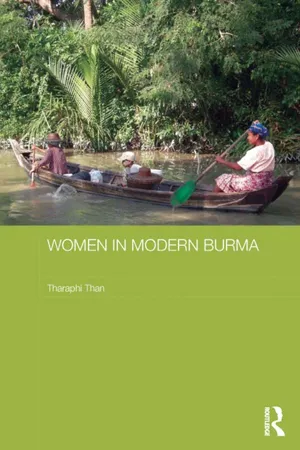
This book challenges the popular notion that Burmese women are powerful and are granted equal rights as men by society. Throughout history Burmese women have been represented as powerful and as having equal status to men by western travellers and scholars alike. National history about women also follows this conjecture. This book explains why actually very few powerful Burmese women exist, and how these few women help construct the notion of the high status of Burmese women, thereby inevitably silencing the majority of 'unequal' and disempowered women. One of the underlying questions throughout this book is why a few powerful women feel compelled to defend the notion that women hold privileged positions in Burmese society. Combining historical archives with statistical data published by UN agencies, this book highlights the reality of women's status in modern Burma. Case studies include why the first Burmese women's army was disbanded a few months after its establishment; how women writers assessed the conditions of Burmese women and represented their contemporaries in their works; the current state of prostitution; how modern-day sex-workers are trying to find their voice; and how women fared vis-à-vis men in education.
- 182 pages
- English
- ePUB (mobile friendly)
- Available on iOS & Android
eBook - ePub
Women in Modern Burma
About this book
Information
1 Introduction
Official narrative and popular images of Burmese/Myanmar women1
The official and popular narrative concerning the status of Burmese women in the twentieth century was that they were granted equal status to that of men. In 2002, Ni Ni Myint, a historian, Director General of the Universities Historical Research Centre and Director of the Southeast Asian Ministers of Education Organization (SEAMEO) Regional Centre for History and Tradition, penned a book entitled The Status of Myanmar Women, in which she quips: ‘Traditionally it has been the custom for women to defer to men, but this has not meant that the oppression of women has been advocated or tolerated in Myanmar society, generally women are considered the weaker sex but are treated as equal as men’.2
The national framework of history writing has defended this privileged position that Burmese women have enjoyed over many generations, unlike their ‘oppressed’ sisters from two neighbouring countries, China and India – albeit with a disclosure or uncomfortable admission of the ubiquitous deference women show to their male counterparts in every layer of the society, as seen in Ni Ni Myint’s argument. Overshadowed by this overwhelming objective in writing and sustaining the official version of women’s history, the actual political and social landscape of Burmese women has been elided. Instead, Burmese women have been mostly portrayed as powerful agents, who not only enjoy high status in society but are also granted equal rights to those of men. This book challenges this notion and attempts to delineate the real status that contemporary Burmese women enjoy in society against the backdrop of the popular and official narratives about them.
Contrary to national or official history, this is not a book about how powerful Burmese women are; rather, this is a book about why very few powerful Burmese women exist and how the few there are help to construct the notion of Burmese women’s high status, thereby inevitably silencing the majority of ‘unequal’ and disempowered women.3 One of the underlying questions throughout this book is why a few powerful women feel compelled to defend the notion that women hold a privileged position in Burmese society, and this book also attempts to depict their constant personal struggle – that is, the struggle between feeling obliged to build or at least spread the message that they live in a utopian world where women’s emancipation is celebrated and confronting the reality that sees women being denied their rights by society.
Previous scholars, such as J. S. Furnivall in the 1940s, and western travellers to Burma have made a considerable contribution towards the notion of powerful Burmese women and helped construct the long unchallenged thesis that Burmese society allows women to rise, and few cultural and social barriers exist for such a rise. A common observation made by scholars and travellers to Burma is that Burmese women enjoy profound freedom. Furnivall once wrote that the ‘freedom of women’ was an attractive feature of the country.4 Burmese themselves, both men and women, viewed the status of women as unique, often claiming that few countries had achieved more than Burma in liberating their women.5 Daw Mya Sein – ‘the most prominent lady in Burmese public life’, according to the editor of her 1944 book – was clear that ‘Burmese women occupy a place in society no greatly different from that held by their sisters in the West’.6
These views gave many scholars the impression of a Burmese society with few or no gender barriers, unlike the situation in her great neighbours India and China. Chinese women, who had to bind their feet to make them look beautiful, and Indian widows, who had to practise Sati at the funeral of their husbands, stood in contrast to Burmese women who, it was said, enjoyed immense freedom.7 Such oft-cited examples helped scholars, the mainstream media and the masses maintain an enduring image of liberated Burmese women. To justify that view, they searched for social and economic factors that might have brought about this unique, almost exotic, freedom for Burmese women.
The Status of Myanmar Women by Ni Ni Myint can be seen as the official defence of Burmese women as holders of high positions in the society. Ni Ni Myint set out to defend Burmese women’s high status and her arguments echo some of the writings of the pioneer Burmese women such as Daw Mya Sein, who symbolized and sustained the notion of powerful Burmese women.
Throughout Myanmar history women have enjoined equal rights with men in the household and economy. In the eyes of law, men and women were equal. Marriage was a civil act; women retained their own names during marriage, and divorce was a simple procedure with no stigma attached to either party. More importantly, women have always had the right of inheritance. Women liked to give precedence to their own men in their own houses because by tradition women acknowledged them as head of the household until their death. This was offered to the husbands because women felt secure in their own rights and status.8
Here Ni Ni Myint was in fact echoing what her predecessor – another highly educated woman, Daw Mya Sein – wrote half a century earlier. In 1958, the latter wrote in Atlantic Monthly that women favoured men because ‘women felt secure in their own rights and status’.9 The authors themselves are highly educated and powerful women; yet they condemn women who demanded rights as ‘insecure’. A Burmese euphemism for accepting the acquired knowledge to accept one’s lower status, at least in the household, is ‘feeling secure’, and powerful women have passed down the knowledge and use of such euphemisms from generation to generation via their writings. According to women like Daw Mya Sein and Daw Ni Ni Myint, Burmese women do not demand rights, or there does not exist any precedent for Burmese women to initiate feminist movements, as they are content and secure. As recently as May 2012, one of the most prominent women writers and philanthropists, Than Myint Aung, defended the status of women thus: ‘I am proud to be a Burmese woman. In our society, there is no such discrimination because a person is a woman.’10 The overwhelming message for Burmese women is that they must feel secure and content, and feeling otherwise is against both Burmese traditions and Burmese women’s traditions.
Burmese women in the twentieth century were, however, by no means unique, and their position could be read as universal. In other words, the world of Burmese women during the Japanese Occupation and after independence did not present them with exceptional opportunities. They experienced political, social and cultural restrictions comparable to those imposed on Indian and Chinese women. Burmese women were looked down upon when they worked outside the home; women writers were believed to be capable of producing only kitchen-sink literature; women nationalists were discouraged from running for office and daughters’ education was not deemed as important as that of sons. Daw Mya Sein wrote that ‘[women were] content to work in the home and for the home’, and they seldom left ‘the home of [their] parents or [their] husbands to follow independent careers’.11 ‘Content’ perhaps was a euphemism, for Burmese women probably believed that it was not worth the fight to demand opportunity and equality.
The perception that Burmese women enjoyed equality and suffered little prejudice removed gender from understandings of Burmese society. In other words, a male/female dichotomy was deemed irrelevant in Burma studies, since both men and women were thought to have enjoyed equal status historically. Burma was therefore seen through a gender-neutral lens. Only one study – Chi Ikeya’s doctoral thesis – has analysed the discourse of colonialism, modernity and nationalism in late colonial Burma in the context of gender.12
The numerous studies on Burma after independence have focused on such issues as the civil war and the military regime.13 But few have considered the role of women in these important political and social contexts. Using primary resources and personal interviews, this book reassesses the social, economic and political position of Burmese women in modern Burma throughout the twentieth century. Whereas nationalism profoundly shaped the political and social landscape of Burma from the beginning of the twentieth century through to the late 1930s, party politics, civil war and modernity influenced the country’s postindependent social topography. Popular public discussion and debate shifted from the theme of colonialism versus nationalism to continuity versus change or tradition versus modernity.
Burmese women, alongside men, as writers, doctors, lawyers, journalists and editors, helped outsiders to see the social landscape of Burmese women as unique. But behind these poster girls of modern Burma, from Daw Mya Sein through Ni Ni Myint to Aung San Suu Kyi, the social and political landscape of Burmese women was far from attractive. Interestingly, some Burmese women knew and accepted that the social terrain was far from smooth but decided not to seek to change it. Neither did they attempt to challenge the social and political agencies that sustained it. Khin Myo Chit, a leading literary figure and nationalist who wrote Three Years Under the Japs,14 argued that men came first in many aspects of Burmese political, social and cultural life, and that women publicly admitted that they acknowledged the boundaries between men and women. She also confessed that she would not attempt to cross these boundaries or challenge them openly.15
Using women’s writings, personal interviews and newspaper and magazine reports, this book attempts to explore the world of Burmese women soldiers, politicians, writers and prostitutes. It challenges the concept of the ‘liberated Burmese woman’ and shows that Burmese women experienced little freedom. Political institutions did not create a viable space for women; social institutions, such as the media, constantly reminded women to know their place in society, behind and beneath men and women’s organizations themselves practised self-censorship, discouraging women from joining male professions.
This book will describe the conflicts between Burmese women and society, the internal dilemmas of women professionals, the sacrifices they had to make when setting priorities between their careers and the traditional roles of women and mothers, the negotiations they had to broker between modernity and tradition, the censorship and criticism they faced from male colleagues and society and the difficult choices they had to make when representing their real selves.
Brief political and cultural outline of twentieth-century Burma
The era of the Golden Press: post-independent media landscape
During the late 1940s and the 1950s, Nu’s Anti-Fascist People’s Freedom Le...
Table of contents
- Cover
- Half Title
- Title Page
- Copyright Page
- Dedication
- Table of Contents
- List of figures
- List of tables and charts
- Acknowledgements
- 1 Introduction
- 2 Print media and women journalists, editors and writers
- 3 Women’s education
- 4 The creation of the Burma Women’s Army
- 5 Disbanding the army and communist women
- 6 Women and modernity
- 7 Marginalized women in the making of the ‘Burman’ nation
- Epilogue
- Index
Trusted by 375,005 students
Access to over 1.5 million titles for a fair monthly price.
Study more efficiently using our study tools.
Frequently asked questions
Yes, you can cancel anytime from the Subscription tab in your account settings on the Perlego website. Your subscription will stay active until the end of your current billing period. Learn how to cancel your subscription
No, books cannot be downloaded as external files, such as PDFs, for use outside of Perlego. However, you can download books within the Perlego app for offline reading on mobile or tablet. Learn how to download books offline
Perlego offers two plans: Essential and Complete
- Essential is ideal for learners and professionals who enjoy exploring a wide range of subjects. Access the Essential Library with 800,000+ trusted titles and best-sellers across business, personal growth, and the humanities. Includes unlimited reading time and Standard Read Aloud voice.
- Complete: Perfect for advanced learners and researchers needing full, unrestricted access. Unlock 1.5M+ books across hundreds of subjects, including academic and specialized titles. The Complete Plan also includes advanced features like Premium Read Aloud and Research Assistant.
We are an online textbook subscription service, where you can get access to an entire online library for less than the price of a single book per month. With over 1.5 million books across 990+ topics, we’ve got you covered! Learn about our mission
Look out for the read-aloud symbol on your next book to see if you can listen to it. The read-aloud tool reads text aloud for you, highlighting the text as it is being read. You can pause it, speed it up and slow it down. Learn more about Read Aloud
Yes! You can use the Perlego app on both iOS and Android devices to read anytime, anywhere — even offline. Perfect for commutes or when you’re on the go.
Please note we cannot support devices running on iOS 13 and Android 7 or earlier. Learn more about using the app
Please note we cannot support devices running on iOS 13 and Android 7 or earlier. Learn more about using the app
Yes, you can access Women in Modern Burma by Tharaphi Than in PDF and/or ePUB format, as well as other popular books in Social Sciences & Ethnic Studies. We have over 1.5 million books available in our catalogue for you to explore.