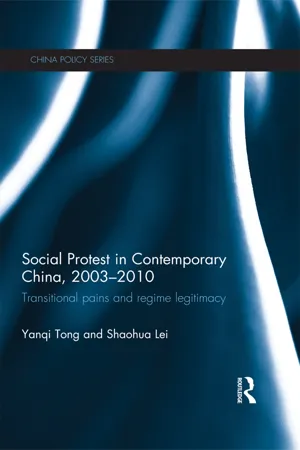
China's economic transformation has brought with it much social dislocation, which in turn has led to much social protest. This book presents a comprehensive analysis of the large-scale mass incidents which have taken place in the last decade. The book analyses these incidents systematically, discussing their nature, causes and outcomes. It shows the wide range of protests – tax riots, land and labour disputes, disputes within companies, including private and foreign companies, environmental protests and ethnic clashes – and shows how the nature of protests has changed over time. The book argues that the protests have been prompted by the socioeconomic transformations of the last decade, which have dislocated many individuals and groups, whilst also giving society increased autonomy and social freedom, enabling many people to become more vocal and active in their confrontations with the state. It suggests that many protests are related to corruption, that is failures by officials to adhere to the high standards which should be expected from benevolent government; it demonstrates how the Chinese state, far from being rigid, bureaucratic and authoritarian, is often sensitive and flexible in its response to protest, frequently addressing grievances and learning from its own mistakes; and it shows how the multilevel responsibility structure of the Chinese regime has enabled the central government to absorb the shock waves of social protest and continue to enjoy legitimacy.
eBook - ePub
Social Protest in Contemporary China, 2003-2010
Transitional Pains and Regime Legitimacy
- 234 pages
- English
- ePUB (mobile friendly)
- Available on iOS & Android
eBook - ePub
Social Protest in Contemporary China, 2003-2010
Transitional Pains and Regime Legitimacy
About this book
Information
1 Introduction
Ever since China embarked on the course of socioeconomic transformation in the late 1970s, social protests have accompanied the process every step of the way just like inseparable shadows. The redistribution of wealth and power inevitably produces winners and losers. The further and deeper transformation proceeds, the more social protests break out. The types of social protest range from tax riots to land and labor disputes, and from environmental protests to ethnic clashes. The breadth of the social protest types reflects the extensiveness of the transformation. According to various sources and calculations, the collective protest incidents increased from 8,700 in 1994, to 90,000 in 2006, and to an unconfirmed 127,000 in 2008.1 This number might have fluctuated between 150,000 and 200,000 since 2009.2
Socioeconomic transformations involve profound structural changes. The profound structural changes inevitably produce broad displacement, affecting state employees, migrant workers, farmers, ex-servicemen, teachers and ethnic minorities. We have witnessed changes from central planning to market-oriented economic operation, and from state-subsidized education, medical care and housing to the state withdrawal from these areas. Together with the collapse of the work units and rural collectives, social groups and individuals have to face the increasing and oftentimes irregular market logics that are not necessarily beneficial to those who are not familiar with them. Yet, all these changes are not occurring on a blank page. Previous frameworks (both institutional and conceptual) have their inertia. People continue to hold the state responsible for their well-being despite the official effort to institute market logics. The chaotic changes also involve rampant official corruption and perceived injustice that violate the principles of what people believe to be a good government.
To be sure, this social unrest exemplifies the pains and challenges associated with China’s development. To a certain extent, they are normal symptoms for any society that experiences profound social and economic transformation, yet the prolonged and widespread social unrest may very well trigger regime transition.3 Since social unrest is believed to be the expression of intense social discontent and a barometer for regime stability, the study of social protest in contemporary China has become a rapidly growing industry among American social scientists.4
A brief review of this growing body of literature will give us some background knowledge about the development of social protest in contemporary China. The existing scholarship has primarily explored four aspects of social protests in China: the origins of social grievance; the framing of the protest movement; strategies and tactics of protests; and government reactions and the implications for the political future of China.
Careful readers may find that we have left out writings on the role of the nongovernmental organizations (NGOs). As important as the NGOs may be in changing China’s public landscape, their impact on social protest is negligible in the current political climate. The NGOs may have staged some small-scale petitions over issues related to public good, such as environmental protection, yet most of the time they intentionally stay away from social protests in order to survive under the tight surveillance of the government.5 Moreover, since our interests are in collective protest, we will not discuss protests by individuals, such as the resistance to birth control or relocation of individual households.
Origins of social grievance
The natural question for any study of social protest is why it occurs. The literature on the origins of grievance mainly details the specifics of how the market-oriented economic reforms led to the outburst of social protest. In the 1990s, as the market reforms moved into the state sector, the reform measures abolished many benefits for state employees guaranteed under the previous planned economy. With the official cancellation of the permanent employment system and the introduction of the labor contract system in 1995, state workers lost their “iron rice bowl”—a Chinese metaphor for job security. The number of laid-off workers soared. When the inefficient or bankrupt state-owned enterprises fell behind in paying minimum living allowance to their laid-off workers and pensions to their retirees in the late 1990s, labor unrest and pension protests ensued.6 In short, a barrage of reform policies had brought about massive lay-offs and destitution for veteran workers in state sectors.7 While Chinese workers have increasingly learned to take their labor and pension disputes to court,8 many more have adopted collective action and taken this to the street.9 It was estimated that more than 3.6 million workers were involved in some kind of protest in 1998.10
In rural areas, the introduction of a “household responsibility system” had, in the 1980s, successfully raised production efficiency in agriculture, yet small-scale agricultural production soon reached its limit. There is only so much a piece of land can produce. In the meantime, the central government has adopted a “gross domestic product (GDP)-first” strategy and used economic growth as a measuring stick for the performance of local officials. The official developmental frenzy in the post-household responsibility system era at first led to excessive taxation on farmers and later the predatory land requisition for industrial and commercial development. Both were met with furious peasant resistance.
In efforts to raise funds for developmental infrastructure or to pay the bill for an ever-enlarging grassroots bureaucracy, the financially destitute local officials in poor agricultural regions sought to increase their revenues from extra taxation on farmers.11 The extraction of excessive taxes and fees combined with brutal collection methods caused villagers great economic distress and led to protest and violence.12 Later, the huge profits generated by land requisition induced local governments to ally themselves with the developers and to deny the land ownership rights of the natural village. Land disputes have replaced tax protests as the primary trigger of collective action in rural China.13
The priority given to high economic growth often led to environmental degradation. Economic growth involves the exploitation of natural resources for expanding production of material goods and may involve the dumping of the waste of this production into the environment. Increased use of energy and insufficient facilities and technologies to treat industrial and life waste cause serious air and water pollution and other environmental degradation problems. The resulting environmental degradation increases public environmental grievance and often leads to grassroots protests over pollution.14
Further along the analysis of the origins of social protest, contentious politics scholars find that not only economic status, but also gender, ethnicity, generation and regional location, constitute powerful sources of conflict and spurs to resistance in the reform era.15 For example, there is a significant correlation between Falun Gong membership and elderly and laid-off workers.16 A young generation of migrant workers leads China in the volume of arbitrated labor dispute.17 In the end analysis, all these correlations are closely related to the disadvantaged groups—women, minority groups, the elderly, laid-off and migrant workers—at various stages of China’s long march to development and prosperity.
Framing the meaning of the protest
Social movement theories suggest that defining problems, assigning blame and giving meaning to collective actions are crucial to the success of the protest movement.18 Students of contentious politics in China have recognized two primary tendencies in framing the purpose and meaning of social protests in the reform era. One is the emerging consciousness of individual rights, which was foreign to Chinese before the country’s opening up in the 1980s. The other tendency is the adoption of traditional symbols to generate public support or the more familiar political idioms from Mao’s period.
The thesis of “rightful resistance” is among the first to argue that the notion of being a citizen is seeping into popular discourse and that people should not underestimate the implications for the Chinese population. By using the laws or central government directives to challenge the abusive practice of the local government, the rural resistance activities have shown a sign of growing rights consciousness and a more contractual approach to political life.19 The rightful resisters, according to O’Brien, are loudly proclaiming their allegiance to the core values of the regime. Instead of treating the law as inaccessible, arbitrary and alien—an approach the powerless groups tend to take20—Chinese farmers have learned to exploit the potent symbolic capital rooted in the notions of equality, rights and rule of law.21 As long as a gap exists between rights promised and rights delivered, the rightful resistance scholars argue, there is always room for rightful resistance to emerge.22 Following this line of analysis, most rural protests were framed as a confrontation between an emerging “rights-conscious peasantry” and rapacious or entrepreneurial bureaucrats.23
The increasing “rights talk” among the Chinese protesters is warmly embraced by many China observers as the major changes in the last two decades of the twentieth century. They believe that, conceptually, a growing sense of rights consciousness, particularly of political rights among the Chinese population at large, signals a fundamental breakthrough in the state-society relationship. Practically, this newfound claim to citizenship would pose a fundamental challenge to state authority and produce in China changes as profound as those that ended the communist regimes in other former communist countries.24
Amid the excitement that the Chinese have gradually adopted the universal concept of individual rights, some scholars have detected “a distinctly normative tone, inflected with an Anglo-American language of human rights.”25 This “rights talk” by the protesters is merely a new bottle for the old wine. Instead of absorbing the Western conception of individual rights, scholars of social protests in traditional China see an enduring emphasis on collective socioeconomic justice—a salient feature of peasant rebellion in the history of China—in the framing of collective protests from the past to the present.
Heaven, a symbolic term for justice in traditional China, has loomed large in contemporary urban, as well as rural, protests. For example, many rural protesters marched behind banners proclaiming “Prepare the Way for Heaven” and “The People’s Anger Overwhelms Heaven,” as they demanded lower taxes.26 Heavenly justice in contemporary circumstances represents a fundamental right to subsistence. With the collapse of the paternalistic institutional arrangement for state workers, there has been a clear effort by protesters to frame their demand in a more traditional subsistence ethic. Laid-off workers have used the traditional ideas of the right to subsistence to justify their protests, such as “We Want Survival!” and “We Want Food!”27 It is the insistent demand for socioeconomic justice, rather than the rights of being a citizen, that provides a thread that binds many of the disparate incidents together.28
In the meantime, the state-owned enterprise (SOE) workers have also shown a tendency to return to the rhetorical resources that had been used in the recent past—the Mao period. Slogans during Mao’s era, such as “Yes to Socialism, No to Capitalism,” “Factories Belong to All the Workers,” “Down with the New Bureaucratic Bourgeoisie,” were on display during labor protests.29 The adoption of such slogans may reflect on the one hand the deep appeal of socialist principles to state workers, and on the other hand a paucity of language available for the protesters to employ.
The different framing may depend on the types of ownership and the composition of the labor force. For example, in her comparison of the labor protests in rustbelt and sunbelt areas, Lee pointed out the differences in framing. Rustbelt refers to the Northeast state-owned industries and sunbelt refe...
Table of contents
- Cover
- Half Title
- Title Page
- Copyright Page
- Dedication
- Table of Contents
- List of illustrations
- Acknowledgements
- 1 Introduction
- 2 Analyzing social protests
- 3 An overview of large-scale social protests
- 4 Subsistence expectation protests
- 5 Benevolence violation protests
- 6 Protests over developmental syndromes and identity
- 7 Creating public opinion pressure: Large-scale Internet protests
- 8 Government responses and regime resilience
- 9 Conclusion
- Bibliography
- Index
Trusted by 375,005 students
Access to over 1.5 million titles for a fair monthly price.
Study more efficiently using our study tools.
Frequently asked questions
Yes, you can cancel anytime from the Subscription tab in your account settings on the Perlego website. Your subscription will stay active until the end of your current billing period. Learn how to cancel your subscription
No, books cannot be downloaded as external files, such as PDFs, for use outside of Perlego. However, you can download books within the Perlego app for offline reading on mobile or tablet. Learn how to download books offline
Perlego offers two plans: Essential and Complete
- Essential is ideal for learners and professionals who enjoy exploring a wide range of subjects. Access the Essential Library with 800,000+ trusted titles and best-sellers across business, personal growth, and the humanities. Includes unlimited reading time and Standard Read Aloud voice.
- Complete: Perfect for advanced learners and researchers needing full, unrestricted access. Unlock 1.5M+ books across hundreds of subjects, including academic and specialized titles. The Complete Plan also includes advanced features like Premium Read Aloud and Research Assistant.
We are an online textbook subscription service, where you can get access to an entire online library for less than the price of a single book per month. With over 1.5 million books across 990+ topics, we’ve got you covered! Learn about our mission
Look out for the read-aloud symbol on your next book to see if you can listen to it. The read-aloud tool reads text aloud for you, highlighting the text as it is being read. You can pause it, speed it up and slow it down. Learn more about Read Aloud
Yes! You can use the Perlego app on both iOS and Android devices to read anytime, anywhere — even offline. Perfect for commutes or when you’re on the go.
Please note we cannot support devices running on iOS 13 and Android 7 or earlier. Learn more about using the app
Please note we cannot support devices running on iOS 13 and Android 7 or earlier. Learn more about using the app
Yes, you can access Social Protest in Contemporary China, 2003-2010 by Yanqi Tong,Shaohua Lei in PDF and/or ePUB format, as well as other popular books in Social Sciences & Ethnic Studies. We have over 1.5 million books available in our catalogue for you to explore.