eBook - ePub
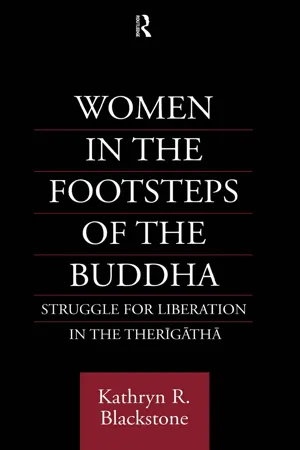
Women in the Footsteps of the Buddha
Struggle for Liberation in the Therigatha
- 260 pages
- English
- ePUB (mobile friendly)
- Available on iOS & Android
eBook - ePub
About this book
A detailed exploration of the quest for liberation on the part of the early bhikkunis. Only text in the Buddhist tradition of known female authorship. Important to anyone investigating women's own perspective on their religion. Also provides a clear statement about how renunciants understand nibbana.
Information
Chapter I
The Language of Liberation
As we would listen to the call of distant lions' roar Resounding from the hollow of the hills, Listen to the verses of them whose selves were trained, Telling us messages about themselves: How they were named, and what their kin, and how They kept the Faith, and how they found Release. Wise and unfaltering they lived their lives; Now here, now there they saw the Vision gleam; They reached, they touched the ageless, deathless Way; And retrospective of the accomplished End, They set to speech these matters of their quest.
Dhammapāla, Paramatthadīpanī1
According to Pali textual sources, the religious goal of early Buddhism was nibbāna, liberation from the cycle of saṃsāra.2 The Buddha's attainment of nibbāna is the culminating event in all his biographies, and the quest for this goal comprises the main import of his teachings. The life of renunciation and the Vinaya rules that circumscribe it are designed to propel people towards that goal. The goal, in short, is the definitive religious characteristic of Buddhism.
Nibbāna is frequently defined as the utterly transformative realization of the impermanence of all things, and the concomitant severing of the bonds of saṃsāra, the relentless cycle of desire, attachment, delusion, animosity, and grief to which human beings are bound. To realize the truth of impermanence and the insubstantiality of all things is to liberate oneself from bondage to one's mistaken expectations and perceptions of value. Nibbāna involves a thorough transformation of human cognitive and emotive faculties, including prevailing attitude, ways of interacting with others, and the structure of one's perceptions of reality. In metaphoric terms, nibbāna means the obliteration of one's socially conditioned lenses, so that one no longer perceives things through a filter, but sees things 'as they really are'. This shattering, the 'blowing-out' of false, desire-ridden perceptions, results in an emotional state of absolute equanimity. One is no longer at the mercy of unrealistic expectations, of one's ceaseless striving for stability in the midst of relentless waves of change. Instead, in truly understanding the absolute pervasiveness of change, one accepts whatever happens as a natural consequence of what has come before; one achieves a state of perfect peace.
As the opening quote from Dhammapāla's commentary indicates, the main emphasis of the Therīgāthā and Theragāthā is the quest for this ultimate religious goal. Both texts are devoted almost entirely to descriptions of liberation, methods to attain it, or characteristics of those individuals who have attained it. It is the most frequently referred to, the most frequently symbolized, and the clear goal of most of the authors. All the authors of both collections are described by the commentary as having attained liberation, that is, as having become arahants.
In this way, the texts are similar to the Jātakas or the Apadānas. Moreover, their preoccupation with the experiences of the ascribed authors in a single lifetime marks them as quite distinct. The Buddha is frequently referred to, particularly in the Theragāthā, but the verses, for the most part, are not about him. Rather, they focus on the quest for liberation of his followers. However, unlike the Apadānas, they are not overly concerned with the past lives of the authors and the karmic events that led to their attainment of nibbāna. They thus appear to be 'liberation manuals' designed to provide models of success for the women and men who join the Buddhist sangha.
The Therīgāthā and Theragāthā employ two mediums to explain the meaning of nibbāna and to convey the authors' attainment of it. The vast majority of the verses contain highly formalized technical terms that are common throughout Buddhist and even Jain gāthās.3 Many of the verses also use more poetic descriptions of the experiences, emotional states, and characteristic attitudes of the arahant authors. This makes sense. If liberation is a radical transformation of perspective, words alone cannot adequately communicate the repercussions of that transformation.
These more poetic descriptions comprise the focus of the rest of this monograph. In this chapter, I am interested only in how the texts use technical terminology. The goal of this chapter is not a philosophical study of the meaning of the technical vocabulary used by the texts to define nibbāna (others have done this in far more depth than I)4 but to compare typical patterns of usage characteristic of each text.
Underlying my analysis is the theory that the authors or redactors of the Therīgāthā and Theragāthā had access to a pool of stock terms and phrases which was part of the distinctive language of gāthā composition (maybe of renunciants in general, as Jain sources contain identical terms and phrases, used in much the same way). In all probability, the verses were composed orally and preserved as part of an oral tradition.5 They fit easily into the Lord-Parry oral-formulaic theory.6 Although Lord's work has been criticized for definitional imprecision and problematic assumptions,7 the insights guiding the theory accord well with my findings. In the theory, the performance of oral epics is inseparable from the composition. Performers string together formulaic phrases, descriptions, and whole passages to construct a tale. They have learned patterns of sounds, rhythms, rhymes and themes by exposure to other performances, and, in their own performances, will choose various combinations and sequences of formulas in the midst of the performance, according to the mood of the audience.8 In Lord's theory, the formulas a performer employs will evoke other formulas by metrical, stylistic, conceptual, or thematic association. The formulas are thus often linked together, though individual performers will have their own style.9
The Therīgāthā and Theragāthā's usage of stock terms and phrases appears to follow this theory. The poems use identical vocabulary, follow an identical organizational structure, and often repeat sequences of terms or phrases in identical patterns. Clearly, their authors were members of an established tradition of highly formalized gāthā composition. The repetitiveness, structural congruity, and, above all, the use of stock terms and phrases marks this tradition as oral. The fact that both texts use the same formulas indicates that the authors of each share membership in this tradition. But, as I shall demonstrate in this chapter, the texts exhibit subtle variations in their characteristic usage of these otherwise identical stylistic features. The similarity of pattern marks the texts as part of a common tradition; the variance in usage indicates the presence of sub-groups within the tradition.
Liberation Refrains
An initial reading of the texts leaves an impression of similarity rather than difference. The arrangement of the poems in the Therīgāthā and Theragāthā follows a clear organizational pattern and the poems themselves exhibit structural similarities. Many of the poems in both collections contain both a poetic and a doctrinal section: they begin with a poetic description and end with a recitation of technical terms and phrases which I call a 'liberation refrain'.10 This pattern is more evident in the longer poems, but even the shorter poems follow it. For example, Meghiya's one-verse poem in the Theragāthā begins with a description of the Buddha and ends with Meghiya's attainment of nibbāna:
The great hero, having reached the far shore of all phenomena, counselled me. Hearing his doctrine I dwelt in his presence, mindful. The three knowledges have been obtained, the Buddha's teaching has been done.
(Theragāthā 66)
Similarly, Aḍḍhakāsī's two-verse poem in the Therīgāthā opens with a description of her renounced prostitution, but quickly slips into the stock terminology:
My wages (of prostitution) were as large as the (revenue of the) country of Kāsī; having fixed that price the townspeople made me priceless in price.
Then I became disgusted with my figure, and being disgusted I was disinterested (in it). May I not run again through the journeying-on from rebirth to rebirth again and again. The three knowledges have been realized. The Buddha's teaching has been done.
(Therīgāthā 25–26)
Almost all of the poems in both collections follow this pattern, though in a few of the longer poems the stock refrains are interspersed with the more descriptive passages. For example, Soṇa Koḷivisa's poem in the Theragāthā opens with his background as a former attendant of a king (632), outlines the doctrinal implications of indolence and mindfulness (633–37), acknowledges the Buddha's instruction (638), and conveys his liberation refrain ('the three knowledges have been obtained, the Buddha's teaching has been done', 639). However, instead of concluding here, as most poems would, this poem continues its doctrinal discussion for another five verses (640–44). This poem, however, is the exception rather than the rule; the majority of poems in both collections that refer to liberation end with a liberation refrain, regardless of the content of the description that precedes it.
In the examples above I have intentionally chosen verses that contain an identical refrain: 'the triple knowledge has been obtained, the Buddha's teaching has been done.' These two phrases are among the fifteen most common stock phrases that make up the liberation refrains in the texts. Appendix A contains a table of the verses that contain these phrases. As translated by K.R. Norman, in the order of their frequency of occurrence in the Therīgāthā, they are: desire or craving (rāga, taṇhā, nicchāta, anupādāya) overcome; rebirth ended (amata, macchuhāyin, bhavanetthi samūhata, etc.); fetters, bonds or sensual pleasures (yoga, visaṃyutta, kāma, kāmarati) destroyed; nibbāna or nibbuta (quenched); triple knowledge (tisso vijjā or tevijja) obtained;11 freedom (mutta, vimutta) obtained; āsavas (intoxicating ideas, obsessions)12 destroyed; Buddha's teaching done (kataṃ buddhassa sāsanaṃ); pain (dukkba, soka) gone; darkness torn asunder (tamokkhandhaṃ padāliya); peace (upasanta, santi, anāvila) obtained; conquest (jayati, vihanti, nihanti) achieved; rest obtained or the load is put down (ohito baruko bhāro or yogakkhemaṃ anuttaraṃ); fear (bherava, bhaya, dara) overcome; and, far shore reached (pāragavesin).
Each of these phrases appears frequently in the texts, as is readily apparent in Table 1 which documents the total number of occurrences of each term or phrase in each text. The number of occurrences in the Theragāthā is naturally higher than those in the Therīgāthā as it has almost two and one-half times as many verses (Theragāthā 1279; Therīgāthā 522). The number in parentheses in the table represents an adjustment for this differential in total numb...
Table of contents
- Cover
- Original Title
- Title
- Copyright
- Dedication
- Contents
- Editors' Preface
- Preface
- Introduction
- Chapter I: The Language of Liberation
- Chapter II: Looking Backward: Attitudes Towards Renunciation
- Chapter III: Looking Inward: Attitudes Towards the Body
- Chapter IV: Looking Outward: Attitudes Towards the Environment
- Chapter V: Struggle for Liberation in the Therīgāthā
- A Technical Terms for Liberation
- B Tables of Liberated Therīs and Theras
- C Images of the Environment
- D Settings of Liberated Therīs and Theras
- Notes
- Bibliography
- Glossary
- Index
Trusted by 375,005 students
Access to over 1.5 million titles for a fair monthly price.
Study more efficiently using our study tools.
Frequently asked questions
Yes, you can cancel anytime from the Subscription tab in your account settings on the Perlego website. Your subscription will stay active until the end of your current billing period. Learn how to cancel your subscription
No, books cannot be downloaded as external files, such as PDFs, for use outside of Perlego. However, you can download books within the Perlego app for offline reading on mobile or tablet. Learn how to download books offline
Perlego offers two plans: Essential and Complete
- Essential is ideal for learners and professionals who enjoy exploring a wide range of subjects. Access the Essential Library with 800,000+ trusted titles and best-sellers across business, personal growth, and the humanities. Includes unlimited reading time and Standard Read Aloud voice.
- Complete: Perfect for advanced learners and researchers needing full, unrestricted access. Unlock 1.5M+ books across hundreds of subjects, including academic and specialized titles. The Complete Plan also includes advanced features like Premium Read Aloud and Research Assistant.
We are an online textbook subscription service, where you can get access to an entire online library for less than the price of a single book per month. With over 1.5 million books across 990+ topics, we’ve got you covered! Learn about our mission
Look out for the read-aloud symbol on your next book to see if you can listen to it. The read-aloud tool reads text aloud for you, highlighting the text as it is being read. You can pause it, speed it up and slow it down. Learn more about Read Aloud
Yes! You can use the Perlego app on both iOS and Android devices to read anytime, anywhere — even offline. Perfect for commutes or when you’re on the go.
Please note we cannot support devices running on iOS 13 and Android 7 or earlier. Learn more about using the app
Please note we cannot support devices running on iOS 13 and Android 7 or earlier. Learn more about using the app
Yes, you can access Women in the Footsteps of the Buddha by Kathryn R. Blackstone in PDF and/or ePUB format, as well as other popular books in Social Sciences & Ethnic Studies. We have over 1.5 million books available in our catalogue for you to explore.