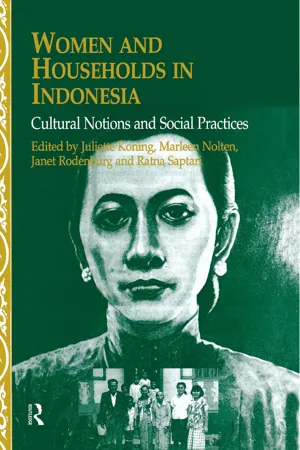
Critically examines the usefulness of the 'household; concept within the historically and culturally diverse context of Indonesia, exploring in detail the position of women within and beyond domestic arrangements. So far, classical household and kinship studies have not studied how women deal with two major forces which shape and define their world: local kinship traditions, and the universalising ideology of the Indonesian regime, which both provide prescriptions and prohibitions concerning family, marriage, and womanhood. Women are caught between these conflicting notions and practices. How they challenge or accommodate such forces is the main issue in this book.
eBook - ePub
Women and Households in Indonesia
Cultural Notions and Social Practices
- 372 pages
- English
- ePUB (mobile friendly)
- Available on iOS & Android
eBook - ePub
Women and Households in Indonesia
Cultural Notions and Social Practices
About this book
Information
Section III: Challenging the Household Concept
The three chapters in this section unequivocally contest the notion that the household is the most suitable unit of analysis when trying to analyse and understand gender relations and the dynamics that underlie them. Studies from respectively the Moluccas, Northern Bali and Sumatra demonstrate that this holds true not only for the relations between men and women, but also for the relations women have vis-à-vis other women.
The study of Franz and Keebet von Benda-Beckmann on 'Houses, People and Residence: the Fluidity of Ambonese Living Arrangements', shows that in Ambon co-residence is a just another strand to already multi-stranded relationships, leading to cooperation in some spheres but also functioning as a potential source of tension and conflict. Actually the demarcation principles according to which care and cooperation are given to others are not so much sharing a roof or common cooking pot, but rather dependent on status, age and gender. It is, for example, largely on the basis of patrilineal kin relationships and the principle of patrilocality that individuals are brought together as co-residential units. But once living under one roof, it depends mainly on the women who spend much time together in the house, whether this situation is to continue or not.
In her study 'Bitter Honey: Female Agency and the Polygynous Household, North Bali', Jennaway shows that women engaged in polygynous marriages usually prefer to live in separate dwellings (a place with a separate kitchen or kuren), but for economic reasons may be compelled to live together under one roof. If we are to understand the nature of gender relations and understand what motivates the wives and the husband, we have to look beyond the various spatial arrangements – at the different interests that Balinese women may have in the establishment or termination of such an arrangement. First wives greatly lose out when their spouses marry another woman and they will usually try to prevent this from happening. (Potential) co-wives on the other hand benefit in terms of economic security and social status. In contrast to what is often assumed, it is not so much the spouse then, but co-wives whose initiatives lead to the ongoing establishment of polygynous marriages on Bali.
As Joke van Reenen's contribution on 'The Salty Mouth of a Senior Woman: Gender and the House in Minangkabau' reveals, in the Minangkabau situation too, individual women are figuratively and literally at the centre of the so-called rumah gadang (or 'big house', so characteristic for this matrilinear society). This in particular applies to senior women, who continue to be pivotal in shaping domestic and kin structures in and outside the rumah gadang. Analysing the personal networks of women and men, then, reveals more about gender relations within Minangkabau society than studying the pariuak [cooking pot unit], 'household' or 'family'.
7
Houses, People and Residence
The Fluidity of Ambonese Living Arrangements
Keebet and Franz von Benda-Beckmann
Introduction
Over the past 15 years the debates about 'the household have reached a high level of sophistication. The 'black box', as the household has been described, has been opened (Niehof 1994). Its contents have proved to be a rich variety of diverse relationships, undermining the explicit or implicit assumptions that households were so uniform and homogeneous in relevant social and economic aspects that they could serve as a useful basis for scientific analysis and comparison as well as for planning. From the side of women's studies it has been pointed out that women hold a different position in households than men. There is also general consensus now that households cannot be easily separated from the social world outside because household members have diverse relationships with persons living in other houses which may be more intensive and important than contacts with the persons within the same house. The internal and external relationships of persons living together in a house thus have been submitted to intensive scrutiny.
One of the virtues of the critique of the household concept has been to show how much variation is subsumed under this term, how varied the patterns of internal and external cooperation are, and how these change over time and throughout the life-cycle. This variation is captured by distinguishing types of households in terms of composition and authority or representational structure (male- or female-headed). The explanation of the variation in the social and economic functions of households then is usually sought in the composition of the household – or the heardihold – and in economic and practical considerations (see e.g. Finch 1989: 25). However, the conditions under which people live together in houses and which underlie the variation in the composition of households as co-resident units, have rarely been analysed systematically.
In this chapter we shall argue that for such an analysis it is not enough to open the 'black box' and look to see what is inside; we also have to look at the black box itself, examine its physical structure and social meaning, and question the reasons for the structure and composition of co-residing people. The physical structure and social meaning of a house itself are important explanatory factors of variation in the composition of and cooperation among inhabitants. The purpose of this chapter is to examine the relationships between houses, common accommodation and cooperation in the most important aspects of social and economic life. In particular we are interested to see the extent to which residence affects gender differences. As will become clear, residence is not merely a way of locating persons and identifying them with a certain space and house as a place of accommodation. Residence also localizes economic activties, or at least the profits of economic activities; and it is a way of localizing people's political positions, rights and obligations.1 By shifting the focus from households as the basic social unit to co-residence, we hope to contribute to the further unravelling of the concept of the household. This perspective allows for a widening of the explanations that might account for cooperation and network formation and maintenance through shared accommodation. After a discussion of the current household critiques and the implication these critiques should have for the study of residence, we shall demonstrate our approach with an analysis of residence in the village of Hila, a Muslim village on the north coast of the island of Ambon.2 We shall address three sets of issues which together provide an analysis of residence that takes houses as such into account.
- Variation in the association between people and houses. We shall start by describing the variation in residential arrangements, their stability or fluidity. We shall trace groups of people through the various houses in which they live during their lifetime. And we shall also look at different types of houses, and at their social history (Appadurai 1986; Kopytoff 1986).
- The conditions of co-residence. We shall then examine the conditions under which co-residence comes about. We shall look at the legal regulations structuring co-residential arrangements, at the social structure and social relationships which lead to the formation, or termination of such arrangements, and at the strategies developed to deal with these factors.
- The significance of co-residence for social, economic, political, religious and ritual cooperation and organization. Finally we approach the question of what co-residing means: In what ways is the fact that people live together in one house important to the organization of their lives? What do they do that people not living in one house do not do? What variation do we encounter here, and what are the social, legal, cultural and ecologicae factors that underlie these variations?
Household Critiques and Their Implications
In the recent debates about households a pragmatic-political and a theoretical line can be discerned. The pragmatic line comes first of all from politicians and administrators, from census and tax officials. The more involved the state administration became in controlling village life, the smaller the administrative units with which it dealt became. Sometimes these units had to be created in order to facilitate administration. These units were narrowed down from villages, via clans and lineages to households, i.e. a unit formed by houses and the people living in them. Like all the other units, households were seen, or deemed to be represented by a head who was typically a male, the presumed authority in the household. Indirect rule was thereby brought to the lowest level of social organization. Officials may not always have chosen the most relevant or enduring form of social organization for their administrative system. The unity of people co-residing in a house, created by this household concept, may not everywhere have been functionally very important in other social, economic, political or ritual spheres of life. Yet it was a practical choice. Households have the advantage that they tie people to territorially fixed and bounded space – thus getting rid of more or less vaguely localized and bounded units such as the family or the clan, while avoiding having to deal with each individual separately. The administrators therefore should not be reproached. They had no pretensions to elevate their pragmatic administrative unit to the analytical level. They were not concerned with theories on tribal subsistence or peasant economies or comparative analyses of co-residential units across time and space. Their task was simply to count people and to levy taxes, and the household served these purposes well. Only when they started to design economic and social policies based on the assumption of homogeneous households did they run into trouble.
Pragmatic considerations also undoubtedly played a part in the increasing popularity of the household unit for social scientists. Houses are a convenient location to gather data. Besides, the economic and political significance of more encompassing social units or categories (like lineages, clans and tribes) seemed to have faded with the increasing incorporation of local social organizations into wider political and economic networks and institutions. Rather than drawing intricate genealogical diagrams or tracing spatially dispersed members of lineages or extended families, social scientists found it easier to map households, which were more readily identifiable, if only because these had been identified by the state administration as the new building-blocks of social organization. To some extent, research – and in particular development and action-oriented research carried out under time constraints of rapid rural appraisals and oriented at the objectives of development projects – simply had to adapt to such constraints, often against better judgement.
More important, however, seems to have been the other, theoretical descent line of the household. For social anthropologists, development sociologists and economic theorists of subsistence or peasant production, the household provided a recurring frame of reference and challenge, as evidenced in Sahlins' ideas of the domestic mode of production (1974), the 'classical battle line Lenin vs. Chayanov' (Wong 1987: 15), and the assumptions and propositions of the new household economics (Ellis 1988). Although the concepts of 'peasants', 'domestic group', 'family farm' and 'household' had different connotations, the household was regarded as the social unit of income pooling and consumption sharing, of production and reproduction, and of joint decision-making. So strong was this functional unity of the household that it became reified and personalized: the household became an actor in that it allocated labour, it had needs and utility functions, and it pursued strategies (see Whitehead 1990).
These theories form the background against which much contemporary critical research in rural areas in developing countries has been carried out. It has given researchers concepts and propositions to test. Over the past 15 years an impressive body of ethnographical evidence and theoretical argument has been built up by social scientists and economists; researchers of gender relations in particular having made important contributions. The evidence shows convincingly that the concept of the household and the assumptions built into it were rarely empirically supported and were theoretically misleading, at best superficial. Many authors have shown that in the societies they studied, the people co-residing in a house did not always form units of income pooling, consumption and production, and they pointed at the methodological consequences for the study of production and reproduction of rural people (E.g. Cohen 1976, Elwert 1980, Evers 1984, Wong 1984, Fapohunda 1988, Wolf 1990, 1992). The assumptions of new household economics based on the household as an 'actor' have been convincingly criticized (E.g. Guyer and Peters 1987, Dwyer and Bruce 1988, Folbre 1988, Guyer 1988).
Gender studies in particular have questioned these propositions and have pointed to the divisions of labour and the power relationships within households, the differential power, needs, wishes and strategies of members of a household (Whitehead 1990; Moore 1994). The external relationships of persons living together in a house thus have been submitted to intensive scrutiny. Furthermore, the relations between (members of different) households were shown to play an important role in the economic and social organization (see Elwert 1980; Wong 1984). Consequently, it was argued, researchers must pay attention to intra-household differences and differentiation, as well as to interhousehold relations and networks.3
What were the implications to be drawn from these critiques? One way out has been the continued search for 'fundamental' social units. If earlier understandings and definitions of the household could not be substantiated empirically and consequently flawed theories in which these understandings figured prominently, then perhaps a more narrowly defined social unit would do: the household redefined as a hearthhold, as universal social unit in which at least the most important social functions for consumption and reproduction converged (van den Berg 1997). Others have adopted a fresh perspective on social and economic organization in which households, however defined, would not a priori play a major analytical role, but would be just one, potentially important, unit within and among the wider sets of supra-individual relationships and social institutions. As Wong has argued 'the fundamental fallacy of this approach lies in its methodology – that of an analysis built around a unit defined a priori rather than analytically derived concepts that would focus on attention on processes' (Wong 1984; see also Guyer and Peters 1987). Already in 1979 Yanagisako concluded in her review that
it seems to be more analytically strategic to begin with the investigation of the activities that are central to the domestic relationships in each particular society, rather than with its domestic groups. If we start with identifying the important productive, ritual, political and exchange transactions in a society and only then proceed to ask what kinds of kinship or locality-based units engage in these activities, and in what manner, we decrease the likelihood of overlooking some of these salient units, particularly those that do not fit our conventional notion of household
(Yanagisako 1979: 186).
We certainly subscribe to such a functional approach. However, we feel that th...
Table of contents
- Cover
- Original Title
- Title
- Copyright
- Contents
- Contributors
- Preface
- SECTION I: INTRODUCTION
- SECTION II: DOMINANT NOTIONS OF FAMILY AND THE HOUSEHOLD
- SECTION III: CHALLENGING THE HOUSEHOLD CONCEPT
- SECTION IV: MOBILITY, DOMESTIC ARRANGEMENTS AND FAMILY LIFE
- SECTION V: BEYOND THE DICHOTOMIES
- Bibliography
- Glossary
- Overview of the papers presented at the WIVS conference
- Index
Trusted by 375,005 students
Access to over 1.5 million titles for a fair monthly price.
Study more efficiently using our study tools.
Frequently asked questions
Yes, you can cancel anytime from the Subscription tab in your account settings on the Perlego website. Your subscription will stay active until the end of your current billing period. Learn how to cancel your subscription
No, books cannot be downloaded as external files, such as PDFs, for use outside of Perlego. However, you can download books within the Perlego app for offline reading on mobile or tablet. Learn how to download books offline
Perlego offers two plans: Essential and Complete
- Essential is ideal for learners and professionals who enjoy exploring a wide range of subjects. Access the Essential Library with 800,000+ trusted titles and best-sellers across business, personal growth, and the humanities. Includes unlimited reading time and Standard Read Aloud voice.
- Complete: Perfect for advanced learners and researchers needing full, unrestricted access. Unlock 1.5M+ books across hundreds of subjects, including academic and specialized titles. The Complete Plan also includes advanced features like Premium Read Aloud and Research Assistant.
We are an online textbook subscription service, where you can get access to an entire online library for less than the price of a single book per month. With over 1.5 million books across 990+ topics, we’ve got you covered! Learn about our mission
Look out for the read-aloud symbol on your next book to see if you can listen to it. The read-aloud tool reads text aloud for you, highlighting the text as it is being read. You can pause it, speed it up and slow it down. Learn more about Read Aloud
Yes! You can use the Perlego app on both iOS and Android devices to read anytime, anywhere — even offline. Perfect for commutes or when you’re on the go.
Please note we cannot support devices running on iOS 13 and Android 7 or earlier. Learn more about using the app
Please note we cannot support devices running on iOS 13 and Android 7 or earlier. Learn more about using the app
Yes, you can access Women and Households in Indonesia by Juliette Koning,Marleen Nolten,Janet Rodenburg,Ratna Saptari in PDF and/or ePUB format, as well as other popular books in Social Sciences & Ethnic Studies. We have over 1.5 million books available in our catalogue for you to explore.