eBook - ePub
Pilgrimage
Timothy Gabashvili's Travels to Mount Athos, Constantinople and Jerusalem, 1755-1759
- 224 pages
- English
- ePUB (mobile friendly)
- Available on iOS & Android
eBook - ePub
Pilgrimage
Timothy Gabashvili's Travels to Mount Athos, Constantinople and Jerusalem, 1755-1759
About this book
A remarkable record of a pilgrimage through Turkey, Greece and the Levant. The Introduction examines the historical background to his travels and life, which ended in poverty and exile. Also included are a historically annotated gazetteer and extensive bibliography.
Information
The Travels
TIMOTHY GABASHVILI
The Text
{Page numbers} in curved brackets refer to the Georgian text in Metreveli 1956.
[Passages in square brackets] are not from Manuscript C, the main text, but from Timothy's additional manuscripts and the notes they contain.
<Passages in this kind of enclosure> are not translations of words in the Georgian text, but are added to make the English clearer.
The Psalms are given their Hebrew numbers, as in the English Bibles.
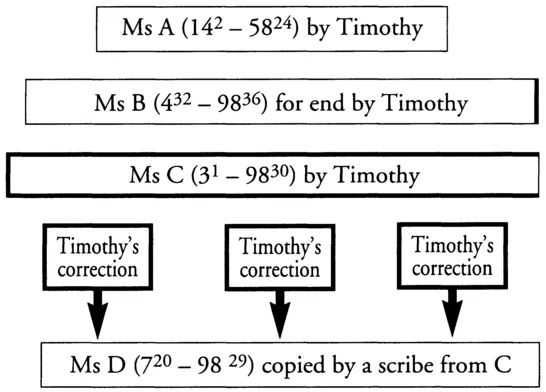
The different Manuscripts are not exactly copies of each other, and the most important variations are given in the footnotes. Metreveli's edition gives a full account of the text which is here translated, but in simplified terms the text is based on Manuscript C. Mistakes in Manuscript C are corrected according to the notes Timothy made in Manuscript D. The beginning and the last paragraphs of the Travels are restored according to Manuscript B (with its copy H-1014). The boxes with bold lines are the sources.
The Travels
{3}
I have always remembered how insufficient it is to praise in words God on high. How inappropriate it is for us, living beings in our idleness, to reach out to any thing divine or to talk about divine revelations. The words of our mind would not suffice and our language would not express the heartrending words of the much-troubled world. Why do men take the liberty of talking about the Supreme without the fear that this boldness and impertinence could risk His wrath and jealousy? It is better to live one's life in silence, than to be like me, the unworthy Monk Timothy of Jerusalem, for I have so daringly and unhesitatingly started to interpret God's Words, only because of the love for the brotherhood and loyalty of my fellow-countrymen, and because they have forgotten that they once possessed these holy places. What has happened to Georgian Kings, who had once possessed Jerusalem and Palestine, and whose relatives in Georgia had been supreme and powerful. Now they are so much weakened that, at least in our vicinity, those who have any slight influence do not take even the trouble to talk to us.
This and similar reasons have made me break my silence, and I began to scrutinize some books. Then I dedicate it: to you, the wise men who study divine and scientific matters; to you the kind, humane, and silent forgivers of transgressions you have beheld and heard; to you the worthy Fathers and Brothers who are following the deeds of the men-loving God; to you the clergy and the laymen, renowned for righteous deeds, who are standing on the steps of science. {4}
Readers of this book, I request that you heed my words. I went to Jerusalem and to the Holy Mount, the Holy Place of the Fathers. But I was very surprised, because we had seen and read the works of our Georgian Fathers, and had never before heard, even as a hint, the things I have described here. Why did not any of those Georgians who had come here before find out anything concerning these things? We have therefore described everything we have learned about Jerusalem, about the Holy Mount and the other monasteries, about the Holy Martyrs' martyria, about the dwellings of the worthy Fathers, and about a great many other places as well. <In this way> we have described everything authentic that we have seen or heard.
We have discovered and described some teachings of these Fathers that have been lost in Georgia. And I myself have — unintelligently — written some other teachings. I who cannot see so much as a log, have begun to write in order that others, as ignorant as me, can read it. I have also talked in a way which is far above my abilities about theology and the Law of the Lord. I have not spoken on my own, but I have relied on the studies of the wisest scholars. Moreover I have visited many countries, had conversations with a great many wise men and philosophers. I have questioned spiritual and reliable persons and received their explanations. <And only> afterwards have I written this book with the aim of truth, with love to Christ, and for the benefit of peace and love. Thus have I sent it to Georgia.
Therefore I plead with you, Christ-loving Georgians, that after you have attended to <this book> and read it, that you will not be grudging towards me, but forgiving. This is what we are afraid of, so I beseech you, in respect of your holy life, not to disregard my negligible words. If you find anything which enriches your souls, pray for my forgiveness in the name of Him who has granted eternal salvation with his own Blood. And if you find anything which is incorrect, you should first turn to the scholars, and if you still find it wrong, then I ask your forgiveness, for there is no one unerring but God. {5}
At that time, believe me, I did not know anybody quite as ignorant and sinful as me — I was the lowliest of all. In those times past, the wisest people of the Georgia used to elucidate the Holy Scripture within strict limits and little by little, thus educating the people of our country, but those who were unaware of God's commandments kept a humble silence. Both these people gained salvation, yet I was withdrawn from both of them, as I could neither speak adequately nor retreat in humble silence. We have now described it trusting in your virtuous character, so that you may grant me the dawn of your forgiveness. Be merciful to me, your fellow-countryman, and forgive me my inconsistencies, so that you, charitable as you are, may be granted long life by the Light of Lights, and may the Lord, sitting at the Table of Abraham, give you a drink of immortality, and grant you a green place in his paradise. {6}
In order to help those who desire to abandon <their country> and travel to foreign parts, and who painfully beseech God to safeguard them and to make them worthy of their desire to see the sites of martyrdom, and the mysterious places of the saints, <I will now describe everthing> I have there beheld and heard, both for the benefit of the nation and to strengthen the souls of the faithful. That is why this book is called "The Courtyard".1
Though having lived so unworthy a life, I have always been yearning in my mind to flee <the country>, as I was incessantly reminded of the heavy burden of my sins. So I was eager to go to foreign countries and to go up to the Holy City of Jerusalem in order to worship at the Lord's life-giving Holy Sepulchre, and the Holy Mount, and Mount Sinai, and to see Sinai and our holy Fathers' dwellings and cells, and the Holy Places; to venerate the altar of God's Will and to kneel down at the places where our holy fathers, the keepers of these places, had dwelt. Because seeing all these and receiving their blessing would enable my weary and sluggish life to awake from its sinful slumber, to comfort my wretched existence, and to desire to find shelter in the House of my God. But, in order to fulfil my long-wished desire, I neither had leisure nor could find any time.
In 1755 when Georgia was ruled by the blessed and Christ-loving King Teimuraz, and their firstborn renowned Son and Servant of God, King of Georgia, Irakli, I announced my intentions to their {7} Sovereignty and left the place2 with their presents and their letters that ensured my long journey to distant lands.3 We took everything necessary and came to Samtskhe, to the town of Akhaltsikhe, and into the house of the Pasha-Atabag.4 On hearing about our arrival, they sent men and prepared the customary lodgings and food. Afterwards we were invited to the Pasha 's palace and he gave us various kindnesses according to their customs. Some time passed and we came to his palace and spoke with him about choosing the best route for our journey. He approved that we should journey by sea, and wrote letters in the Turkish language to Constantinople: one to the Sultan, one to the Vezir and the Courtiers, and another to receive us with honour. We were attended by a Turkish Beg and <were given> a number of books. We left Akhaltsikhe and came to the former monastery of Zarzma, and the villages in the neighbouring area. On Ascension Day we rested there. We walked across the mountain Adjara.5 After walking for four days we came to the river Chorokhi and from there to the sea coast and the qasaba of Batumi.6 We spent twelve days there in search of a ship.7 By God's mercy there came a mild north wind. We managed to find an appropriate boat and, in gratitude to God, the protector of travellers, we embarked on it on the Fiftieth Day, the Descent of the Holy Spirit. We left the boundaries of Georgia and prayed to God to protect our voyage over the seas and a great many stretches of water.
We travelled 150 miles, day and night, and went past Rize that from ancient times had been regarded as the border of Georgia. We reached the renowned Trabzon, the place of the throne and dwelling of Greek kings. It is very beautiful in many different ways with the sea and the mountains. When we landed on shore we sent our Archdeacon to give our regards to the Metropolitan of Trabzon. And he then sent a priest to give us his regards. We were exhausted by the sea journey. We were led to the palace —- a very beautiful building — and to the gardens, with a wonderful view of the splendid waves of the sea. When we had rested for quite a time, we went to see the most holy priest Annania of Trabzon. Then he came forth to meet us, this honourable man, righteous in his behaviour, and lavishly endowed with the grace of love for foreign visitors. He received us very well and often invited us to share a meal with him. He wished us to offer Sacrifice in the main chapel of St {8} Gregory of Nyssa, as Agia Sophia in Trabzon and many other churches had already been occupied by the Turks. The Archpriest and people of the city treated us with great honour.
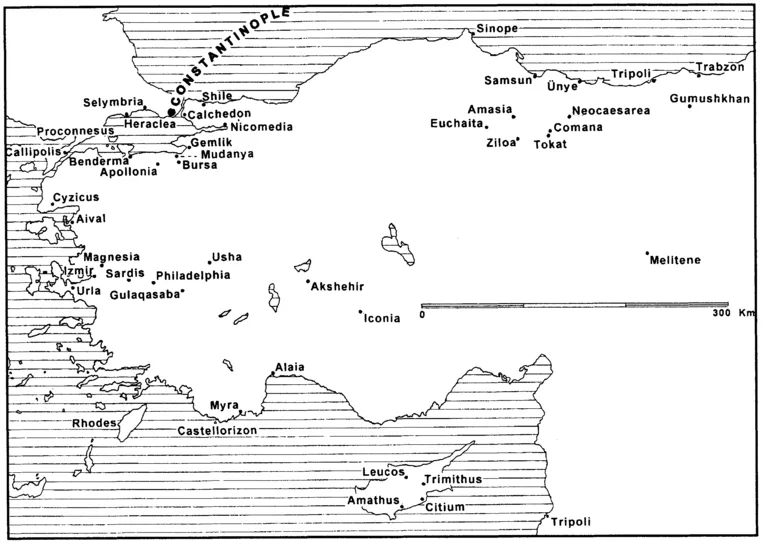
Figure 13. Travels in Turkey
They received from us, the unworthy foreigners, the offering of Sacrifice and Agiasma, whereas we ourselves sought for their kind support.8
We went up to the Nunnery and were met by the spiritual mother, the Superior, and other sisters and mothers, and a group with crosses. They led us with chanting and large tapers and we venerated the altar and the holy places. The church was hewn in the rock and there were rooms and cells of the monastery beautifully decorated by the King Alexis Comninus. His portrait was there with his mother and also his wife. We were led to the common refectory, and they laid the table for us, and they treated us well. We stayed there as long as we wanted. Then we returned to our lodging. We stayed there for a month. We got a good boat and went to the Metropolitan to receive his blessing. It was very difficult to part with him. Having received his blessing, he gave us provisions for our journey, and we got into the boat. During our voyage we passed the city of Tripoli and then came to the city of Ünye, a beautiful place! Some Christians guided us, and lodged us in premises near to the church of St Nikoloz. The people assembled there. They treated <us kindly> and received us well. We chose to travel by land. They provided us with food and horses. We travelled for four days and reached Neocaesarea, the city and church of Gregory Thaumaturgus. With our own eyes we saw the miracle performed by him. A great river called Lupus, that flows through the city, damaged the people's labours. St Gregory, when they appealed to him, went to see it himself. He diverted the river far away and placed his staff there, so that it would not come there any more. In the name of the Lord Jesus Christ he told the river, "Don't cross this boundary!" That staff has now grown into a great tree, and the river, as if it is scared, forms a great bend there. The bridge that had once been built over the river now stands there useless, as the water has left the place. We {9} spent one night by the old bridge. Christians are still in possession of the main church. We left the place, and came to Comana, Cucusus of Somkhiti.9 We saw the tomb of our Holy Father John Chrysostom, where he lived in exile and where he passed away. A bit farther on from there, there is a great city Cucusus of Somkhiti that at present is called Tokat by the Turks. There is the see of the most holy Bishop of Neocaesarea and Paphlagonia. Having approached the place, we let their Metropolitan know about our arrival. They guided us and lodged us in the premises of the church. We saw the most holy Bishop Gerasimos of Neocaesarea. He accommodated us well and received us like brothers. We spent there several days. We went to see an admirable monastery built by Theodora the Queen in the outskirts of the town. It was the fifteenth of August. The people assembled and invited us to the sacred Sacrifice and they received us foreigners with great honour.
At the time when we were enquiring about the way taking us up to Jerusalem, there was a big caravan going to Izmir and we got ready to leave the place. We received the blessing of the Bishop and set off, as it was sixty days' distance away. In several days we passed the city Amasia, the see of holy father Basil of Amasia, who is commemorated on the 26th of April. We also passed the city of Zile and the diocese of Caesarea-Cappadocia. We travelled for twenty-five days in sparsely populated territory and came to the city of Lycaonia, where Holy Philemon was martyred. He is commemorated on November 29th. Near the city there is the monastery of St Helena. Amphilochius of Iconia was brought up there. Within the monastery plenty of natural hot water was running in the bath, that was just enough to turn a mill. From there we went to Akshehir, in the diocese of the Bishop of Iconia, where the holy Martyrs Cyricus and Julita were martyred. There was the Bishop Dionysius of Iconia. The Christians gave us a good reception and plenty of provisions and gifts. On our way, as we left the place, we saw some arches, where Turkish mullahs were sitting and reading books. When I enquired about it they told me, "This is Mullah Asradin's10 tomb, {10} and he is regarded as a saint". I was amazed how much they worshipped that liar and clown.
From thence we went to the place where holy father Chariton had built a monastery and where a great number of Georgians had dwelt. We came to Usha and then to Gulaqasaba11 where there was the Monastery of Archangels. We parted with the caravan and had a rest with the Christians. From there we went to the city of Philadelphia, where John the Theologian wrote to the Seven Churches of Asia:12 Ephesus, Smyrna, Thyatira, Sardis, Philadelphia, Laodicea. We came to this very Philadelphia and the Christians came out to meet us and lodged us in the premises of the Church. They received us very well. We saw an old church of John the Theologian that had been so ruined that only some columns remained. Near Colossae,13 that is Khone, there is the Church of the Archangel. The feast day is September 6th. The miraculous story is as follows: The heathen had dug out the river and directed it to the Monastery of the Archangel in order to flood it. The Christians gathered to pray to the Archangel and when the river approached the monastery, it did not go to the monastery, but bored its way into the ground, and the water ran into it. It runs like this till today. Nearby there is a city where St Marina was martyred.
We left the place for another of the Theologian's Seven Churches, Sardis, where was the see of the holy father Euthymius, Bishop of Sardis, [the feast day is on December 26th].14 It was so totally ravaged, that only some ruined sections still remained there and in the neighbourhood no human beings were to be found. We spent there only a night. Next day we continued our travel an...
Table of contents
- Cover
- Title
- Copyright
- Dedication
- Contents
- Preface
- Acknowledgements
- List of illustrations and maps
- Introduction:
- THE TRAVELS
- Transliteration of Georgian names
- Gazetteer
- Notes
- Bibliography
- Index of persons
Trusted by 375,005 students
Access to over 1.5 million titles for a fair monthly price.
Study more efficiently using our study tools.
Frequently asked questions
Yes, you can cancel anytime from the Subscription tab in your account settings on the Perlego website. Your subscription will stay active until the end of your current billing period. Learn how to cancel your subscription
No, books cannot be downloaded as external files, such as PDFs, for use outside of Perlego. However, you can download books within the Perlego app for offline reading on mobile or tablet. Learn how to download books offline
Perlego offers two plans: Essential and Complete
- Essential is ideal for learners and professionals who enjoy exploring a wide range of subjects. Access the Essential Library with 800,000+ trusted titles and best-sellers across business, personal growth, and the humanities. Includes unlimited reading time and Standard Read Aloud voice.
- Complete: Perfect for advanced learners and researchers needing full, unrestricted access. Unlock 1.5M+ books across hundreds of subjects, including academic and specialized titles. The Complete Plan also includes advanced features like Premium Read Aloud and Research Assistant.
We are an online textbook subscription service, where you can get access to an entire online library for less than the price of a single book per month. With over 1.5 million books across 990+ topics, we’ve got you covered! Learn about our mission
Look out for the read-aloud symbol on your next book to see if you can listen to it. The read-aloud tool reads text aloud for you, highlighting the text as it is being read. You can pause it, speed it up and slow it down. Learn more about Read Aloud
Yes! You can use the Perlego app on both iOS and Android devices to read anytime, anywhere — even offline. Perfect for commutes or when you’re on the go.
Please note we cannot support devices running on iOS 13 and Android 7 or earlier. Learn more about using the app
Please note we cannot support devices running on iOS 13 and Android 7 or earlier. Learn more about using the app
Yes, you can access Pilgrimage by Mzia Ebanoidze,John Wilkinson in PDF and/or ePUB format, as well as other popular books in Social Sciences & Ethnic Studies. We have over 1.5 million books available in our catalogue for you to explore.