eBook - ePub
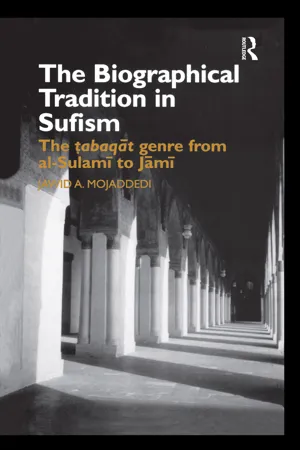
The Biographical Tradition in Sufism
The Tabaqat Genre from al-Sulami to Jami
- 230 pages
- English
- ePUB (mobile friendly)
- Available on iOS & Android
eBook - ePub
About this book
This book is a study of the major works of Sufi historiography, which takes the form of collections of biographies. It provides a literary context in which one can appreciate fully the theological significance and historical value of Sufi biographies.
Information
Part One
All these memories, superimposed upon one another, now formed a single mass, but had not so far coalesced that I could not discern between them – between my oldest, my instinctive memories, and those others, inspired more recently by a taste or ‘perfume’, and finally those which were actually the memories of another person from whom I had acquired them at second hand – if not real fissures, real geological faults, at least that veining, that variegation of colouring, which in certain rocks, in certain blocks of marble, points to differences of origin, age and formation.
(Marcel Proust, Remembrance of things past, Vol. I, p.203)
Chapter One
Sulamī’s Ṭabaqāt al-Ṣūfiyya
I
Abū ʿAbd al-Raḥmān Muḥammad b. al-Ḥusayn al-Sulamī (d.412/1021) was an eleventh century Sufi scholar from Nishapur. Over twenty works that are ascribed to him have survived.1 Whilst little is known about the events of his life,2 it would appear that he was greatly revered by his fellow-citizens; his biography in al-Khatīb al-Baghdādī’s (d.463/1071) Ta’rīkh Baghdād mentions that his grave in Nishapur had already become a pilgrimage destination.3 It also specifies that the grave was located within a small monastery (duwayra)4 which was named after Sulamī. The monastery may have been established only after his death as an extension of the grave, or it may even have been the place where he had taught and compiled his works.
The inclusion of a biography of Sulamī in the Ta’rīkh Baghdād is apparently on account of his visits to that city, when he would transmit reports about the Sufi leaders of Khurasan to the scholars of Baghdad (wa-ḥaddatha bihā ʿan shuyūkh Khurāsān).5 Such occasions could also have provided an opportunity for him to collect reports about the Sufis of Baghdad, which account for a substantial proportion of the contents of his own works.
Sulamī took his nisba (title denoting descent), by which he is commonly known, from his maternal grandfather, Ismāʿīl b. Nujayd al-Sulamī (d.365/976), who is usually referred to as Ibn Nujayd.6 He describes the latter as one of the eminent followers of Abū ʿUthmān al-Ḥīrī (d.298/910), ‘who spread the Sufi path in Nishapur’.7 Ibn Nujayd is often classified in later tradition as a member of the Malāmatiyya (the people of blame),8 and a treatise about this group is in fact counted amongst Sulamī’s own surviving works. It confirms that he himself was at least familiar with the term and its connotations.9 Ibn Nujayd is likely then to have been an important early influence on Sulamī, perhaps even as his first teacher in Sufism. ʿAbd al-Karīm b. Muḥammad al-Samʿānī (d. 562/1162), over a century later, informs us that Ibn Nujayd was also very wealthy, and that Sulamī’s mother was the sole heir to his fortune.10 In this way, he may have provided the resources for his grandson to pursue his interest in Sufi scholarship, as well as the original inspiration.
Although Sulamī is claimed as one of their own as much by Shafi’ite as by Sufi biographers, his surviving works indicate that he was primarily a Sufi. In fact, the aforementioned Risālat al-Malāmatiyya, as well as the Kitāb al-samāʿ,11 which is the earliest surviving monograph on Sufi musical audition, suggest that he was immersed in Sufism to an extent that he took an interest even in the more contentious aspects of the tradition.12 The two works that are most often mentioned by name in his medieval biographies are the Ḥaqā’iq al-tafsīr, a work of mystical exegesis,13 and the Ṭabaqāt al-Ṣūfiyya, a collection of biographies of Sufis.14 The latter, as the earliest example of the Sufi ṭabaqāt genre, is arguably Sulamī’s most influential work.
II
The Ṭabaqāt al-Ṣūfiyya is a collection of 103 biographies of Sufis.15 The biographies are grouped into five consecutively numbered sections called ṭabaqāt (generations) (See Fig.1), framed by an introduction at the beginning of the work and a postscript at the end. The first four of Sulamī’s generation sections are each made up of 20 biographies.16 The fifth generation section consists of 23 biographies.17 This final section contains an excess of biographies perhaps because, since it represents the generation closest to the time in which the work was compiled, it proved too difficult to restrict to only twenty biographies. That is, Sulamī may have intended to include only twenty biographies in each section, but decided to make the final generation the exception.
The introduction of the Ṭabaqāt al-Ṣūfiyya describes the work as consisting of 100 biographies divided into five ‘generations’, each made up of 20 biographies (aj ʿaluh ʿalā khams ṭabaqāt … wa-adhkur fī kull ṭabaqāt ʿashrīn shaykhan).18 Moreover, in the postscript it is stated that each biography contains ‘about twenty segments (ḥikāyat)’, despite the fact that this is clearly not the case for most of them.19 The evident discrepancies are perhaps due to the wish to offer a neat and balanced account of the methodology applied in the compilation of the work.
Most of the biographies in the Ṭabaqāt al-Ṣūfiyya offer the date of their subject’s death.20 An examination of these dates shows that Sulamī’s five generations cover a period extending back from the late 4th/10th century to the late 2nd/8th century. That is to say, the earliest of the first generation lived in the eighth century, whilst the latest of the fifth generation lived in the late tenth century. It is perhaps to be expected that the latest ones to be included should be the immediate predecessors of Sulamī, but the reason why the earliest of them should be from the eighth century is not self-evident. An explanation is provided in the introduction of the work, where it is stated that Muhammad, the last of the prophets, was succeeded by saints (wa-atbaʿa ’l-anbiyā’ ʿalayhim al-salām bi-rl-awliyā’),21 and that the first three generations of these ‘saints’ were the ṣaḥāba (the Prophet’s companions), the tābiʿūn (the successors of the ṣaḥāba) and the tābiʿū ’l-tābiʿūn (the successors of the successors) respectively. The latter constitute the same three ‘generations’ who are known collectively as the ‘pious predecessors’ (al-salaf al-ṣālih), and are considered to be the religious successors to Muhammad in the Sunni tradition.22 The continuation of the introduction concerns the position of the individuals included in the Ṭabaqāt al-Ṣūfiyya in relation to the salafi in the image of the past that is being structured:
I already mentioned, in the Kitāb al-Zuhd, the ṣaḥāba, the tābiʿūn and the tābiʿū ’l-tābiʿīn, century by century and generation by generation, until the turn of those endowed with mystical states (aḥwāt), who speak about unicity (tafrīd), the truths of unity (tawḥīd) and the application of the methods of detachment (tajrīd). I therefore wished to compile a book about the lives of the later awliya’ which I name Ṭabaqāt al-Ṣūfiyya.
(TABS, 5.7–10)
The Sufis whose biographies are contained in the Ṭabaqāt al-Ṣūfiyya are thus presented as the successors of the salaf, who are said to have been the subject of an earlier work by Sulamī, entitled the Kitāb al-Zuhd.23 It is implied that the Ṭabaqāt al-Ṣūfiyya is its sequel, and that the Sufis it includes are therefore successors ultimately of the Prophet himself, through those three intermediary salaf generations. This serves to explain the fact that the earliest individuals to be included in the Ṭabaqāt are from the eighth century, and it takes a form that one would expect from the representative of any Sunni Muslim tradition; Sulamī is depicting the past of his own specific tradition as extending back to the time of the prophet of Islam, by a method, or route, that serves to attribute to Sufism the same foundations as Sunni Islam. The Sufis included in the Ṭabaqāt are the ‘later awliyā”, who are characterised as being ‘those endowed with mystical states, who speak about unicity, the truths of unity and the application of the methods of detachment’, with the implication that these are their distinctive qualities in relation to those who preceded them.
It is perhaps best to return to the actual structure of the work itself, in order to gain an insight into the methodology that has been applied (see Fig.1). The criteria used for grouping biographies into the five generation sections is particularly instructive. The members of Sulamī’s fifth generation section, for whom dates are supplied in the Ṭabaqāt itself, are said to have died between the years 378/988 and 341/952;24 his fourth generation section between 340/951 and 328/940;25 his third generation section between 330/941 and 291/903;26 and his second generation section between 319/931 and 283/896.27 Thus a sequential pattern through time emerges in the last four sections, each of which is made up of the biographies of individuals who could actually have been contemporaries.28
It is at this point that Sulamī’s first generation stands out as being especially problematic. This is because it includes not only the biographies of individuals from the third/ninth century (e.g. Ḥamdun al-Qaṣṣār (d.271/884)) as one would expect from the sequential pattern in the other generation sections of the work (which represent a gradual recession in time), but also those of individuals from as early as the second/eighth century (e.g. al-Fuḍayl b. ʿIyāḍ, d. 178/803). The pattern is broken by the inclusion of the biographies of these earliest figures, who could not possibly have belonged to the same actual generation as Qaṣṣār and his contemporaries, together with whom they have been grouped into the same ‘generation’. One can therefore see that the first generation is anomalous for the opposite reasons to the final generation; whilst the latter is overlong in terms of the number of biographies it contains for the same (relatively short) time span, the former is overlong in terms of the time-span covered by its selection of twenty individuals.
Rather than adding extra sections, Sulamī has decided to cover a period of over a century in a single generation section. There is no inherent reason why he should have restricted himself to five generation sections. It may be then that brevity in general was a priority, or there may have been a scarcity of Sufis from the earliest period (he needed twenty). The fact that it is the first generation section which is anomalous in this way suggests that it was the most difficult to assemble, with regard to structuring a credible ‘generation’. The inclusion of the biographies of individuals from the eighth century causes the break up of the established pattern of gradual recession, so it suggests that they were considered necessary by Sulamī in spite of this. This was probably because representatives of the Sufis from this period would be required in order to bridge a continuity with the salaf. In theory, it would be possible for individuals living in the eighth century to have met and obtained authority from the tābiʿū ’l-tābiʿīn, the final generation of the salaf. The irregularity of the first generation s...
Table of contents
- Cover Page
- Half Title page
- Series Page
- Title Page
- Copyright Page
- Dedication
- Contents
- Abbreviations
- Note on presentation
- Introduction
- Part One
- Part Two
- Part Three
- Notes
- Appendix
- Bibliography
- Index
Trusted by 375,005 students
Access to over 1.5 million titles for a fair monthly price.
Study more efficiently using our study tools.
Frequently asked questions
Yes, you can cancel anytime from the Subscription tab in your account settings on the Perlego website. Your subscription will stay active until the end of your current billing period. Learn how to cancel your subscription
No, books cannot be downloaded as external files, such as PDFs, for use outside of Perlego. However, you can download books within the Perlego app for offline reading on mobile or tablet. Learn how to download books offline
Perlego offers two plans: Essential and Complete
- Essential is ideal for learners and professionals who enjoy exploring a wide range of subjects. Access the Essential Library with 800,000+ trusted titles and best-sellers across business, personal growth, and the humanities. Includes unlimited reading time and Standard Read Aloud voice.
- Complete: Perfect for advanced learners and researchers needing full, unrestricted access. Unlock 1.5M+ books across hundreds of subjects, including academic and specialized titles. The Complete Plan also includes advanced features like Premium Read Aloud and Research Assistant.
We are an online textbook subscription service, where you can get access to an entire online library for less than the price of a single book per month. With over 1.5 million books across 990+ topics, we’ve got you covered! Learn about our mission
Look out for the read-aloud symbol on your next book to see if you can listen to it. The read-aloud tool reads text aloud for you, highlighting the text as it is being read. You can pause it, speed it up and slow it down. Learn more about Read Aloud
Yes! You can use the Perlego app on both iOS and Android devices to read anytime, anywhere — even offline. Perfect for commutes or when you’re on the go.
Please note we cannot support devices running on iOS 13 and Android 7 or earlier. Learn more about using the app
Please note we cannot support devices running on iOS 13 and Android 7 or earlier. Learn more about using the app
Yes, you can access The Biographical Tradition in Sufism by Jawid A. Mojaddedi in PDF and/or ePUB format, as well as other popular books in Social Sciences & Ethnic Studies. We have over 1.5 million books available in our catalogue for you to explore.