- 978 pages
- English
- ePUB (mobile friendly)
- Available on iOS & Android
eBook - ePub
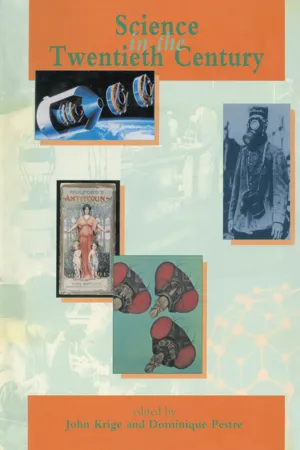
Science in the Twentieth Century
About this book
With over forty chapters, written by leading scholars, this comprehensive volume represents the best work in America, Europe, and Asia. Geographical diversity of the authors is reflected in the different perspectives devoted to the subject, and all major disciplinary developments are covered.
There are also sections concerning the countries that have made the most significant contributions, the relationship between science and industry, the importance of instrumentation, and the cultural influence of scientific modes of thought. Students and professionals will come to appreciate how, and why, science has developed - as with any other human activity, it is subject to the dynamics of society and politics.
CHAPTER 4
Science, Political Power and the State
Different social actors define the sciences differently. For some, they are systems of action which shape the material and social worlds; for others, they are systems of values which define ideals and norms; for others again, they are systems of representations underpinning positions of authority. In a high-energy laboratory like CERN, the physics practiced there is THE science. Seen as the leading edge of knowledge and understanding, it is defined as a system of propositions, describing the ultimate constituents of matter, which is confirmed or rebutted by experiments. For the director of an electronics company, science might be this system of statements, and he would certainly be willing to describe it as such at an official banquet, but it is above all a means to control and transform the material world, one means, amongst others, to impose an economic standard, to get around a law, to dominate a market, to beat his competitors, to make money — or to justify a new organization of work in his factory. For a graduate from the Ecole Polytechnique working for the French state at the beginning of this century, science was probably a general method, a tool for treating very different kinds of problems, social problems included. It was an approach which enabled him to find universal solutions which promoted ‘the public good’ that he often embodied, and which legitimized his claim to transcend particular interests that disrupted the perfectly managed society he dreamt of. Finally, for a qualified worker in a firm of the same period, science could, by the use of machines or the introduction of a new organization of the workplace, be a means of stripping him of his knowhow, undermining his social status, destroying his culture, subverting his autonomy and submitting his working day to a rhythm which he found odious.
In this chapter I want to focus on the practice of the sciences in their interaction with the political world and the state. The sciences I study are sites of power, they contribute to the management of the state and society. Be they civilian or military, articulated around ‘pure’ or industrial science, they are an integral part of large techno-polidcal systems.
A survey of the recent literature on the sciences in the twentieth century reveals four dominant trends. The first takes the sciences as systems of knowledge and tends to produce a history of major disciplinary developments, a history of ideas and concepts. Albeit essential, this will be of little concern in this chapter. The second approach considers the sciences and their associated techniques, as above all systems of practices. Accepting the intrinsic contextuality of scientific knowledge, it produces a history focused on the protocols and methods of proof, on the variety of the spaces of legitimation, but deals only marginally with the political apparatus. A third dominant tendency of contemporary historiography studies the science/technology/industry interface. It overlaps with industrial and business history, it is concerned with R&D and the modalities of innovation, but it intersects political questions primarily through public policy. More recently, the relations between science and the military have enjoyed a surge of interest, of which the central object has mainly been the post-1945 military/industrial/academic American complex.
Scientific relations with la politique are thus infrequently studied, and when they are, it is usually the national security aspect, or the management of the hard sciences for the benefit of national economies, that is of interest. The question of the relationships between science and the world of politics is far more wide-ranging however, and should include considerations on the nature of the scientific activity in its relationship to power for example, or on how science and scientific ideologies are used by the state to regulate the social. Since historical studies on these questions are few and far between, it appeared impossible for me to give a global overview of the issue here. Thus I propose a study in two parts. The first poses the question in its generality, but without giving a continuous historical narrative. The second focuses on a more delimited object: the relationship between the state and physicists and biologists throughout this century in Europe and the USA. Here the approach is more systematic.
SCIENCE AND POLITICAL POWER: SOME METHODOLOGICAL REMARKS
Scientific intellectuals and those who manage society at the political level, often have a rather similar image of the relations between science and the political system. It embodies the scientistic conception which has come to dominate Western societies for the last two to three centuries. It holds that science and the world of politics constitute two different, even antagonistic domains, two worlds with opposed logics and goals. Deeply rooted in social consciousness (in the sense that Louis Althusser gave to the expression: “spontaneous ideology of the savants”) this image is crucial to the smooth functioning of both groups. The world of science is said to be the world of Reason, a world which enables one to settle issues with certainty. The political world has a less straight-forward logic and relies mainly on consensus established between conflicting interests.
One corollary is the image of science as pure by nature but polluted or twisted by ‘material’ interests or reasons of state. This too has a long history and regained popularity after World War II, particularly among physicists who worked on the bomb (it found expression in Oppenheimer’s famous dictum that scientists had lost their innocence). It has contributed to posing the question in the very narrow mode of the personal ‘responsibility’ of the savant, the kind of ethical obligation which the scientist has (or does not have) in continuing research which he judges ‘potentially dangerous for society.’ That discourse rarely prevented physicists from working for the military however. A kind of ‘mental compartimentalization,’ to use Paul Forman’ expression, enabled them to keep both attitudes in parallel without too much disquiet.
This image is of course to be found outside scientific contexts where it offers both an ideal of purity and certainty. It locates the perversion outside Science, in the economic or social system for example, and provides a neat and simple way of separating Good from Evil. The positive and negative values can easily be inverted however, and many people outside the scientific sphere clearly situate science, associated with technology, on the side of Evil and the impure. Marginal among scientists and politicians, and without doubt amongst the majority of those who esteem intellectual activity, the Faustian image of science, the image of the sorcerer’s apprentice, of the pact with the devil, and of a science dangerous by nature, is rather commonplace among the remainder of the body politic.
Most of the time, science and the political world are then taken for granted and considered independent of one another. One way of better appreciating the pervasiveness of this image is to study the very extensive work done in the past forty years on the economics of technical change which postulates the separation between science, which is a public good freely available to all those who wish to appropriate it through publications, and the uses to which it is put, and which are informed by political, industrial or military logics. This split made it is easy for economists to conceptualize innovation and economic development and suggest how the independent variable that was science could be controlled and manipulated for other purposes. The problem is that knowledge is always deployed in very specific contexts. The characteristics of the spaces in which it is produced, whether it is a Bell laboratory, or an academic research center, profoundly determine its outlook. Unfortunately, as we know only too well, the effects of these beliefs on developing countries have been extremely painful throughout this century. Experience has proved rather quickly that science was only public in name and that it was just as costly to acquire as any other product or know-how.
I do not wish to deny the analytical value of separating the two notions of the Scientific and the Political, but this divide is at best a convenient tool and a first approximation. Science is always and already entangled with the state and political questions, and it always has been, and the question of power is always and already in the practice of science itself. For example, the Ecole Polytechnique in Paris was, from its creation at the end of the eighteenth century, an institution intrinsically linked to the state. It was, at the same time, the center of European science. Similarly, the Physikalische Technische Reichanstallt in Berlin was a response, almost a century later, to the needs of industry and the German state at a time of imperial expansion. This did not prevent it being, in the same move, one of the citadels of scientific achievement. By definition, I would say. More generally, scientific intellectuals have often been associated with weapon systems, as with the management of the state and of production. They have contributed, and still do, to the definition of technical norms: norms specifying quality (for medicines, fertilizers or the color of fabrics); norms defining levels of socially acceptable security (for machines or nuclear reactors); norms and standards of measurement (which are essential for the entire industrial sector). They participate in the evaluation of risks (for the state, but also for insurance companies), in the elaboration of legislation as well as in the definition of the enabling instrumentation and institutions. By nature one might conclude, since science is a social institution, it is immersed in the political system, it is linked to it by a thousand networks.
Symmetrically, the fact that power over nature is at the very core of the modern scientific enterprise, the fact that the manipulation of the material world is intrinsic to science itself, and that it is even one of its defining characteristics, has often been shown, by feminist studies for example, and there is no need for me to belabor the point and demonstrate why scientific achievements are of interest to other social actors. These remarks stressing the interconnectedness between modern science and the state must not mask two points however. Very important differences are to found from one epoch to another, and I have no intention of obliterating the periodization so essential to the historian. World War II and the Cold War, for example, are important turning points in the relationship between science and political power. Secondly, this organic and long-lasting link between science and political management must not blind us to what scientists themselves say. It is extremely important for them to perceive what they do as autonomous and to claim a large degree of freedom for their practices.
If one starts from the idea that the democratic state is the forum in which the compromises needed to perpetuate the social order are negotiated, its management implies that an image of neutrality vis-à-vis interest groups be constantly recreated by words, by gesture or by symbolic action. This image of the neutrality of the state is sustained in two ways. It is first demonstrated by the democratic nature of the appointments procedures. The major decisions of civil society are taken during elections, and this is the way major interests express themselves. Through complex rituals codified in constitutions, a solution becomes a majority opinion. This way of legitimating the state and its social neutrality is nevertheless constantly short-circuited by another which is based on ‘expert opinion,’ on the authority of science pronouncements, and not on the opinion of a majority. In that case, the state no longer speaks on behalf of the majority mediated through a vote, its legitimacy no longer rests on the democratic compromise emerging from the ballot box — it speaks and acts in the name of statements which are universal truths. There is no ‘choice of society’ anymore, no particular interests to transcend. There is only the one best way, inevitable, surely painful for those excluded from its benefits, but the only possible road for society to follow. At least that is what experts are frequently ready to claim, and what governments are ready to accept when the solutions fit with their objectives.
In the exact and social sciences, the strength of experts comes from the fact that they are able to manipulate techniques and artefacts, to invent material and symbolic technologies which stand for the ‘real world’ out there and which allow them to act. More importantly however, it is the very idea of expertise, the conviction that such an expertise does exist, which is crucial. Experts might systematically disagree on concrete questions, as is too obvious, but that is of secondary importance. What counts is the certainty that social and natural facts can be assessed authoritatively by science. Be it in the state apparatus, in court or in front of a panel investigating an industrial desastre...
Table of contents
- Cover
- Half Title
- Title Page
- Copyright Page
- Table of Contents
- List of Figures
- List of Tables
- List of Contributors
- Introduction
- Images of Science
- Science and the Social Fabric
- Interlude
- Research Dynamics
- Science and its Practices
- Regional and National Institutions
- Index
Trusted by 375,005 students
Access to over 1.5 million titles for a fair monthly price.
Study more efficiently using our study tools.
Frequently asked questions
Yes, you can cancel anytime from the Subscription tab in your account settings on the Perlego website. Your subscription will stay active until the end of your current billing period. Learn how to cancel your subscription
No, books cannot be downloaded as external files, such as PDFs, for use outside of Perlego. However, you can download books within the Perlego app for offline reading on mobile or tablet. Learn how to download books offline
Perlego offers two plans: Essential and Complete
- Essential is ideal for learners and professionals who enjoy exploring a wide range of subjects. Access the Essential Library with 800,000+ trusted titles and best-sellers across business, personal growth, and the humanities. Includes unlimited reading time and Standard Read Aloud voice.
- Complete: Perfect for advanced learners and researchers needing full, unrestricted access. Unlock 1.5M+ books across hundreds of subjects, including academic and specialized titles. The Complete Plan also includes advanced features like Premium Read Aloud and Research Assistant.
We are an online textbook subscription service, where you can get access to an entire online library for less than the price of a single book per month. With over 1.5 million books across 990+ topics, we’ve got you covered! Learn about our mission
Look out for the read-aloud symbol on your next book to see if you can listen to it. The read-aloud tool reads text aloud for you, highlighting the text as it is being read. You can pause it, speed it up and slow it down. Learn more about Read Aloud
Yes! You can use the Perlego app on both iOS and Android devices to read anytime, anywhere — even offline. Perfect for commutes or when you’re on the go.
Please note we cannot support devices running on iOS 13 and Android 7 or earlier. Learn more about using the app
Please note we cannot support devices running on iOS 13 and Android 7 or earlier. Learn more about using the app
Yes, you can access Science in the Twentieth Century by John Krige,Dominique Pestre in PDF and/or ePUB format, as well as other popular books in History & World History. We have over 1.5 million books available in our catalogue for you to explore.