- 450 pages
- English
- ePUB (mobile friendly)
- Available on iOS & Android
eBook - ePub
About this book
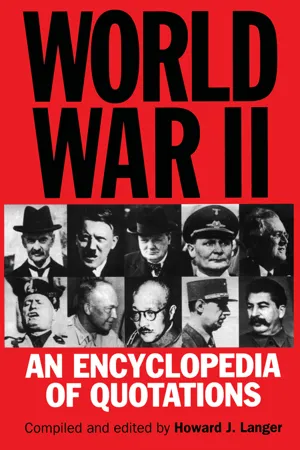
An all-encompassing book with more than a thousand quotations, this work breathes life into an era unprecedented in world history. It looks at World War II in a new way with quotations from speeches, news accounts, memoirs, and interviews. Represented, too, are captured documents and material from Ultra and Magic, which broke the German and Japanese secret codes. All major political and military figures of the war are included, as well as many hitherto unknown. In addition, the encyclopedia serves as a lexicon of slang, nicknames and code names, and of war movies and war songs.
1
The War Leaders
Winston Churchill
(1874-1965)
Winston Churchill was British prime minister during most of World War II—from the fall of France until just before the Japanese surrender. First Lord of the Admiralty during World War I, he was blamed for the failure of the Dardanelles campaign and was forced to resign. In the years between the wars, he warned against Hitler and fought attempts to appease him. In 1940, Churchill became prime minister amidst catastrophic defeats in northern France. He forged an alliance with President Roosevelt before Pearl Harbor, and his brilliant oratory kept British morale high during the worst days of the London Blitz. After the war in Europe ended, a Labor Party victory removed Churchill as prime minister.
1. Dictators ride to and fro upon tigers which they dare not dismount. And the tigers are getting hungry. (1936; from While England Slept, by Winston S. Churchill.)
2. The German dictator, instead of snatching the victuals from the table, has been content to have them served to him course by course. (Speech to House of Commons, October 5, 1938.)
[Following the Munich Agreement (q.v.) with Hitler.J
3. I find unendurable the sense of our country falling into the power, into the orbit and influence of Nazi Germany, and of our existence becoming dependent upon their good will or pleasure. (Debate in the House of Commons following the Munich conference, October 1938.)
4. We have passed an awful milestone in our history, when the whole equilibrium of Europe has been deranged, and that the terrible words have for the time being been pronounced against the Western Democracies: "Thou art weighed in the balance and found wanting." And do not suppose that this is the end. This is only the beginning of the reckoning. This is only the first sip, the first foretaste of a bitter cup which will be proffered to us year by year unless, by a supreme recovery of moral health and martial vigor, we arise again and take our stand for freedom as in the olden time. (Ibid.)
5. Disaster of the first magnitude has befallen Britain and France. We have sustained total and unmitigated defeat.... Czechoslovakia, left to herself, would have been able to get better terms than we have given her.... We have sustained a defeat without war. (Speech to the House of Commons, October 1938.)
[During a debate on Prime Minister Neville Chamberlain's (q.v.) appeasement policy, which turned over the Sudetenland to Hitler. The House of Commons approved the policy by a vote of 366 to 144.]
6. I cannot forecast to you the action of Russia. It is a riddle wrapped in a mystery inside an enigma. (Radio speech, October 1, 1939.)
[Following the carving up of Poland by Hitler and Stalin.]
7. I would say to the House, as I said to those who have joined this Government: I have nothing to offer but blood, toil, tears and sweat. (Address to Parliament upon becoming prime minister, May 13, 1940.)
8. You ask, what is our policy? I will say: It is to wage war, by sea, land, and air, with all our might and with all the strength that God can give us; to wage war against a monstrous tyranny, never surpassed in the dark, lamentable catalogue of human crime. (Ibid.)
9. You ask, what is our aim? I can answer in one word: It is victory, victory at all costs, victory in spite of all terror, victory, however long and hard the road may be, for without victory there is no survival. (Ibid.)
10. Behind this armored and mechanized onslaught came a number of German divisions in lorries, and behind them again there plodded comparatively slowly the dull brute mass of the German army and German people, always so ready to be led to the trampling down in other lands of liberties and comforts which they have never known in their own land. (Speech to the House of Commons, June 4, 1940.)
[Reporting on the Dunkirk Evacuation (q.v.) of May 27-June 4, 1940. Some 338,000 British, French, and Belgian troops were evacuated from the French beaches by nearly
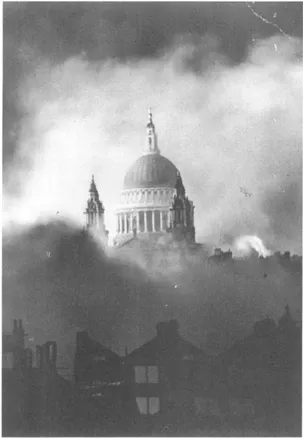
"I have nothing to offer but blood, toil, tears and sweat."
—WINSTON CHURCHILL
Smoke swirls around the dome of St. Paul's Cathedral during the London Blitz.
900 naval vessels, from warships to fishing trawlers and yachts. This was the culmination of a catastrophic defeat suffered by the Allies in northern France.]
11. When, a week ago today, I asked the House to fix this afternoon as the occasion for a statement, I feared it would be my hard lot to announce the greatest military disaster in our long history. I thought—and some good judges agreed with me—that perhaps 20,000 or 30,000 men might be re-embarked. But it certainly seemed that the whole of the French First Army and the whole of the British Expeditionary Force north of the Amiens-Abbeville gap would be broken up in the open field or else would have to capitulate for lack of food and ammunition. These were the hard and heavy tidings for which I called upon the House and nation to prepare themselves a week ago. The whole root and core and brain of the British Army, on which and around which we were to build, and are to build, the great British Armies in the later years of the war, seemed about to perish upon the field or to be led into an ignominious and starving captivity. (Ibid.)
12. [Our evacuation forces] had to operate upon the difficult coast, often in adverse weather, under an almost ceaseless hail of bombs and an increasing concentration of fire. Nor were the seas . . . themselves free from mines and torpedoes. (Ibid.)
13. Suddenly the scene has cleared, the crash and thunder has for the moment—but only for the moment—died away. A miracle of deliverance achieved by valor, by perseverance, by perfect discipline, by faultless service, by resource, by skill, by unconquerable fidelity, is manifest to us all. The enemy was hurled back by the retreating British and French troops. He was so roughly handled that he did not hurry their departure seriously. (Ibid.)
14. We must be very careful not to assign to this deliverance the attributes of a victory. Wars are not won by evacuations. (Ibid.)
15. I have . . . full confidence that if all do their duty, if nothing is neglected, and if the best arrangements are made, as they are being made, we shall prove ourselves once again able to defend our Island home, to ride out the storm for years, if necessary alone. (Ibid.)
16. Even though large tracts of Europe and many old and famous States have fallen or may fall into the grip of the Gestapo and all the odious apparatus of Nazi rule, we shall not flag or fail. (Ibid.)
17. We shall go on to the end, we shall fight in France, we shall fight on the seas and oceans, we shall fight with growing confidence and growing strength in the air, we shall defend our Island, whatever the cost may be, we shall fight on the beaches, we shall fight on the landing grounds, we shall fight in the fields and in the streets, we shall fight in the hills, we shall never surrender, and even if, which I do not for a moment believe, this Island or a large part of it were subjugated and starving, then our Empire beyond the seas, armed and guarded by the British Fleet, would carry on the struggle, until, in God's good time, the New World, with all its power and might, steps forth to the rescue and the liberation of the old. (Ibid.)
18. I urged the French Government to defend Paris. I emphasized the enormous absorbing power of the house-to-house defense of a great city upon an invading army.
I recalled to Marshal Petain [q.v.] [events of World War I] ... and how he, as I put it, not mentioning Marshal Foch, had restored the situation. I also reminded him how Clemenceau had said, "I will fight in front of Paris, in Paris, and behind Paris."
The Marshal replied very quietly and with dignity that in those days he had a mass of manpower of upwards of sixty divisions; now there was none. He mentioned that there were then sixty British divisions in the line. Making Paris into a ruin would not affect the final event. (Recalling events of June 11, 1940; from The Second World War: Their Finest Hour, by Winston S. Churchill.)
19. L'homme du destin. (Addressing General Charles de Gaulle [q.v.] following a meeting in which French officials indicated they were considering peace with Hitler, June 13, 1940; Ibid.)
20. Let us therefore brace ourselves to our duties, and to bear ourselves that, if the British Empire and its Commonwealth last for a thousand years, men will say: "This was their finest hour." (Speech to the House of Commons, June 18, 1940.)
[After France had asked for an armistice.]
21. The gratitude of every home in our Island, in our Empire, and indeed throughout the world, except in the abodes of the guilty, goes out to the British airmen, who, undaunted by odds, unwearied in their constant challenge and mortal danger, are turning the tide of world war by their prowess and by their devotion. (Tribute to the Royal Air Force, address to Parliament, August 10, 1940.)
22. Never in the field of human conflict was so much owed by so many to so few. (Ibid.)
23. All hearts go out to the fighter pilots, whose brilliant actions we see with our own eyes day after day, but we must never forget that all the time, night after night, month after month, our bomber squadrons travel far into Germany, find their targets in the darkness ... and their attacks, often under the heaviest fire, often with serious loss ... and inflict shattering blows upon the whole of the technical and war-making structure of the Nazi power. (Ibid.)
24. The need of American destroyers is more urgent than ever in view of the losses and the need of coping with the invasion threat as well as keeping the Atlantic approaches open and dealing with Italy. There is nothing that America can do at this moment that would be of greater help than to send 50 destroyers except sending 100. (Message to American officials, August 1940; cited in From the Morgenchau Diaries, by John Morton Blum.)
25. Our supreme effort must be to gain overwhelming mastery in the air. The fighters are our salvation, but the bombers alone provide the means to victory. (September 1940.)
26. We are waiting for the long-promised invasion. So are the fishes. (Radio speech, October 21, 1940.)
27. It seems now to be certain that the Government and people of the United States intend to supply us with all that is necessary for victory. In the last war the United States sent two million men across the Atlantic. But this is not a war of vast armies, firing immense masses of shells at one another. We do not need the gallant armies which are forming throughout the American Union. We do not need them this year, nor next year, nor any year that I can foresee. (Radio broadcast, February 9, 1941.)
28. I regard these developments [about appointment of Admiral Darlan (q.v.) as successor to Marshal Petain (q.v.)] with misgiving and distrust. We have received nothing but ill-treatment from Vichy. It would have been better to have had Laval [q.v.], from our point of view, than Darlan, who is a dangerous, bitter, ambitious man, without the odium which attaches to Laval. .. In the meantime an end should be put to the cold-shouldering of General De Gaulle [q.v.] and the Free French movement, who are the only people who have done anything for us, and to whom we have made very solemn engagements. The emphasis should be somewhat shifted. (Note to Foreign Office, February 27, 1941; from The Second World War: The Grand Alliance, by Winston S. Churchill.)
29. This man [Rudolf Hess (q.v.)], like other Nazi leaders, is potentially a war criminal, and he and his confederates may well be declared outlaws at the close of the war. (Memo to Foreign Secretary, May 13, 1941.)
[Following the flight of Rudolf Hess to Scotland. Hess, chief deputy to Adolf Hitler, attempted to make peace with England prior to the Nazi invasion of the Soviet Union.]
30. No one has been a more consistent opponent of Communism than I have for the last 25 years. I will unsay no word that I have spoken about it. But all this fades away before the spectacle which is now unfolding. (Radio address on the Nazi invasion of Russia, June 22, 1941.)
31. This bloodthirsty guttersnipe [Hitler] must launch his mechanized armies upon new fields of slaughter, pillage and devastation. Poor as are the Russian peasants, workmen and soldiers, he must steal from them their daily bread; he must devour their harvests; he must rob them of the oil which drives their ploughs, and thus produce a famine without example in human history. And even the carnage and ruin which his victory, should he gain it—he has not gained it yet—will bring upon the Russian people, will itself be only a stepping stone. (Ibid.)
32. It is not too much to say here this summer evening that the lives and happiness of a thousand million additional people are now menaced with brutal Nazi violence. (Ibid.)
33. We have to contemplate the descent from the air of perhaps a quarter million parachutists, glider-borne or crash-landed aeroplane troops. Everyone in uniform, and anyone else who likes, must fall upon these wherever they find them and attack them with the utmost alacrity—
"Let every one
Kill a Hun."
Kill a Hun."
(Memo to Secretary of State for War, June 29, 1941; from The Second World War: The Grand Alliance, by Winston S. Churchill.)
34. We will have no truce or parley with you [Hitler], or the grisly gang who work your wicked will. You do your worst—and we will do our best. (Speech, London, July 14, 1941.)
35. You will, perhaps, have noticed that the President of the United States and the British representativ...
Table of contents
- Cover
- Title
- Copyright
- Dedication
- Contents
- Acknowledgments
- Introduction
- Scope of This Book
- 1. The War Leaders
- 2. Military Officers
- 3. Government Officials
- 4. Diplomats
- 5. Warriors
- 6. Chaplains
- 7. Intelligence Officials and Spies
- 8. Scientists and Engineers
- 9. Journalists and Cartoonists
- 10. Historians and Biographers
- 11. Influential Personalities
- 12. Civilians
- 13. Institutional Quotations
- 14. Anonymous Quotations
- 15. War Movies
- 16. War Songs
- 17. War Lexicon
- 18. Miscellaneous Quotations
- Appendix: Quotations by Category
- Bibliography
- Name Index
- Subject Index
Trusted by 375,005 students
Access to over 1.5 million titles for a fair monthly price.
Study more efficiently using our study tools.
Frequently asked questions
Yes, you can cancel anytime from the Subscription tab in your account settings on the Perlego website. Your subscription will stay active until the end of your current billing period. Learn how to cancel your subscription
No, books cannot be downloaded as external files, such as PDFs, for use outside of Perlego. However, you can download books within the Perlego app for offline reading on mobile or tablet. Learn how to download books offline
Perlego offers two plans: Essential and Complete
- Essential is ideal for learners and professionals who enjoy exploring a wide range of subjects. Access the Essential Library with 800,000+ trusted titles and best-sellers across business, personal growth, and the humanities. Includes unlimited reading time and Standard Read Aloud voice.
- Complete: Perfect for advanced learners and researchers needing full, unrestricted access. Unlock 1.5M+ books across hundreds of subjects, including academic and specialized titles. The Complete Plan also includes advanced features like Premium Read Aloud and Research Assistant.
We are an online textbook subscription service, where you can get access to an entire online library for less than the price of a single book per month. With over 1.5 million books across 990+ topics, we’ve got you covered! Learn about our mission
Look out for the read-aloud symbol on your next book to see if you can listen to it. The read-aloud tool reads text aloud for you, highlighting the text as it is being read. You can pause it, speed it up and slow it down. Learn more about Read Aloud
Yes! You can use the Perlego app on both iOS and Android devices to read anytime, anywhere — even offline. Perfect for commutes or when you’re on the go.
Please note we cannot support devices running on iOS 13 and Android 7 or earlier. Learn more about using the app
Please note we cannot support devices running on iOS 13 and Android 7 or earlier. Learn more about using the app
Yes, you can access World War II by Howard J. Langer in PDF and/or ePUB format, as well as other popular books in History & World History. We have over 1.5 million books available in our catalogue for you to explore.