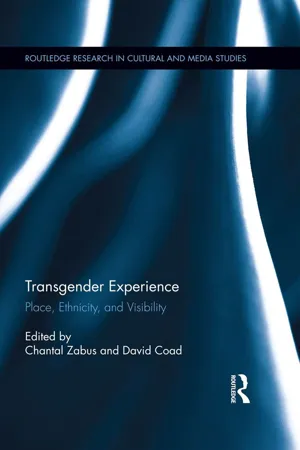
This collection by trans and non-trans academics and artists from the United States, the UK, and continental Europe, examines how transgenderism can be conceptualized in a literary, biographical, and autobiographical framework, with emphasis on place, ethnicity and visibility. The volume covers the 1950s to the present day and examines autobiographical accounts and films featuring gender transition. Chapters focus on various stages of transitioning. Interviews with trans people are also provided.
- 172 pages
- English
- ePUB (mobile friendly)
- Available on iOS & Android
eBook - ePub
About this book
Information
Place
1
On the History of Transsexuals in France
The exhibition Les amies de Place Blanche, which took place at the International Center of Photography (18 May–2 September, 2012), was the first exhibition of Christer Strömholm in the United States. It was also the opportunity to discover an illustration of the early history of transsexuals in France. The transsexual street hustlers photographed by Strömholm, living and working around Pigalle in the 1960s in Paris, showed evidence of a transgender subculture in the French capital. What kind of subculture was it, and in which respect was it specifically different from male homosexual prostitution?
In How Sex Changed, a history of transsexuality in the United States, Joanne Meyerowitz argues that what was happening in France was known across the ocean and had a stimulating impact on the lives of many U.S. MTF transsexuals:
In the United States and elsewhere, the press publicized the “sex changes” of the French travestis, especially Coccinelle and Bambi. Coccinelle, in particular, inspired dozens of magazine and newspaper stories that associated her with the world of celebrity. […] For American MTFs, the French example served as a draw. (188)
In this chapter I will draw on my book outlining the history of transsexuals in France and emphasize four characteristics of this history that are specific to France: Coccinelle’s stardom, which differs from Jorgensen’s fame, the birth of a transsexual community around the transgender cabaret subculture, the influential activism of Pastor Doucé in the 1980s, and the radical impact of GAT (Groupe Activiste Trans’) after 2000.
Founding Figure: Coccinelle
Thanks to her artistic talent and sense of scandal, Coccinelle (ladybug, in French), who started her career as a transvestite artist at Chez Madame Arthur in the late 1940s, became the most famous transsexual in France for at least 20 years at a time when Paris was the center of transgender cabaret, a burgeoning new phenomenon at the crossroads of medicine and show business. When Coccinelle convinced her father to sign a paper allowing her to work by night at Chez Madame Arthur, she was not, legally speaking, an adult yet. Her father thought it would be a good thing to make his son, then Jacques Dufresnoy, born in 1931, work as a waiter in a bar. He had no idea that this bar was actually a cabaret, founded by Marcel Oudjman in 1946, whose specialty was shows of female impersonators. Nor did he know that his son was already very much keen on performing on stage as one of these impersonators. What Coccinelle herself could not have imagined at the time, in spite of her skills and ambition, is that she would soon start a revolution at Chez Madame Arthur and then at the Carrousel, when she discovered hormones and the possibility of sex-change surgery.
How Coccinelle discovered hormones is the story of a happy coincidence. While on a train, Coccinelle met a woman who told her that she had also been a man. Because Coccinelle was more than skeptical about this statement, the woman took her to the bathroom in order to display the evidence of her male anatomy. Marie-André Schwindenhammer (1909–81), the woman who introduced Coccinelle to the use of hormones, founded AMAHO (Association des Malades Hormonaux) in 1965. This was the first official transsexual association in France. After learning about the use of hormones from Schwindenhammer, Coccinelle was thrilled to follow her example. Coccinelle was later approached by another young woman who told her about her meeting with Georges Burou and her sex-change surgery in Casablanca. In her memoirs, this is how Bambi (Marie-Pierre Pruvot) recalls Coccinelle:
While [Coccinelle] was on tour in Nice she met a small creature who was a little over five feet tall, a young girl who seemed to be under eighteen. She introduced herself to Coccinelle and said: “I am like you,” which could only mean one thing. Two years later, she saw her again and told her about her amazing story. She had been given the opportunity to meet Dr. Burou, an obstetrician who ran a maternity clinic. She confided in him and begged him to do something. This man was talented. He was a brave and good man. His surgery ended up being successful. I do not know whether Coccinelle knew more than that. She simply saw what she wanted to believe and did not miss her own opportunity. Faithful to her strategy, she kept it secret and what Dr. Claoué was not able to do for fear of prosecution was done in Morocco. (187)
As these two encounters show, Coccinelle requested the help of science for the purpose of her transformation from a male transvestite into an MTF transsexual.
Until the 1940s, male artists working as female impersonators identified as men, came to work dressed as men, and clearly separated their cross-dressing as part of their work from their mainstream gender role outside of their artistic performances. They were considered transformistes onstage, just like the mime and athlete Barbette who had delighted Jean Cocteau, Man Ray, and many others during the années folles in Paris in the 1920s and 1930s. Private life was not supposed to influence the transgender aspect of their performances. Coccinelle, however, embraced the confusion between her career onstage and her private life. She was praised as a brilliant impersonator of feminine icons such as Marilyn Monroe and Brigitte Bardot. Her impersonations were not just a performance; they were above all an identity. Unlike her male colleagues, Coccinelle would come to work already dressed as a woman. The reality of her female identity was so convincing that she was accused of concurrence déloyale (being unfair). After starting to take hormones, she did not need false breasts to provide her audience with evidence of feminine beauty.
Coccinelle was praised for her voice, her dancing, and her charismatic presence. She was delightfully audacious. She knew how to turn people’s curiosity into a source of wonder and jealousy. At the climax of her career, while giving a series of concerts at the famous Olympia concert hall in Paris, she did not have to impersonate anyone but herself. In one of her songs, especially written for her, Cherchez la femme, Coccinelle presents herself as the living proof of a convincing feminine gender without denying her odyssey as a transsexual woman. Even if she was able to pass as a biological woman, she was never tempted to hide her past and be ashamed of her transition.
When most of her peers were dreaming of becoming average housewives, but were afraid of the consequences of taking hormones and going through a vaginoplasty, Coccinelle did not pay any attention to rumors about contracting cancer or becoming crippled after the operation. Instead, she jumped on the plane, flew to Morocco (at the time, castration was forbidden in France, and sex surgery was unthinkable in French hospitals), and asked Dr. Burou to repeat with her the miracle that he had already performed on a few men before her. Faced with such a stubborn client, Dr. Burou was more than happy to confirm his skills as the best surgeon for vaginoplasty.
Extremely proud and happy with her new body, it did not take Coccinelle very long, once she was back in Paris, to show her transformed body to all of her friends. This triggered the beginning of a growing transhumance from Paris to Casablanca. During the next 20 years, Dr. Burou welcomed many artists who were working for Monsieur Marcel (Marcel Oudjman’s nickname). They all aspired to become rising stars of the Carrousel. Because the French authorities did not know much about transsexuality and did not take it seriously at first, they would not pass a law banning the sale of hormones that would create a space for legal experimentation among trans-sexual pioneers. Coccinelle was given the right not to do her military service, a mandatory obligation at the time for all French male citizens. She also received new identity papers that gave her legal recognition as a woman. At this point, nothing could prevent her from finding a husband.
The first civil and religious marriage of Coccinelle caught the attention of many newspapers in 1962, provoking a scandal. One of the consequences of the scandal was that the French authorities stopped delivering new identity papers for MTF transsexuals who had been operated on. In the year following her marriage, Coccinelle published her first autobiography, Coccinelle est lui, written with the journalist Mario Costa. This autobiography gives an account of Coccinelle’s flamboyant career. It shows her poor social background and makes a reference to her first job as a hairdresser in a Parisian salon, a job she had to leave because her father thought it would turn his son into an effeminate boy. The autobiography also contains a series of intimate photographs, which show Coccinelle in the nude.
Glamour, Competition, Sociability: Building a Transsexual Community
After leaving Monsieur Marcel’s cabarets to find a role in movies such as Europa di notte (1959), or Interpol attaque (1964), Coccinelle went on tour in Spain and all over Latin America. During this time, however, she kept in touch with many of her admiring friends who each had their own moments of stardom, thus making Paris the capital of a transgender cabaret subculture. This subculture was organized around Chez Madame Arthur, rue des Martyrs, which was located close to Pigalle, and at the Carrousel, opened in 1947 by Monsieur Marcel in the chic rue du Colisée close to the presidential Palais de l’Elysée. Although Monsieur Marcel, an Algerian-born Jewish Frenchman who had survived the anti-Semitic collaboration during World War II under the Vichy regime, was not officially married to Madame Germaine, they lived together as a married couple. Madame Germaine was also his business partner, specifically in charge of Chez Madame Arthur, where artists started working. Some artists hoped to be selected to perform at the Carrousel, whose clients were wealthy celebrities such as Salvador Dalì, Marlene Dietrich, Maria Callas, and Josephine Baker. Taking her cue from R. E. L. Masters, Meyerowitz makes it clear in How Sex Changed that in the 1950s the fame of the Carrousel and its artists was not just a Parisian phenomenon. Instead, it was one of the emergent transsexual communities in Europe and America and a major reference point in terms of visibility and glory for successful MTF transsexuals:
The world of female impersonators had its own hierarchy. At the upper rungs, performers at Le Carrousel or Madame Arthur’s in Paris, at Club 82 in New York, at Finocchio’s in San Francisco […] Lower on the ladder, some professional female impersonators worked in lesser known urban nightclubs. (qtd. in Meyerowitz 324)
Coccinelle, whose autobiography was published in English in 1962 under the title Reverse Sex (Costa), was the ambassador of transgender cabaret. Many Anglo-Saxon transsexuals, including future tennis woman Renée Richards or artists such as April Ashley and Sonne Teal, wanted to discover, as Coccinelle had done, a place where transsexuals could be praised as artists and achieve stardom. As April Ashley was taking a holiday on the Riviera, this is how, as she recalls in her memoirs, she was advised to go to Paris and work at the Carrousel:
Being a freak has its compensations on the Côte d’Azur. In singlet and Audrey Hepburn hair I walked out of the pension, down to the Eden Plage, and into a crowd of faces from London. Eric Lindsay and Ray Jackson, who ran the Heaven and Hell Coffee Bar next to the Two Eyes, were among them.
“Why don’t you go to Le Carrousel?”
“Le Carrousel?”
“The most famous nightclub in the world for female and male impersonators. They’d love you. We’re driving to Paris; we’ll give you a lift.” (49)
A few days later, April Ashley started working at the Carrousel. If the whole world could not go to the Carrousel, the artists working for Monsieur Marcel would go on concert tour at least once a year to some exotic, faraway destination such as Algeria, Israel, Senegal, Japan, or Australia. The future diva Bambi, for instance, who was born and raised in colonial Algeria, discovered for the first time the possibility of transsexuality when she heard of Coccinelle coming to Algeria for a show at La Corniche:
This is when the unexpected event that I had been waiting for and that ended up changing my destiny happened: the casino La Corniche was organizing a show with the Carrousel from Paris. The regular clients of the Beau Rivage would not stop giggling as they talked about sissies cross-dressing. […] I would have given everything to attend this show. (Pruvot 75)
Beyond the question of fame, places such as the Carrousel and Chez Madame Arthur played a crucial role in the creation of a transsexual community. Rivalry between artists may have been intense, but in the dressing room (les loges) there was a lot of constructive socializing between the stars, the debutantes, and those in between. Tips were exchanged concerning the art of being a beautiful woman. Useful contacts and addresses were traded for wigs, sequins, electric waxing, surgeons, and other helpful contacts. Information did not only circulate about hormones, clothing, and medical services. As well, a sense of community was built up around shared values and emotions the artists felt in common. For example, a joke was passed on about the operation in Casablanca: “Allo Casa? Ne coupez pas!” (The latter means “hold on” on the telephone; it can also mean “don’t cut it”). After the crash of a plane in Japan in which five transsexual artists on tour lost their lives, pictures of the victims were pinned up on the walls of the dressing room. This interaction was extremely valuable, given the fact that many MTF transsexuals could not find a daytime job or could not become famous in the cabaret and had to work as prostitutes, thereby encouraging police harassment. Some of these transsexual hustlers have been immortalized by Strömholm in his album Les amies de Place Blanche. The transgender cabaret subculture thus gave a space for encounters and exchanges between transsexuals from various backgrounds and nationalities. They discovered that after so many years of loneliness, they could confide in a small community in the making. By the beginning of the 1960s, when swinging London became the place to be in Europe, the transgender cabaret culture started losing its fame, and transsexuals expressed themselves in other ways. Two such cases are FTM athletes Léon Caurla and Pierre Brésolles. The cabaret scene suddenly appeared to be too much of a limited sphere to reflect the diversity of profiles and questions attached to transsexuality.
Pastor Joseph Doucé
Apart from Coccinelle, another important, atypical person who played a crucial role in the history of transsexuals in France is Pastor Joseph Doucé (1945–1990). Raised in a Belgian Catholic family, he studied sexology at the University of Amsterdam and founded a church known as the Centre du Christ Libérateur (Centre of the Liberating Christ) in Paris in 1976. Doucé was a Protestant pastor who had left the Catholic Church to become a Baptist. He was very interested in the study of gender and sexuality. He believed that his mission was to love, support, and understand what he called sexual minorities: homosexuals, sadomasochists, pedophiles, and transsexuals. Doucé lived openly as a gay man. Helped by his partner, Doucé had as one of his goals to establish a constructive dialogue between an interpretation of the scriptures and the understanding of human sexualities. He was marginalized among his religious peers. In 1990 he was murdered under circumstances that still remain unclear.
Pastor Doucé became very committed to the promotion of transsexual rights and to raising awareness about transsexuality. His biographer, Bernard Violet, reports that the Centre du Christ Libérateur hosted regular meetings over the years, which welcomed about 500 transsexuals to discuss their problems, find support, and sometimes engage in activism. Interviewed by Violet, Professor Louis Gooren, a specialist in transsexualism in Amsterdam, remembers his meeting with Pastor Doucé:
We met when he launched his transsexual association in Paris. We would meet about twice a year. At first, there were few specialists in France: only one in Bordeaux. Overall, he must have sent me about twenty trans-sexual candidates that I would operate on once they had been psychologically prepared. Joseph was in charge of this preparation that took about one year. (Violet 56)
Because AMAHO, the first association in favor of transsexuals, had lost its president, Marie-André Schwindenhammer, in 1981, Joseph Doucé provided a new place for transsexuals to gather, exchange ideas and contacts, and fight for respect and change in France. When the socialist candidate François Mitterrand was elected president of France in 1981, he wanted to be considered as a gay-friendly and profeminist politi...
Table of contents
- Cover Page
- Half Title page
- Series page
- Title Page
- Copyright Page
- Contents
- Figures
- Acknowledgments
- Introduction
- Part I Place
- Part II Ethnicity
- Part III Visibility
- List of Contributors
- Index
Trusted by 375,005 students
Access to over 1.5 million titles for a fair monthly price.
Study more efficiently using our study tools.
Frequently asked questions
Yes, you can cancel anytime from the Subscription tab in your account settings on the Perlego website. Your subscription will stay active until the end of your current billing period. Learn how to cancel your subscription
No, books cannot be downloaded as external files, such as PDFs, for use outside of Perlego. However, you can download books within the Perlego app for offline reading on mobile or tablet. Learn how to download books offline
Perlego offers two plans: Essential and Complete
- Essential is ideal for learners and professionals who enjoy exploring a wide range of subjects. Access the Essential Library with 800,000+ trusted titles and best-sellers across business, personal growth, and the humanities. Includes unlimited reading time and Standard Read Aloud voice.
- Complete: Perfect for advanced learners and researchers needing full, unrestricted access. Unlock 1.5M+ books across hundreds of subjects, including academic and specialized titles. The Complete Plan also includes advanced features like Premium Read Aloud and Research Assistant.
We are an online textbook subscription service, where you can get access to an entire online library for less than the price of a single book per month. With over 1.5 million books across 990+ topics, we’ve got you covered! Learn about our mission
Look out for the read-aloud symbol on your next book to see if you can listen to it. The read-aloud tool reads text aloud for you, highlighting the text as it is being read. You can pause it, speed it up and slow it down. Learn more about Read Aloud
Yes! You can use the Perlego app on both iOS and Android devices to read anytime, anywhere — even offline. Perfect for commutes or when you’re on the go.
Please note we cannot support devices running on iOS 13 and Android 7 or earlier. Learn more about using the app
Please note we cannot support devices running on iOS 13 and Android 7 or earlier. Learn more about using the app
Yes, you can access Transgender Experience by Chantal Zabus,David Coad in PDF and/or ePUB format, as well as other popular books in Social Sciences & Artist Biographies. We have over 1.5 million books available in our catalogue for you to explore.