There are over thirty million disabled people in Russia and Eastern Europe, yet their voices are rarely heard in scholarly studies of life and well-being in the region. This book brings together new research by internationally recognised local and non-native scholars in a range of countries in Eastern Europe and the former Soviet Union. It covers, historically, the origins of legacies that continue to affect well-being and policy in the region today. Discussions of disability in culture and society highlight the broader conditions in which disabled people must build their identities and well-being whilst in-depth biographical profiles outline what living with disabilities in the region is like. Chapters on policy interventions, including international influences, examine recent reforms and the difficulties of implementing inclusive, community-based care. The book will be of interest both to regional specialists, for whom well-being, equality and human rights are crucial concerns, and to scholars of disability and social policy internationally.
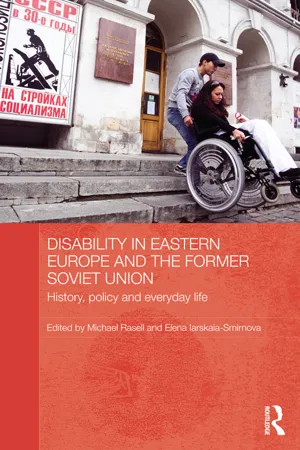
eBook - ePub
Disability in Eastern Europe and the Former Soviet Union
History, policy and everyday life
- 288 pages
- English
- ePUB (mobile friendly)
- Available on iOS & Android
eBook - ePub
Disability in Eastern Europe and the Former Soviet Union
History, policy and everyday life
About this book
Information
1
Conceptualising disability in Eastern Europe and the former Soviet Union
The topic of disability in Eastern Europe and the former Soviet Union commonly evokes a range of depressing images from abandoned children in dilapidated orphanages to military veterans in uniform begging on street corners. More positive associations are far less frequent, whether disability activism, inclusive kindergartens or disability-themed film festivals. The ‘micro worlds’ of disabled people–their home lives, daily routines, family and friends–are similarly unknown to both scholars and large parts of society in the region. This collection of recent research explores how disabled people in postsocialist countries live in a context of weak safety nets, unstable polities and ambivalent civil society development that make it difficult to overcome historical legacies of control, segregation and stigma. Studying disabled people’s lives provides insights into the contested conceptions of citizenship, health, diversity and well-being circulating in policy circles and society in an area of the world that has undergone significant transformation in the past 20 years.
This introduction and the overall book are addressed to scholars of the postsocialist region, researchers within the field of disability studies as well as practitioners and activists wishing to learn about disability outside Western Europe and North America. For all readers, this volume echoes calls for greater consideration of the local specificities shaping disabled people’s lives, particularly in non-Western contexts (e.g. Ingstad and Whyte 2007; Meekosha 2011). Bringing together researchers from a range of humanities and social sciences, the collection provides a dedicated chronicle of the political, social and cultural dynamics affecting physically and mentally disabled people in Eastern Europe and the former Soviet Union. The research emphasizes the heterogeneity of societies in the region–including within disabled populations–by investigating the experiences of ‘actually lived socialism’ and ‘actually lived transition’ from the standpoint of bodies and minds that do not fit with dominant norms and ideals in society.
In this opening chapter, we seek to contextualize the study of disability in Eastern Europe, Russia and the countries of the former Soviet Union. We outline the importance of disability perspectives to research on the region and also discuss how engagement with postsocialist specifics can enrich disability studies in empirical and theoretical terms. We make two inter-related arguments while tracing the evolving field of Eastern European disability studies. Firstly, disability discrimination in the region cannot be reduced solely to the state socialist past or to events since 1991. Instead, developments should be seen in the wider context of modernity’s hostility to disability as well as the distinctive combination of economic hardship, social upheaval and limited international influences that characterizes postsocialism. Although certain scholars–including some authors contributing to this book–view the state socialist past as the major source of problems facing disabled people, a more nuanced view in some other chapters highlights the negative dynamics of the neoliberal transition and political authoritarianism in terms of impeding equal rights. Recent developments in disabled people’s lives and broader socio-political struggles are thus not necessarily a simple story of overcoming socialist legacies. This relates to our second point that there was no single experience or model of disability during state socialism or the transformations since the late 1980s. Whilst there were certainly similarities between Soviet bloc countries, especially in terms of state welfare structures, individual and local factors also affected the lived experience of disability. Indeed, much of the research in the book shows how different forms of agency have always subverted official practices and continue to shape disabled people’s lives and strategies today.
Disability as a lens for understanding Eastern Europe
The topic of disability has been only patchily covered in scholarly work on Eastern Europe and the former Soviet Union even though United Nations’ estimates suggest that 7 to 10 per cent of any country’s population will be disabled. Local and overseas scholars frequently apply the analytical lenses of gender, nationality and ethnicity in their research on the region, but disability has rarely been considered despite the insights it can shed on social and political dynamics. Indeed, disability as both a substantive topic and a framework for scholarly analysis represents difference, dissent and a challenge to mainstream norms by focusing on experiences and perspectives that have historically been marginalized in society and academia.
The usefulness of a disability perspective for advancing understanding of Eastern Europe, indeed any region, becomes clear when the term ‘disability’ is understood as a complex social and cultural construction. The authors in this book all subscribe to an understanding of disability as the interaction between individual physiology or psychology and broader conditions in society. Rather than reducing disability to an inherent feature of bodies and minds, the analyses reveal how broader attitudes, conditions and practices in society stigmatize people whose bodily forms or cognitive patterns do not match an illusory norm or standard. Factors such as the built environment, legislative provision and attitudes of pity and shame delineate people as ‘disabled’ with frequently negative connotations. Studying societal reactions to disability can therefore shed light on the development of local politics, culture and treatment of otherness.
It is very important to highlight that placing emphasis on the externally constructed nature of disability is not to deny that pain, discomfort and emotional unease can inform the experience of living with disability (cf. Thomas 2007). The phenomenon of ‘disability’ encapsulates physiological and psychological experiences of impairment as well as society’s reactions to them. At the same time, focusing on societal discrimination does not mean that people with disabilities or their peers, relatives and supporters lack agency to challenge negative conditions and practices. The effort and resourcefulness of many disabled Eastern Europeans to challenge barriers comes out in a range of chapters. Yet, it would be unrealistic and patronising to offer ‘heroic’ depictions of disabled people (cf. Smart 2001); instead, we can suggest that individual agency is exerted whilst being embroiled within political and social structures that may undermine well-being.
In advancing a conceptualisation of disability that is both embodied and relational, this book challenges the ‘medical’ model of disability that often dominates societal and professional discourses in Eastern Europe and the former Soviet Union. Disability scholars have carefully traced how conventional medicine has historically operated with an image of a presumed ‘normal’ body and therefore conflated impairment–a disruption in physiology or functioning–with disability (Stiker 1999; Morris 2000). The upshot is a policy approach to disability based around ‘rehabilitation’, ‘treatment’ and attempts to achieve a supposedly ‘normal’ body. As discussed in several chapters in this book, the intensely normative and often unsympathetic undertones of this ‘deficit approach’ can be seen in the name of the Soviet rehabilitation paradigm–defectology–that was implemented to differing degrees across socialist Europe.
Given its roots in societal and cultural practices, disability is a highly useful frame for interrogating how societies relate to and ‘manage’ alterity and otherness. Whether unease arises over the aesthetics of disability (Hughes 1999; Schweik 2009) or the fact of human frailty and vulnerability (Shildrick 2005), disability has frequently been something that societies have sought to condemn, neglect and expunge. This makes it unfortunate that the topic has been largely neglected in research on Eastern Europe by local and foreign scholars. Sarah Phillips (2009) has called for a ‘disability history’ of state socialism and her agenda can be extended to more contemporary analyses. Consideration of disability can contribute to scholarly understanding of such varied topics as nongovernmental activities, international influences on policy reform, secret police machinations or styles of visual culture. As an interdisciplinary and cross-cutting theme, the applicability of disability perspectives extends across a wide range of disciplines, including history, sociology, cultural studies, political science and more applied professional subjects.
Whilst advocating for a disability perspective within research on Eastern Europe, this book does not offer a monolithic understanding of disability as something that dominates life experiences, identity or self-identity. Many of the articles instead implicitly or explicitly advocate an ‘intersectional’ approach that looks at the overlap of multiple markers of difference and identity. Although there is a distinct tendency for policy and society in the region to reduce disabled people to their impairment and thereby degender and desexualize them (Iarskaia-Smirnova 2011), disability is shaped by various social differences and stages of the life course (cf. Priestley 2001). It is therefore important to challenge assumptions that disabled people have broadly similar lives and face common issues. This misleading construction of ‘disabled people’ as a homogenous group reflects the trend of modernist politics to divide society into ‘normal’ and ‘abnormal’ sections, thus erasing all other social differences. Beyond the point that impairments vary, it should be recognized that gender, sexuality, class, wealth, location, education, religious faith and further contextual factors all shape the lived experience of disability. Official discourses and political priorities are important here because they strongly influence the position and stratification of disabled citizens. For example, state socialist governments were materially and rhetorically more supportive of disabled people in employment or who had become disabled during military service. Welfare systems differentiated such groups of ‘deserving’ disabled people from those regarded as ‘dependent’, less worthy or politically suspicious, for example people with chronic health issues or ones associated with such discredited organisations as tsarism or organized religion. The lens of disability can thus highlight the complexity of populations and the effects of political, cultural and economic developments, including the involvement of welfare states in creating inequalities and determining the entitlements of ‘good’ and ‘bad’ citizens.
In presenting a collection of disability research on a particular region, we have inevitably faced the challenge of delineating its meaningful and relevant borders. Whereas many area scholars spoke of ‘post-Soviet’ and ‘postsocialist’ during the 1990s, questions over the usefulness of such broad monikers are growing (e.g. Buckler 2009). For one, the countries of Eastern Europe and the former Soviet Union were never completely similar during socialist rule, not least in terms of welfare provision (Lal 1991). The transformations since 1991 have also been diverse: Central-Eastern European countries have largely stabilized their economies and democracies whilst reorienting to the European Union, but the Balkan countries experienced protracted conflict and political strife and much of the CIS has become politically authoritarian with high levels of deprivation. Wide differences exist between the republics of the former Soviet Union as well as among Eastern European countries, meaning that there are multiple disability histories in the region. A final issue is that certain trends in the region reflect global dynamics beyond (post) socialism, for example neoliberal retrenchment and discourses about human rights. Social stigma, medicalized treatment regimes and the inaccessibility of the built environment are issues facing disabled people across the world, meaning that researchers should not treat Eastern Europe and the former Soviet Union as completely unique.
In the case of disability research, commonalities from the state socialist period and similar trajectories of recent disability politics agitate for a broad regional sweep that includes the ex-USSR, the former Soviet bloc countries as well as Yugoslavia. Within the constraints of available research, the book thus encompasses Central and Eastern European members of the European Union, the Balkans, Russia and the western CIS, the Caucasus and Central Asia. Yet, the compilation of research on the ‘postsocialist’ region does not necessarily mean there are identical legacies from the state socialist period. Instead, we emphasize that the countries surveyed in this book do not have a single model of disability either historically or nowadays. Recent influences–for example neoliberal welfare policies and ideas of social inclusion–have thus become entwined with socialist-era programmes, institutions and attitudes in ways that are particular to each individual country. The proverbial slate was not wiped clean by the political, social and economic rearrangements associated with the end of state socialism. Instead, elements of former practices and systems around disabled people are being reconfigured with newer influences within countries and from abroad. It is thus more appropriate to speak of ‘recombinations’ of the remains of the old order rather than path dependency or direct legacies of state socialism (cf. Stark and Bruszt 1998). Occasionally there are even abrupt breaks with tradition, for example the abolition of special schools in Armenia or deinstitutionalisation processes in many countries. Unravelling the reasons for the continuities and disjunctures in the lived experience of disability can illuminate wider political and social dynamics in this fast-changing region. This collection therefore seeks to expose diverse aspects of disability in Eastern Europe and the former Soviet Union rather than offer a meta-analysis or systematic comparison of ‘postsocialist disability’ that would over-generalize and over-simplify a complex set of dynamics.
Disability, modernity and postsocialism
The chapters in this book interrogate the various ideas about health, aesthetics and the body that circulate in Eastern European political and social discourses. Physiological prowess was a powerful theme promoted by state socialist regimes. Whether heroic labourers, medal-winning sportspeople or victorious soldiers, there was an official championing and near fetishisation of bodily strength, functioning and ability. Such messages were striking both in their own right and for whom they marginalized in official realms of politics, culture and society. Yet, it is very important to recognize that the origins of disability discrimination are not to be found exclusively in the state socialist past. They are rooted more broadly in the precepts of modernism that accompanied industrialisation across Europe, North America and later in other parts of the world (Hughes 1999; Morris 2000).
In many ways, state socialism represented a triumph of modernism in terms of standardisation, urbanisation, mass production and rationalist social planning. The rise of cities, science and industries led to the commoditisation of the human body in both capitalist and socialist countries, during which people were increasingly classified and valued according to their labour contribution (Hughes 2002). Modernity’s demand for standardized units of (manual) labour meant that disability and other possible impediments to work were increasingly equated with deviation that needed to be regulated through reproduction, fertility, public health and other demographic policies. By propagating strict and homogeneous notions of the body and mind, there could be little tolerance or acceptance of impairment.
As highlighted by Michel Foucault (2003), state medical and welfare institutions from the late eighteenth century onwards formed part of a broader system of ‘biopower’ that sought to control and manipulate physiology and public health. Welfare institutions and discourses were sites for the exercise of authority and knowledge over bodies that ‘produce and maintain the ways we think about human normality and abnormality, and that mold the lives and the very selves of those caught up in them: disabled people, their nondisabled friends and loved ones, support workers, advocates, and so on’ (McWhorter 2005: xiii). For example, rehabilitation policies aimed to ‘restore’ lost ability whilst ideas about disability being an individual and largely medical problem dominated official discourses to the extent that people unable to demonstrate productivity were often consigned to large and isolated residential homes.
Although memoirs and fictional works reveal that some disabled people in state socialist countries were included in local life (e.g. Kochergin 2007), official policies sought to separate them from mainstream society. Institutionalisation domin...
Table of contents
- Cover
- Half Title
- Title Page
- Copyright Page
- Table of Contents
- List of figures and tables
- Notes on contributors
- Acknowledgements
- 1. Conceptualising disability in Eastern Europe and the former Soviet Union
- 2. Soviet-style welfare: the disabled soldiers of the ‘Great Patriotic War’
- 3. Prosthetic promise and Potemkin limbs in late-Stalinist Russia
- 4. Heroes and spongers: the iconography of disability in Soviet posters and film
- 5. Between disabling disorders and mundane nervousness: representations of psychiatric patients and their distress in Soviet and post-Soviet Latvia
- 6. Living with a disability in Hungary: reconstructing the narratives of disabled students
- 7. Breaking the silence: disability and sexuality in contemporary Bulgaria
- 8. Citizens or ‘dead souls’?: an anthropological perspective on disability and citizenship in post-Soviet Ukraine
- 9. Those who do not work shall not eat!: a comparative perspective on the ideology of work within Eastern European disability discourses
- 10. The challenges of operationalizing a human rights approach to disability in Central Asia
- 11. The complex role of non-governmental organizations in advancing the inclusion of children with disabilities in Bosnia-Herzegovina and Bulgaria
- 12. Lost in transition: missed opportunities for reforming disabled children’s education in Armenia, Azerbaijan and Georgia
- Index
Trusted by 375,005 students
Access to over 1.5 million titles for a fair monthly price.
Study more efficiently using our study tools.
Frequently asked questions
Yes, you can cancel anytime from the Subscription tab in your account settings on the Perlego website. Your subscription will stay active until the end of your current billing period. Learn how to cancel your subscription
No, books cannot be downloaded as external files, such as PDFs, for use outside of Perlego. However, you can download books within the Perlego app for offline reading on mobile or tablet. Learn how to download books offline
Perlego offers two plans: Essential and Complete
- Essential is ideal for learners and professionals who enjoy exploring a wide range of subjects. Access the Essential Library with 800,000+ trusted titles and best-sellers across business, personal growth, and the humanities. Includes unlimited reading time and Standard Read Aloud voice.
- Complete: Perfect for advanced learners and researchers needing full, unrestricted access. Unlock 1.5M+ books across hundreds of subjects, including academic and specialized titles. The Complete Plan also includes advanced features like Premium Read Aloud and Research Assistant.
We are an online textbook subscription service, where you can get access to an entire online library for less than the price of a single book per month. With over 1.5 million books across 990+ topics, we’ve got you covered! Learn about our mission
Look out for the read-aloud symbol on your next book to see if you can listen to it. The read-aloud tool reads text aloud for you, highlighting the text as it is being read. You can pause it, speed it up and slow it down. Learn more about Read Aloud
Yes! You can use the Perlego app on both iOS and Android devices to read anytime, anywhere — even offline. Perfect for commutes or when you’re on the go.
Please note we cannot support devices running on iOS 13 and Android 7 or earlier. Learn more about using the app
Please note we cannot support devices running on iOS 13 and Android 7 or earlier. Learn more about using the app
Yes, you can access Disability in Eastern Europe and the Former Soviet Union by Michael Rasell, Elena Iarskaia-Smirnova, Michael Rasell,Elena Iarskaia-Smirnova in PDF and/or ePUB format, as well as other popular books in Social Sciences & Ethnic Studies. We have over 1.5 million books available in our catalogue for you to explore.