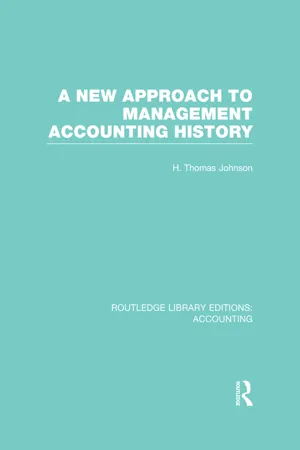
The articles and papers reprinted in this volume, all written after 1970, represent a departure from the earlier conventional notion of accounting history research. They approach the study of management accounting history by regarding the accounting and business records of actual organizations as indispensable source materials for historical analysis. Analysis of these records has yielded a new conception of management accounting. These studies suggest that the forces contributing to management accounting's development are more numerous and complex than historians had realized. The case studies in the first part of the book trace the historical development of virtually all the internal accounting practices associated today with management accounting. Those in the second section consist of articles which interpret the case material.
- 162 pages
- English
- ePUB (mobile friendly)
- Available on iOS & Android
eBook - ePub
A New Approach to Management Accounting History (RLE Accounting)
The Role of Accounting History in the Study of Modern Business Enterprise
IT is a truism to observe that one major objective of accounting history is a “better understanding of economic . . . history” (American Accounting Association, 1970, p. 53). Works by accounting historians have long been acknowledged as indispensable to the investigations of economic historians studying Europe and North America from the medieval era to approximately 1850. Indeed, accounting historians and economic historians concentrating upon these early periods often consult the same research materials and ask questions strikingly similar in nature.
This intimate relationship seldom obtains, however, when accounting and economic historians examine the modern age. Economic historians assessing developments from 1850 to the present rarely weigh the findings of accounting historians. Certainly one explanation of the economic historian’s indifference to modern accounting history is the increasing sophistication of accounting practices. Only highly trained accounting historians are able to deal with these practices gracefully and perceptively. Although economic historians are capable of recognizing and discussing elementary accounting principles common before the nineteenth century, they are seldom familiar with those complex accounting techniques current since the late 1800’s. The work of the economic historian studying the modern era usually ignores, then, the issues and conclusions which would naturally occur to the accounting historian concentrating upon modern history. At times the two fields appear to be as unrelated as C. P. Snow’s two cultures. Although the economist and the accountant may not single out the same modern issues and problems for their attention, and although they may not acknowledge the possibility that their modern studies can merge, nevertheless I believe that they can work together effectively to explain the development of American large-scale business firms between 1850 and 1930. The need for cooperative investigation becomes evident if one considers how the typical manufacturing firm of the mid-nineteenth century evolved into those vertically integrated industrial firms that appeared in great numbers during the merger wave of 1897-1903. It is well known, of course, that typical manufacturing firms of the mid-nineteenth century specialized mainly in one activity: that of transforming raw materials into finished products. These manufacturing firms necessarily relied for nonmanufacturing services upon outside companies that specialized, as did they, primarily in one operation (Chandler and Redlich, 1961). For example, the manufacturer depended upon wholesale suppliers and commission merchants to provide raw materials and to sell finished goods to the final customer. In that world of specialized firms, “the impersonal forces of supply and demand [governed] the coordination of the flow of goods from the original producer to the final consumer” (Chandler, 1970, p. 56). The vertically integrated industrial firm is quite unlike a mid-nineteenth century firm. The vertically integrated industrial combined into one centrally managed enterprise each specialized activity formerly carried out separately by independent firms. However, in order to control and coordinate these combined activities, the vertically integrated industrial firm had to develop new organizational methods. It is these methods, or structures, which are of particular interest to both the accounting and economic historian.
One new method for controlling and coordinating company procedure was an innovation commonly called “the unitary form of organization.” This innovation entailed the creation of independent departments and of one central office to manage both the departments and the entire firm (Williamson, 1970, pp. 10 and 110-12; Chandler, 1966, pp. 43-50). The unitary form of organization also involved the design of complex accounting systems to carry out assessment, operations, and planning throughout the firm. Were accounting historians to conduct extensive analyses of these complicated accounting systems, they would undoubtedly contribute enormously to the economic historian’s interpretation of the evolution of America’s giant industrial firms. A brief look at the evolution of the E. I. du Pont de Nemours Powder Company suggests how the expertise of the accounting historian is needed to complement the economic historian’s work on the development of modern industry since about 1850.
The Du Pont Powder Company exemplifies the early use of accounting data for management control in vertically integrated industrial firms. In order to assess the development of the accounting practices which enabled management to govern the complex operation of this integrated firm, it is useful to know something of the company’s background (Chandler and Salsbury, 1971, passim). Since 1804 E. I. du Pont de Nemours and Company had engaged primarily in one economic function, the manufacture of explosives. In 1903, however, when three Du Pont cousins purchased this company’s assets, thus founding the E. I. du Pont de Nemours Powder Company, they vertically integrated the new firm. After 1903, then, the Du Pont Powder Company was a centrally managed enterprise coordinating through its own departments most of the activities formerly conducted by scores of firms which specialized only in a single operation.
As one might anticipate, a centralized accounting system was indispensable to the Du Pont Powder Company’s complex structure (Johnson, 1975). This centralized accounting system needed to accomplish two major objectives: to enable top management to control, coordinate, and assess the horizontal flow of operations among the company’s three main departments—manufacturing, sales, and purchasing; and to enable top management to plan the company’s long-range development. The first of these objectives was achieved in part because the centralized accounting system coordinated activities among departments by transmitting routine data and instructions. This coordination among departments was complemented by top management control; such control was streamlined as a result of certain accounting procedures. These accounting procedures affected control, for example, by making possible the delegation of responsibility for decisions and daily operations and by generating profit incentives among lower-level management and staff. The centralized accounting system permitted more, however, than the control and coordination of activities within the various departments. It also provided routine data which allowed top management to assess each department’s operations in terms of management’s basic objective—maximum return on investment.
Because the centralized accounting system permitted the coordination, control, and assessment of operations within and among the company’s departments, it alleviated the need of time-consuming, demanding attention of top management to daily operations. Once freed from the necessity of making short-term operating decisions, the Powder Company’s top management could concentrate on a task relatively unknown in nineteenth century enterprise, the task of planning long-range development. Such planning involved two fundamental activities: the allocation of new investment among competing uses and the financing of new capital requirements. These activities could not be executed without data supplied by the centralized accounting system. This system made available return-on-investment information, cash forecasts, and earnings forecasts. Having established in very general terms the major objectives of the Du Pont Powder Company’s centralized accounting system, let us now consider in more detail how this system facilitated short-term operations and long-term planning.
An examination of the uses made of accounting data in the manufacturing, sales, and purchasing departments indicates ways in which the centralized accounting system affected administration of the Powder Company’s day-to-day operations. A cost system was the main accounting device that enabled top management to control and assess manufacturing, the largest and most complex of the Powder Company’s operations, involving over forty geographically dispersed mills. Maintained in the home office in Wilmington, Delaware, the centralized cost accounting system compiled full financial information on the cost of goods manufactured. This information was derived in part from home office accounting records and in part from records kept at each mill. Home office payroll and purchasing records supplied wages and raw material costs, while mill production control records provided information on labor, quantities of materials used, and quantities of output produced. Drawing upon all these data, the home office cost department issued separate monthly reports not only for top management, but for each mill superintendent as well.
The monthly reports to superintendents pertained to the physical efficiency of production processes and showed the quantities of raw materials, the dollar costs of labor, and the dollar costs of all other inputs (except administrative overhead) used in every stage of production in each mill. Clearly such data allowed mill superintendents to assume responsibility for daily operational decisions. This responsibility was more limited, however, than would have been the case had the data described the full financial cost of goods manufactured. For example, because their information was only partial, mill superintendents could not make informed “buy or make” decisions.1 The monthly reports to mill superintendents did encourage them, however, to compete against their own past performance records and those of other mills.
The monthly reports sent by the home office cost department to top management did contain, as one might expect, complete financial descriptions of product and mill costs. These data enabled top management to make decisions about mill operations in full knowledge of the effect their decisions would have on company profits and return on investment.
Just as centralized accounting procedures were indispensable to the administration of the manufacturing department, so were these procedures essential to the conduct of operations within the I)u Pont Powder Company’s sales department. Before 1903, the marketing activities of the American explosives industry had been conducted primarily by many independent agents and commission salesmen. Instead of depending upon such decentralized market methods, the Du Pont Powder Company established a large network of branch sales offices across the United States and trained salaried salesmen to move almost all company products. This highly integrated sales department was able to execute its responsibilities successfully—responsibilities which began when goods were finished in the mills and lasted until their delivery to the customer—only because of an effective centralized accounting system. This system provided for control of customer balances, timely appraisal of market trends, and coordination of customer orders with mill production schedules.
Based in part upon the accounting practices of early nineteenth century firms, the Du Pont Company’s centralized accounting system, particularly as it affected the sales department, entailed several innovations. One of the most important of these enabled top management to set minimum prices guaranteeing a target rate of return on investment for each product.2 Because top management was able to fix minimum prices, it could entrust further pricing almost entirely to branch office sales managers. The Du Pont Powder Company’s centralized accounting system, in other words, made it possible for top management to delegate some of the responsibility of making decisions about pricing; thus it minimized considerably what had been, prior to 1903, one of management’s major tasks in the explosives industry. Branch office managers were encouraged to set actual prices to customers at levels which, while low enough to discourage new entrants into the industry, were sufficient to allow maximization of total revenue. Indeed, branch managers and their salesmen understood that, if they should bring in a total revenue exceeding that earned merely by selling the required volume at the set minimum price, they would receive a bonus. A bonus incentive system was made available to members of the sales staff, then, as an indirect consequence of the accounting system.
Accounting procedures also aided the administration of daily operations in the purchasing department. Rather than rely upon separate mills to purchase their raw materials, the Powder Company relegated all purchasing of materials to one central purchasing department. A centralized accounts payable voucher system made such an arrangement possible, for it enabled control of the ordering, receiving, and expensing of all raw material purchases. Eventually top management concluded that total reliance upon outside suppliers was ill advised and decided instead to invest capital in the ownership and manufacture of materials required by their company. This decision was based upon careful analysis of expected return from such investment. An investment of this sort (in an outside supply .source) was deemed advisable if it seemed likely to yield at least 15% per annum, the return normally earned by the Powder Company’s most profitable production activity, dynamite making.
The Powder Company’s centralized accounting system did more than provide for the control, coordination, and assessment of short-run operations within the manufacturing, sales, and purchasing departments. In addition, it assisted top management with the task of long-term planning. Long-term planning involved two phases: allocation and financing. Allocation of new investment among competing uses was conducted according to the principle that there “be no expenditures for additions to the earning equipment if the same amount of money could be applied to some better purpose in another branch of the company’s business . . .” (Johnson, 1975, p. 4). Return on investment was used to evaluate investment alternatives. Because the centralized accounting system routinely provided information both on net earnings and total investment for each product line and each mill, top management could allocate new investment funds to those products and to those mills that earned the highest return. The Du Pont Powder Company’s accounting system enabled top management to carry out another phase of long-term planning, that of financing, by providing monthly forecasts of the company’s net earnings and cash position for a year in advance. Since it was the policy of the Du Pont Powder Company to finance its development primarily from retained earnings and sale of common stock, top management required reliable forecasts of net earnings. These forecasts permitted them to determine how much capital would be forthcoming to finance future growth. New long-term capital was needed primarily to construct plant and equipment. An elaborate construction appropriation system advised top management each month for one year in advance of the amounts that would be necessary to cover building outlays. This construction appropriation system and the forecast of net earnings provided the essential information for cash forecasts.
Certainly present-day management accountants are well acquainted with the use of accounting data to plan long-term development and to coordinate, control, and assess short-run operations. When the Du Pont Powder Company followed these practices, however, it was being highly innovative. The uniqueness of the Powder Company’s centralized accounting system becomes apparent if one considers some of the most obvious features of accounting systems employed by typical manufacturing firms prior to 1900 (Chandler, 1970, pp. 45-54; Johnson, 1972; Litterer, 1963). Before 1900, routine accounting information seldom guided long-term planning in business firms. On the contrary, the Du Pont Powder Company may well have been the first industrial enterprise to develop an accounting procedure which regularly provided forecasts and other financial information essential to informed long-ter...
Table of contents
- Cover Page
- Half Title page
- Title Page
- Copyright Page
- Original Title Page
- Original Copyright Page
- Contents
- Preface
- I. Historical Case Studies of Management Accounting
- II. New Interpretations of Management Accounting History
Trusted by 375,005 students
Access to over 1.5 million titles for a fair monthly price.
Study more efficiently using our study tools.
Frequently asked questions
Yes, you can cancel anytime from the Subscription tab in your account settings on the Perlego website. Your subscription will stay active until the end of your current billing period. Learn how to cancel your subscription
No, books cannot be downloaded as external files, such as PDFs, for use outside of Perlego. However, you can download books within the Perlego app for offline reading on mobile or tablet. Learn how to download books offline
Perlego offers two plans: Essential and Complete
- Essential is ideal for learners and professionals who enjoy exploring a wide range of subjects. Access the Essential Library with 800,000+ trusted titles and best-sellers across business, personal growth, and the humanities. Includes unlimited reading time and Standard Read Aloud voice.
- Complete: Perfect for advanced learners and researchers needing full, unrestricted access. Unlock 1.5M+ books across hundreds of subjects, including academic and specialized titles. The Complete Plan also includes advanced features like Premium Read Aloud and Research Assistant.
We are an online textbook subscription service, where you can get access to an entire online library for less than the price of a single book per month. With over 1.5 million books across 990+ topics, we’ve got you covered! Learn about our mission
Look out for the read-aloud symbol on your next book to see if you can listen to it. The read-aloud tool reads text aloud for you, highlighting the text as it is being read. You can pause it, speed it up and slow it down. Learn more about Read Aloud
Yes! You can use the Perlego app on both iOS and Android devices to read anytime, anywhere — even offline. Perfect for commutes or when you’re on the go.
Please note we cannot support devices running on iOS 13 and Android 7 or earlier. Learn more about using the app
Please note we cannot support devices running on iOS 13 and Android 7 or earlier. Learn more about using the app
Yes, you can access A New Approach to Management Accounting History (RLE Accounting) by H. Johnson in PDF and/or ePUB format, as well as other popular books in Business & Accounting. We have over 1.5 million books available in our catalogue for you to explore.