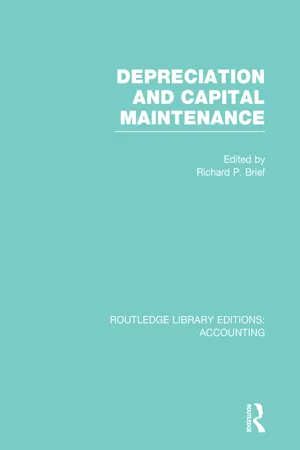
Of the nine articles reprinted in this volume originally published in 1984, those by Ladelle, Hotelling and Anton are recognized as being the classic articles on the depreciation of a single 'machine'. Each of these articles was published in a journal that is often not accessible and reprinted here has brought them together in one place. For many years accountants have dealt with depreciation and capital maintenance as a static problem. This volume recognizes its dynamic aspects.
ONE of the most commonly used methods of depreciating capital goods is to write off their initial value in equal annual portions in the course of the estimated lifetime. When this lifetime is correctly estimated and when the depreciation fund is left idle its value (apart from price changes which will be left entirely out of account here) at the end of the lifetime will evidently be equal to the initial value of the capital good and will allow for the replacement of the worn-out item by an exactly identical new one.
In reality, this equality will very seldom be fulfilled. This is not only due to the fact that the individual lifetimes of identical capital goods will vary so that, at best, only a correct average can be used which could yield equality for very large values of the initial stock only, but still more because depreciation funds are usually reinvested in one way or another long before replacement has become necessary.
In particular, in dynamic processes replacement and depreciation may differ considerably. Already in 1953 E. Domar [2] has proved that in an exponentially growing economy, when depreciation funds are immediately reinvested, the method of constant depreciation over time will lead to an amount of depreciation Dt at time t bearing a constant ratio to the amount to be replaced Rt, given by:
Dt : Rt = (eγT - 1) : γT (1)
where γ is the rate of growth of the economy and T the average lifetime of the capital goods. For reasonable values of γ and T the ratio may differ greatly from one.
Dr. Horvat [3] studies the consequences of the method for a different kind of dynamic process. He considers a large stock of identical new capital goods K0 at t = 0. All items are assumed to have exactly the same lifetime, T. Hence, according to the method of constant depreciation over time, each year
of the capital stock at the beginning of the year is depreciated. Dr. Horvat now makes two assumptions: that the depreciation fund is immediately reinvested in identical new capital goods and that no other investment takes place. Under these circumstances, the time path of the capital stock is completely determined. At first it will be subject to heavy fluctuations but these tend to be dampened and by some experimentation with numerical data, Dr. Horvat makes it plausible that the capital stock Kt will approach a limiting value Kα. As the ratio M = Kx : K0 in the cases considered by him turns out to be larger than one, he introduces for M the term depreciation multiplier.
In this article, it will not only be proved that Dr. Horvat's conjectures are correct and that M depends on the value of n, but also that Kt approaches a limiting value for a much more general form of lifetime distribution of the capital goods. The multiplier then turns out to depend to the average, T, and the standard deviation, σ, of this distribution and moreover, for certain combinations of the two, M can even become less than one.
The techniques to be used are the familiar ones of renewal theory. They go back to work done by Lotka in 1939 [4]. Here, the discrete approach will be used. Reference may also be made to a book by Cox [1] which contains bibliographical material.
II The General Formula for the Depreciation Multiplier
The capital stock (m...
Table of contents
Cover
Title
Copyright
Original Title
Original Copyright
Contents
Introduction
Theory of Depreciation: Single Machine
Theory of Depreciation: Composite Plant
Depreciation Multiplier
Depreciation and Capital Maintenance: Hicks's Views
Trusted by 375,005 students
Access to over 1.5 million titles for a fair monthly price.
Study more efficiently using our study tools.
Frequently asked questions
Yes, you can cancel anytime from the Subscription tab in your account settings on the Perlego website. Your subscription will stay active until the end of your current billing period. Learn how to cancel your subscription
No, books cannot be downloaded as external files, such as PDFs, for use outside of Perlego. However, you can download books within the Perlego app for offline reading on mobile or tablet. Learn how to download books offline
Perlego offers two plans: Essential and Complete
Essential is ideal for learners and professionals who enjoy exploring a wide range of subjects. Access the Essential Library with 800,000+ trusted titles and best-sellers across business, personal growth, and the humanities. Includes unlimited reading time and Standard Read Aloud voice.
Complete: Perfect for advanced learners and researchers needing full, unrestricted access. Unlock 1.5M+ books across hundreds of subjects, including academic and specialized titles. The Complete Plan also includes advanced features like Premium Read Aloud and Research Assistant.
Both plans are available with monthly, semester, or annual billing cycles.
We are an online textbook subscription service, where you can get access to an entire online library for less than the price of a single book per month. With over 1.5 million books across 990+ topics, we’ve got you covered! Learn about our mission
Look out for the read-aloud symbol on your next book to see if you can listen to it. The read-aloud tool reads text aloud for you, highlighting the text as it is being read. You can pause it, speed it up and slow it down. Learn more about Read Aloud
Yes! You can use the Perlego app on both iOS and Android devices to read anytime, anywhere — even offline. Perfect for commutes or when you’re on the go. Please note we cannot support devices running on iOS 13 and Android 7 or earlier. Learn more about using the app
Yes, you can access Depreciation and Capital Maintenance (RLE Accounting) by Richard Brief in PDF and/or ePUB format, as well as other popular books in Business & Accounting. We have over 1.5 million books available in our catalogue for you to explore.