eBook - ePub
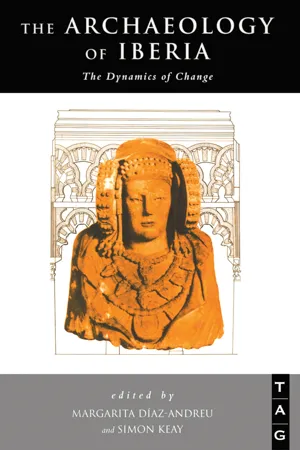
The Archaeology of Iberia
The Dynamics of Change
- 336 pages
- English
- ePUB (mobile friendly)
- Available on iOS & Android
eBook - ePub
The Archaeology of Iberia
The Dynamics of Change
About this book
For many archaeologists, Iberia is the last great unknown region in Europe. Although it occupies a crucial position between South-Western Europe and North Africa, academic attention has traditionally been focused on areas like Greece or Italy. However Iberia has an equally rich cultural heritage and archaeological tradition. This ground-breaking volume presents a sample of the ways in which archaeologists have applied theoretical frameworks to the interpretation of archaeological evidence, offering new insights into the archaeology of both Iberia and Europe from prehistoric time through to the tenth century.
The contributors to this book are leading archaeologists drawn from both countries. They offer innovative and challenging models for the Paleolithic, Neolithic, Copper Age, Bronze Age, Iron Age, Roman, Early Medieval and Islamic periods. A diverse range of subjects are covered including urban transformation, the Iron Age peoples of Spain, observations on historiography and the origins of the Arab domains of Al-Andalus. It is essential reading for advanced undergraduates and those researching the archaeology of the Iberian Peninsula.
Information
Chapter One
Introduction
This book is an integral part of the project to publish the proceedings of the TAG Conference which was held at Southampton in 1992, and which had European archaeology as its underlying theme. The other volumes in this series focus on the world perspective of European archaeology (Ucko 1995), the archaeology of human ancestry (Steele and Shennan 1995), the role of cultural construction in the identity of Europe (Graves–Brown et al. 1995) and theory in Greek archaeology (Spencer 1995). This volume seeks to explore the application of such new theoretical traditions to a particular European region through a number of case studies ranging from the Palaeolithic through to the medieval period.
Iberia is Europe in microcosm. It represents a juxtaposition of north, south, east and west and mirrors a heterogeneous multicultural, multilingual Europe. Throughout the first million years of Iberian prehistory, the Mediterranean and the Atlantic exercised a dual influence over the development of communities in the peninsula. It is within this context that one should understand the appearance in Iberia of such peoples as the Phoenicians, Greeks, ‘Celts’, Romans, Germanic peoples and Muslims from the protohistoric period onwards. Iberia is, thus, one of the few European regions which provides the archaeologist with a cross-section of the full range of culture contact and culture change in antiquity. This very rich archaeological heritage easily lends itself to the testing of new theoretical models of social, religious, economic and political change.
There are many perspectives from which the archaeological record can be analysed, and that of Iberia has been no exception. In the current context, however, two trends merit special attention. The first is that of a growing acceptance of functionalist (sensu lato) perspectives in Iberian archaeology (Gilman 1995: 4). The second concerns the fact that despite this, an underlying culture-historical perspective persists within interpretative frameworks. The practice of using a culture-historical theoretical framework, which dominated Iberian archaeology from the 1920s until the 1970s, emphasized the collection of data and the construction of archaeological ‘cultures’. That is not to say that other perspectives were not unknown. Despite the academic restrictions imposed by the dictatorships of Franco and Salazar, the works of authors such as Gordon Childe were familiar to archaeologists. However, they were only consulted selectively and attention was focused upon culture-historical sequences (Díaz-Andreu 1995). Growing opposition to the dictators in Spain and Portugal changed this scenario. It gave rise to a very different understanding of Childe in the late 1960s. His Marxist ideas and conception of history were particularly attractive and laid the foundations of the historical-materialist schools that have played an important role in the interpretations of the archaeology of Iberia. This historical materialism was put into practice in what Antonio Gilman calls functionalism in the broadest sense.
The political embeddedness of the discipline does not explain every change in the theoretical realm in science (Gilman 1995: 1). There is at least one further factor that has to be considered: the structure of the academic profession. It plays a role in the increasing popularity of post-processual archaeology in British and North American universities, the persistence of culture-history in most countries, and the current state of Spanish and Portuguese archaeology. Thus, in most countries, entry to and progress within the academic world is based on a system of patronage (for Germany see Härke 1991). The advancement of an individuals career relies upon the support of superiors already in post. The position of a newcomer in a department with an established ‘school’ of thought is initially weak, and any new challenging ideas can be controlled by senior academics.
This kind of academic patronage has long prevailed in Spain and Portugal, although it has been interrupted from time to time. This happened in the 1920s with the introduction of prehistoric studies into university curricula by two relative outsiders, Pere Bosch Gimpera and Hugo Obermaier, who nevertheless in turn formed their own circle of disciples. The system of academic patronage was again interrupted for a decade during the later years of the 1970s and the early 1980s. As a result of an earlier demographic increase, a ‘baby-boom’ generation entered the universities, at that time provoking an urgent need for new staff. Among the new generation of academics were to be found stout defenders of historical materialism. Arturo Ruiz Rodríguez at Jaén and Vicente Lull at the Autònoma University of Barcelona are just two examples. Other ‘baby-boomers’ linked innovation to the adoption of such new techniques as radiocarbon dating, survey methods, pollen analysis, spatial analysis, etc. However, this was not necessarily accompanied by a complementary emphasis on archaeological method, theory and ecology.
Post-processual approaches to archaeology are not popular amongst academics in Spain and Portugal, with explicit rejections of them appearing in print (Ruiz Zapatero et al. 1988, Vicent 1990; see also Vazquez Varela and Risch 1991). The reasons for this are not clear. It may be that it is perhaps unrealistic and inappropriate to expect that a range of theoretical approaches which are best understood in the context of one academic tradition, such as post-processualism, should necessarily be adopted by archaeologists working elsewhere and within distinct academic traditions. This is not the appropriate place to attempt to explain the popularity of post-processual approaches in Britain and the United States (where there are at least fifteen practitioners: Thomas 1995: 349). Nevertheless it is possible that it may perhaps be understood in the context of access to and advancement within certain sectors of the profession in both countries.
It is probable that post-processual archaeology and its emphasis upon the role of ideology and the individual may find greater acceptance amongst Spanish and Portuguese archaeologists in the future. Currently, however, there is an implicit belief that archaeological evidence allows us to define the systems which generate cultural behaviour and rejects the study of the individual in the creation of cultural symbols. Behind this may lie pessimism about the ability of the individual to bring about change in societies, or the scope of the individuals role in society. This, of course, has to be understood in the context of the recent political histories of both Spain and Portugal.
Currently, functionalist perspectives (in the broadest sense) are gaining increasing acceptance amongst archaeologists in Iberia. This is a trend which Antonio Gilman (1995: 4) explains in terms of ‘a guarantee of professional respectability’. This means that analyses of the archaeological record increasingly focus upon socio-political and economic factors, which had hitherto received little attention. This is evident in most of the chapters in this volume.
The origins of this book lie in the TAG session ‘The Dynamics of Change’ held at Southampton in 1992. The line-up of speakers comprised Margarita Díaz-Andreu, Paloma Gómez Marcen, Almudena Hernando Gonzalo, Susana Jorge Oliveira, Vitor Jorge Oliveira, Simon Keay, Isabel Lisboa, Arturo Ruiz Rodríguez, Gonzalo Ruiz Zapatero and Roberto Risch. All were recognized as having a particular contribution to make to the theme of cultural change in Iberia. In the planning of the book that arose from this meeting, however, it was decided to broaden the range of contributors. The aim was to contrast the theoretical approaches to cultural change adopted by specialists within the key traditional period divisions, such as the Palaeolithic, Neolithic, Chalcolithic, Bronze and Iron Ages, as well as the Roman and early medieval periods. Given the great inherent regionalism of the Iberian Peninsula, care was also care taken to ensure that archaeologists from as many different parts of Iberia as possible were represented: Catalunya (Molist et al., Rodà), Madrid (Enamorado, Ruiz Zapatero, Díaz-Andreu, Hernando, Caballero), Andalucía (Hurtado, Ruiz Rodríguez, Salvatierra), northern Portugal (Martins dos Reis), southern Portugal (Jorge and Jorge), as well as British scholars working in Iberia (Chapman and Keay). Needless to say, such heterogeneity is also reflected in the theoretical perspectives that they adopt. The aim of this approach was to try and break away from singleperiod or single-regional period studies which dominate the analysis of Iberian antiquity. While these have many merits they are achieved at the expense of the longue durée or the broader picture. Thus, apart from the ‘national’ histories of Spain and Portugal, this volume represents one of the very few attempts to treat Iberia as a whole and to span its full chronological range of archaeology, especially including the Palaeolithic and medieval periods. This stands in contrast to many syntheses, especially those translated into the English language, which have tended to focus upon the period between the Chalcolithic and Roman periods (Chapman 1990, Fernández Castro 1995, Cunliffe and Keay 1995, Gilman and Thornes 1985, Harrison 1988, Lillios 1995, Mathers and Stoddart 1994).
Apart from an introduction to the history of archaeology in Iberia (Díaz-Andreu), all of the chapters address the theme of change. Some adopt a ‘global’ perspective within the Iberian peninsula (Enamorado, Ribe et al., Oliveira Jorge and Oliveira Jorge, Rodà, Caballero), while others reflect upon the nature of cultural change from the perspective of regional studies (Hernando, Hurtado, dos Reis Martins, Ruiz Zapatero, Ruiz Rodríguez, Keay and Salvatierra). Moreover some contributors focus upon the transition between one period and another, while others analyse the internal dynamics within apparently ‘static’ societies. In most contributions the theoretical perspective is implicit and the authors concentrate upon its application to archaeological case studies.
A range of contrasting academic traditions have traditionally governed the development of interpretational frameworks within the prehistoric, protohistoric, classical and medieval periods. Consequently the models invoked by authors in this book invoke a range of models to shed light upon cultural change. In light of the comments above, it will come as no surprise to discover that historical materialism predominates. All of this and its implications in the broader context of recent developments in Iberian archaeology are discussed in the concluding chapter. Theoretical heterogeneity of this kind within individual chronological periods and across the cultural divide is not restricted to Iberia and poses a challenge to those who seek over-arching theories of cultural change in prehistoric and early historical societies.
References
Chapman, R. (1990) Emerging Complexity. The Later Prehistory of south-east Spain, Iberia and the West Mediterranean, Cambridge: Cambridge University Press.
Cunliffe, B. and Keay, S. (eds) (1995) Social Complexity and the Development of Towns in Iberia, Proceedings of the British Academy 86, Oxford: Oxford University Press.
Díaz-Andreu, M. (1995) ‘Childe and the Iberian Atlantic Bronze Age’, in ‘Is There an Atlantic Bronze Age?’, Colloquium held at Lisbon, October 1995.
Fernández Castro, M. C. (1995) Iberia in Prehistory, Oxford: Blackwell.
Gilman, A. (1995) ‘Recent trends in the archaeology of Spain’, in K. Lillios (ed.) The Origins of Complex Societies in Late Prehistoric Iberia: 1–6. International Monographs in Prehistory, Ann Arbor: University of Michigan Press.
Gilman, A. and Thornes, H. B. (1985) Land-use and Prehistory in south-east Spain, University of London Monograph Series, London: Allen and Unwin.
Graves-Brown, P., Jones, S. and Gamble, G. (eds) (1995) Cultural Identity and Archaeology: The Construction of European Communities. The Theoretical Archaeology Group, London: Routledge
Härke, H. (1991) ‘All quiet on the western front? Paradigms, methods and approaches in West German archaeology’, in I. Hodder (ed.) Archaeological Theory in Europe. The Last Three Decades, London: Routledge.
Harrison, R.J. (1988) Spain at the Dawn of History. Iberians, Phoenicians and Greeks, London: Thames and Hudson.
Lillios, K.T. (ed.) (1995) The Origins of Complex Societies in Late Prehistoric Iberia, International Monographs in Prehistory, Archaeological Series 8, Michigan: Ann Arbor.
Mathers, C. and Stoddart, S. (eds) (1994) Development and Decline in the Mediterranean Bronze Age, Sheffield Archaeological Monographs 8, Sheffield: J. R. Collis Publications.
Ruiz Rodríguez, A., Chapa, T. and Ruiz Zapatero, G. (1988) ‘La arqueología contextual: una revisión crítica’, Trabajos de Prehistoria 45: 11–17.
Ruiz Zapatero, G. (1991) ‘Arqueología y Universidad’, Revista de Arqueología 118: 6–7.
Spencer, N. (ed.) (1995) Time, Tradition and Society in Greek Archaeology: Bridging the Great Divide. The Theoretical Archaeology Group, London and New York: Routledge.
Steele, J. and Shennan, S. (eds) (1995) The Archaeology of Human Ancestry: Power, Sex and Tradition. The Theoretical Archaeology Group, London and New York: Routledge.
Thomas, J. (1995) ‘Where are we now? Archaeological theory in the 1990s’, in P. Ucko (ed.) Theory in Archaeology. A World Perspective: 343–362, London and New York: Routledge.
Ucko, P. (ed.) (1995) Theory and Archaeology: A World Perspective. The Theoretical Archaeology Group, London and New York: Routledge.
Vazquez Varela, J.M. and Risch, R. (1991) ‘Theory in Spanish archaeology since I960’, in I. Hodder (ed.) Archaeological Theory in Europe. The Last Three Decades: 25–51, London and New York: Routledge.
Vicent, J. (1990) ‘El debat postprocessual: algunes observacions «radicals» sobre una arqueología «conservadora»’, Cota Zero 6: 102–107.
Chapter Two
Conflict and Innovation
The development of archaeological traditions in Iberia
Introduction
Spain and Portugal are located on the southwest edge of Europe. Their extra-centrality has not, however, prevented them from following the main European trends. Therefore, the formation and development of archaeology in both countries has, in general terms, gone through similar periods to the rest of the continent, although without having the might of more developed countries. In Europe at the end of the eighteenth century a powerful interest in history grew up because it could be used as a means of justifying the nation, a concept which was the nucleus of the new emergent political system of nationalism. This attempt to define the nation historically ultimately led to archaeology’s formation as a scientific discipline. The fact that history in its widest sense now became a key element in the political legitimation of the different nations represented a new motive for the study of the remote past, already on the increase during the preceding three centuries; so much so, that it attained a new status and history, became a discipline which ranked among the most important and was therefore worthy of specialization. However, this process did not advance at the same rhythm in different countries as it was related to the weight of the middle classes, who had the greatest interest in establishing the liberal system which brought them the right to gove...
Table of contents
- Cover
- Half Title
- Title Page
- Copyright Page
- Table of Contents
- List of figures and tables
- List of contributors
- General editor’s preface
- Acknowledgements
- 1. Introduction
- 2. Conflict and innovation: the development of archaeological traditions in Iberia
- 3. Behavioral transformations during the Pleistocene: an Iberian perspective
- 4. The Neolithic of the Iberian Peninsula
- 5. The funerary world and the dynamics of change in southeast Spain (fourth–second millennia BC)
- 6. The dynamics of the occupation of the middle basin of the river Guadiana between the fourth and second millennia BC: an interpretational hypothesis
- 7. The Neolithic/Chalcolilthic transition in Portugal: the dynamics of change in the third millennium BC
- 8. The dynamics of change in northwest Portugal during the first millennium BC
- 9. Migration revisited: Urnfields in Iberia
- 10. The Iron Age Iberian peoples of the upper Guadalquivir valley
- 11. Urban transformation and cultural change
- 12. Hispania: from the second century AD to Late Antiquity
- 13. Observations on historiography and change from the sixth to tenth centuries in the north and west of the Iberian Peninsula
- 14. The origins of Al-Andalus (the eighth and ninth centuries): continuity and change
- 15. All change? A commentary on Iberian archaeology
- Index
Trusted by 375,005 students
Access to over 1.5 million titles for a fair monthly price.
Study more efficiently using our study tools.
Frequently asked questions
Yes, you can cancel anytime from the Subscription tab in your account settings on the Perlego website. Your subscription will stay active until the end of your current billing period. Learn how to cancel your subscription
No, books cannot be downloaded as external files, such as PDFs, for use outside of Perlego. However, you can download books within the Perlego app for offline reading on mobile or tablet. Learn how to download books offline
Perlego offers two plans: Essential and Complete
- Essential is ideal for learners and professionals who enjoy exploring a wide range of subjects. Access the Essential Library with 800,000+ trusted titles and best-sellers across business, personal growth, and the humanities. Includes unlimited reading time and Standard Read Aloud voice.
- Complete: Perfect for advanced learners and researchers needing full, unrestricted access. Unlock 1.5M+ books across hundreds of subjects, including academic and specialized titles. The Complete Plan also includes advanced features like Premium Read Aloud and Research Assistant.
We are an online textbook subscription service, where you can get access to an entire online library for less than the price of a single book per month. With over 1.5 million books across 990+ topics, we’ve got you covered! Learn about our mission
Look out for the read-aloud symbol on your next book to see if you can listen to it. The read-aloud tool reads text aloud for you, highlighting the text as it is being read. You can pause it, speed it up and slow it down. Learn more about Read Aloud
Yes! You can use the Perlego app on both iOS and Android devices to read anytime, anywhere — even offline. Perfect for commutes or when you’re on the go.
Please note we cannot support devices running on iOS 13 and Android 7 or earlier. Learn more about using the app
Please note we cannot support devices running on iOS 13 and Android 7 or earlier. Learn more about using the app
Yes, you can access The Archaeology of Iberia by Margarita Diaz-Andreu, Simon Keay, Margarita Diaz-Andreu,Simon Keay in PDF and/or ePUB format, as well as other popular books in Social Sciences & Archaeology. We have over 1.5 million books available in our catalogue for you to explore.