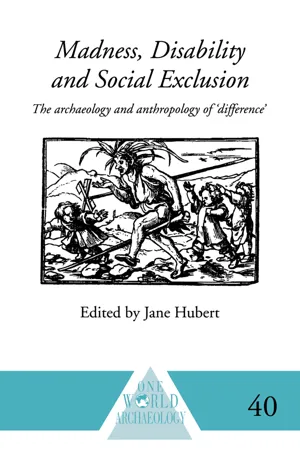
eBook - ePub
Madness, Disability and Social Exclusion
The Archaeology and Anthropology of 'Difference'
- 272 pages
- English
- ePUB (mobile friendly)
- Available on iOS & Android
eBook - ePub
Madness, Disability and Social Exclusion
The Archaeology and Anthropology of 'Difference'
About this book
A unique work that brings together a number of specialist disciplines, such as archaeology, anthropology, disability studies and psychiatry to create a new perspective on social and physical exclusion from society. A range of evidence throws light on such things as the causes and consequences of social exclusion stigma, marginality and dangerousness.
It is an important text that breaks down traditional academic disciplinary boundaries and brings a much needed comparative approach to the subject.
Information
1 Official madness: a cross-cultural study of involuntary civil confinement based on ‘mental illness’
Involuntary commitment1 laws usually contain two components, first that the person in question be diagnosed with a ‘mental illness’,2 and second that they either: (a) pose a danger to themselves or others, (b) are in need of treatment, or (c) cannot see to their basic necessities of life. Involuntary commitment laws are said to serve three social functions: protection of society (‘police power’), looking after the patient’s ‘own good’ (parens patriae), and meeting people’s basic needs (‘custodial confinement’) (Stromberg and Stone 1983: 279–80).
Involuntary commitment laws exist at the crossroads of two potent social forces, law and medicine, and are the subject of constant controversy. Terms such as ‘mental illness’ and ‘dangerousness’ are social constructs arising from political arguments among various constituencies regarding the classification of deviant behaviours. Involuntary commitment laws in different jurisdictions3 thus reflect a wide variety of conceptions about mental illness, and offer different justifications for incarcerating the ‘mentally ill’. However, the effect of differing wordings of involuntary commitment laws is not clear because various extra-legal factors may ‘trump’ the intentions behind carefully worded statutes.
The Medical Model and ‘Mental Disorder’
During the modern age the field of medicine has attained a monopoly over the assessment and treatment of mental illness (Foucault 1965). The ‘medical model’ of mental illness claims that psychological disorders are ‘sicknesses’; mental illness is seen as an objective disorder arising within the person that may be diagnosed and treated (or cured) through therapeutic intervention (Sanua 1994). The first psychiatric classification system of mental disorders was developed just over 100 years ago (Murthy and Wig 1993: 388). Since then, diagnostic manuals have been subject to continuous revision; new disorders are identified and old ones put to rest (Aderibigbe and Pandurangi 1995). Such revisions are ostensibly grounded in medical ‘science’; however, the debate over some disorders reflects more the socio-cultural environment of psychiatric practice. For example, in 1973, members of the American Psychiatric Association (APA), after several years of highly charged discussions, voted to remove homosexuality from the Association’s list of mental disorders (Greenberg 1997). Some saw the decision as a reversal of the inappropriate inclusion of homosexuality in the first place, while others contended that psychiatry had caved in to political demands of ‘activists’ (Bayer 1987). Other battles have been waged over such diagnoses as ‘passive–aggressive syndrome’ (Wetzler and Morey 1998), ‘premenstrual syndrome’ (Lorber 1997), and ‘attention-deficit hyperactivity disorder’ (Searight and McLaren 1998).
Typically, psychiatry defines mental disorder as arising in the individual; Wakefield’s (1997, 1992a, 1992b) definition of ‘harmful dysfunction’ and Ossorio’s (1985) ‘inability to engage in deliberate action’ are two prominent models. Wakefield (1992a) distinguishes six other accounts of mental disorder: the sceptical antipsychiatric view, the value approach, the idea that disorder is whatever professionals treat, two scientific approaches (statistical deviance and biological disadvantage), and the operational definition of disorder as ‘unexpected distress or disability’. The two major contemporary psychiatric classification systems – the Diagnostic and Statistical Manual of Mental Disorders (currently the DSM-IV) (American Psychiatric Association (APA) 1994) and the International Classification of Diseases (currently the ICD-10) (World Health Organization (WHO) 1992) – define and explain a multitude of specific syndromes, illnesses, and disorders.
Yet the broader concepts of ‘mental illness’ or ‘mental disorder’ are not fixed psychiatric definitions. The DSM-IV recognizes that ‘no definition adequately specifies precise boundaries for the concept of “mental disorder”’. However, mental disorder is broadly conceptualized as a clinically significant behavioural or psychological syndrome that is associated with present distress, disability, or with an increased risk of suffering death, pain, disability, or an important loss of freedom (APA 1994: xxi). Such dysfunction must occur in the individual; a disturbance limited to conflict between the individual and society is not in itself a mental disorder (APA 1994: xxi-xxii; Bennett 1986: 80–1).
The reasons for the ascendance of the ‘medical model’ are complex and outside the scope of this chapter. However, it is worth noting that psychiatric explanations of mental illness came to predominate long before psychiatry had offered any explanations for the causes of mental illness or developed any successful treatments for it (Conrad and Schneider 1980). Thus, some (e.g. Foucault 1965; Conrad and Schneider 1980) conclude that the early rise of the medical model was more a social and political phenomenon than a medical one.
The Social Construction of Mental Disorder
Every known society employs some conception of ‘madness’ (Conrad and Schneider 1980: 38). However, societies differ – culturally, contextually, and temporally, as to their conceptions of exactly what constitutes madness (Lillard 1998), what causes madness, and what ought to be done with the mad (Conrad and Schneider 1980). For example, while there is wide consensus as to the core symptoms of schizophrenia (Brislin 1993; Draguns 1990), other disorders are ‘culture-bound’ (Hughes et al. 1996). These include susto in Latin America (typified by extreme anxiety, restlessness and fear of Black Magic) (Castro and Eroza 1998), taijin-kyofusho in Japan (marked by social anxiety, easy blushing, and fear of eye contact) (Kleinknecht et al. 1997), and anorexia and bulimia in western (or westernized) cultures (DiNicola 1990).
In fact, a medical explanation is only one of many possible axes on which to place mental illness (Siegler and Osomond 1966: 1193–203). During the 1960s and 1970s ‘sociogenic’ factors began to be emphasized over ‘egocentric’ ones (Murthy and Wig 1993: 395), leading to ‘bio-psycho-social’ models of mental illness. Adding to this shift is increasing recognition of promoting mental health, rather than simply treating mental illness (Desjarlais et al. 1995). Under these models, the psychiatrist is viewed as one of several people on a treatment team (Symonds 1998). However, some perceive a ‘new medicalization’ of mental illness over the past few years (Zaumseil 1998).
The socio-cultural view conceptualizes mental disorder as usually identified with behaviours that are bizarre, irrational, or unusually distressful (Mechanic 1999). Under the social view, mental illness cannot be said to arise in persons’ behaviours, as such; rather, mental illness is a ‘quality’ attributed to persons and behaviours by others (Conrad and Schneider 1980). The ‘social’ view of madness is not altered by consideration of biological ‘causes’ of mental disease. Illness does not exist in nature (Sedgwick 1973); rather, illness is a negative human value judgement of objectively neutral conditions. Under this view, psychiatrists do not classify diseases or disorders; rather, they classify ‘the kinds of problems which psychiatrists currently deal with’ (Kendall 1988: 339). Also, the fact that there is widespread agreement at a certain place and time as to the nature of a particular illness does not change the fact that illness is a judgement; it only obscures the process of consensus (Conrad and Schneider 1980: 31). This is so even without recognizing that mental illness may have sociogenic causes as well as social definitions.
Some critics of psychiatry, notably Szasz (1974a, 1974b), go a bit further, claiming that ‘mental illness’, as such, is a ‘myth’, a social construction designed for the control of individuals deemed socially deviant. Szasz acknowledges that personal suffering exists, and that people should be afforded treatment when they request it. However, Szasz emphasizes the harmful effects of the labelling process – the means by which certain people or groups of people are determined to be disordered or deviant – and argues that it is essentially political (Szasz 1974b, 1963). Because labelling is a political process, labels ultimately reflect the view of the dominant social institutions and forces. When the Church was the pre-eminent institution, mental illness was considered punishment for sin (Conrad and Schneider 1980: 41–42). In contemporary society, mental illness is a medical affliction.
Civil Commitment: Legalized Exclusion of the Mentally Ill
Notwithstanding the wide variety of cultural conceptions of mental illness, almost all cultures have viewed mental illness as a deviant form, subject to negative social sanctions. The mentally ill are viewed as ‘the other’ (Foucault 1965). This has been true whether mental illness has been explained by sin, possession by spirits, heredity, or bio-physiological factors (Simon 1992). Even in the relatively sophisticated western world at the end of the twentieth century, the mentally ill remain highly stigmatized and subject to discrimination (Sayce 1998). Media portrayals misrepresent mental illness, falsely depict the mentally ill as violent, and ‘poke fun’ at mental illness in ways that would be unthinkable of ‘physical’ illness (Wahl 1995; Philo et al. 1996).
While the mentally ill have been socially excluded in most societies, physical exclusion is a phenomenon of the modern age (Foucault 1965). Beginning in the 1700s in the West, in what has been dubbed the ‘First Wave’, states enacted involuntary commitment laws, incarcerating mental deviants alongside convicted criminals, and treating alike ‘idiots’, ‘lunatics’, and those found to be ‘of unsound mind’. The focus was on the preservation of law and order, and treatment was nonexistent or minimal (Conrad and Schneider 1980).
Later, in the ‘Second Wave’ of reforms, separate asylums for the mentally ill were constructed, and various ‘treatments’ were offered for the first time (Noble 1981: 17). The asylum system remained dominant until the middle of the twentieth century, when, in response to a number of factors (including the introduction of powerful medications, public outcry over asylum conditions, and fiscal motivations), states began to shift treatment from asylums to community mental health centres, at least in theory (e.g. Curran and Harding 1978: 44 (generally); Burti and Benson 1996 (Italy); Bottomley 1987 (New South Wales)). However, the legacy of physical exclusion remains, as many communities object to placing the mentally ill in their midst (Sayce 1998). This ‘Third Wave’ of reforms saw major substantive and procedural revisions to involuntary commitment statutes. In the United States, California was the first to enact reform legislation, in 1968; most other states followed shortly thereafter. Diagnostic categories were sharpened; for example, those with epilepsy, mental retardation, dementia, and other ‘organic’ brain disorders were now categorized and treated differently from those with ‘mental illness’, and, in some cases, more specific, legalistic criteria further delineating ‘mental illness’ were developed and introduced (Curran and Harding 1978: 35). More significantly, many of the new involuntary commitment laws changed involuntary commitment requirements by eliminating the ‘need for treatment’ standard, leaving only the ‘dangerousness’ standard, and perhaps the ‘disability’ criterion as well.
However, the greater focus of reforms – Gostin (1983) calls this the ‘new legalism’ – was in regard to procedural rights rather than being concerned with substantive changes. The new laws guaranteed the right to a judicial hearing, to appointed counsel, and to an appeal. Similar changes were instituted in other western jurisdictions. However, the procedural reforms may have had limited effect, as many of the substantive decisions remained with medical personnel (Gostin 1983). Many claim that these reforms resulted in dramatic increases in the homeless mentally ill, and the diversion of many mentally ill into the criminal justice system (Miller 1992a; Bonovitz and Bonovitz 1981). In response, some jurisdictions in recent years have re-instituted a ‘need for treatment’ basis in their involuntary commitment statutes (Miller 1992b).
Most developing countries were left out of the Third Wave. Many did not have mental health laws to begin with. Others inherited the antiquated laws of their colonial forebears. In many cases, such laws remain in effect today while having been repealed and replaced in the colonizing country. Many Asian countries particularly have been slow to adopt mental health legislation. Taiwan’s law was first submitted in 1983, and became law in 1990 (Salzberg 1993: 171). China and Thailand have no involuntary commitment law; nevertheless, compulsory admissions take place in those countries (Pearson 1996 (China); Soothill et al. 1981 (Thailand)). Chinese families are willing to endure great hardship to avoid committing a family member. However, once the family identifies a member as ‘crazy’, the decision is sealed (Pearson 1996: 452).
Many middle-eastern countries also do not have involuntary commitment laws (Curran and Harding 1978) but operate under similar ‘informal systems’ of compulsory admission, wherein the patient’s family acts as the social control agents, rather than the state or psychiatrists. Curran and Harding (1978: 20) identified twelve of the forty-three countries they surveyed as having no involuntary commitment law. Eight of the twelve were countries in the eastern Mediterranean region. In most such countries, the stigma of mental illness is very strong, and psychiatric hospitalization affects the family very directly (for example, single women with known psychiatric histories are not ‘marriageable’). Given these strong cultural forces, it is not surprising that state involvement with psychiatry is strictly limited.
Maintenance of a separate legislative framework for those considered mentally disordered is difficult to justify (Campbell and Heginbotham 1991; Sza...
Table of contents
- Cover
- Half Title
- Title Page
- Copyright Page
- Table of Contents
- List of figures and table
- List of contributors
- Foreword
- Preface
- Introduction: the complexity of boundedness and exclusion
- 1. Official madness: a cross-cultural study of involuntary civil confinement based on ‘mental illness’
- 2. Hidden or overlooked? Where are the disadvantaged in the skeletal record?
- 3. Did they take sugar? The use of skeletal evidence in the study of disability in past populations
- 4. Developmental defects and disability: the evidence from the Iron Age semi-nomadic peoples of Aymyrlyg, south Siberia
- 5. Two examples of disability in the Levant
- 6. Disability, madness, and social exclusion in Dynastic Egypt
- 7. Skeletons in wells: towards an archaeology of social exclusion in the ancient Greek world
- 8. Madness in the body politic: Kouretes, Korybantes, and the politics of shamanism
- 9. Impaired and inspired: the makings of a medieval Icelandic poet
- 10. ‘Strange notions’: treatments of early modern hermaphrodites
- 11. The logic of killing disabled children: infanticide, Songye cosmology, and the colonizer
- 12. Leprosy and social exclusion in Nepal: the continuing conflict between medical and socio-cultural beliefs and practices
- 13. Between two worlds: the social implications of cochlear implantation for children born deaf
- 14. The social, individual and moral consequences of physical exclusion in long-stay institutions
- 15. Exclusion from funerary rituals and mourning: implications for social and individual identity
- 16. Social exclusion in northern Nigeria
- Index
Trusted by 375,005 students
Access to over 1.5 million titles for a fair monthly price.
Study more efficiently using our study tools.
Frequently asked questions
Yes, you can cancel anytime from the Subscription tab in your account settings on the Perlego website. Your subscription will stay active until the end of your current billing period. Learn how to cancel your subscription
No, books cannot be downloaded as external files, such as PDFs, for use outside of Perlego. However, you can download books within the Perlego app for offline reading on mobile or tablet. Learn how to download books offline
Perlego offers two plans: Essential and Complete
- Essential is ideal for learners and professionals who enjoy exploring a wide range of subjects. Access the Essential Library with 800,000+ trusted titles and best-sellers across business, personal growth, and the humanities. Includes unlimited reading time and Standard Read Aloud voice.
- Complete: Perfect for advanced learners and researchers needing full, unrestricted access. Unlock 1.5M+ books across hundreds of subjects, including academic and specialized titles. The Complete Plan also includes advanced features like Premium Read Aloud and Research Assistant.
We are an online textbook subscription service, where you can get access to an entire online library for less than the price of a single book per month. With over 1.5 million books across 990+ topics, we’ve got you covered! Learn about our mission
Look out for the read-aloud symbol on your next book to see if you can listen to it. The read-aloud tool reads text aloud for you, highlighting the text as it is being read. You can pause it, speed it up and slow it down. Learn more about Read Aloud
Yes! You can use the Perlego app on both iOS and Android devices to read anytime, anywhere — even offline. Perfect for commutes or when you’re on the go.
Please note we cannot support devices running on iOS 13 and Android 7 or earlier. Learn more about using the app
Please note we cannot support devices running on iOS 13 and Android 7 or earlier. Learn more about using the app
Yes, you can access Madness, Disability and Social Exclusion by Jane Hubert in PDF and/or ePUB format, as well as other popular books in Social Sciences & Anthropology. We have over 1.5 million books available in our catalogue for you to explore.