eBook - ePub
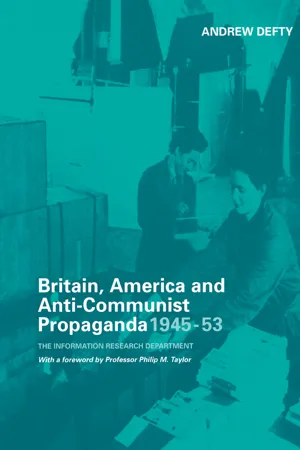
Britain, America and Anti-Communist Propaganda 1945-53
The Information Research Department
- 312 pages
- English
- ePUB (mobile friendly)
- Available on iOS & Android
eBook - ePub
Britain, America and Anti-Communist Propaganda 1945-53
The Information Research Department
About this book
In the Cold War battle for hearts and minds Britain was the first country to formulate a coordinated global response to communist propaganda. In January 1948, the British government launched a new propaganda policy designed to 'oppose the inroads of communism' by taking the offensive against it.' A small section in the Foreign Office, the innocuously titled Information Research Department (IRD), was established to collate information on communist policy, tactics and propaganda, and coordinate the discreet dissemination of counter-propaganda to opinion formers at home and abroad.
1 | The origins of Britain’s anti-communist propaganda policy, 1945–47 |
In January 1948, Britain launched a new propaganda policy designed to ‘oppose the inroads of communism by taking the offensive against it.’ Britain’s ‘future foreign publicity policy’ was outlined in a paper presented to the Cabinet at its first meeting of 1948. It stated that since the end of the War, Soviet propaganda, had carried on ‘a vicious attack against the British Commonwealth and against Western democracy.’ The time had come to ‘pass over to the offensive and not leave the initiative to the enemy, but make them defend themselves.’ It also claimed that it was up to Britain, as a European social democratic government, and not the Americans to take the lead in uniting the forces of anti-communism.1
Although the USA had also begun to respond to communist propaganda, in January 1948 Britain led the way by developing a policy and an organizational machinery to provide a coordinated global response to hostile communist propaganda. This chapter will examine the formulation of this new propaganda policy. It will identify the factors which, between the end of the War and the drafting of the Cabinet paper at the end of 1947, influenced Britain’s decision to go over to the offensive. It will also argue that from the earliest stages Britain’s response to communist propaganda was paralleled by, and even complemented, the propaganda policy and machinery of the USA.
The first year of peace saw the dissolution of wartime propaganda agencies and the development of new policies for national projection and the creation of new government propaganda agencies to implement these policies. At the same time British and US policy-makers gradually developed complementary perceptions of the Soviet threat, which by the end of 1947 led to the development of a more offensive concept for the use of propaganda. Although the Soviet Union posed a considerable military threat the principal fear was communist subversion of democracy through the use of techniques short of war such as propaganda. Britain’s initial response to communist propaganda was a propaganda policy based on the positive projection of Britain’s national achievements. As this policy proved increasingly inadequate as a counter to hostile foreign propaganda Britain and the USA developed complementary propaganda policies designed to supplement passive national projection with various defensive and offensive measures. In the case of Britain a series of ad-hoc offensive measures led eventually to the adoption of a coordinated global response to communist propaganda by January 1948.
British and American propaganda 1945–46
The British and US Governments emerged from the Second World War convinced of the value of a permanent peacetime propaganda machinery. During the War all the major powers had employed propaganda on an unprecedented scale both at home and abroad. Britain and the USA had developed a complex bureaucratic machinery for the dissemination of government propaganda and the coordination of allied psychological warfare. Before the end of the War, an official committee set up to consider the machinery of government in post-war Britain noted the potential for peacetime employment of propaganda for ‘securing publicity and goodwill for Britain abroad and the Government’s policies at home.’2 At the end of the War, British and US leaders expressed their conviction that propaganda was an important tool of policy. In December 1945, the British Prime Minister, Clement Attlee, expressed himself satisfied that the information services ‘have an important and permanent part in the machinery of government under modern conditions.’ He described the services as ‘essential’ to keep the public informed about government policy and to ensure that, ‘a true and adequate picture of British policy, British institutions and the British way of life should be presented overseas.’3 In the USA earlier the same year, President Harry S. Truman had observed that, ‘the nature of present day foreign relations makes it essential for the United States to maintain information activities abroad as an integral part of our conduct of foreign affairs.’4 However, initially Truman and Attlee did not envisage peacetime propaganda as a defence against hostile foreign powers. They reverted to concepts of government propaganda which owed more to ideas of national projection and advertising developed in the inter-war years than the lessons of the Second World War. Propaganda was not to be employed in dishonourable and deceitful pursuits as exemplified by the totalitarian dictatorships. In the immediate aftermath of the War, Britain and the USA developed government propaganda as a positive aid to diplomacy. By explaining their position more clearly to foreign powers, they hoped to promote international understanding and more particularly, to improve the prospects for international trade.
Before a peacetime propaganda machinery could be established, both governments had to overcome a widespread antipathy towards the use of propaganda. Although the use of propaganda could be excused as expedient in wartime, many British and US politicians and officials held deep-seated reservations about the employment of government propaganda in peacetime. The maintenance of government agencies for the manipulation of opinion was viewed by many as the preserve of totalitarian dictatorships, and many wartime propaganda agencies were hastily dismantled.5 In Britain there was a general feeling that government departments generated by wartime necessity should be dissolved. Those agencies responsible for covert propaganda – the Political Warfare Executive and the Special Operations Executive – were dismantled early in 1946. Attlee noted brusquely that ‘he had no wish to preside over a British Comintern.’6 The Ministry of Information was also abolished, and overall responsibility for overseas propaganda was shifted to the Foreign Office, where enthusiasm for such activity was by no means universal. As late as 1952 one senior Foreign Office official wrote sardonically to Sir Robert Fraser, Director of the Central Office of Information, that ‘no normal diplomatist, I suspect, can be a real enthusiast about publicity and propaganda.’7
In the USA popular support for the dissolution of wartime agencies was if anything more pronounced. Congress and the public had a distaste for the application of wartime methods to the problems of peace and any wartime agency which was not clearly demonstrable as necessary to the Government’s peacetime policy was rapidly dismantled. The Office of War Information was dissolved in 1945, and responsibility for overseas propaganda was foisted on an unwelcoming State Department. A handful of officials argued the case for peacetime propaganda but the State Department information programme suffered drastic cuts between 1946 and 1948.8 The USA’s covert propaganda apparatus fared little better. Sensational press articles predicting the creation of a ‘super-Gestapo agency’ stifled early plans for a post-war intelligence agency.9 The Office of Strategic Services (OSS) was praised for its wartime achievements and promptly abolished.10 Although elements of OSS were transferred to other departments there was little apparent concern to preserve its propaganda apparatus. State Department officials considered that maintaining such a capability would be ‘contrary to the fundamental premises of our own governmental system and would be honouring the totalitarians by imitating them.’11
Britain was the first to overcome such reservations. Faced with a worsening economy and a declining position as a world and imperial power, the Labour Government placed considerable faith in the projection of British power and achievements through propaganda. The social and economic policies of the Labour Government marked a radical departure from Conservative precedents, and Labour was aware of the need to explain its policies to a wide domestic and foreign audience. At home, propaganda was employed on an unprecedented scale to explain the benefits of Labour’s economic policies to managers, workers and the public at large.12 Competition in the world markets and Britain’s increasing dependence on the USA’s economy made it essential that Britain’s case should not be allowed to go unexplained overseas. In the USA in particular, British propaganda was widely employed to explain to sceptical Congressmen that British socialism was not a step on the road to communism.13
Beyond the explanation of Labour’s socialist policy, this new commitment to national projection served other less tractable ends. The post-war expansion of Britain’s overseas propaganda also reflected an awareness of diminished power and the need to convince the world that traditional prestige and skills could compensate for economic and military decline.14 As the historian Philip M. Taylor has observed:
Propaganda may indeed fail ultimately to disguise weakness or the realities of decline but it can provide an illusion of strength and confidence that does serve to aid foreign policy objectives in effective short term ways.15
In pursuing these ends, British post-war foreign propaganda reflected a concept of positive national projection developed in the inter-war years. This concept was most famously developed by Sir Stephen Tallents who coined the phrase ‘The Projection of England’ in a pamphlet published in 1932. Tallents argued that because Britain no longer enjoyed that position of supremacy which had generated its own prestige and had enabled her to remain aloof for long periods in the past, she must forego her traditional insularity and make Britain more widely known and understood in the world. By ‘projecting’ a balanced interpretation of British civilization and personality, the Government would thereby ensure that its views and policies were clearly understood and appreciated abroad.16
In the post-war years, Britain’s straitened financial situation invested this theme with new value. One of the first directives sent to British information officers by the Foreign Office Information Policy Department (IPD) was entitled ‘The Projection of Britain’. The paper was designed to explain British policy and aid ‘the spread of British ideas and British standards’ abroad. The principal themes were to be industrial welfare and the new social legislation of the Labour Government.17 Initially at least, the overriding objective of the ‘Projection of Britain’ was to foster the nation’s economic well-being. When Bevin wrote to information officers announcing the continuation of information activities he suggested that one of the most important objectives for the post-war years would be the ‘promotion of British exports, and the explanation of British trading policy.’18 Bevin also believed that propaganda could be used overseas as a suitable tool for the projection of British social democracy. The Labour Party’s election manifesto had stated that Britain ‘must play the part of brave and constructive leaders in international affairs,’ promoting worldwide prosperity through their own example of high production and a steady improvement in living standards.19 ‘The Projection of Britain’ was likewise designed to depict Britain as a leading exponent of social democracy and the leading power in the development of progressive welfare legislation.20 This was overseas propaganda at its most positive. The Government was clearly proud of its achievements and Bevin in particular was ‘anxious that our light should not remain under a bushel.’21
Projecting British achievements had traditionally been the job of the BBC and the British Council. In the post-war years, implementing this national projection on an unprecedented scale was facilitated by the retention of significant elements of Britain’s wartime information apparatus. The ease and speed with which post-war propaganda was instituted and expanded suggests that the dissolution of wartime information agencies was largely superficial. The Ministry of Information’s functions were divided between various government departments that, in many cases, expanded their information activities accordingly. In 1945 the Foreign Office had only two departments responsible for overseas propaganda, by 1947 it had nine.22 Although the Ministry of Informat...
Table of contents
- Cover
- Half Title
- Title Page
- Copyright Page
- Dedication
- Table of Contents
- List of plates
- Foreword
- Acknowledgements
- List of abbreviations
- Introduction: historians, the media and British Cold War propaganda
- 1. The origins of Britain’s anti-communist propaganda policy, 1945–47
- 2. Launching the new propaganda policy, 1948
- 3. Building a concerted counter-offensive: cooperation with other powers, 1948–50
- 4. ‘Close and continuous liaison’: British and American cooperation, 1950–51
- 5. A global propaganda offensive: Churchill and the revival of political warfare
- 6. A new strategy of political warfare
- Conclusion
- Bibliography
- Index
Trusted by 375,005 students
Access to over 1.5 million titles for a fair monthly price.
Study more efficiently using our study tools.
Frequently asked questions
Yes, you can cancel anytime from the Subscription tab in your account settings on the Perlego website. Your subscription will stay active until the end of your current billing period. Learn how to cancel your subscription
No, books cannot be downloaded as external files, such as PDFs, for use outside of Perlego. However, you can download books within the Perlego app for offline reading on mobile or tablet. Learn how to download books offline
Perlego offers two plans: Essential and Complete
- Essential is ideal for learners and professionals who enjoy exploring a wide range of subjects. Access the Essential Library with 800,000+ trusted titles and best-sellers across business, personal growth, and the humanities. Includes unlimited reading time and Standard Read Aloud voice.
- Complete: Perfect for advanced learners and researchers needing full, unrestricted access. Unlock 1.5M+ books across hundreds of subjects, including academic and specialized titles. The Complete Plan also includes advanced features like Premium Read Aloud and Research Assistant.
We are an online textbook subscription service, where you can get access to an entire online library for less than the price of a single book per month. With over 1.5 million books across 990+ topics, we’ve got you covered! Learn about our mission
Look out for the read-aloud symbol on your next book to see if you can listen to it. The read-aloud tool reads text aloud for you, highlighting the text as it is being read. You can pause it, speed it up and slow it down. Learn more about Read Aloud
Yes! You can use the Perlego app on both iOS and Android devices to read anytime, anywhere — even offline. Perfect for commutes or when you’re on the go.
Please note we cannot support devices running on iOS 13 and Android 7 or earlier. Learn more about using the app
Please note we cannot support devices running on iOS 13 and Android 7 or earlier. Learn more about using the app
Yes, you can access Britain, America and Anti-Communist Propaganda 1945-53 by Andrew Defty in PDF and/or ePUB format, as well as other popular books in History & Military & Maritime History. We have over 1.5 million books available in our catalogue for you to explore.