First published in 1968. This volume includes an new introduction on the life of Edmond Morel and his work as a journalist in West Africa and champion of African rights as he stood up against the cruelty of the Leopoldian system in the Congo state.
“West Africa, that great feeding-ground for British manufactures.”
MARY KINGSLEY.
ONE still—but too often, alas I—meets with people who wonder why England should bother about West Africa at all, and pooh-pooh the idea that we have interests there at the present time worth looking after, while as for the future possibilities of that huge country as a field for British enterprise, they simply will not trouble themselves to give the matter a moment’s consideration.
Now figures are very uninteresting things, no doubt, to the average reader; but they possess a practical significance superior to any number of the most glowing dissertations, and I trust my readers will forgive me if I make, as a basis of justification for inflicting this volume upon them, a few sets of figures which I would respectfully suggest as worthy of their attentive consideration. The statistics are compiled from the Custom House returns, and they show the extent, nature and distribution of British trade in Western Africa during the last few years. In perusing them, three facts should be borne in mind: first, that, although Europeans have been engaged in commercial transactions on the West Coast for upwards of five hundred and fifty years, those transactions were, prior to the abolition of the over-sea slave trade, confined, with very few exceptions1—so far as the exports from West Africa were concerned—to the human cargo, and to gold dust and ivory: that the trade in palm oil and kernels, which are now the staple articles of export from West Africa, is therefore of comparatively recent growth, and that the mahogany trade and the rubber trade have only come into existence—to any appreciable extent—within the last few years, a fair indication of the fertility and producing power and almost boundless resources of West Africa. Secondly, that the extensive business relationship which has been built up between Great Britain and West Africa, in the shape of a legitimate commerce, has grown to its present proportions under circumstances absolutely disadvantageous to development, without railways, with but few roads, with intertribal wars often preventing the circulation of trade for months at a time, by merely scratching the surface of the most prolific region in the world. Thirdly, that the figures given below do but show the actual volume of Britain’s trade with West Africa and the wages earned by thousands of English men and women who directly and indirectly benefit by that trade; the British capital invested in West Africa in factories, machinery, craft for navigating the rivers, coaling depots, surf-boats and lighters, stores and the like, to which must now be added railway material, dredging apparatus, batteries and soon, we may hope, cotton gins, not to mention a fleet of some sixty steamers employed in the carrying trade and passenger traffic—all these things have to be taken into account in estimating West Africa’s worth to Great Britain.
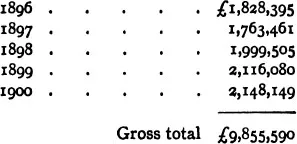
The total values of British produce and manufactures 2 shipped to the British possessions in West Africa in the five years 1896–1900 were respectively as follows:
Percentage of increase in five years,
per cent.
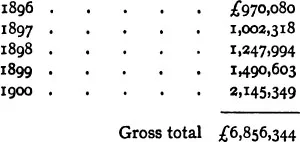
The total values of British produce and manufactures shipped to the possessions of Foreign Powers in West Africa in the five years 1896–1900 were respectively as follows :
Percentage of increase in five years, 121 per cent.
If we add these two totals together, we find that the value of British produce and manufactures shipped to West Africa in the period mentioned was £16,711,934, which is a percentage of increase of 138 per cent.
From the British export trade we turn to the British import trade with West Africa.
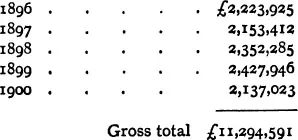
The total values of raw produce imported by Great Britain from British West Africa in the five years 1896–1900 were respectively as follows :
The total values of raw produce imported by Great Britain from the possessions of Foreign Powers in West Africa in the five years 1896–1900 were respectively as follows :
These two totals added together show that Great Britain imported West African produce in the period under review to the amount of £14,260,931.
The value of Great Britain’s direct commerce with West Africa in the five years 1896–1900 was, therefore, £30,972,865. To this might be added a further sum of £1,750,888, representing foreign and colonial merchandise shipped to West Africa from British ports in the years mentioned.3
It is interesting, and valuable, to see which, among the possessions of Foreign Powers in West Africa, were the chief absorbers of British goods and the chief exporters of raw produce to Great Britain. Examination yields the following knowledge :
Principal possessions of Foreign Powers which absorbed in five years £6,856,344 of British goods: 4
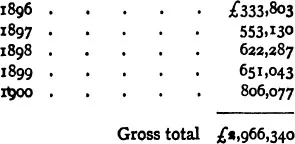
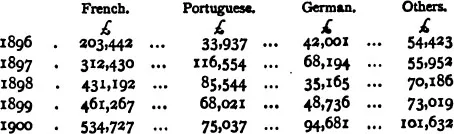
Principal possessions of Foreign Powers which exported to Great Britain in five years £2,966,340 of raw produce :
The French possessions are, it will be observed, far and away our principal markets and our principal suppliers among the possessions of Foreign Powers. Our exports to and imports from the French possessions amounted together to £4,627,543, or just under 50 per cent. of our total export and import trade with the possessions of Foreign Powers together. The increasing importance of the French possessions in West Africa as a market for the sale of British goods and as suppliers of British home markets is a fact which it is of the utmost consequence for British statesmen to lay to heart. The subject is one which I shall refer to later on. It is already one of the dominant factors of West African politics affecting Great Britain, and is destined to become so more and more as the years go on, for France is in a territorial sense the mistress of West Africa, and may become so in a commercial sense as well.
The general conclusions to be drawn from a study of these figures are various. First and foremost there is the clearly established fact that British trade with West Africa is expanding enormously and has almost unlimited prospects before it, now that serious and concentrated efforts are being made on all sides to open up the untapped wealth of the interior by the means of roads and railways and by the improvement of navigable waterways, while the cessation of intertribal warfare in many districts must entail a large increase in the population, and therefore, in the native capacity for production and purchase. It is also demonstrated that every year West Africa absorbs a larger quantity of British manufactured goods: that the exports of British manufactured goods are steadily increasing to British West Africa and increasing to an extraordinary degree to the possessions of Foreign Powers in West Africa, especially to the French possessions: that Great Britain is consolidating her hold upon the carrying trade of West Africa as testified by the increased quantity of foreign and colonial manufactures shipped to West Africa from British ports: that the Continent—Germany6 chiefly—is receiving a greater amount of raw produce from the British possessions in West Africa, a deduction which can be fairly drawn from the stationary aspect of the importation by Great Britain of such produce from her own West African possessions. And the final conclusion is this, that, in view of the restricted extent of the British possessions in West Africa, compared with the possessions of Foreign Powers in that part of the world, the latter offer a very much vaster field for the sale of British goods. Consequently, it is the bounden duty of the British Government and the British Chambers of Commerce, while in no way neglecting the brilliant possibilities which the British West African possessions offer under wise administration for the enterprise of Englishmen, to be ever on the alert to look to the future and to protect British trade with the possessions of the Foreign Powers in West Africa against legislation tending to close the door of those possessions against it; and to insist that, whenever international treaties guaranteeing freedom of trade to the subjects of all nations exist in West Africa, they shall be rigidly adhered to by the signatories. In this respect British diplomacy has shown itself singularly lax. But the mischief already committed may even yet be remedied, and further dangers which loom ahead averted, if the British public will only realise before it is too late the enormous issues at stake.
1 Among the principal exceptions may be mentioned gum arabic from Senegal, pepper, spices, &c., from the Guinea Coast.
2 The totals here given do not, of course, include foreign and Colonial merchandise shipped to British West Africa from British ports.
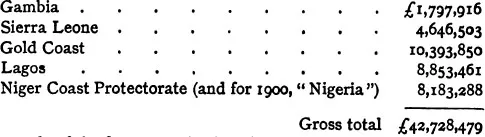
3 The total volume of trade—British and foreign and coastwise—in each of the West African Colonies in the five years 1996–1900, including specie, has been as follows :
The trade of the former territories of the Niger Company, from 1896 to 1899 inclusive, is not reckoned in this total, no public figures being available.
4 The totals given are, of course, exclusive of foreign and Colonial merchandise shipped to these foreign possessions from British ports.
5 Due to exceptional imports of coal and telegraph apparatus.
6 German imports, like British imports, are largely for re-exportation to other European and American ports.
Chapter II
The Old and the New
“The past has gone with its follies and its waste… Let us then face the present and contemplate the future.”
IN the previous chapter we discussed in practical fashion the grounds upon which the British public is called upon to devote more attention to the affairs of West Africa than it does at present, and an attempt—I hope a successful attempt—was made to show how very short-sighted and singularly misinformed is the opinion which would disinterest itself from a part of the world where the possibilities of commercial development are so strikingly manifest. There has never been such urgent need for an intelligent appreciation, on the part of the British public, of the problems which confront this country in West Africa. In a few short years the policy of Great Britain in West Africa has undergone a complete change. Events have followed one another with bewildering rapidity. Official indifference has been galvanised into life by French activity, and after a brief but dangerous period of international rivalry, British political rights have been established over a considerable extent of territory, not, however, nearly so considerable as a pacific, consistent, well-thought-out programme adopted some years previously would have brought, had our merchant-pioneers been listened to, and had successive Governments been able to throw off the paralysing influence of the resolution of 1865. There is a story told of a certain Minister in charge of the Foreign Office—it was related to me by one of those present at the interview—which illustrates very forcibly the feeling which prevailed in Government circles in those days. A deputation of merchants waited upon his Excellency with the request that he would permit the hoisting of the Union Jack on certain parts of the West African littoral where British merchants had long been trading, and where the rulers of the country were genuinely desirous of receiving a British protectorate. Pro-formâ treaties were produced by the deputation between these rulers and the resident merchants. The merchants asked for no reward. There was no question of expenditure involved. All that the Government was required to do was to meet the wishes of the chiefs. The deputation pointed out that, so far as the relations between the natives and the commercial representatives of Great Britain were concerned, the acceptance of the Government would in no wise alter them, but would simply have the effect of cementing a friendly understanding which already existed. But, urged the deputation, the treaties, if agreed to by the Government, would prove an invaluable diplomatic instrument if the time came, as it seemed likely to do, when England might find herself faced in West Africa by foreign competition. The Minister flung the treaties across the table.
It was a time of wasted opportunities, when a little political foresight would have conferred upon this country great future benefit, and it seems extraordinary, but is unhappily true, that the same failure to look ahead as regards West Africa appears to afflict our Foreign Office to-day despite the lessons of the past. Of this, more anon.
But if successive Governments showed unpardonable negligence in safeguarding British interests in West Africa, for decade after decade, down to the very time when the French had worked their way so far southward into the natural hinterlands of our old Colonies that action became imperative if anything was to be saved from the wreck, the British press and public were greatly to blame also. I well remember that at the very height of the recent Anglo-French controversy which culminated in the Convention of 1898, when rival English and French expeditions were rushing hither and thither through the territories west of the Niger, and when British and French efforts were concentrated upon wringing out of the unfortunate Borgu Chiefs all sorts, kinds, and conditions of agreements, sowing Union Jacks and Tricolors by the wayside, the well-known editor of an equally well-known newspaper to which I then contributed, asked me to show him Nikki1 on the map, as he had not the least idea where it was.
Mr. Chamberlain came into power just at the moment when French enterprise in the West African uplands had reached its maximum of threatening intensity, and he set himself to vigorously counteract it as far as he could. The invertebrate policy had, however, compromised the situation almost beyond remedy, and had it not been for Mr. Joseph Thomson’s success in obtaining treaty rights with the Emirs of Sokoto and Bornu in 1884 on behalf of the National African Company of Merchants—subsequently the Royal Niger Company—and, it may be added, for the loyal adherence of those native States to the treaties passed with the Company, the magnificent possession of Northern Nigeria would have gone the way of Futa Jallon, of Mossi, and of so many other countries lying at the back of our Colonies; that is to say, would have fallen into French hands. The man who deserves the most credit for saving Northern Nigeria to the Empire is Sir George Taubman Goldie, and however one may deplore some of the uses to which he put his Charter—things we are paying for now in the French Congo and elsewhere—it is but common fairness to assert that, if it had not been for Sir George Goldie, the possessions of Great Britain in West Africa would have been reduced by about one half. It is a matter for some surprise that the Government should not have succeeded in securing the continuation of Sir George Goldie’s co-operation in West Africa after the Royal Niger Company’s Charter was cancelled. An old opponent has lately sai...
Table of contents
Cover
Title Page
Copyright Page
Dedication
Introduction to the Second Edition
Preface to the First Edition
Table of Contents
Illustrations
Foreword
Part I
Part II.—Nigeria
Part III
Part IV.—The French in West Africa
Part V.—Monopoly in West Africa
Appendix
Index
Trusted by 375,005 students
Access to over 1.5 million titles for a fair monthly price.
Study more efficiently using our study tools.
Frequently asked questions
Yes, you can cancel anytime from the Subscription tab in your account settings on the Perlego website. Your subscription will stay active until the end of your current billing period. Learn how to cancel your subscription
No, books cannot be downloaded as external files, such as PDFs, for use outside of Perlego. However, you can download books within the Perlego app for offline reading on mobile or tablet. Learn how to download books offline
Perlego offers two plans: Essential and Complete
Essential is ideal for learners and professionals who enjoy exploring a wide range of subjects. Access the Essential Library with 800,000+ trusted titles and best-sellers across business, personal growth, and the humanities. Includes unlimited reading time and Standard Read Aloud voice.
Complete: Perfect for advanced learners and researchers needing full, unrestricted access. Unlock 1.5M+ books across hundreds of subjects, including academic and specialized titles. The Complete Plan also includes advanced features like Premium Read Aloud and Research Assistant.
Both plans are available with monthly, semester, or annual billing cycles.
We are an online textbook subscription service, where you can get access to an entire online library for less than the price of a single book per month. With over 1.5 million books across 990+ topics, we’ve got you covered! Learn about our mission
Look out for the read-aloud symbol on your next book to see if you can listen to it. The read-aloud tool reads text aloud for you, highlighting the text as it is being read. You can pause it, speed it up and slow it down. Learn more about Read Aloud
Yes! You can use the Perlego app on both iOS and Android devices to read anytime, anywhere — even offline. Perfect for commutes or when you’re on the go. Please note we cannot support devices running on iOS 13 and Android 7 or earlier. Learn more about using the app
Yes, you can access Affairs of West Africa by Edmund Dene Morel in PDF and/or ePUB format, as well as other popular books in History & World History. We have over 1.5 million books available in our catalogue for you to explore.