- 243 pages
- English
- ePUB (mobile friendly)
- Available on iOS & Android
eBook - ePub
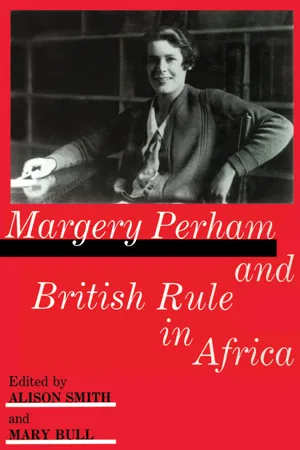
Margery Perham and British Rule in Africa
About this book
Margery Perham was an outstanding influence on official and academic thinking on British Colonial rule and decolonization in Africa during the middle part of the century. The book traces how the Second World War transformed her view of colonial rule and of the rate at which it would have to be relinquished.
Information
Prologue: The Two Miss Perhams
I have been asking myself where, in the record of her many achievements, the essence of Margery Perham’s historical significance is to be found. And I have no doubt that it is in the immense effort, maintained through forty years, to address the opinion-forming public in Britain, at monthly or sometimes even fortnightly intervals, on the aspect of public affairs which was also her academic speciality. This was not done for any significant financial reward, much of it not even in response to any positive invitation. Most of it was supplied quite free, in the correspondence columns of the The Times, seizing the opportunities offered by the news of the day, or the opinions of other correspondents. It was gruelling, always interrupting, work which brooked no delay, and usually allowed no time for second thoughts. Yet it was this work which, cumulatively, brought her the public respect which hardly any academic expert enjoys. It is one thing to gather golden reviews for the book which it has taken ten years to write, and quite another to be judged by the opinions hammered out at three in the morning and rushed to the post before breakfast.
Looking through these ephemeral writings, as she later presented them selectively in the two volumes of her Colonial Sequence, one sees at once that there were two very different Miss Perhams, and the volumes should have been divided not in 1949, but in March 1942. The ‘first’ Miss Perham sprang rather suddenly (at the age of 34) into public view in 1930, during a world tour financed by the Rhodes Trust to study the administration of ‘coloured races’, when she made her debut in The Times newspaper with a series of brilliant articles on Samoa and various parts of Africa. We can say without hesitation that the first Miss Perham was someone whose thought was dominated by ideas of social engineering. That may sound a dull theme, but Margery could clothe it for her readers with all the romance of dominion. In a passage about northern Nigeria, written in 1932, she says:
The way to see this country is to travel through it on horseback. The political officer on his rounds is, by rigorous tradition, always accompanied by the emir’s representative, mounted and robed as fits his position, while behind him in single file will come the local district head and village head, a couple of mallams and one or two other anonymous horsemen, all with flowing, embroidered robes and bright saddle cloths, the leather of their harness brilliantly dyed and hung with coloured fringes and tassels. To ride with such a company, turning in perhaps on the homestead of some half-naked peasant, who with all his family falls prostrate to the ground, is to understand what it meant to be a horseman in feudal Europe.1
In relation to Nigeria, she was fair enough to point out that in Lagos at the same period there were half a dozen newspapers owned, written and printed by Africans, and that the African bourgeoisie of the southern towns demanded British sympathy and attention not only because the standards they are following’ are our standards, ‘but because the fact that they are just beginning to understand us gives them power to help or hinder us in the business of government.’2 But the social formation which really interested her at this time was something she called unhesitatingly the ‘tribe’, and which she visualized as a kind of force or current, which could be harnessed to all sorts of modern purposes by those who understood the system. ‘The organized vitality of the tribe’, she wrote in 1930, ‘of which the highest concentration was once expressed in war, can now be harnessed to economic production, to education, hygiene and a dozen other constructive activities, with results which … may astonish the world in another 50 years.’3 Much of her early writing amounted to a kind of Malinowski for the Million. ‘The aim of our administration must be to find the true foundations of native society, and build upwards and outwards from them. … We should foster tribal society into an all-embracing organ of local government, through which all, and not merely a few, of our administrative activities would be expressed … and turn officers of all departments into teachers.’4 The fundamental notion was that one was working on communities, not individuals. One should be nice to those Africans who had improved themselves as individuals and passed beyond the compass of their own communities, but colonial government was about the improvement of communities as such.
The first Miss Perham mounted no campaign to include the educated Africans into colonial government, even to its central, proto-national functions. She believed that this kind of work was best done by impartial outsiders, and preferably by graduates of Oxford and Cambridge. Although she never formally took herself outside the Christian camp in which she had been brought up, these years of the 1930s were those in which she was most detached from it, viewing Christian missions with a good deal of suspicion, as organizations which existed to disrupt her tribal communities. This after all was the view of most of those with whom she mixed at the time. Most telling, perhaps, was her attitude to the South African Protectorates. In 1934 she argued for their retention by Britain, but mainly so that they could be licked into shape as shining examples of actively developmental indirect rule. At some later date they could possibly be transferred to the Union of South Africa ‘in a state in which they would be a credit to us and to themselves’. The Union, she argued, need have no reason to distrust the success of such an experiment. ‘Successful administration on tribal lines touches no controversial issues; all parties [in South Africa], and most of all the segregationists … desire to see the utmost possible development of native institutions in Reserves.’5
The ‘second’ Miss Perham, who was the one I knew personally, came into existence very suddenly, following the fall of Singapore to the Japanese in February 1942. She was deeply affected by the war on a personal as well as on an intellectual level; one of her sister’s sons was killed and another taken prisoner. It seems that it was also a spiritual crisis, which brought her right back into full Christian belief, and caused her to revise the whole context of her thinking about colonialism. Just four weeks after the fall of Singapore she sent to The Times a pair of articles, which expressed her new stance, and which, in her published work at least, is the nearest we can come to the central event in her life.
The Malayan disaster,’ she wrote, ‘has shocked us into sudden attention to the structure of our colonial empire. Events such as we have known in the last few weeks are rough teachers, but our survival as a great power may depend on our being able to learn their lesson.’ She went on to examine the whole concept of a plural society in the colonial context, as it had existed in South East Asia, and as it still existed in so much of Africa, and stressed how the whole existence of the minority communities – be they Europeans and Chinese in South East Asia, or Europeans and Indians in East Africa – rested upon the illusion that the steel frame of imperial power would be there for ever to hold the ring. She invited her readers to imagine what would be the position in Kenya, if Japanese transports and aircraft carriers were to make their appearance off Mombasa. She suggested that ‘even to imagine Kenya in the throes of desperate war is to set us wondering whether it is wisdom to encourage separate communities to develop on “their own lines” upon parallels that will never meet.’
She concluded that a revision of the time factor was needed for all aspects of our colonial policy. ‘We regarded empire as part of the order of things, at once beneficent and enduring. We developed towards our backward charges a paternalism that could hardly conceive of their coming of age.’6 To recall that, at the time she wrote this, India was still five years short of independence, is to understand how radical was her change of outlook. One might wonder if she realized how much of her own past habits of mind she was abandoning – for example, when she remarked that ‘Many an officer works and overworks with the utmost devotion for the peasants in his charge, while, in their clubs and residential quarters, he and his wife may live almost wholly insulated from the aspiring educated minority of the country.’ It was necessary, she concluded, to achieve ‘a new and more intimate and generous relationship with [the colonial] peoples’.7
And that meant, of course, the kind of rapid, indiscriminate westernization to which hitherto she had been so much opposed:
We have got to shift the basis of our empire still more from power to service, change it from a distant, half-forgotten affair which we leave to professionals, to officials. Make it a much more direct contact between them and us. Do you realize that they want almost everything that we have to give … Parliamentary and local government, trade unions, universities, rural colleges, co-operative systems, penal reform, ideas about architecture, or midwifery, or football.
That was a broadcast talk given in 1943.8 By 1946, with India still short of independence, Margery was deeply involved in plans for the development of higher education in Africa, and she described the need in this way:
We are now coming … to the climax of this relationship; they are on the verge of coming forward as communities fit to govern themselves and they are asking from us this one great essential, the training of their leaders and experts so that they may take back from us the control of their own affairs … The British universities have now got a more important task than any handled by the Colonial Office itself.9
In the following years she was at the heart of that extraordinary movement of intellectual colonization whereby more than twenty universities were established in British colonial and post-colonial Africa, and handed over in less than a generation to local management.
During the years between 1946 and 1954, still well before the independence of any African country, Margery Perham showed quite astonishing wisdom and foresight about the direction things would take. She perceived very clearly the consequences for Africa of the rise of American and Russian power, and, unlike most of her contemporaries, she did not resent it. ‘Very important criticisms of imperialism have been made by the two major powers in the world, and these are finding now, particularly among the growing number of literate colonial groups, a very ready echo.’10 That was in 1946. And in 1947 she said in a radio broadcast: The spell of our absolute authority is broken. Quite small groups can challenge our right to govern, and by their political leadership and journalism and the outside support they get, they can undermine the confidence of the people in our government.’11 It was bootless, she wrote in 1952, to claim that the rural millions in the colonies were still friendly and loyal. Even if true, could they be considered an effective or enduring majority, when the fact, easily verified in London, was that every young African who succeeded in rising above the unconscious mass through education and travel, was filled with bitterness as he contemplated the place allotted to himself and his compatriots in the world scene?12 But perhaps the most amazingly prophetic piece she ever wrote was in 1954, when in an article for the Listener she declared her conviction that:
Independence is something that cannot be given, but must be taken. And first it has to be demanded, and demanded by more than the first half-dozen lawyers and journalists who have learned to direct against us the civil liberties we wrested from the Stuarts: by more than the first handful of nationalists’ who have created a miniature copy of the Indian Congress. Before their demand can be taken seriously, before there can be any successor to whom we can hand over power, these first self-constituted leaders have to create at least the appearance of a nation. To do this it seems to be inevitable that they first set about breaking the crust of habitual subservience to the colonial government: their weapons are invective and ridicule. They try to raise the desire for freedom by playing upon every possible cause of discontent. Any concessions by the government, short of the final one, are ignored or condemned … A high emotional temperature is needed in which they can fuse their diverse human material and hammer it into the rough shape of a nation. And how perfectly natural it is that the readiest emotional element from which to draw the required heat is hatred. There is always a small but responsible group … who struggle bravely for moderation, but they are often thrust contemptuously aside as imperialist stooges.13
Here, more than in any other single text, we have the pointer to the historical significance of Margery Perham. Of course we know that there was a long tradition of anti-imperialism in Britain, but most of it was theoretical, retrospective and condemnatory. When the time for decolonization arrived, the literature of anti-imperialism and its characteristic exponents would not make many new converts to the cause. But Margery, whatever her voting record, was an establishment figure, who had spent fifteen years explaining how to govern colonies, and consorting with men like Lugard, Hailey, Grigg and Cameron. When, in one decisive month of 1942, she had experienced...
Table of contents
- Cover
- Half Title
- Title Page
- Copyright Page
- Table of Contents
- Acknowledgements
- Introduction
- 1. Prologue: the two Miss Perhams
- 2. Margery Perham’s Image of Africa
- 3. Margery Perham’s Initiation into African Affairs
- 4. Forging a Relationship with the Colonial Administrative Service, 1921-1939
- 5. Margery Perham, Christian Missions and Indirect Rule
- 6. Margery Perham and Africans and British Rule
- 7. Margery Perham’s The Government of Ethiopia
- 8. Writing the Biography of Lord Lugard
- 9. The Coming of Independence in the Sudan
- 10. ‘Dear Mr Mboya’: correspondence with a Kenya nationalist
- 11. Margery Perham and the Colonial Office
- 12. Margery Perham and Broadcasting: a personal reminiscence
- 13. The Nigerian Civil War
- 14. Margery Perham and her Archive
- Chronology of Margery Perham’s Life
- Bibliography
- Notes on Contributors
- Index
Trusted by 375,005 students
Access to over 1.5 million titles for a fair monthly price.
Study more efficiently using our study tools.
Frequently asked questions
Yes, you can cancel anytime from the Subscription tab in your account settings on the Perlego website. Your subscription will stay active until the end of your current billing period. Learn how to cancel your subscription
No, books cannot be downloaded as external files, such as PDFs, for use outside of Perlego. However, you can download books within the Perlego app for offline reading on mobile or tablet. Learn how to download books offline
Perlego offers two plans: Essential and Complete
- Essential is ideal for learners and professionals who enjoy exploring a wide range of subjects. Access the Essential Library with 800,000+ trusted titles and best-sellers across business, personal growth, and the humanities. Includes unlimited reading time and Standard Read Aloud voice.
- Complete: Perfect for advanced learners and researchers needing full, unrestricted access. Unlock 1.5M+ books across hundreds of subjects, including academic and specialized titles. The Complete Plan also includes advanced features like Premium Read Aloud and Research Assistant.
We are an online textbook subscription service, where you can get access to an entire online library for less than the price of a single book per month. With over 1.5 million books across 990+ topics, we’ve got you covered! Learn about our mission
Look out for the read-aloud symbol on your next book to see if you can listen to it. The read-aloud tool reads text aloud for you, highlighting the text as it is being read. You can pause it, speed it up and slow it down. Learn more about Read Aloud
Yes! You can use the Perlego app on both iOS and Android devices to read anytime, anywhere — even offline. Perfect for commutes or when you’re on the go.
Please note we cannot support devices running on iOS 13 and Android 7 or earlier. Learn more about using the app
Please note we cannot support devices running on iOS 13 and Android 7 or earlier. Learn more about using the app
Yes, you can access Margery Perham and British Rule in Africa by Mary Bull,Alison Smith in PDF and/or ePUB format, as well as other popular books in Storia & Storia mondiale. We have over 1.5 million books available in our catalogue for you to explore.