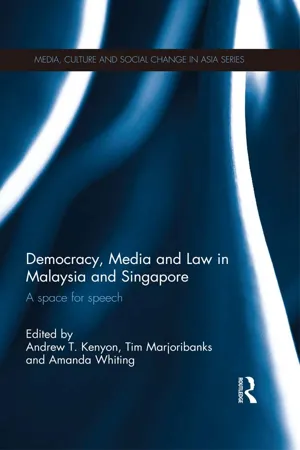
Commentators on the media in Southeast Asia either emphasise with optimism the prospect for new media to provide possibilities for greater democratic discourse, or else, less optimistically, focus on the continuing ability of governments to exercise tight and sophisticated control of the media. This book explores these issues with reference to Malaysia and Singapore. It analyses how journalists monitor governments and cover elections, discussing what difference journalism makes; it examines citizen journalism, and the constraints on it, often self-imposed constraints; and it assesses how governments control the media, including outlining the development and current application of legal restrictions.
eBook - ePub
Democracy, Media and Law in Malaysia and Singapore
A Space for Speech
- 210 pages
- English
- ePUB (mobile friendly)
- Available on iOS & Android
eBook - ePub
Democracy, Media and Law in Malaysia and Singapore
A Space for Speech
About this book
Information
1 Media governmentality in Singapore
Terence Lee
Introduction: Singaporean governmentality?
The art of government can take all sorts of stances towards freedom. It can try to shape it or treat it as an artefact of certain governmental arrangements. It can seek to educe it among some and presuppose it among others. It can treat the governed as free persons or citizens, and rely on their capacities to govern themselves rather than try to govern them. It can use freedom [or unfreedom or control] as a technical means for achieving its ends.
(Dean 2002: 37)
The late French philosopher Michel Foucault’s wide-ranging works on the uses of power, discourse, language and politics have prompted much discussion and debate in various spheres of humanities and the social sciences, and continue to influence many in the academy. His concern with public administration, described as the management of ‘human subjects’, was apparent, though much of it was investigated in specific institutional discourses and contexts (such as schools, prisons, barracks and so on).1 In 1991, a collection of Foucault’s writings was published alongside other essays dealing with the subject matter of ‘government’ specifically to address issues surrounding the art, activity and problems of governing or of political control over people (Burchell, Gordon and Miller 1991). These essays deal with what Rose and Miller (1992: 181) refer to as the ‘prob-lematising activity of government’, a task which involves the consideration of both the diagnosis and programmatic solutions of political rule. This is what Dean (2002: 37) refers to in the opening quote above as ‘certain governmental arrangements’ that are intended to achieve specific outcomes. The volume by Burchell et al. (1991), entitled The Foucault Effect: Studies in Governmentality, has since incited further thoughts on the discourse of governmentality, making Foucault’s thinking on ‘governmental rationality’ (Gordon 1991: 1) in relation to culture and politics a lot more pointed and accessible.
Foucault’s discourse on governmentality is in essence about the ‘art of government’ whereby sovereignty and discipline via the subjection of individuals to a range of rules, regulations, codes and guidelines – what Foucault calls the ‘technologies of rule’ – can be rendered thinkable and practicable (Burchell et al. 1991: ix). In other words, government – commonly understood in contemporary terms as ‘the conduct of conduct’ – is a methodical and rational task that can be positioned within any governmental discourse, liberal, neoliberal or, in the context of Singapore, illiberal (Burchell 1996: 19), so that it is sufficiently understood by both the government and the governed. Governmentality, therefore, deals with the different ‘mentalities’ of government, or the thinking about as well as the thinking behind government. Indeed, a hyphenated ‘govern-mentality’ helps to elucidate the point that Foucault was essentially interested in the kinds of thinking associated with particular approaches to governmental rule-making and control. The primary objective is to make sense of the oft taken-for-granted and generally unquestioned practices of governing, rule and control (Dean 1999: 16).
While Foucault situates the concept of governmentality within a Western-led liberal political thought, where notions of freedom and liberality are, to a large extent, pivotal and taken for granted, this chapter considers how critical discourse of governmentality may be employed to make sense of Singapore’s notoriously tight control of the media and expression. Tony Bennett (1998: 60–61), one of the early proponents of Foucauldian governmentality studies, has argued that the influence of Foucault’s work in problematizing the relations of culture and power makes it a useful theoretical tool for the study of policies that frame a nation’s cultural and media practice. In applying governmentality to culture and the media in Singapore, this chapter extends Foucauldian studies beyond Western liberal democratic contexts onto Singapore, a society seen via Western lenses as non-democratic and dictatorial at worst (for example, Huntington 1991, 1996), or as a semi-authoritarian or soft-authoritarian state at best (for example, Fukuyama 1992: 49–50). The annual United States Department of State Human Rights Reports on Singapore since the 1990s have consistently declared that the Singapore government generally respects the rights of its citizens, although there are some significant problems, most of which relate to freedom of speech and expression in various forms. The reports also acknowledge that although Singaporeans have democratic means to change their government, primarily via regular general elections, formidable obstacles are often placed before serious and threatening political opponents (Mauzy and Milne 2002: 128), such that no sensible person would believe that a change of government is a remote possibility in Singapore. The record loss of six opposition parliamentary seats by the People’s Action Party (PAP) Government at the May 2011 general election may have reduced the odds somewhat, but the reality of a single-party rule remains largely intact in Singapore (Tan and Lee 2011). Nevertheless, the vast majority of such problems, obstacles and beliefs are played out in the Singaporean media.
One of Singapore’s most prolific and well-known journalism academics is Cherian George, formerly a journalist with The Straits Times. In one of his early published works since successfully completing his ‘transition’ from industry to academia, George threw light on the subtle way that control of the media is attained in Singapore when he wrote:
Contrary to folklore, the newsroom [in Singapore] does not receive daily instructions about what to publish, and sensitive articles are not submitted to government officials for vetting. Like all major newsmakers, government officials try to influence coverage of their particular portfolios through a mix of persuasive tactics, from offering the inducement of greater access to dangling the veiled threat of legal action. ... The most senior figures in the leadership prefer to have editors who independently come to the right conclusions – even if they occasionally do not – than to replace them with mere functionaries. As members of the establishment, newspaper editors are expected to have an instinctive grasp of Singapore’s national interests and how to protect them.
(George 2002, 177–178; emphasis in original)
George’s explanation of how the Singapore government is able to control reporting and editorial outcomes via ‘persuasive tactics’, ‘inducement’ and via ‘preferences’ – as in the description of having the media leadership arrive independently at the ‘right conclusions’ – provides a newsroom-based example of how a Foucauldian ‘conduct of conduct’ might operate in the confines of Singapore. Indeed, it provides an excellentA*STARting point to this chapter, which aims primarily to disambiguate and explicate the complex discourse of media governmentality in Singapore.
Governing the traditional Singapore mediascape
In 1996, the well-known anthropologist Arjun Appadurai coined the term ‘mediascape’ as one of five dimensional ‘scapes’ intended to explicate differences and disjuncture in the global cultural economy. According to Appadurai (1996: 35), the term refers to the production and dissemination of mediated information via traditional and electronic means to form political and ideological ‘images of the world’. Singapore’s mediascape operates in much the same manner in that management and control of the mass media are intended to keep the government in absolute power and control. According to McNair, this mode of media management – also commonly referred to as political communication – occurs when and where governments seek to ‘control, manipulate or influence media organizations in ways which correspond to their political objectives’ (McNair 1995: 135).
In the context of Singapore, media and cultural management have been mostly successful due to a combination of regulatory instruments and strategies of co-optation and ‘technological auto-regulation’ (Lee 2010) . The ability of the political leadership to instil discipline and compliance within the broad, influential and expanding Singapore mediascape could thus be described as media governmentality, where the shaping of citizens’ cultural conduct via the media is exacted and expected. In other words, editors, journalists and, indeed, all media users are expected to govern themselves in a rational manner that is consistent with the broader discourses of govenmentality. As George explicates (in the quote cited above), media editors, journalists and indeed all media consumers and citizens are expected to internalize the psyche of their political masters such that they would ‘independently arrive at the right conclusions’. As he further explicates, the media are ‘expected to have an instinctive grasp of Singapore’s national interests and how to protect them’ (George 2002: 178). I would argue further that these exercises of conduct go beyond the bounds of self-censorship – a term that is often cited to explain away Singapore’s success in controlling media, cultural and political discourses – since direct interventions (for example, bans on media products and literature) on undesirable writings or public expressions are rarely invoked these days to rein in noncompliance. In the sections that follow, I consider how media cum cultural control has been achieved so rapidly in a young nation such as Singapore, and how the leadership is attempting to extend media governmentality from traditional media to the comparatively less secure world of new and alternative media as played out in the blogosphere and online social networks.
The mediascape of Singapore can be divided into three broad categories: broadcast media, print media and the internet. All three categories are required to serve as handmaidens to the nation’s economic development effort. Until 1980, the government controlled and maintained all television and radio stations through the official Radio and Television Singapore (RTS) department. This department evolved into a statutory body, the Singapore Broadcasting Corporation (SBC), before it was corporatized in 1994 to become Singapore International Media (SIM) (Lee 2010: 130). While the intention of the government was, and still is, to privatize television and radio broadcasting, this has not happened – and does not look set to materialize in the near future – because national broadcasting has not lived up to its commercial potential and is therefore unlikely to be financially viable on its own. There are also perpetual murmurings with regard to whether the public service charter is being honoured if the mainstream media becomes private. Nevertheless, SIM is positioned as a ‘private’ company wholly owned by the government through its state-owned sovereign wealth fund (SWF) Temasek Holdings. To improve SIM’s opportunities for competition in the domestic and global media industries, the company was subsequently restructured and renamed the Media Corporation of Singapore (MediaCorp).
At first glance, Singapore appears to house a thriving local print media environment with very strong circulation numbers for English and Chinese-language newspapers and a relatively vibrant press aimed at the Malay and Indian minorities (Bokhorst-Heng 2002). However, a pattern of mergers and politically motivated closures of various newspaper companies, which began in the mid-1980s, has resulted not only in fewer mainstream newspapers (compared to the 1970s-1980s), but also in the formation of the Singapore Press Holdings (SPH), essentially a government-linked print media monopoly. Although the creation of SPH through mergers was largely commercially successful, it led to a reduction in alternative voices and venues as domestic news about Singaporean political affairs became more and more centralized and mainstreamed. In an article which proposes an interesting delineation of the mass media in Singapore as either ‘mainstream’ or ‘marginal’, George (2002: 175) describes Singapore’s media as one that facilitates ‘the government’s freedom from the press’ as opposed to the democratic model of freedom of the press from government, otherwise known as the fourth estate. This ‘freedom from the press’ in effect frees the government from any serious scrutiny of its modes of governance, policies and practices, not unlike Nikolas Rose’s (1989: 1999) take on what it means to govern ‘advanced liberal’ states through the powers of freedom.
The Singapore government has been able to harness such freedoms – to govern both media and media users – through a variety of legal and regulatory controls, which were frequently invoked to bring local editors and journalists to task (or to keep them muted). These controls include – in addition to the subtleties of technological auto-regulatory strategies (see Lee 2010: 103–128) – ownership structure of main media organizations (as mentioned above) and licences to publish newspapers and a range of ‘draconian laws’ and restrictions (Lee and Wilnat 2009: 94). Such draconian laws, typically referenced to determine Singapore’s status as an authoritarian state (Mauzy and Milne 2002), include:
• The Internal Security Act, a piece of legislation that was instituted during British rule to counter Communist insurgents and is used by the PAP to detain political opponents;
• The Societies Act, which requires most organizations of more than 10 people to be registered;
• The Official Secrets Act, which deters journalists from being on the receiving end of political leaks. As a consequence, journalists and news editors in Singapore are mindful of the inherent risks of their trade as they go about ther daily practice, with political scoops or investigative journalism hardlyfeaturing in mainstream news reporting in Singapore.2
In addition to the above broad laws, the key legislation governing the print media is the Newspaper and Printing Presses Act (NPPA). Enacted in 1974, and amended several times thereafter to tighten its juridical reach, the NPPA empowers the government to determine the composition of a newspaper company’s board of directors. With the NPPA’s structure and mechanism in place, George (2002: 177) argues that ‘the government needs neither to post its officials directly into top newsroom positions, nor to nationalize the press.’ Instead, the control of the press is much more subtle as it relies on the workings and reach of media governmentality, where each person in the process of media transmission is more or less aware of what needs to be said, to whom, when, where and why.
Although domestic political opponents and foreign critics have long criticized Singapore’s tight-fisted controls of both traditional media and the internet media – especially after each successful lawsuit that the government wrings against foreign publications – the tools of media governmentality ...
Table of contents
- Cover
- Half Title
- Media, culture and social change in Asia
- Title Page
- Copyright Page
- Table of Contents
- Notes on contributors
- Acknowledgements
- Introduction: making spaces for speech
- 1 Media governmentality in Singapore
- 2 Why Singapore journalists don't press for legal reform
- 3 Malaysiakini's citizen journalists: navigating local and national identities online
- 4 Seeking democracy in Malaysia: new media, traditional media and the state
- 5 Defaming politicians, scandalizing the courts: a look at recent developments in Singapore
- 6 Media professionals' perceptions of defamation and other constraints upon news reporting in Malaysia and Singapore
- 7 Moulding a 'rational' electoral contest regime Singapore-style
- 8 New media and general elections: online citizen journalism in Malaysia and Singapore
- Index
Trusted by 375,005 students
Access to over 1.5 million titles for a fair monthly price.
Study more efficiently using our study tools.
Frequently asked questions
Yes, you can cancel anytime from the Subscription tab in your account settings on the Perlego website. Your subscription will stay active until the end of your current billing period. Learn how to cancel your subscription
No, books cannot be downloaded as external files, such as PDFs, for use outside of Perlego. However, you can download books within the Perlego app for offline reading on mobile or tablet. Learn how to download books offline
Perlego offers two plans: Essential and Complete
- Essential is ideal for learners and professionals who enjoy exploring a wide range of subjects. Access the Essential Library with 800,000+ trusted titles and best-sellers across business, personal growth, and the humanities. Includes unlimited reading time and Standard Read Aloud voice.
- Complete: Perfect for advanced learners and researchers needing full, unrestricted access. Unlock 1.5M+ books across hundreds of subjects, including academic and specialized titles. The Complete Plan also includes advanced features like Premium Read Aloud and Research Assistant.
We are an online textbook subscription service, where you can get access to an entire online library for less than the price of a single book per month. With over 1.5 million books across 990+ topics, we’ve got you covered! Learn about our mission
Look out for the read-aloud symbol on your next book to see if you can listen to it. The read-aloud tool reads text aloud for you, highlighting the text as it is being read. You can pause it, speed it up and slow it down. Learn more about Read Aloud
Yes! You can use the Perlego app on both iOS and Android devices to read anytime, anywhere — even offline. Perfect for commutes or when you’re on the go.
Please note we cannot support devices running on iOS 13 and Android 7 or earlier. Learn more about using the app
Please note we cannot support devices running on iOS 13 and Android 7 or earlier. Learn more about using the app
Yes, you can access Democracy, Media and Law in Malaysia and Singapore by Andrew T. Kenyon,Tim Marjoribanks,Amanda Whiting in PDF and/or ePUB format, as well as other popular books in Social Sciences & Ethnic Studies. We have over 1.5 million books available in our catalogue for you to explore.